
Research & Benchmark Contractors
Lead Sellers and Look-Alike Listings: Who Else Ranks in Contractor Searches
Search your own trade and city and you may see a Maps listing named only for your city and "roofing contractors", or a site that takes your customer's details and passes them to someone else. How common is that in roofing, electrical, concrete and fence searches? We counted. We analyzed 100 local searches across 25 US metros and four specialty trade search types, 1,191 contractor websites (1,096 crawled) and 1,136 Google Business Profiles, November 2026. This page covers the sites and listings in those results that aren't contractors: how many there are, what they hold, and how to tell them apart.
We don’t name any of these sites or listings. A count is what the study can support; a list of names would be a claim about each business that a page read can’t prove. We collected this data on 16 November 2026, past the summer peak for roofing, concrete and fence work, so rankings, review pace, Google posting and ad activity may look different in season.
Key findings
- 5% of the sites weren’t contractors. Screening the 1,256 sites found 65 non-providers (5%), among them 15 lead-generation sites and 10 concrete and fence suppliers.
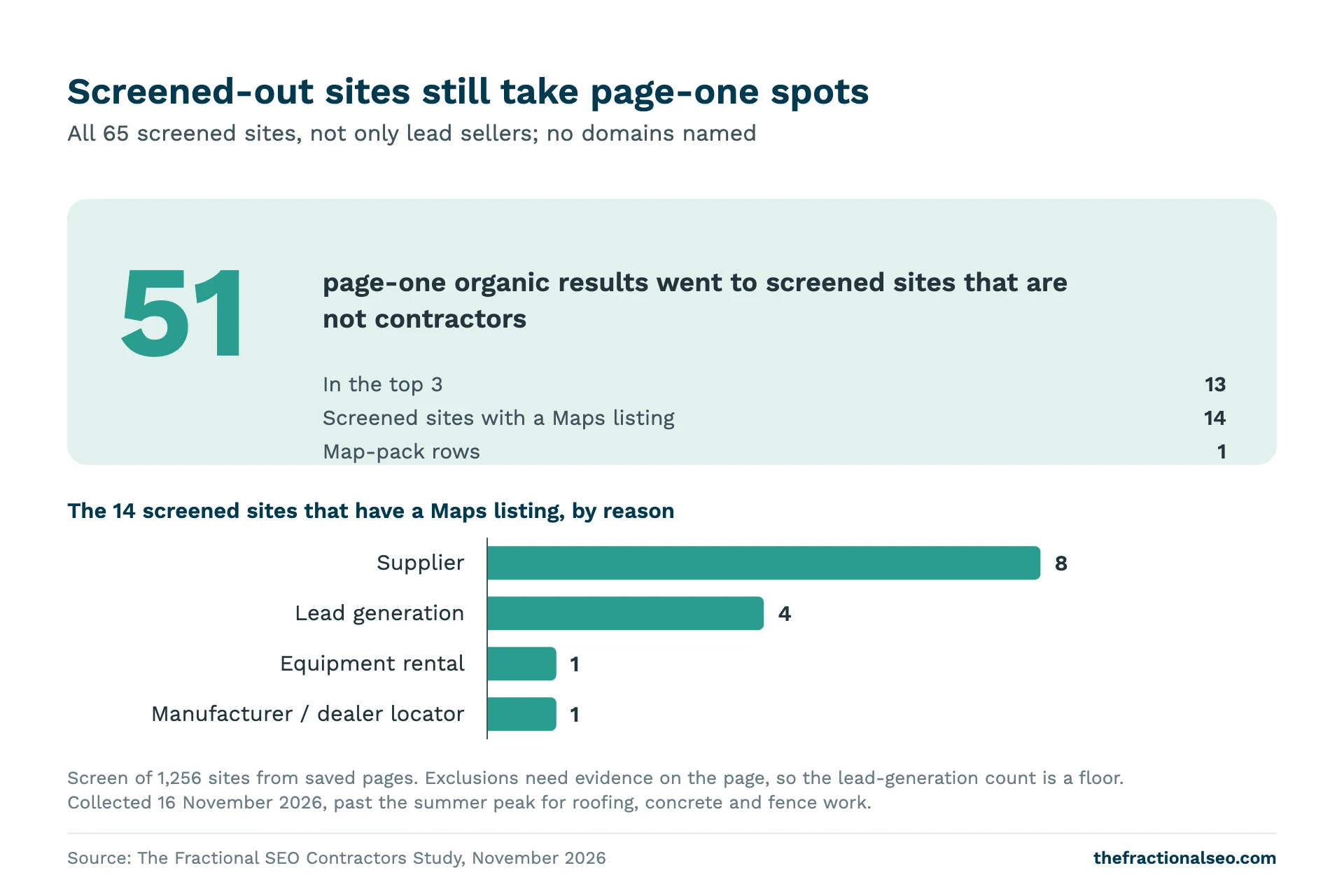
- They hold real page-one spots. Screened sites held 51 page-one organic results, 13 of them in the top 3.
- 15 lead sellers is a floor. A site came out only when its own pages said it passes homeowners on to other contractors.
- Keyword-named listings are common in Maps. About 60 listings named only for a city and a trade, with few reviews, about 10 of them in the map pack.
- Directories are the bigger crowd. Lead-generation sites took 25 of 845 page-one results; directories took 249.
The website side of the same study is in what map-pack contractors’ websites do differently.
What counts as a lead seller or a look-alike
A lead seller here is a site that collects a homeowner’s request and passes it to other contractors, and says so on its own pages. It may look like a local company, with a city in the domain and a phone number, but the work goes to whoever buys the lead.
A look-alike listing is a Google Maps listing whose name is only a city and a trade, with few reviews and no company name. Some are real small businesses with a plain name. Some aren’t. The study flags them by rule and doesn’t decide which is which.
Directories and lead marketplaces such as Angi, Thumbtack and HomeAdvisor are a different thing. They say what they are, and the study counts them as directories. Google’s guidelines for representing your business set the bar for Maps: a business name should match the real-world name on the storefront, website and stationery, and adding extra words to it isn’t permitted and can get a profile suspended.
What the screen found
Before running any numbers, we read every one of the 1,256 domains that came up in the searches, from the saved homepage, page titles, Maps category and the title it ranked with. A site came out only with evidence on its own pages: referral or “connect you with” wording, a supplier or manufacturer page, a parked domain.
Contractor search results carry many sites that look like contractors and are not: screening the 1,256 sites found 65 non-providers (5%), among them 15 lead-generation sites (four of them with their own Google Maps listing and page wording that says they pass homeowners on to other contractors) and 10 concrete and fence suppliers.
| Why the site came out | Sites |
|---|---|
| Lead generation | 15 |
| Directory | 11 |
| Supplier (ready-mix, precast, fence supply) | 10 |
| Not a provider (unrelated, parked or placeholder) | 9 |
| City guide or media | 4 |
| Content site | 4 |
| Manufacturer or dealer locator | 3 |
| Government or reference | 2 |
| Social | 2 |
| Association | 1 |
| Equipment rental | 1 |
| Forum | 1 |
| Listicle | 1 |
| Software vendor | 1 |
Screened sites held 51 page-one organic results, 13 of them in the top 3. Those counts cover all 65 screened sites, not only the lead sellers. On the Maps side, 14 of the screened sites had their own listing (8 of them suppliers, 4 lead sellers), and one screened site held a map-pack spot.
Two cautions. First, 15 is a floor. Exact-match keyword sites without referral wording on the page were kept as contractors, so some lead sellers may still be counted as contractors. Second, the screen changed the picture: before it, contractor sites read as 51% of page one; after it, 44%.
Keyword-named Maps listings
Keyword-named Maps listings with few reviews (a name that is only a city and a trade, such as “<city> roofing contractors”) are common: about 60 listings in the Maps results, about 10 of them in the map pack, most in the largest metros (Los Angeles and New York lead).
The rule is simple: a name made only of city and trade words, under 20 reviews and no company suffix such as LLC or Inc. It’s a rule, not proof a listing is fake. The exact count also depends on the word lists, which is why we say about 60. For comparison, our painting study found 4 such listings in 308 profiles. In these four trades they are a pattern, not a stray case.
Google has fought this for years. In a 2019 post on fake business profiles, it said it took down more than 3 million fake business profiles the year before, and that some scammers pose as real businesses to collect leads and sell them. That is a Google-wide figure, not a contractor one.
Where they sit among everyone else on page one
Lead sellers are one slice of a crowded page. Only 44% of page-one organic results for local roofing, electrician, concrete and fence searches go to the contractors’ own websites; the other 56% go to directories (29%), social sites (15%) and lead-generation, manufacturer, media and other non-contractor sites (12%).
In counts, lead-generation sites took 25 of the 845 page-one results. Directories took 249 and social sites 124. The sites contractors compete with most are directories and lead marketplaces that say what they are: Yelp (92 appearances), Angi (23), Thumbtack (20), BBB (18) and HomeAdvisor (13), alongside Facebook (66) and Reddit (45).
A site that is not a contractor holds the #1 organic spot in 53 of 100 local trade searches, and 61% of all top-3 organic spots.
The full picture by trade is in who wins local contractor searches, and the directories are covered in why directories outrank roofers, electricians and fence companies.
How to tell a lead seller from a contractor
These are the signs the screen used. None of them alone proves anything, but two or three together usually tell the story.
- Referral wording. Phrases like “connect you with”, “match you with”, “our partner contractors” or “find local contractors” in the headline or the form.
- A disclaimer. A line saying the site is a free service and the contractors are independent.
- No business on the page. No business named anywhere on the page, only a city and a trade.
- A shared toll-free number on a page that claims to be local.
- The same template in many cities. Identical pages with the city swapped, often on city subdomains or on hundreds of near-identical service pages.
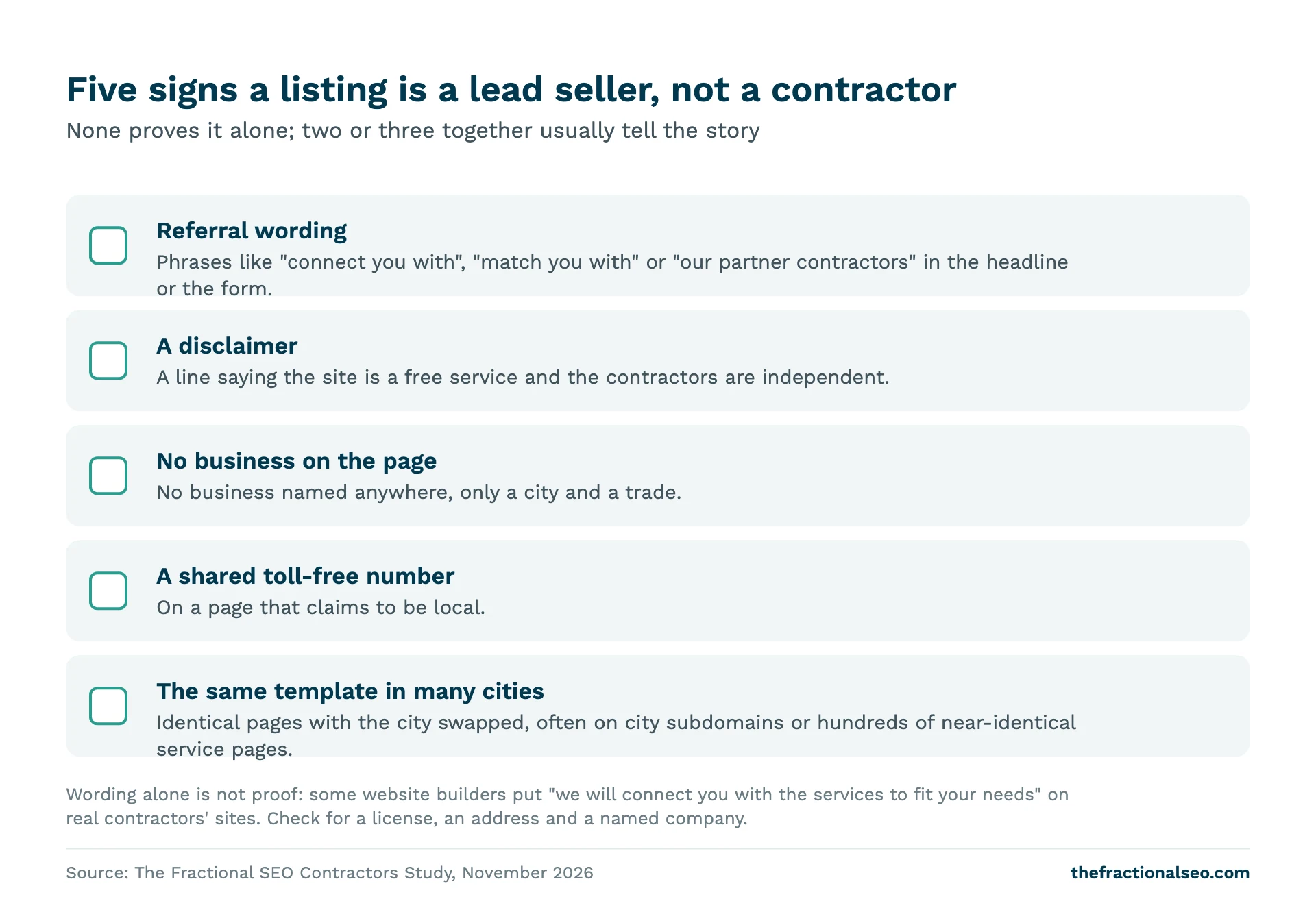
One warning from the screen: some website builders put a line like “we will connect you with the services to fit your needs” on real contractors’ sites. Wording alone isn’t proof. Check for a license, an address and a named company before you decide what you’re looking at.
What a real contractor can do
The best defense is to look like the real business everywhere a homeowner checks. Use your real business name on your Google Business Profile, the same one that’s on your trucks, website and invoices. Link your website from the profile. Almost every contractor in the map pack shows a website: 9 of 300 map-pack listings (3%) had no website link.
Reviews lean strongly with the map pack: businesses that reach a map pack in any search have about twice the reviews of those that never do, median 166 vs 82, and the gap is strong in all four trades. By trade that is 252 vs 150 for roofing, 422 vs 107 for electricians, 52 vs 24 for concrete and 153 vs 84 for fence. That’s a correlation, not proof that reviews put anyone in the pack, but a listing with few reviews is exactly what a look-alike has. More detail is in reviews by trade.
On the website, a click-to-call link (94% of pack sites vs 85%) and the city in the homepage title (83% vs 69%) lean strongly with the map pack, and location or service-in-city pages lean with it too (68% vs 56%), though that gap only narrowly passes our statistical correction. Inside the trades the title and location-page gaps are strong only for concrete contractors; for roofers none of the three shows a clear gap.
If a listing uses a misleading name, phone number or URL, Google’s Business Redressal Complaint Form is the route. Google says it can’t promise action and won’t send status updates, so report what you can show and move on.
Some contractors buy from lead sellers instead. “Roofing leads” gets 1,000 searches a month (DataForSEO Google Ads, US, November 2026 study export). Before you do, run your numbers through the Lead Platforms vs SEO: Cost per Won Job Calculator. The study didn’t measure lead quality or cost, only who ranks.
How we did this
We analyzed 100 local searches across 25 US metros and four specialty trade search types, 1,191 contractor websites (1,096 crawled) and 1,136 Google Business Profiles, November 2026.
Searches were “roofing contractor”, “electrician”, “concrete contractor” and “fence company”, each followed by the metro: 25 searches per trade, in the same 25 metros as our HVAC and Construction studies (10 large, 10 mid-size, 5 small). We recorded page one on desktop through SerpAPI and 2,000 Google Maps rows (positions 1-20) on 16 November 2026 (US time). The map pack is positions 1-3 of the Maps list for the same search.
The screen read all 1,256 domains; 65 came out with evidence on their own pages and 1,191 remain. The listing flag is a rule (city and trade words only, under 20 reviews, no company suffix).
What it can’t claim: that any listing is fake or any site breaks a rule, how many jobs anyone loses to them, or why anyone ranks. The lead-seller count is a floor, and this is one off-season snapshot.
Questions, answered
Are lead generation sites allowed on Google?
A website can rank like any other. On Maps, Google’s guidelines say a business name should reflect its real-world name, and extra words can get a profile suspended.
How many contractor search results are lead sellers?
We found 15 lead-generation sites among 1,256, a floor, and lead-generation sites took 25 of 845 page-one results.
How do I report a fake contractor listing?
Use Google’s Business Redressal Complaint Form for a misleading name, phone number or URL. Google doesn’t promise action.
Do keyword-named listings make the map pack?
Some do: about 10 of the roughly 60 we flagged. Most of the 60 are in the largest metros.
Want to know who you’re really up against in your own metro, lead sellers included? See how we approach SEO for specialty contractors.
More research & benchmarks
The whole Contractors library- We Analyzed 1,096 Contractor Websites: What Map-Pack Contractors Do Differently In a crawl of 1,096 contractor sites, three website basics lean with the map pack, unevenly…
- Who Wins Local Contractor Searches in 2026: A Benchmark of 100 Roofing, Electrician, Concrete and Fence Searches Who holds page one, the map pack and the space above the results when people search…
- Google Reviews and Contractor Rankings: What 1,136 Roofing, Electrical, Concrete and Fence Profiles Show Which review signals lean with the map pack for roofers, electricians, concrete and fence contractors, and…