
Collection HVAC
Call Tracking, Review and Marketing Tools HVAC Companies Use
Search for HVAC call tracking and many of the results are one vendor selling one tool. We looked at what HVAC homepages actually load, then checked each tool on its own site.
How we judged them
Every tool here was found on HVAC contractor homepages in our November 2026 study and checked on its own website the same month.
Found on HVAC homepages
Its code appeared on homepages in our study of 754 HVAC contractor sites. Counts shown where our findings report them.
Does a lead job
Tracks calls and forms, collects or shows reviews, books jobs, or measures ads.
Checked at the source
Prices and features from the vendor's own site, as of November 2026. Where a vendor publishes no prices, we say so.
Grouped by job
Sorted by what an HVAC company needs done, not by feature count.
Reviewed by hand, 20261112. Nobody pays for a place on this list.
We analyzed 100 local searches across 25 US metros and four HVAC search types, 853 HVAC contractor websites (768 crawled) and 797 Google Business Profiles, November 2026. As part of that, we read 754 HVAC homepages and looked for the code each marketing tool leaves behind. Call tracking shows on 21% of HVAC homepages, with CallRail on 13% and WhatConverts on 6%. Each tool below shows how many homepages it appeared on, where our findings report a count, and what it costs.
This page lists the tools we found, grouped by the job they do: call tracking, reviews and messaging, marketing platforms, measurement and online booking. We checked each one on its own website. For rank tracking, citations and audits, the tools are the same for any local business, so we point you to our list of local SEO tools instead of repeating it.
The short answer
- Call tracking: CallRail or WhatConverts. CallRail is the most common on HVAC homepages; WhatConverts has the lower entry price.
- Reviews: Podium if you want review requests, texting and webchat in one inbox; Trustindex for a low-cost review widget.
- All-in-one platform: HighLevel, if your field-service software doesn’t already handle follow-up texts and forms.
- Measurement: Google Tag Manager plus Google Ads call conversions, both free.
- Online booking: the scheduler from your field-service software.
Our advice: if you only fix one thing this month, make sure calls are tracked by source. Without that, it’s hard to tell which marketing brings in jobs. All prices below are as of November 2026, from each vendor’s own pricing page.
How we picked
Every tool here passed four tests. Its code appeared on HVAC contractor homepages in our study; we show counts where our findings report them. It does a lead job: it tracks calls and forms, collects or shows reviews, books jobs or measures ads. We checked its prices and features on the vendor’s own site in November 2026, and where a vendor publishes no prices, we say so. And we grouped the tools by what an HVAC company needs done, not by feature count.
We describe what each vendor says its tool does and what it costs; we haven’t rated them by hand. There are no affiliate links on this page, and we don’t take affiliate commissions or referral fees.
| Tool | Job | On study homepages | Free option | Paid from | Trial |
|---|---|---|---|---|---|
| CallRail | Call tracking | 97 | No | $50/month | 14 days, no card |
| WhatConverts | Call and form tracking | 47 | No | $30/month | 14 days |
| CallTrackingMetrics | Call tracking | 14 | No | $79/month ($65 annual prepay) | None; first month’s plan fee $0 |
| Google Ads call conversions | Ads call tracking | Ads tag on 116 (a floor) | Free with Google Ads | Free | n/a |
| Podium | Reviews and texting | 68 | No | Not published | Not stated |
| Birdeye | Reviews and listings | 5 | No | Not published | Not stated |
| Trustindex | Review widget | Yes | Free package | $65/year | 7 days |
| Elfsight | Review widget | Yes | Free plan | $5/month, billed yearly | Not stated |
| HighLevel | CRM and marketing | 31 | No | $97/month | 14 days |
| HubSpot | CRM and marketing | 8 | Free tools, up to 2 users | $7/month per seat | Not stated |
| Google Tag Manager | Tag management | 476 | Free | Free | n/a |
| Schedule Engine | Online booking (ServiceTitan) | 153 | No | Not published | Not stated |
| Housecall Pro | Field-service software with booking | 70 | No | $59/month, billed annually | 14 days on Max |
“Yes” means we found the tool on study homepages but our findings give no count for it.
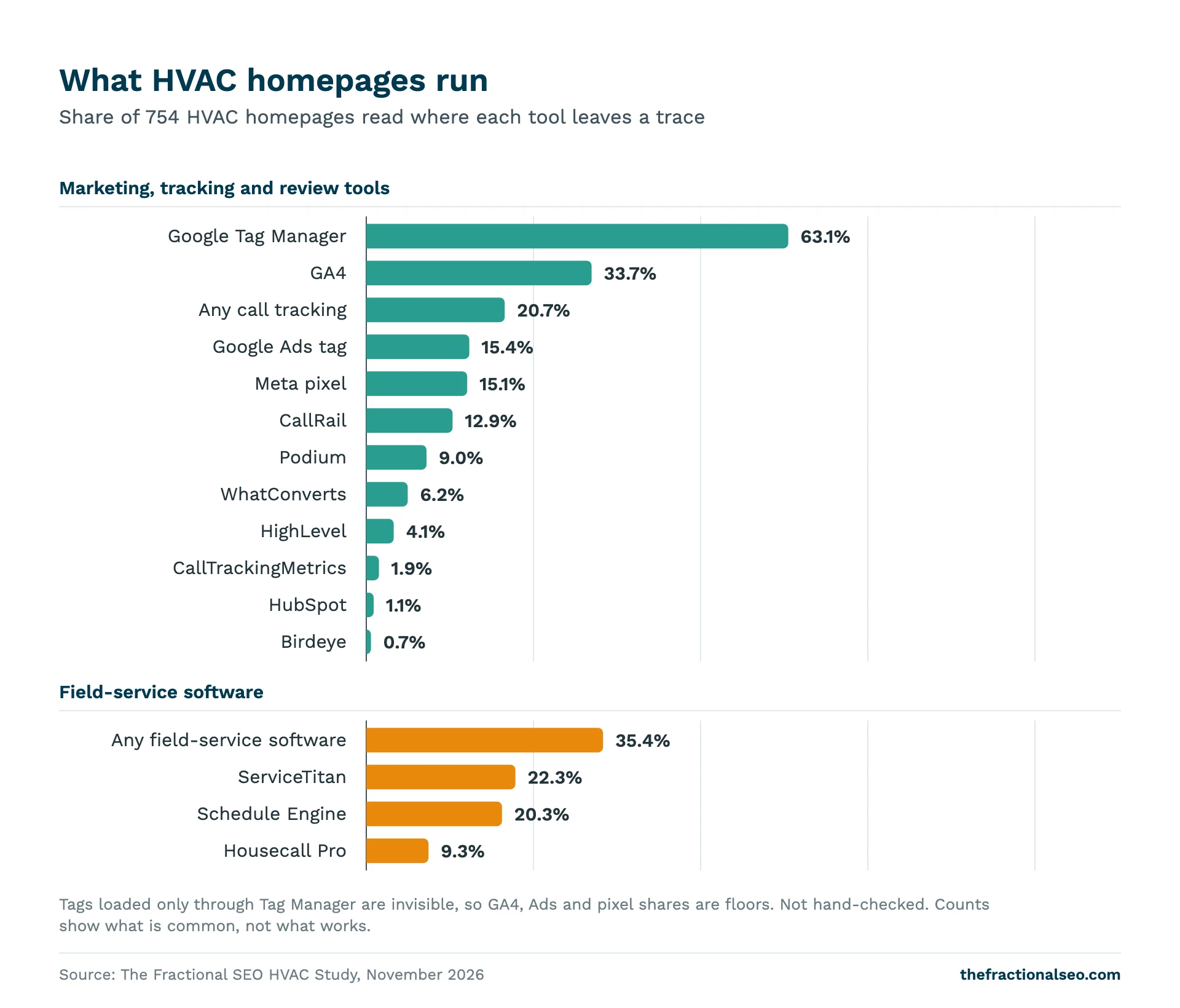
What HVAC homepages run
Here is what we found on the 754 homepages we read:
- Call tracking: 156 homepages (20.7%). CallRail on 97 (12.9%), WhatConverts on 47 (6.2%), CallTrackingMetrics on 14 (1.9%).
- Google Tag Manager: 476 (63.1%).
- Google Analytics 4: 254 (33.7%).
- Google Ads tag: 116 (15.4%). Meta pixel: 114 (15.1%).
- Review and messaging platforms: Podium on 68 (9.0%), Birdeye on 5 (0.7%).
- Marketing platforms: HighLevel on 31 (4.1%), HubSpot on 8 (1.1%).
Tags loaded only through Tag Manager are invisible in raw HTML, so GA4, Ads and pixel shares are floors. Not hand-checked. A site can run GA4 or an Ads tag through Tag Manager and look like it has neither.
Field-service software is visible on 35% of HVAC homepages: ServiceTitan on 22% and Schedule Engine, ServiceTitan’s online scheduler, on 20%, and Housecall Pro on 9%. Only tools that leave a trace on the homepage, such as booking widgets and scripts, are detected. Many companies use software that never shows on the website.
These counts tell you what is common, not what works. We didn’t measure whether any of these tools goes with better rankings or more leads.
Call tracking
Call tracking gives each marketing source its own phone number, swaps the number on your website depending on how the visitor arrived (dynamic number insertion), and records calls so you can hear what came in. Without it, a call from your Google Business Profile, a call from a Google ad and a call from a yard sign all look the same in your phone log. If you run ServiceTitan or Housecall Pro, ask what your software already tracks first. An ACHR News column frames the choice as tracking inside your CRM vs a dedicated tool. For how tracking fits a wider plan, see our guide to tracking every lead.
CallRail
The most common call tracking tool in our study, on 97 HVAC homepages (12.9%). As of November 2026, the Lead Tracking plan is $50 a month and includes 5 local numbers, 250 minutes and 25 texts, with call recording, routing and transcription. Lead Tracking Complete, at $95, adds form tracking with 1,000 form submissions. Lead Conversion is $150 and Lead Conversion Complete $195. There is a 14-day free trial with no credit card, and yearly billing saves up to 10%.
Usage beyond a plan’s minutes is billed extra, and the rates are on the pricing page; read them against your call volume before you pick a plan. CallRail suits a company that wants the option most common on HVAC homepages in our study and plans to add form tracking later.
WhatConverts
On 47 HVAC homepages (6.2%). As of November 2026, the Call Tracking plan is $30 a month and covers call and text tracking, dynamic number insertion, recordings and transcripts. Plus, at $60, adds form and chat tracking and Google Ads and Analytics integrations. Pro, at $100, adds HIPAA-compliant tracking and call flows, and Elite is $160. There is a 14-day free trial.
WhatConverts suits a company that wants calls and form leads in one report at the lowest entry price of the call tracking tools here.
CallTrackingMetrics
On 14 HVAC homepages (1.9%). CallTrackingMetrics now lives at ctm.com. As of November 2026, Marketing Lite is $79 a month billed monthly, or $65 a month with annual prepay, and includes unlimited users, call and text attribution, recording, and Google Ads, Local Services Ads and GA4 integrations. Marketing Pro is $179 a month ($149 annual) and adds form tracking and AI call analysis. Sales Engage is $329 and Enterprise $1,999. There is no free trial, but the first month’s plan fee is $0.
The Local Services Ads integration makes it worth a look if LSAs are a big part of your spend.
Google Ads call conversions (no extra tool)
A Google Ads tag shows on 116 HVAC homepages (15.4%), and that is a floor, since many sites load it through Tag Manager. Google’s help page explains that the phone snippet “replaces your business phone number with a Google forwarding number” on your site, so Ads can count the calls its clicks produce. Changes can take up to 48 hours to show. It is free, but it tracks Google Ads only. Calls from Maps, organic search or other ads won’t show up in it.
Reviews and messaging
34% of HVAC contractor websites show reviews or testimonials through an embedded review widget (that figure is out of 768 crawled sites; the tool counts above use 754 homepages). Map-pack companies show review widgets a little more often than those lower in Maps, but the difference is weak, and among organic results there is no clear difference. Treat a widget as something for visitors, not a ranking tactic. A widget shows reviews you already have; asking customers for new ones is a separate job. For what reviews themselves do, see what reviews do for HVAC rankings.
Podium
The most common of the review platforms our findings count, on 68 HVAC homepages (9.0%). Podium doesn’t publish prices: the pricing page asks you to talk to its sales team, so pricing is on request as of November 2026. The features it lists include reviews, phones, webchat, a shared inbox, payments and text marketing.
Podium suits a company that wants review requests, webchat and customer texting in one place, and doesn’t mind a sales call to get a price. Ask for the price per location and the contract length in writing.
Birdeye
On 5 HVAC homepages (0.7%). Birdeye doesn’t publish prices either; it quotes by number of locations. Its products cover reviews, listings and webchat. It is rare on HVAC homepages in our study, so treat it as an option to compare against Podium if you have several locations. Ask the same questions: price per location and contract length.
Trustindex
We found Trustindex on study homepages, though our findings give no count for it. Its free package can be used for as long as you like. Paid plans are Single at $65 a year for one company, Pro at $125 a year for five and Ultimate at $349 a year for unlimited companies, all with unlimited widgets and views. Features listed include Google review collection, email campaigns and QR codes. There is a 7-day trial and 30-day refunds.
Trustindex suits a company that mostly wants its Google reviews shown on the website at a low yearly cost.
Elfsight
Also found on study homepages, with no count in our findings. Elfsight sells many website widgets, and Google Reviews is one of them. The free plan allows 200 views a month and one widget, with Elfsight branding. Paid plans are Basic at $5, Pro at $10 and Premium at $20 a month, billed yearly. The pricing page doesn’t say which app each single-app plan covers, so confirm before you buy. Treat it as an alternative widget rather than a main pick.
Marketing platforms and CRM
HighLevel
On 31 HVAC homepages (4.1%). HighLevel bundles a CRM, reputation management, forms, booking calendars and two-way SMS and email. As of November 2026, Starter is $97 a month, Unlimited $297, Founder $497, and Enterprise is priced on request. There is a 14-day free trial.
HighLevel suits a company that wants follow-up texts, review requests and web forms in one system. If your field-service software already does most of that, check the overlap before adding another login. The pricing page’s annual figures don’t line up neatly with the monthly ones, so get a written quote if you plan to pay yearly.
HubSpot
On 8 HVAC homepages (1.1%). HubSpot offers free tools for up to two users. Marketing Hub Starter is listed from $7 a month per seat, though the same page also shows $20, so check the current figure. Professional starts at $800 a month with three seats, plus a $3,000 onboarding fee. It is rare on HVAC homepages in our study, and it makes most sense for a company that already runs HubSpot elsewhere in the business.
Measurement basics: Tag Manager, GA4 and ad pixels
Google Tag Manager is the most common marketing tool on HVAC homepages in our study, on 476 of them (63.1%). GA4 shows on 254 (33.7%) and the Meta pixel on 114 (15.1%). Tags loaded only through Tag Manager are invisible in raw HTML, so GA4, Ads and pixel shares are floors. Not hand-checked.
Tag Manager is free. It lets you add and update tags, such as analytics and conversion tracking, without editing your site’s code; Google’s help page explains how containers, tags and triggers fit together.
Why it matters: tags are how Google Ads, Analytics and Meta count your calls and form fills. If a tag doesn’t fire when someone taps your phone number or submits your quote form, your ad platforms can’t see the lead. Ask your web person which tags fire on those two actions.
Online booking tools
Field-service software is visible on 35% of HVAC homepages. Top-ranked HVAC companies are much more likely to offer online booking on the homepage: 62% of map-pack businesses vs 41% of those lower in Maps, and 69% of organic top-3 sites vs 42% at positions 4-10. Correlation, not cause. Companies that offer online booking may differ from the rest in other ways too; the study didn’t measure company size or budget. Our online booking research and what top-ranked HVAC websites do differently cover this in more detail.
Schedule Engine (now sold as ServiceTitan Scheduling Pro; scheduleengine.com redirects there) shows on 153 homepages (20.3%), and ServiceTitan itself on 168 (22.3%). ServiceTitan describes it as a booking engine built for ServiceTitan contractors that can collect payments and memberships at booking. No price is published.
Housecall Pro shows on 70 homepages (9.3%). As of November 2026, Basic is $59 a month billed annually ($79 monthly, one user), Essentials $149 ($189 monthly, five users) and Max $299 ($329 monthly, eight users). Online booking is included on all three, with a 14-day trial on Max. For the full comparison, see field-service software for HVAC.
Local SEO tools
Rank tracking, citations, Google Business Profile management and site audits work the same way for an HVAC company as for any local business. We covered those in our list of local SEO tools, built for contractors, with prices and free tiers. The same picks apply here, and the list also covers review-request tools that work alongside the widgets above.
FAQs
What is call tracking for HVAC companies?
Software that gives each marketing source its own phone number, swaps the number on your website by traffic source, and records calls, so you can see which ads, listings or pages make the phone ring. In our study, call tracking shows on 21% of HVAC homepages.
Do I need call tracking if I use ServiceTitan or Housecall Pro?
Maybe not. The ACHR News column linked above frames it as tracking inside your CRM vs a dedicated tool, so check what your software already records first. ServiceTitan shows on 22% of HVAC homepages and Housecall Pro on 9%, and more companies may use them without it showing on the website.
How much does call tracking cost?
As of November 2026: WhatConverts from $30 a month, CallRail from $50 a month and CallTrackingMetrics from $79 a month billed monthly. Google Ads call conversions are free but cover Google Ads only. CallRail bills usage beyond a plan’s minutes extra.
What is the most common marketing tool on HVAC websites?
Google Tag Manager, on 63% of HVAC homepages in our study. GA4, Ads and pixel shares are floors, because tags loaded only through Tag Manager don’t show in the page’s code.
Want calls tracked to the search that sent them, and an SEO plan built on what they show? Talk to us about HVAC SEO.
More collections
The whole HVAC library- Best WordPress Themes for HVAC Companies The WordPress themes real HVAC contractor sites run, from our crawl of 530 WordPress sites, with…
- 8 HVAC Websites Built to Convert: Examples from the Study Eight real HVAC websites picked from a crawl of 768 contractor sites by measured features, each…
- Best HVAC Podcasts for Contractors Eight HVAC and home service podcasts, picked from 50, that are still publishing, well rated on…