
Guide HVAC
Technical SEO for HVAC Websites
Technical SEO is the part of SEO that sits under the words on your website: can Google crawl it, does it load on a phone, and does each page say clearly what it is. We analyzed 100 local searches across 25 US metros and four HVAC search types, 853 HVAC contractor websites (768 crawled) and 797 Google Business Profiles, November 2026. The short version: the typical HVAC homepage is slow and heavy on a phone, but speed showed no clear difference between top-ranked HVAC companies and the rest. Fix speed for the customer holding the phone, and fix the cheaper on-page gaps first. The speed tests were run on November 13, 2026, three days after the rest of the study.
The benchmarks at a glance
Here is what normal looks like across the HVAC websites we crawled.
| Check | What we found on HVAC websites |
|---|---|
| HTTPS | 767 of 768 sites |
| Meta description missing on a quarter or more of pages | 16% of sites |
| H1 missing on a quarter or more of pages | 10% of sites |
| Duplicate titles on a quarter or more of pages | 4% of sites |
| Mobile performance score (Lighthouse) | Median 65 out of 100; 13% score 90 or more; 26% score under 50 |
| Time to show the largest element (lab, simulated slow phone) | Median 6.3 seconds; 13% in 2.5 seconds or less |
| Real-visitor speed data (Chrome UX Report) | 27% of sites have it; of the 118 with all three Core Web Vitals reported, 42% pass |
| Homepage weight | Median 3.0 MB; 28% over 5 MB |
| LocalBusiness schema (or a subtype such as HVACBusiness) | 70% of sites |
| Platform | WordPress on 83% of sites where the platform could be identified |
In our view, if your site is better than the median on each line, the technical side is probably not what’s holding you back, and your time is better spent on local SEO for HVAC companies and on the service pages people search for. If you’re worse on several lines, work through the sections below in order.
Fix the on-page gaps first
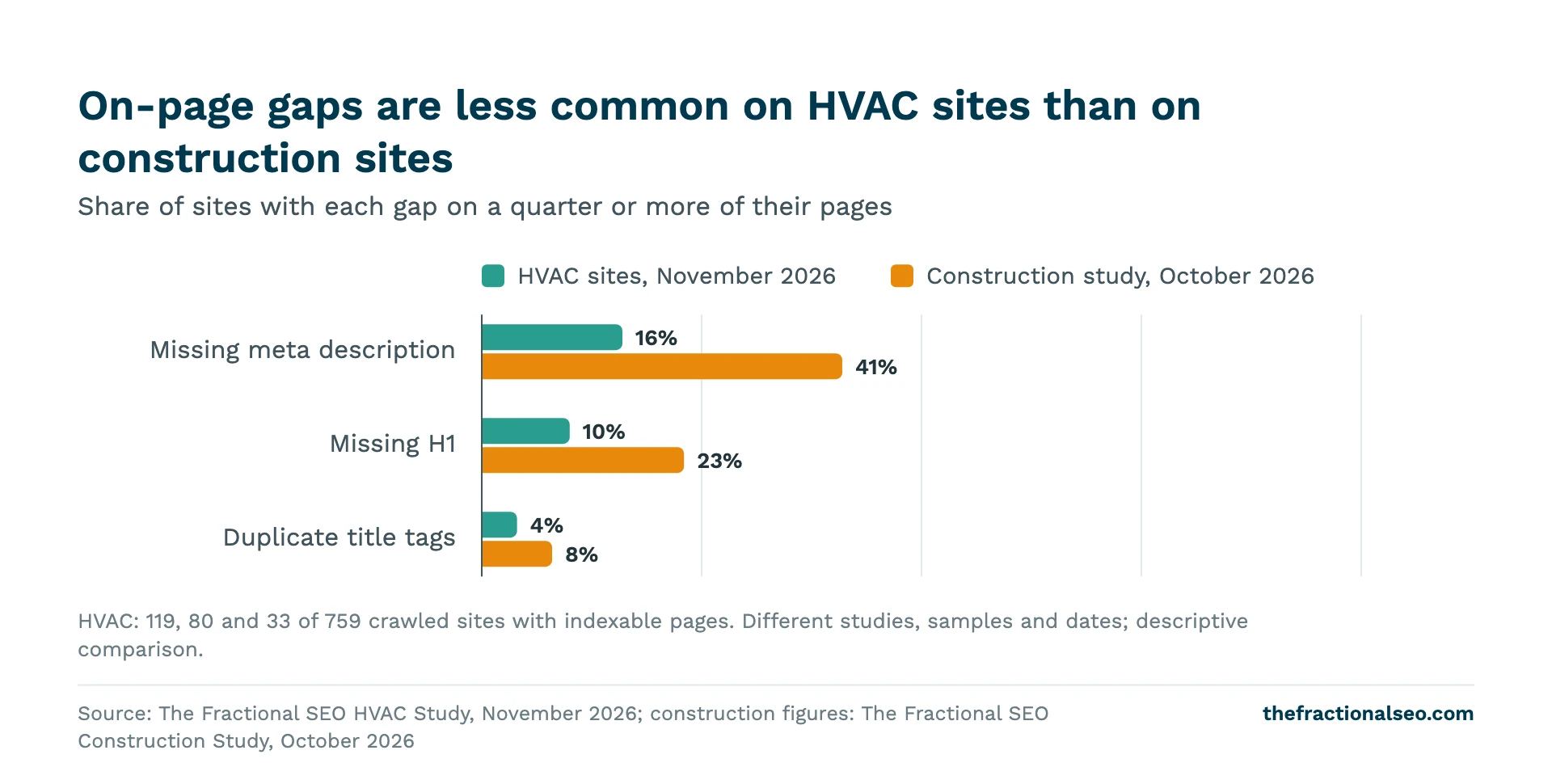
Missing titles, meta descriptions and headings are cheaper to fix than a slow site. On-page basics are missing on a minority of HVAC sites: 16% lack a meta description on a quarter or more of their pages, 10% lack an H1 on a quarter or more, and 4% duplicate titles on a quarter or more. For comparison, the construction contractor sites in our October 2026 study came in at 41%, 23% and 8% on the same three checks.
We won’t repeat why these tags matter or how to write them. Step 4 of our beginner’s guide to SEO for HVAC companies covers that, and our study of the most common SEO mistakes on HVAC websites shows where these gaps sit among the rest. Here we stick to finding them.
How to find your gaps
- Crawl the site. The free version of Screaming Frog SEO Spider has a “Crawl Limit – 500 URLs” (as of November 2026).
- Open the page titles, meta descriptions and H1 reports, and filter each for missing and duplicate.
- Fix the homepage first, then your main service pages (AC repair, furnace replacement, heat pumps, maintenance), then your city pages.
- Crawl again to confirm the fixes went live.
This is standard practice, not something our study measured.
Mobile speed: how fast is a typical HVAC website?
We ran every crawled homepage through PageSpeed Insights on mobile. On mobile, the median HVAC contractor homepage scores 65 out of 100 on Google’s Lighthouse performance test; only 13% score 90 or more and 26% score under 50.
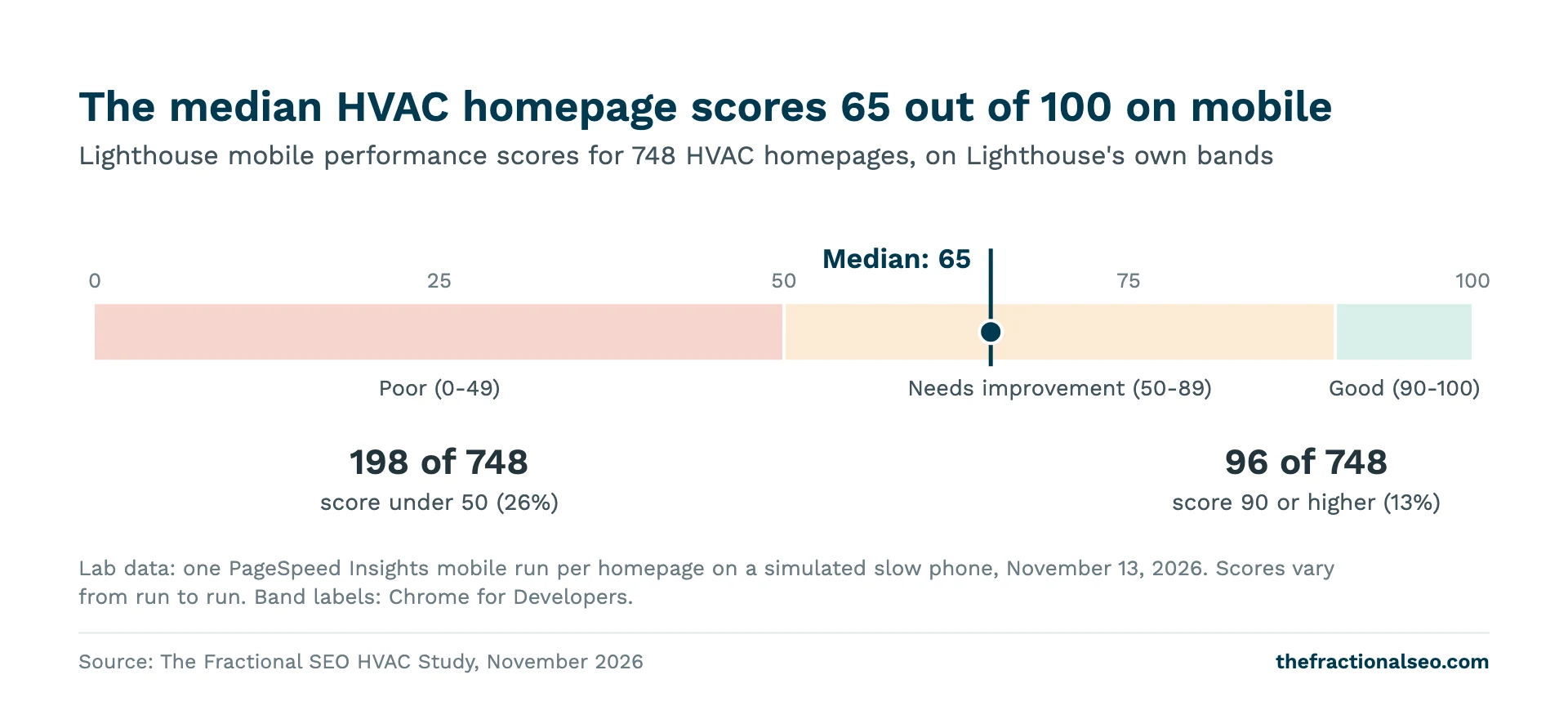
Lighthouse sorts scores into three bands, according to Chrome for Developers (external): 0 to 49 is Poor, 50 to 89 Needs Improvement and 90 to 100 Good. The typical HVAC homepage sits in the middle band.
In the same simulated slow-phone test the median homepage takes 6.3 seconds to show its largest element, and only 13% do it in 2.5 seconds or less. That measure is Largest Contentful Paint (LCP): the moment the biggest image or block of text in view appears, such as a large hero banner. Google’s “good” line for LCP is 2.5 seconds (external, web.dev). The median total blocking time was 285.5 milliseconds, time when the page is too busy running scripts to respond to a tap.
This is a lab test: “a simulated load of a page on a single device and fixed set of network conditions,” in PageSpeed Insights’ words. We ran it once per homepage, and scores move between runs (Lighthouse’s documentation: “a lot of the variability in your overall Performance score and metric values is not due to Lighthouse”). Treat any score, your own included, as a snapshot.
Lab data and field data (Core Web Vitals)
Field data comes from real Chrome users who visited the page, over “the previous 28-day collection period,” according to Google’s PageSpeed Insights documentation. Google’s three Core Web Vitals are judged at the 75th percentile of page loads. The good thresholds (external, web.dev) are Largest Contentful Paint within 2.5 seconds, Interaction to Next Paint of 200 milliseconds or less, and Cumulative Layout Shift of 0.1 or less.
Most HVAC websites get too little traffic for Google to report real-visitor speed data: only 27% have Chrome UX Report data. Of the 118 with all three Core Web Vitals reported, 42% pass. Another 86 have data but no INP figure, so no pass or fail. Sites with field data skew toward busier sites, so that 42% describes busier HVAC sites, not the typical one.
With too few real visits, PageSpeed Insights falls back to the whole site, and failing that it “will be unable to show any real-user experience data.” Then use the lab test, and watch the Core Web Vitals report in Search Console for when it starts to show data.
Does website speed affect HVAC rankings?
This is the question behind “your site is slow” cold emails. Page speed shows no clear difference between top-ranked HVAC companies and the rest: map-pack sites have a median mobile score of 65 vs 64 for those lower in Maps, and organic top-3 sites 63 vs 65 at positions 4-10. Load time, page weight and Core Web Vitals pass rates show no clear difference either.

None of the eight comparisons reaches the usual bar (p<0.05), even before correcting for multiple tests. One pair looks like a gap but isn’t a reliable one: organic Core Web Vitals pass rates, 16 of 37 top-3 sites (43%) vs 8 of 30 at positions 4-10 (27%). The groups are small; no clear difference.
Google’s page experience documentation says “Core Web Vitals are used by our ranking systems.” It also says “Google Search always seeks to show the most relevant content, even if the page experience is sub-par,” and that good results in Search Console or third-party speed tools don’t “guarantee that your pages will rank at the top of Google Search results.” And: “There is no single signal.”
Put together: our data found no clear difference in speed between top-ranked HVAC companies and the rest. That isn’t proof speed doesn’t matter, and Google says Core Web Vitals are used by its ranking systems, but speed doesn’t appear to be what separates the companies at the top. This compares groups at one point in time, so it can’t show cause in either direction. Be wary of anyone who says speed alone will move your rankings, or that it doesn’t matter.
Why speed still matters: the phone call
In our crawl, 93% of HVAC contractor websites have a click-to-call phone link on the homepage. That tells you what the site is for: getting a tap on the phone number. When the median homepage takes 6.3 seconds in the slow-phone test to show its largest element, someone standing next to a dead furnace may give up before the page is ready to use.
We didn’t measure lost calls. The practical advice: put the phone number and a call button in the first thing that loads, keep them out of sliders and pop-ups, and open your homepage on your own phone over cellular data, not office Wi-Fi.
For the rest of the conversion side, see turning HVAC website visits into calls and our research on online booking.
What slows HVAC homepages down
The median HVAC homepage weighs 3.0 MB; 28% are over 5 MB. We didn’t measure what makes each page heavy, but the usual causes are well known (best practice, not study data):
- Full-width hero videos and sliders that load several large images at once.
- Truck, team and job photos uploaded straight from a camera. Save them as WebP, sized to the width they actually display at.
- Chat, review, financing and booking widgets, each loading its own scripts.
- Tracking scripts added over the years and never removed.
On that last point, Google Tag Manager is on 63% of HVAC homepages. The study didn’t measure what any one script costs in speed, so don’t strip tags out blind. Do remove tags for tools you no longer pay for.
Fix order: images first, then widgets nobody uses, then hosting and caching.
LocalBusiness schema
70% of HVAC contractor websites have LocalBusiness (or a subtype such as HVACBusiness) structured data. Google’s local business guidance says “Use the most specific LocalBusiness sub-type possible”; for a heating and cooling company that’s HVACBusiness, a schema.org type. Name and address are required. Test the code in Google’s Rich Results Test.
Map-pack sites have LocalBusiness schema (77% vs 66% of those lower in Maps) somewhat more often, but those gaps are weak. Treat schema as a basic to get right, not a lever. Google adds that it “does not guarantee that features that consume structured data will show up in search results.”
HTTPS, sitemaps and indexing
Nearly all HVAC contractor sites use HTTPS (767 of 768), so the job is keeping it working: check that the certificate renews on its own and that every http:// address redirects to https://.
On sitemaps, Google’s sitemap overview defines a small site as “about 500 pages or fewer” and says one well linked may not need a sitemap, and that a sitemap “doesn’t guarantee that all the items in your sitemap will be crawled and indexed.” If you have one, submit it in Search Console anyway. Then open the Pages report and look for service and city pages marked as not indexed. After any redesign, check robots.txt: a new site that goes live still set to block search engines can drop out of Google.
Platform notes: WordPress and the rest
WordPress runs 83% of HVAC contractor sites where the platform could be identified; next are Duda 5% and Wix 3%. On WordPress you control most of the speed settings, which means more can go wrong: a heavy theme or page builder, plugins nobody uses, two caching plugins fighting each other. Keep one caching plugin, compress images when you upload them, and check what your theme loads. We looked at the WordPress themes HVAC sites use separately.
On hosted builders such as Duda and Wix there’s less to tune, so spend the effort on image sizes and widgets.
A quarterly technical check
Once a quarter, run these five checks (best practice, not study data):
- Run PageSpeed Insights on mobile for your homepage and your top service page.
- Crawl the site again for missing titles, meta descriptions and H1s.
- Open Search Console’s Pages and Core Web Vitals reports and look for new problems.
- Test your schema in the Rich Results Test.
- Confirm HTTPS still redirects correctly and your sitemap is submitted.
For the wider list, including your Business Profile and reviews, use our HVAC local SEO checklist.
FAQs
How fast should an HVAC website be?
Google’s good line for Largest Contentful Paint is 2.5 seconds, and Lighthouse calls a score of 90 or more Good (both external). The typical HVAC homepage is well short: a median score of 65 and 6.3 seconds in our slow-phone lab test.
Does website speed affect HVAC rankings?
Our data found no clear difference in speed between top-ranked HVAC companies and the rest. That isn’t proof of no effect. Google says Core Web Vitals are used by its ranking systems, and that it seeks to show the most relevant content even when page experience is sub-par.
Why doesn’t my site have Core Web Vitals data?
Probably too few real visits. Only 27% of HVAC sites have Chrome UX Report data. When neither the page nor the whole site has enough real-user samples, PageSpeed Insights shows lab data only.
What schema should an HVAC website use?
LocalBusiness, using the most specific subtype: HVACBusiness. 70% of HVAC sites have LocalBusiness or a subtype. Map-pack sites have it somewhat more often, but the gap is weak.
Is WordPress good for HVAC websites?
It’s the most common choice: 83% of HVAC sites where we could identify the platform. We didn’t test platforms against rankings; a light theme and compressed images are what to check.
Want your site checked against these benchmarks?
A fractional SEO looks at the technical basics alongside the local and content work that, in our view, usually matters more for HVAC companies. Learn about fractional SEO for HVAC companies.
About the data
We analyzed 100 local searches across 25 US metros and four HVAC search types, 853 HVAC contractor websites (768 crawled) and 797 Google Business Profiles, November 2026. Speed data: one PageSpeed Insights mobile run (Lighthouse 13.6.0) per homepage on 2026-11-13, three days after the rest of the study.
- Samples: 748 of 768 homepages scored (16 returned Lighthouse load errors, 4 ran without a score); page weight 752; on-page basics 759 sites with indexable pages; platform 641 identified sites; Tag Manager 754 homepages.
- Speed vs rankings: map pack 1-3 vs Maps 4-20 (127 vs 480 scored homepages); organic top 3 vs positions 4-10 (106 vs 165). Core Web Vitals pass: map pack 32 vs 56, organic 37 vs 30 scored sites with all three metrics.
- Lab scores vary run to run. Nine homepages under 100 KB all score 100 and may be placeholder pages; without them the median is 64 and 12% score 90 or more.
- Sites with real-visitor data skew busier; for 89 sites the figures cover the whole site, not the homepage alone.
- Correlation, not cause: a missing difference is not proof that speed has no effect. We use group medians and shares, never one company’s position.
More guides
The whole HVAC library- SEO for HVAC Companies: A Beginner’s Guide What HVAC customers search for, which pages to build first and what 768 HVAC websites show,…
- Seasonal SEO for Heating and Cooling Companies When HVAC searches rise and fall through the year, and what to build, update and promote…
- The Ultimate Guide to Local SEO for HVAC Companies The full local SEO plan for HVAC companies, split into the map pack and the organic…