
Research & Benchmark HVAC
How Many Google Reviews Does an HVAC Company Need to Make the Map Pack?
HVAC companies in the map pack have a median of 1,576 Google reviews. That's far above the 10 to 50 reviews often suggested online, and the number changes with your market and the search. Here are the benchmarks from 300 map-pack listings, and a way to set a target for your own company.
The short answer
HVAC companies in the map pack have far more Google reviews: a median of 1,576 for positions 1-3 vs 615 for positions 4-7. Almost nobody gets in on a handful: 2 of 300 map-pack listings have fewer than 10 reviews, and three-quarters have 591 or more. Google doesn’t publish a minimum, and no review count guarantees a spot. A practical target comes from the three companies in your own market’s map pack.
We analyzed 100 local searches across 25 US metros and four HVAC search types, 853 HVAC contractor websites (768 crawled) and 797 Google Business Profiles, November 2026. For this article we looked at review counts on 300 map-pack listings and 397 listings just below the pack, then broke them out by market size and by search. The website side of the study is in our study of 768 HVAC websites.
What map-pack HVAC companies have: the median
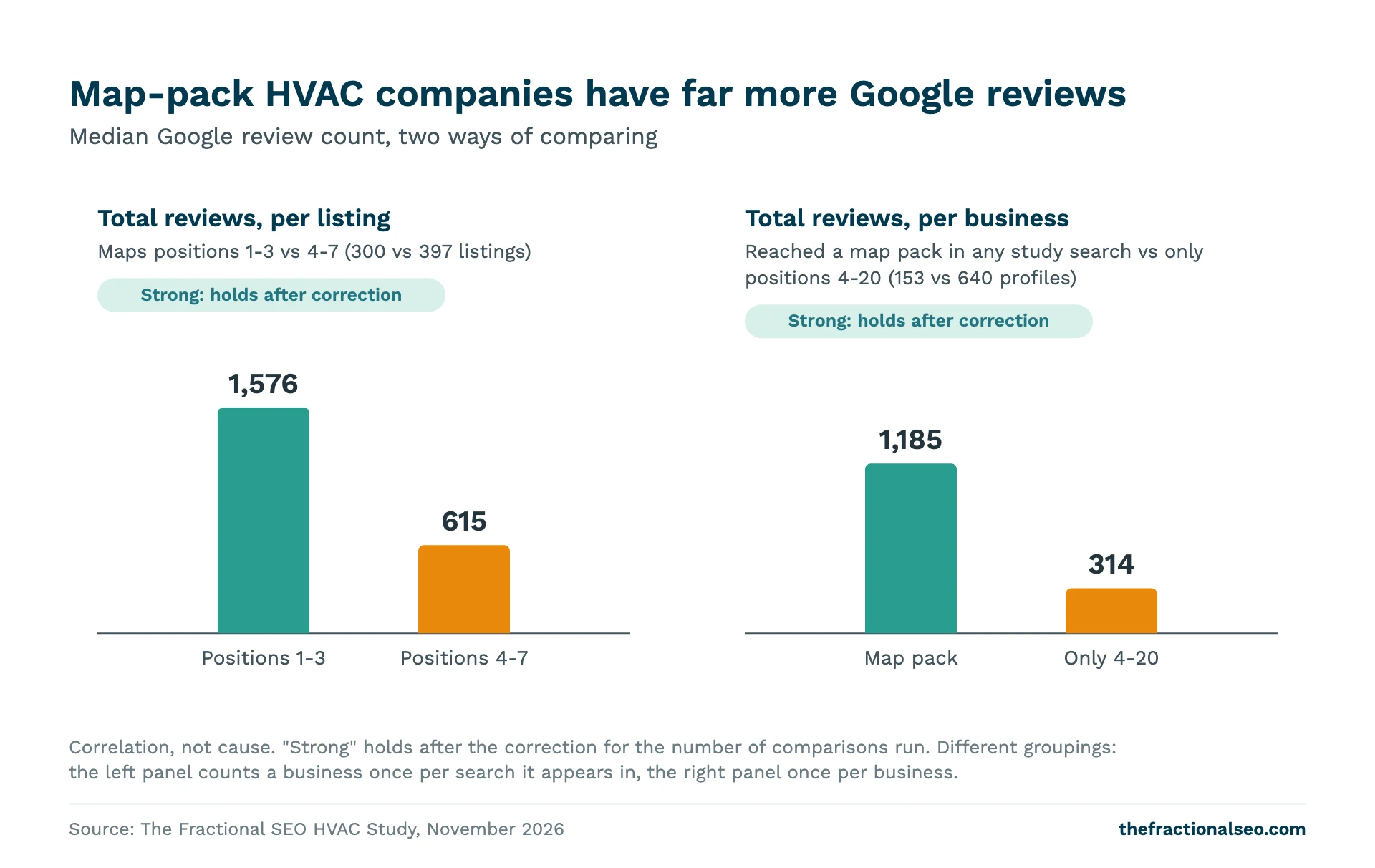
HVAC companies in the map pack have far more Google reviews: a median of 1,576 for positions 1-3 vs 615 for positions 4-7. That compares 300 map-pack listings with 397 listings at positions 4-7 across 100 searches. In this study, the map pack means the top three businesses in the Google Maps list for each search. Positions 4-7 are the next ones in that list.
We also flagged, by rule, listings named only with keywords that have few reviews. The flag is not proof a listing is fake. Without flagged suspect listings, the medians are 1,624 vs 649, so the picture doesn’t change.
That comparison counts a company once for each search it shows up in. A company that shows up for all four searches in its city counts four times. So we also counted each business once. Across the 793 profiles with a review count, businesses that reached a map pack in any study search have a median of 1,185 reviews vs 314 for those that only appeared at positions 4-20. That’s 153 businesses against 640.
The two medians differ because the groups differ, not because one is wrong. Both point the same way.
None of this shows that reviews put those companies in the pack. Established companies tend to have both more reviews and other advantages, such as age, budget and links. For the other signals that go with the map pack, see which review signals lean with the map pack.
The floor and the spread
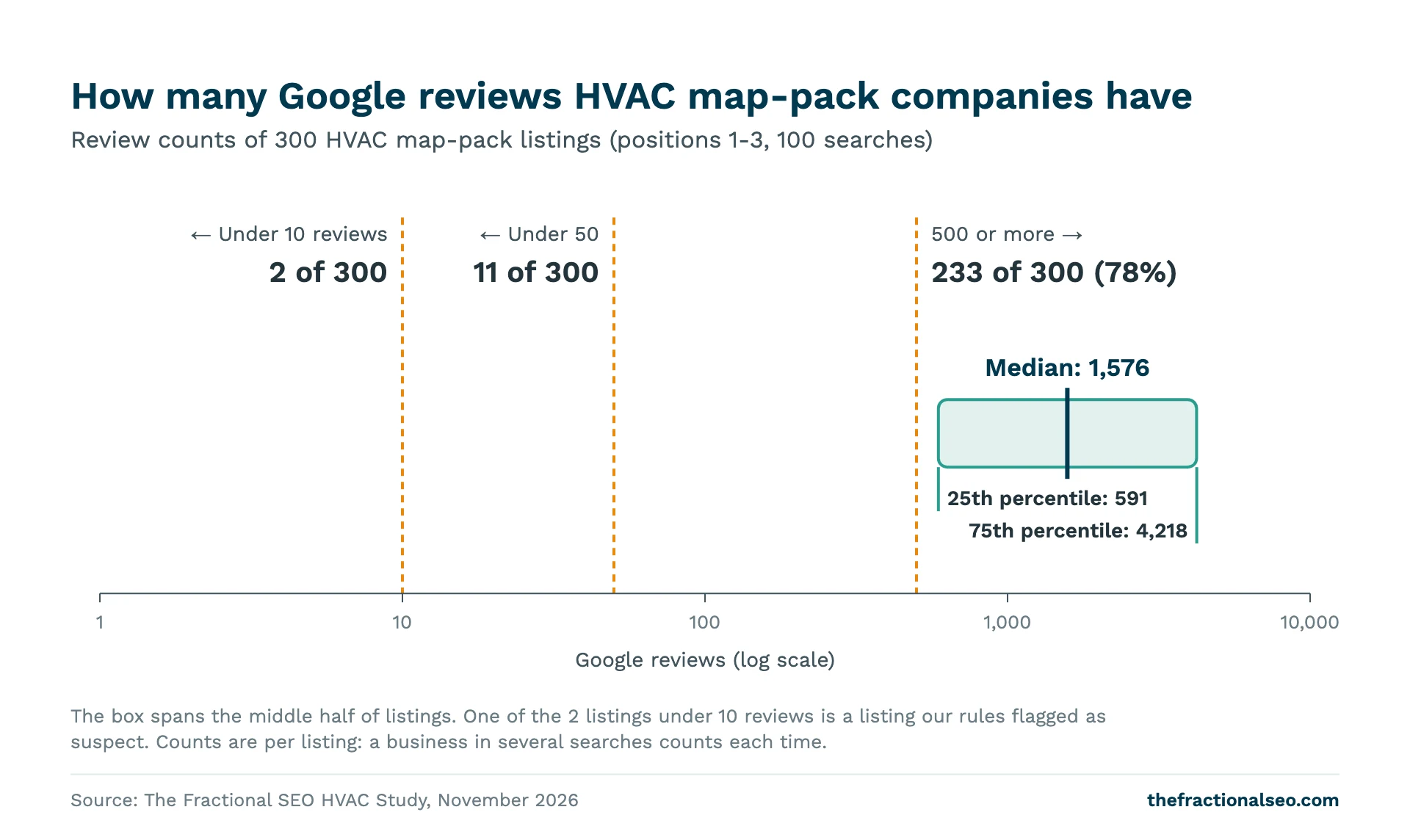
Almost nobody reaches the HVAC map pack on a handful of reviews: 2 of 300 map-pack listings have fewer than 10, three-quarters have 591 or more, and 78% have 500 or more.
Here is the full spread across the 300 map-pack listings:
- Fewer than 10 reviews: 2 of 300. One of the two is a listing our rules flagged as a suspect, keyword-named listing.
- Fewer than 50 reviews: 11 of 300.
- 25th percentile: 591. Three-quarters of map-pack listings have 591 or more.
- Median: 1,576.
- 75th percentile: 4,218.
- 500 or more: 233 of 300 (78%).
Advice of 10 to 50 reviews, common in articles on this question, is far below this. In our data, only 11 of the 300 map-pack listings had fewer than 50. A company with fewer than 50 can still get in, and Google says distance and relevance count as well. But it was the exception in these markets.
By market size
Median reviews for a map-pack spot by market size: Large metros 797; Mid metros 2,702; Small metros 1,352.
| Market size | Metros in the study | Median reviews in the map pack | Map-pack listings |
|---|---|---|---|
| Large metros | 10 | 797 | 120 |
| Mid metros | 10 | 2,702 | 120 |
| Small metros | 5 | 1,352 | 60 |
Mid-size metros (Charlotte, Nashville, Austin, Columbus, Indianapolis, Kansas City, Raleigh, Salt Lake City, Tampa, Richmond) are the most review-heavy.
You might assume the biggest cities need the most reviews. In our data, the large-metro median was the lowest of the three.
We didn’t test why. These are descriptive figures for these 25 metros, not a rule for every city. The small-metro group is only 5 metros, so it rests on fewer listings than the other two.
The practical reading: don’t assume a smaller city means a smaller target. Check your own map pack before you set a number. For how local HVAC searches break down in each kind of market, see who wins local HVAC searches.
By search: heating repair is the most review-heavy
Median reviews in the map pack by search: AC installation 1,359; AC repair 1,550; HVAC company 1,510; Heating repair 2,109. Each figure comes from 75 map-pack listings.
| Search | Map pack (positions 1-3) | Positions 4-7 | Map-pack listings |
|---|---|---|---|
| AC installation | 1,359 | 665 | 75 |
| AC repair | 1,550 | 564 | 75 |
| HVAC company | 1,510 | 571 | 75 |
| Heating repair | 2,109 | 686 | 75 |
In every search, the map-pack median sits well above positions 4-7. Heating repair had the highest map-pack median of the four.
The search here is the wording someone typed, such as “heating repair Columbus”, not the category a business chose for itself. The same company can show up in several searches. Benchmark yourself against the search that brings you the jobs you want most. If heating work is your core, check the heating repair pack first.
One caution: this is one snapshot, collected in November. We didn’t compare seasons.
How many new reviews a month
Map-pack HVAC companies keep getting reviews: a median of 19 new Google reviews in the 30 days before collection vs 4 for the rest. That compares 153 businesses that reached a map pack in any study search with 644 that only appeared at positions 4-20.
We collected each profile’s newest 40 reviews, so a company with more than 40 in the month counts as 40. Both medians are well below that cap.
Treat 19 as a benchmark of flow, not a quota. Getting 19 reviews next month won’t earn a spot on its own. Companies in the pack may get more calls and so have more customers to ask, which would make part of the gap a result of being in the pack. The study didn’t test that. The figure covers one 30-day window, so it shows what map-pack companies collected that month, not how they collect reviews over a year.
How to set your own target
The study gives you a range. Your real target comes from your own market. Here’s the method we’d use. It’s our recommendation, not study data.
- Search your main services on Google Maps. Use the four wordings from the study with your city: AC repair, heating repair, AC installation and HVAC company. Search from inside the area you want to win, because results change with the searcher’s location.
- Note the review counts of positions 1-3. Take the middle one of the three for each search. That’s your market’s map-pack median.
- Compare. Put your own count next to it, and next to the study medians above for your market size and search. If your market’s pack sits far above the study, plan for a longer climb.
- Set a monthly flow target. Count the new reviews you got in the last 30 days and compare that with the map-pack median of 19. Then work out how many customers you’d need to ask each month to close the gap.
Then make asking part of every job. Google’s help page on reviews says you can share a review request link or QR code. Text the link when the job is done, or print the code on the invoice.
Ask every customer. Google’s content policy says businesses may not “Discourage or prohibit negative reviews, or selectively solicit positive reviews from customers.” The same policy bans paying for reviews or offering anything in return. The HVAC Google Business Profile guide and checklist covers the rest of the profile.
Reviews are one part of the picture
Review count leans with the map pack, but it doesn’t explain it on its own. Google’s local ranking page says results are based mainly on relevance, distance and prominence, and that prominence is based partly on how many reviews you have. So a company closer to the searcher may show with fewer reviews. And Google says there’s no way to request or pay for a better local ranking.
For the other signals, read which review signals lean with the map pack and our guide to local SEO for HVAC companies.
Want your own market’s map-pack numbers and a realistic review target? Talk to us about SEO for HVAC companies.
How we did this
We analyzed 100 local searches across 25 US metros and four HVAC search types, 853 HVAC contractor websites (768 crawled) and 797 Google Business Profiles, November 2026.
Map pack means positions 1-3 of the Google Maps list for each search. The benchmarks use 300 map-pack listings, counted once per search. New reviews are counted among each profile’s newest 40, once per business. What it can’t claim: that any review count earns a spot, or why mid-size metros run higher.
Questions, answered
How many Google reviews do I need to get into the map pack?
There’s no fixed number. In our data, HVAC map-pack listings had a median of 1,576 reviews vs 615 at positions 4-7, and three-quarters had 591 or more. It also depends on your market and the search.
Can you get into the map pack with only a few reviews?
Rarely. Only 2 of 300 map-pack listings had fewer than 10 reviews, and one of those two was a listing our rules flagged as a suspect, keyword-named listing.
How many new reviews should I get each month?
Map-pack businesses got a median of 19 new reviews in the 30 days before collection, vs 4 for the rest. Use that as a benchmark for steady flow, not as a rule that earns a spot.
Do reviews guarantee a map-pack spot?
No. Google says local results depend mainly on relevance, distance and prominence, and that you can’t pay for a better local ranking. Established companies tend to have both more reviews and other advantages, such as age, budget and links, so reviews lean with the map pack without explaining it on their own.
Is there a minimum number of reviews Google requires?
Google doesn’t publish one. Its local ranking help page names review count as part of prominence, without any number.
More research & benchmarks
The whole HVAC library- Who Wins Local HVAC Searches in 2026: A Benchmark of 100 Searches Who holds page one, the map pack and the ad slots when homeowners search for HVAC…
- We Analyzed 768 HVAC Websites: What Top-Ranked HVAC Companies Do Differently Seven website gaps measured across 768 HVAC websites, and the one feature that leans with rankings…
- Online Booking and the HVAC Map Pack: What 768 HVAC Websites Show Online booking is the clearest website difference between top-ranked HVAC companies and the rest, and the…