
Research & Benchmark Pest Control
We Analyzed 243 Pest Control Websites: What They Promise, and What Most Leave Out
The guides that rank for pest control websites give much the same list: click-to-call, quote forms, reviews, a guarantee, online booking, a blog. None of the ones we read had counted how many pest control companies actually do these things, so we did. We analyzed 36 local searches across 12 US metros and three pest control search types, 283 pest control company websites (243 crawled) and 305 Google Business Profiles, November 2026. Free inspections and guarantees turn out to be close to standard. Prices and online booking are rare, and more than half of homepages make a pet, family or eco claim. Then we checked whether any website feature goes with ranking higher in Google Maps or the regular results. None clearly does.
We collected this data on November 17, 2026, outside the pest season: in Google Trends, US interest in “pest control” in November averages 56% of its July peak, so rankings, ads, review and posting activity may look different in spring and summer. This study covers the websites. For who actually shows up when a homeowner searches, read who wins local pest control searches. To see how we work with pest control companies, start with fractional SEO for pest control companies. The full sample, dates and limits are in the Method card on this page.
Key findings at a glance
- What homepages promise: free inspection or estimate 68%; guarantee (any kind) or free re-treat 60%; pet, family or eco safe 56%; recurring service plan 49%.
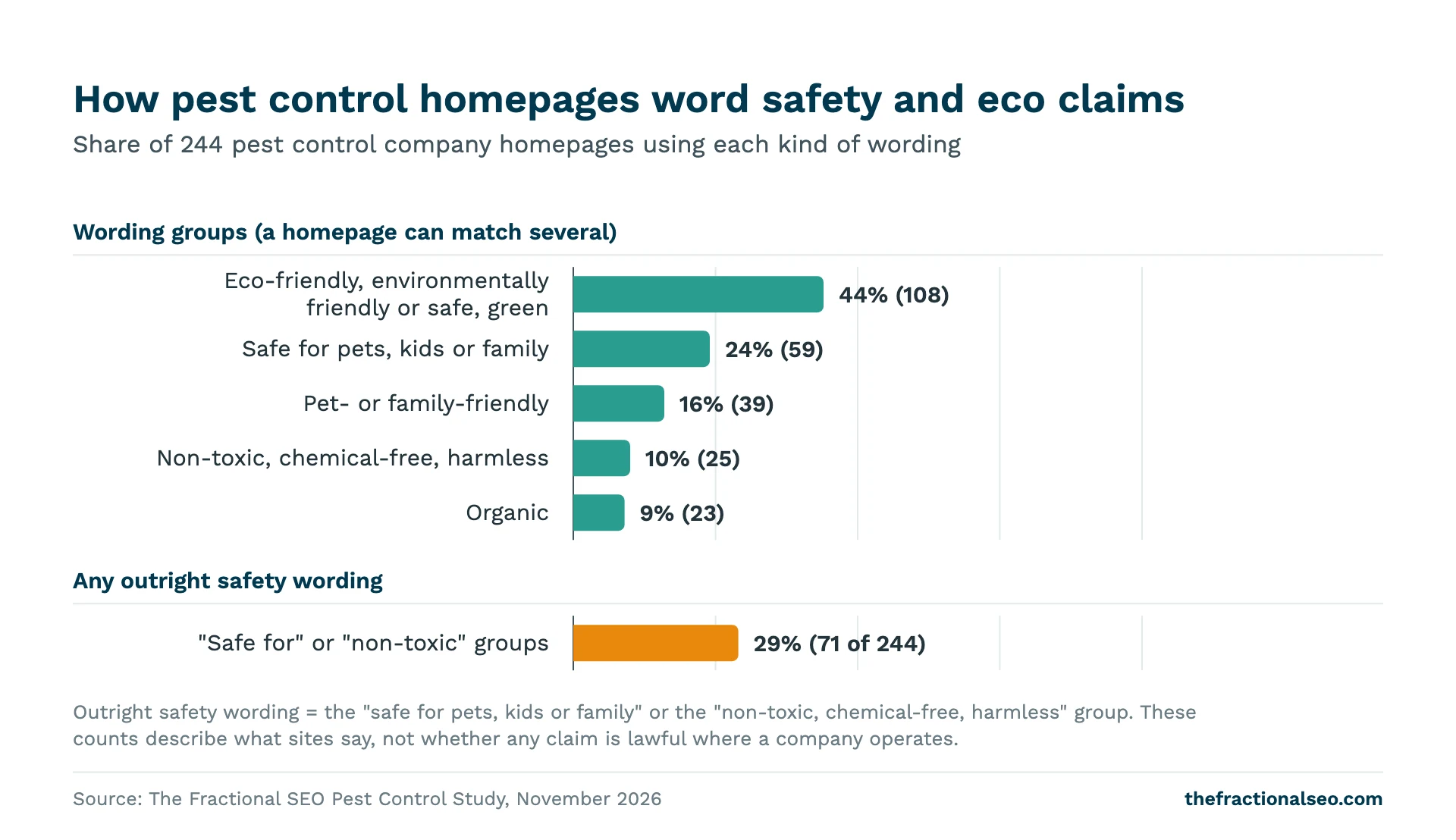
- Safety wording is common: 29% of homepages use outright safety wording such as “pet-safe”, “safe for your family” or “non-toxic”, the kind of wording EPA label rules treat as false or misleading.
- Prices and booking are rare: prices shown 11%; online booking or instant quote 10%; licensed, insured or bonded 22%.
- Blogs go quiet: 61% of pest control company sites have a blog, but only 18% published anything in the last 12 months.
- Phones wait: the median homepage scores 63 out of 100 on Google’s mobile performance test and takes 6.4 seconds to show its largest element.
- No feature clearly leans with ranking: no website feature reliably separates top-ranked pest control companies from the rest. With only 36 searches, a modest real difference could still be missed.
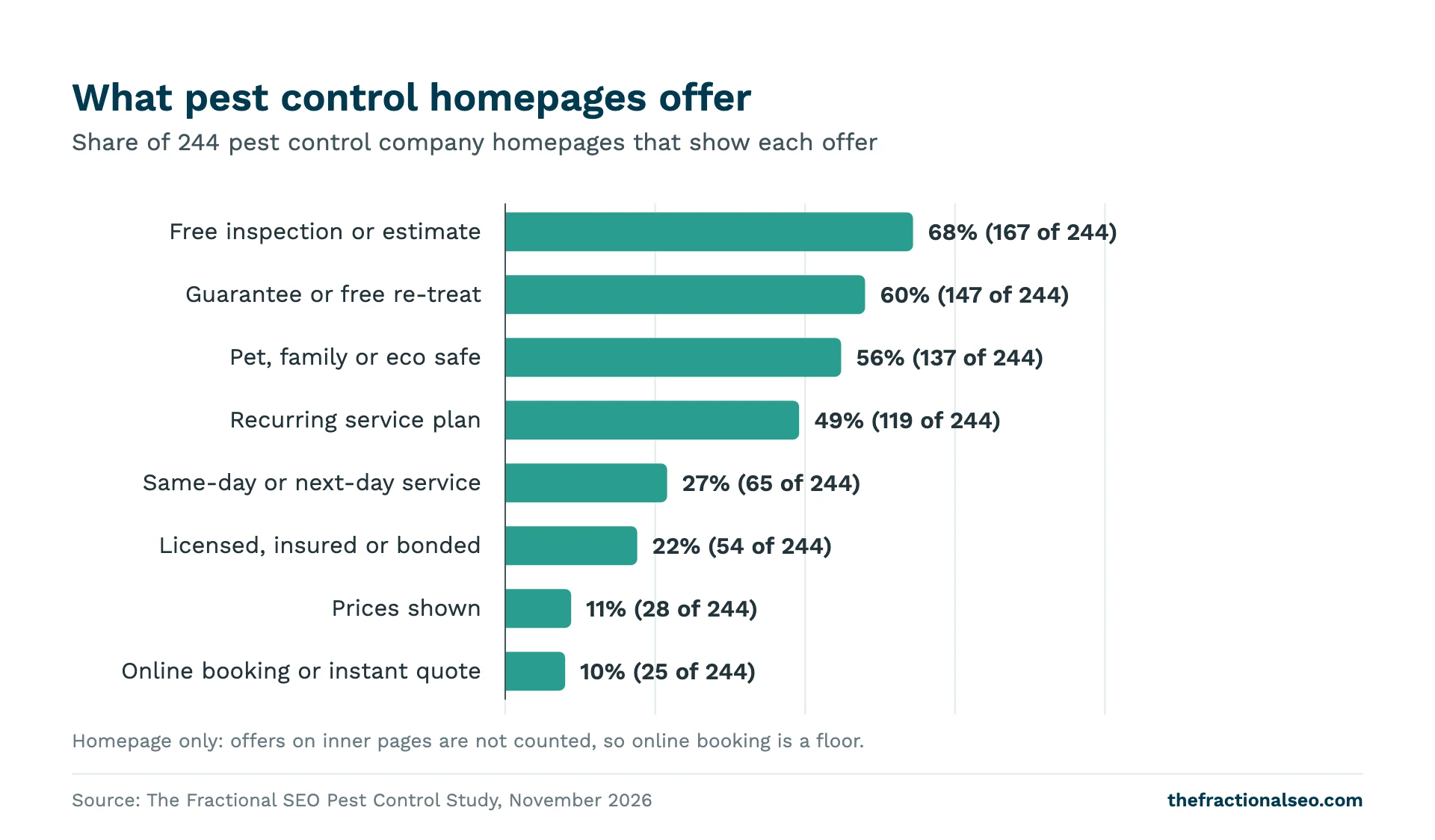
What pest control homepages promise
We read the visible text of 244 pest control homepages and checked each one for eight common offers. Here is what pest control homepages offer: free inspection or estimate 68%; guarantee (any kind) or free re-treat 60%; pet, family or eco safe 56%; recurring service plan 49%; same-day or next-day service offered 27%; licensed, insured or bonded 22%; prices shown 11%; online booking or instant quote 10%.
A person re-checked 27 of the homepages by hand, and agreed with our rules between 89% and 100% of the time depending on the offer. We only read the homepage. A company that explains its guarantee or its prices on an inner page is not counted, so these figures describe what a visitor sees first, not everything a company offers.
The pattern is clear. The free inspection, the guarantee and the safety message are the industry’s standard pitch. A visitor comparing three or four pest control sites will see the same three promises on most of them, which makes them hard to stand out with. The things that would help a homeowner choose, such as a starting price, a way to book without calling, or proof of a license, are the ones most sites leave off.
Do any of these offers go with ranking? We compared businesses in the map pack with those lower in Maps, and organic top-3 sites with positions 4-10. No offer showed a reliable difference in either comparison. The details are in the rankings section below.
“Pet-safe” and “non-toxic”: the wording on 29% of homepages
56% of pest control homepages make a pet, family or eco claim, and 29% use outright safety wording such as “pet-safe”, “safe for your family” or “non-toxic”, the kind of wording EPA label rules treat as false or misleading.
Broken down by wording, a homepage can match more than one group: eco-friendly, environmentally friendly or safe, or green 44%; safe for pets, kids or family 24%; pet- or family-friendly 16%; non-toxic, chemical-free or harmless 10%; organic 9%. A broader list of phrases gave a slightly higher count, up to 30% with safety wording. The hand-check of 27 homepages agreed with our pet, family or eco rule on every one.
Why this matters: the federal pesticide labeling rule, 40 CFR 156.10, lists claims about the safety of a pesticide, including “safe”, “harmless” and “nontoxic to humans and pets”, as false or misleading on a pesticide label. That rule is written for labels. How far it, and each state’s rules, reach a pest control company’s own website and ads differs by state, and we have not settled that here.
So this study makes no recommendation on what wording to use. It counts what is out there. For what the rules say about pet-safe and eco claims, read what pest control companies can say about pet-safe and eco claims before you change a word. In our ranking comparisons, pet or eco claims showed no clear difference either way.
What most pest control websites leave out
Five gaps show up across pest control sites, some on most of them and some on a minority. None of them clearly leans with ranking in this data. They are about what a homeowner can find, trust and do once they land on your site.
Prices and online booking
Prices shown 11%; online booking or instant quote 10%. Those are the two rarest offers on pest control homepages. Online booking is a floor: a Book button whose destination we could not see from the homepage was not counted.
Neither goes with ranking here. Prices: map pack 10% vs 12% lower in Maps, organic 3% vs 11%, no clear difference in either. Online booking: map pack 10% vs 12%, organic 10% vs 5%, no clear difference.
So the case for prices and booking is about the customer, not Google. Many pest control companies sell a recurring plan, and a homeowner comparing plans wants a starting figure before they hand over a phone number. If you can’t publish a price, “plans from” or a typical range for a one-time treatment is a middle ground. That is our view, not study data.
Field-service software rarely shows on homepages either: some field-service tool shows on 9%, led by PestPac (9 sites), GorillaDesk (8) and Briostack (4). Most of that software runs in the back office, so this is not market share. Our pest control software list compares the main options.
Proof that you’re licensed and well reviewed
Only 22% of homepages say the company is licensed, insured or bonded. 27% of pest control company websites show reviews or testimonials through an embedded review widget, and 55% have a contact or quote form on the homepage itself.
Pest control means strangers spraying chemicals around a family’s home. In our view, a license number and an insurance line answer a question many homeowners have and few sites address. It costs one sentence in the footer or near the quote form.
Review widgets showed no clear difference by ranking: map pack 39% vs 26%, organic 17% vs 30%. Homepage forms are one of two weak leads we discuss below. Licensed or insured wording showed no clear difference either.
A blog nobody posts to
61% of pest control company sites have a blog, but only 18% published anything in the last 12 months and 8% averaged a post a month. Post dates come from our crawl, which stopped at 500 URLs per site, so a very large blog may be undercounted.
Having a blog showed no clear difference by ranking: map pack 73% vs 65%, organic 63% vs 48%. This is not evidence that blogging ranks a pest control company. A blog page whose newest post is three summers old tells a visitor nobody is minding the site. If you can’t post regularly, take the blog out of the main menu and put the time into your pest pages. If you do post, write about the questions your office hears every week, timed to the season: termite swarms in spring, mosquitoes in summer, rodents moving indoors in the fall. That is our advice, not study data.
On-page basics
65% of pest control company websites have LocalBusiness (or a subtype) structured data. 55% have their metro’s name in the homepage title tag; boroughs and suburbs were not counted, so that is a floor. On-page basics are missing on a minority of pest control sites: 20% lack a meta description on a quarter or more of their pages, 11% lack an H1 on a quarter or more, and 4% duplicate titles on a quarter or more.
Neither schema nor a city in the title showed a clear difference by ranking (schema: map pack 56% vs 66%, organic 80% vs 66%; city in title: map pack 54% vs 54%, organic 53% vs 56%). They are still basic housekeeping: a page title and description are what a searcher reads in Google before deciding to click.
A slow mobile homepage
On mobile, the median pest control company homepage scores 63 out of 100 on Google’s Lighthouse performance test; 14% score 90 or more and 27% score under 50. In the same simulated slow-phone test the median homepage takes 6.4 seconds to show its largest element, and only 15% do it in 2.5 seconds or less. This is a lab test on a simulated slow phone, not real visitors, and scores vary from run to run.
Speed showed no clear difference by ranking either: map-pack sites have a median mobile score of 58 vs 63 for those lower in Maps, and organic top-3 sites 69.5 vs 63 at positions 4-10. A homeowner with ants in the kitchen is often on a phone, though, and a page that takes several seconds to show anything gives them time to hit Back.
What pest control sites already get right
Some basics are close to universal. 91% of pest control company websites have a click-to-call phone link on the homepage. 88% have dedicated service or pest pages (termites, rodents, bed bugs and so on); median among those that do: 23. 69% have location pages (a page for a city or area, or a service-in-city page such as “termite control in Frisco”); among those that do, the median is 19 such pages.
None of the three showed a clear difference between top-ranked companies and the rest, which makes sense when most sites already have them. Our local SEO guide for pest control companies covers what makes a pest page or a location page useful rather than a copy of the next one.
Does any of this lean with rankings?
We ran two comparisons. In Google Maps, businesses that reached the map pack (positions 1-3) in any of our searches against those that only appeared at positions 4-20: 41 vs 152 crawled sites. In the regular results, sites at organic positions 1-3 against positions 4-10: 30 vs 61. Because we tested many features at once, we applied a standard correction so that a gap that would turn up by chance in a long list of tests isn’t reported as real.
The result: no website feature measured here reliably separates top-ranked pest control companies from the rest. That covers click-to-call, review widgets, LocalBusiness schema, a city in the title tag, a blog, location pages, service pages and every homepage offer we read. Most show no difference at all.
| Feature | Map pack vs lower in Maps | Organic top 3 vs 4-10 |
|---|---|---|
| Homepage form | 76% vs 54% (weak) | 40% vs 49% (no clear difference) |
| Guarantee | 59% vs 63% (no clear difference) | 73% vs 49% (weak) |
| Free inspection | 68% vs 70% (no clear difference) | 77% vs 62% (no clear difference) |
| Pet/eco safe | 63% vs 57% (no clear difference) | 63% vs 49% (no clear difference) |
| Service plan | 56% vs 48% (no clear difference) | 40% vs 57% (no clear difference) |
| Same-day | 32% vs 25% (no clear difference) | 40% vs 23% (no clear difference) |
| Licensed/insured | 17% vs 22% (no clear difference) | 27% vs 20% (no clear difference) |
| Online booking | 10% vs 12% (no clear difference) | 10% vs 5% (no clear difference) |
| Prices shown | 10% vs 12% (no clear difference) | 3% vs 11% (no clear difference) |
| Click-to-call | 93% vs 91% (no clear difference) | 93% vs 92% (no clear difference) |
| Review widget | 39% vs 26% (no clear difference) | 17% vs 30% (no clear difference) |
| LocalBusiness schema | 56% vs 66% (no clear difference) | 80% vs 66% (no clear difference) |
| City in title | 54% vs 54% (no clear difference) | 53% vs 56% (no clear difference) |
| Blog | 73% vs 65% (no clear difference) | 63% vs 48% (no clear difference) |
| Location pages | 71% vs 73% (no clear difference) | 57% vs 70% (no clear difference) |
| Service pages | 83% vs 89% (no clear difference) | 93% vs 90% (no clear difference) |
Two gaps look large but are weak. 76% of map-pack businesses have a form on the homepage vs 54% of those lower in Maps, and 73% of organic top-3 sites mention a guarantee vs 49% at positions 4-10. Neither survives the correction for the number of tests, and neither shows up in the other comparison. We treat them as leads for a later study, not results.
The honest caveat: this is 36 searches in 12 metros. A modest real difference can fail to show in a sample that size, so “no clear difference” here is not proof that there is none. What the data does not show is a large, consistent website edge of the kind we found for one feature in our HVAC website study. And as always, this is correlation: the comparisons show what top-ranked companies have, not what put them there.
If not the website, then what?
Google says local results are mainly based on relevance, distance and popularity, and that the third factor, which its help page calls prominence, depends partly on how many websites link to your business and how many reviews you have (Google Business Profile Help). In our searches, one pattern stands out: national and regional chains are few but hold far more than their share of top spots. 28 of 283 pest control websites (10%) belong to a chain, yet chains hold 33 of 108 map-pack spots (31%) and 48 of 155 company organic results (31%).
Most of that is company-owned chains (21 sites, 27 map-pack spots) rather than franchises (7 sites, 6 spots). Orkin alone holds 10 map-pack spots. Orkin and Truly Nolen sell franchises, but no page we read says whether a given location is franchised, so both are counted as company chains.
An independent company can’t become a national brand by redesigning its homepage. Read who wins local pest control searches for where independents do hold page one, and what 305 pest control Business Profiles show about reviews for the review side.
A 30-minute check of your own homepage
Open your homepage on your phone. The figures in brackets are from the study; the advice is our view, not study data.
- Minutes 1-5, the pitch. Read your homepage as a stranger. Is your offer the same free inspection and guarantee as everyone else’s, or does something set you apart? (Free inspection on 68% of homepages, a guarantee on 60%.)
- Minutes 5-10, safety wording. List every “safe”, “non-toxic”, “pet-friendly” or “green” phrase on the page. Check each one against our pet-safe claims guide. (29% use outright safety wording.)
- Minutes 10-15, price and booking. Can a visitor see a starting price or book without calling? (Prices on 11%, booking on 10%.)
- Minutes 15-20, proof. Is your license or insurance mentioned, and can a visitor see a review without leaving the page? (Licensed or insured on 22%, a review widget on 27%.)
- Minutes 20-25, blog and pest pages. Check the date of your newest post and count your pest pages. (18% posted in the last 12 months.)
- Minutes 25-30, speed and titles. Run your homepage through Google’s PageSpeed Insights on mobile and read your title in the browser tab. Does it name your city? (Median mobile score 63.)
For the full list, use our local SEO checklist for pest control companies.
FAQs
What do most pest control websites leave out?
Prices, online booking and proof of a license. Only 11% of homepages show prices, 10% offer online booking or an instant quote, and 22% say the company is licensed, insured or bonded. Blogs are also mostly idle: 61% of sites have one, but only 18% published anything in the last 12 months.
Does a pest control website help it rank on Google?
Not in a way we could measure. No website feature in this study reliably separated top-ranked pest control companies from the rest, in Maps or in organic results. With 36 searches, a modest real difference could be missed, so treat that as “no clear difference”. Google says local results are mainly based on relevance, distance and popularity.
Should a pest control company say “pet-safe” on its website?
Many do: 29% of homepages use outright safety wording. EPA’s labeling rule treats safety claims such as “harmless” or “nontoxic to humans and pets” as false or misleading on a pesticide label, and how far that reaches advertising differs by state. We don’t recommend wording here. Read our guide to pet-safe and eco claims first.
Should pest control companies show prices online?
Only 11% do, and showing prices made no clear difference to ranking in either comparison. The reason to consider it is the customer: a homeowner comparing recurring plans wants a starting figure. In our view, a typical range or a “plans from” figure is a middle ground.
How fast is the average pest control website on a phone?
Slow. The median homepage scores 63 out of 100 on Google’s mobile Lighthouse test and takes 6.4 seconds to show its largest element on a simulated slow phone. Only 15% do it in 2.5 seconds or less.
Want to know what your site is missing, and which gaps are worth fixing first? See how we work with pest control companies.
More research & benchmarks
The whole Pest Control library- Google Reviews and Pest Control Rankings: What 305 Business Profiles Show What 305 pest control Google Business Profiles show about review counts, new reviews, ratings and replies,…
- Who Wins Local Pest Control Searches in 2026: A Benchmark of 36 Searches Who holds page one, the map pack and the ad slots when homeowners search for pest…