
Guide Financial Advisors
Keyword Research for Financial Advisors: How to Choose the Right Keywords
The right keywords for financial services are the ones your prospects actually type and your firm can honestly answer. This guide shows how to find them, judge them and assign each to a page, with a worked example using real search data.
The short version
- Keyword research is a list of what your prospects type, sorted by what they want. Start from their questions, not from a tool.
- Sort by intent. A person comparing fee models needs a different page from someone searching “financial advisor near me”.
- Volume is a rough size, not a verdict. A search made 110 times a month can matter more to your firm than one made 49,500 times.
- One page per intent. Group the spelling variants of the same search and give them one page.
- Filter for what you are allowed to say. Some popular phrasing invites claims the SEC Marketing Rule does not allow.
What keyword research does for an advisory firm
Keyword research is how you find out what words prospects use when they look for help, and which of those searches your firm can realistically win. It decides which pages you build, what each page is called and what it answers. Get it wrong and you write pages nobody searches for or compete with national brands for terms you cannot win.
For an advisor, there is one more filter: what you are allowed to say. The searches people make and the claims you can make on a page are not always compatible. This guide handles both.
It is a companion to our SEO guide for financial advisors, which covers the pages themselves, and our local SEO guide.
Step 1: Start with the questions clients ask
The best keyword list starts in your calendar, not in a tool. Think back through your last twenty first meetings. What did prospects ask? What had they already tried? What were they worried about? Those questions are searches they ran before they called.
Collect them in four groups:
- What you do: retirement income planning, tax planning, investment management, estate coordination.
- Who you do it for: physicians, business owners, executives with company stock, people within five years of retirement.
- What problem they have: what to do with a 401(k) after leaving a job, how to plan for a business sale, how much to save.
- How to choose: how much an advisor costs, fee-only against fee-based, what a fiduciary is, questions to ask a first meeting.
Write each one the way a client would say it, not the way your industry would. Clients say “financial advisor for doctors”, not “wealth management for healthcare professionals”.
Step 2: Sort by what the searcher wants
Every search has an intent. The same topic can come with three different ones, and each needs a different page.
| Intent | Example search | The page that fits |
|---|---|---|
| Learning | what to do with a 401k after leaving a job | A guide that explains the options |
| Comparing | fee only vs fee based financial advisor | A plain explainer that states your own model |
| Cost | how much does a financial advisor cost | A fees guide or page, reviewed by compliance |
| Finding someone | financial advisor near me | Your home page, an office page and your profile |
| Finding someone like you | financial advisor for doctors | A niche page written for that client |
The two “finding” intents are the ones closest to a decision. They are also the ones with the most competition from large brokerages and directories. Learning and comparing searches are further from a decision and far easier to answer well.
Step 3: Add data
Once you have your list, check how often each is searched and how the searches are worded. Use more than one source, because they measure different things.
- Google Keyword Planner gives estimated monthly searches and average cost to advertise on a keyword. It is a Google Ads tool and you must complete account setup, including billing details, to use it (Google help page).
- Search Console shows the queries that already show your site, with clicks, impressions, click-through rate and average position. The default view covers the past three months (Google help page). It only shows searches you already appear for.
- Google itself. Type a phrase and see what the autocomplete suggests, what “People also ask” shows and what related searches appear at the bottom. These are free and show how people phrase things.
- Paid SEO tools estimate volume and difficulty and show who ranks. Useful, and not required to start.
Treat every volume as an estimate. Figures differ between tools, vary month to month and are not a promise of visitors. Use them to compare one keyword with another, and to decide where to start.
Step 4: Judge each keyword
A keyword is worth targeting when it passes five tests:
- Fit. Does it describe something you actually do for people you actually serve?
- Demand. Is it searched often enough to matter, or is the audience small and valuable?
- Who ranks. Search it in a private window. If every result is a large brokerage, a finance publisher or a lead-matching service, the term is too broad. If firms your size appear, it is within reach.
- Intent match. Can you build the kind of page the results show?
- Say-ability. Can you write the page without a claim you cannot support?
Run them in that order. A keyword with high demand that fails on fit or who ranks costs you time.
Step 5: Map keywords to pages, one page per intent
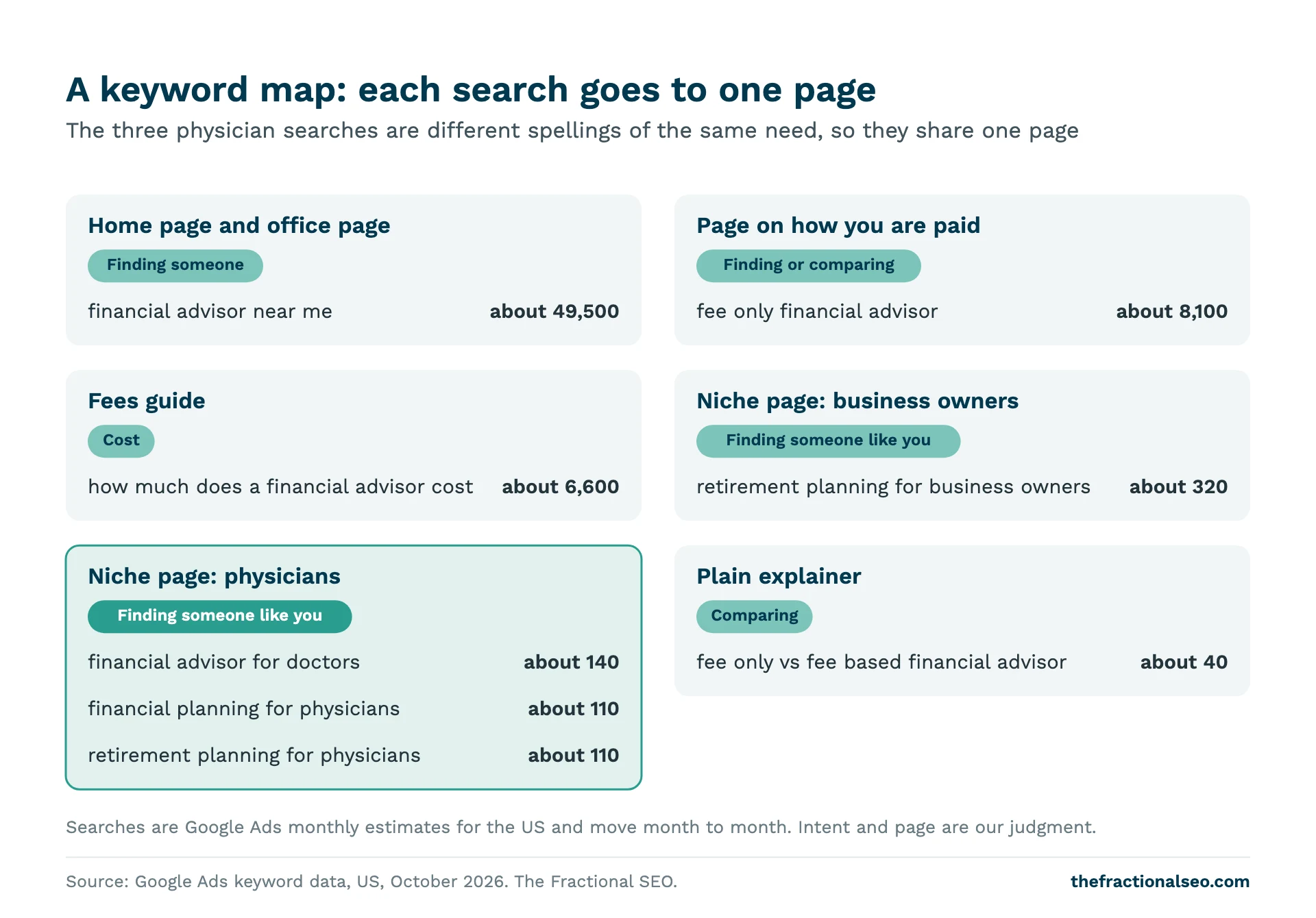
The most useful output of keyword research is a map: each keyword assigned to one page. Two of your pages competing for the same search weaken each other, and one page can answer several spelling variants of the same question.
Here is an example built from real data. The volumes are Google Ads estimates for the US (October 2026). The intent and page columns are our judgment.
| Keyword | Monthly US searches | Estimated cost per click | Intent | Page |
|---|---|---|---|---|
| financial advisor near me | about 49,500 | about $25 | Finding someone | Home page and office page |
| fee only financial advisor | about 8,100 | about $29 | Finding / comparing | A page on how you are paid |
| how much does a financial advisor cost | about 6,600 | about $7 | Cost | A fees guide |
| retirement planning for business owners | about 320 | about $29 | Finding someone like you | Niche page: business owners |
| financial advisor for doctors | about 140 | about $26 | Finding someone like you | Niche page: physicians |
| financial planning for physicians | about 110 | about $12 | Finding someone like you | Same physicians page |
| retirement planning for physicians | about 110 | about $9 | Finding someone like you | Same physicians page |
| fee only vs fee based financial advisor | about 40 | about $8 | Comparing | A plain explainer |
Three things to notice.
- The three physician searches are one page. Combined they are small, about 360 a month, but every one of those searchers is a doctor looking for exactly what a niche advisor offers.
- The biggest number is the least winnable. “Financial advisor near me” is the kind of search where map results, review directories and other firms’ office pages fill the page. Your office page and profile are how you compete there.
- The cheapest search is not the least valuable. Someone asking what an advisor costs is early in their research, and a clear, honest answer is a way to meet them.
Step 6: Check what you are allowed to say
Some searches invite pages that make claims the SEC Marketing Rule restricts. The rule, 17 CFR 275.206(4)-1, prohibits advertisements that contain material misstatements, make claims you cannot substantiate on the SEC’s request, or describe benefits without fair treatment of risks. Broker-dealer representatives work under FINRA Rule 2210, which has its own standards for retail communications.
In practice, check each keyword against these questions:
- Does the natural page for this search require a superlative, such as “best financial advisor in Austin”? You can target the place and service without making the claim: “financial advisor in Austin”.
- Does it imply a result, such as “how to retire early” or “tax-free retirement income”? You can write about the subject, but state the conditions and risks, and avoid promising an outcome.
- Does it call for client stories, reviews or performance figures? Those have their own conditions. Ask your compliance officer before the page is written.
Whether a given page is acceptable is a decision for your compliance officer. A keyword list that has already been through this filter saves rewrites later.
Step 7: Add the local layer
Many advisor searches have a place in them: “financial advisor Raleigh”, “retirement planner near me”. If you have an office, those belong on the page for that office. If you do not, there is no point creating a page for a city you do not serve. The local SEO guide covers how to build the office page and the profile.
Step 8: Keep the list, and update it
A keyword map is a working document, kept in a spreadsheet. For each keyword, record:
- the keyword and its variants;
- estimated volume and where you got it;
- intent;
- the page assigned to it;
- the page status: planned, drafted, in compliance review, published;
- its current position and impressions from Search Console, once it has any.
Review it every quarter. Search Console shows searches where your pages already appear but do not rank well, which is a good source of improvements to existing pages. Add new questions from client meetings as they come up.
How AI answers change the list
People now type full questions into ChatGPT, Perplexity and Google’s AI Overviews. Long, specific questions are easy to collect from client meetings and are the same questions you already put on your list. Write a page that answers one of them directly, name the author, and keep your firm’s details consistent across the web. Nobody can promise placement in an AI answer, but a page that answers a specific question plainly is useful to both kinds of search.
Common mistakes
- Starting with a tool and copying a competitor’s list.
- Chasing the biggest number. High volume often means high competition and weak intent.
- Writing one page for every spelling variant.
- Giving two pages the same target search.
- Targeting a keyword you cannot write about without a claim you cannot support.
- Treating a volume estimate as a forecast of visitors.
- Making the list once and never updating it.
Frequently asked questions
How many keywords should I target?
There is no number. A small firm might start with a dozen pages: a home page, three to five service pages, one or two niche pages, bios, and a few guides. Each page has one main search and a few variants.
Do I need a paid SEO tool?
Not to start. Your own client questions, Search Console, Google’s autocomplete and related searches, and Keyword Planner will get you a working list. A paid tool saves time on volume and competitor checks when the list grows.
Is low volume a problem?
Not by itself. A search made 110 times a month by physicians looking for an advisor who knows their situation can be worth more to a firm that serves physicians than a search made 49,500 times by everyone.
Should I target “best financial advisor” searches?
You can target the place and the service without making the claim. “Best” and similar words need support under the SEC Marketing Rule. Ask your compliance officer how they apply to your pages.
How often should I update the list?
Quarterly, with a look at Search Console each month.
Method and sources
This guide draws on Google’s help pages for Keyword Planner and Search Console, the text of the SEC Marketing Rule, and Google Ads keyword data for the US, October 2026. We checked each figure against its source in October 2026. Intent and page assignments in the example are our judgment. It is general information, not legal or compliance advice.
If you would like senior SEO help that treats compliance as a design constraint, see how fractional SEO works for financial advisors.
More guides
The whole Financial Advisors library- Financial Advisor Marketing Plan: A Compliance-First Guide A nine-step marketing plan for an advisory firm, built around the review process regulators expect, with…
- Local SEO for Financial Advisors: A Practical Guide How an advisory firm appears in local search: eligibility, the Business Profile, consistent details, office pages…
- SEO for Financial Advisors: A Compliance-First Guide How an advisory firm gets found on Google when SEC and FINRA rules limit what its…