
Guide Financial Advisors
SEO for Financial Advisors: A Compliance-First Guide
Most prospects look you up before they call you, even when a client sent them. This guide covers how to make that search work for an advisory firm, within the rules that govern what you can say.
The short version
- Your SEO is a credibility check. Most prospects research an advisor before they call, even when a friend referred them. Your site and your search results are what they find.
- Rules come first. The SEC Marketing Rule (investment advisers) and FINRA Rule 2210 (broker-dealers) shape what you can say about performance, clients, reviews and results. Decide who approves each page before you write it.
- Win specific searches, not broad ones. “Financial advisor” and “retirement planning” belong to Fidelity, Schwab and NerdWallet. Niche, service and location pages are where an independent firm can rank.
- Build in this order: fix the site, publish service and niche pages, set up your local listings, then publish educational content. Measure consultation requests, not traffic.
- Give it time. Technical fixes can show within weeks. Service and niche pages typically take three to six months to rank.
What SEO does for an advisory firm
SEO is the work of making your firm easy to find and easy to trust when someone searches Google for what you do. For an advisor, those searches look like “retirement planning for physicians”, “fee-only financial planner in Charlotte”, or “how much does a financial advisor cost”.
Almost nobody hires an advisor straight from a search result. Financial advice is a high-trust, long-cycle decision, so search plays a different role: it is where prospects check you out. A neighbor recommends you, a colleague mentions your name, a podcast guest sends them your way, and then the prospect opens Google.
There is survey evidence for this. In a 2025 Wealthtender survey of 500 US adults aged 35 to 64 with household incomes of $100,000 or more who planned to hire an advisor within five years, 96% said they would still research an advisor who came highly recommended. Two caveats: respondents were reporting what they planned to do, not what they did, and Wealthtender sells advisor reviews and profiles, so treat the exact figure as indicative. Prospects look before they call.
That changes what good SEO looks like. The goal is not a long list of ranking keywords. The goal is that when a referred prospect searches your name, your firm, or the problem they have, they find a site that answers their question, shows who you are, and makes the next step obvious.
The rules that shape advisor SEO
One note first: we are SEOs, not lawyers. This section describes what the rule text says so you know where to ask your compliance team. It is not legal advice, and your chief compliance officer decides how it applies to your firm.
Which rule applies depends on how you are registered.
- Registered investment advisers (RIAs) are covered by the SEC Marketing Rule, 17 CFR 275.206(4)-1.
- Broker-dealers and their registered representatives are covered by FINRA Rule 2210, which governs member communications with the public.
- Dually registered advisors can have both in play. Ask which rule applies to each page.
What the SEC Marketing Rule means for your pages
The rule applies to “advertisements”, and a website, a blog post or a service page can be one. Its general prohibitions are the ones that matter most for SEO copy. An advertisement may not:
- contain a material misstatement or omit a material fact that makes it misleading;
- make a material claim you cannot substantiate if the SEC asks;
- imply something misleading about your firm;
- describe benefits without fair and balanced treatment of the risks;
- present performance in a way that is not fair and balanced, including through cherry-picked time periods.
For SEO, that rules out the usual agency copy. “Best financial advisor in Denver”, “we beat the market” and “guaranteed retirement income” are the kinds of statements that need substantiation or should not be written at all. Keep titles, headings and meta descriptions plain: what you do, for whom, and where.
The rule also has conditions for testimonials, endorsements and third-party ratings. Three points that affect your site:
- Compensated testimonials and endorsements are allowed, with conditions. The conditions include clear and prominent disclosure of whether the person is a client and whether they were paid, a written agreement for compensated arrangements, and not paying anyone who is disqualified. Compensation of $1,000 or less in a 12-month period is treated as minimal and is exempt from the written agreement and disqualification conditions, though the disclosures still apply.
- Third-party ratings come with conditions too. You need a reasonable basis to believe the survey behind the rating was not designed to produce a predetermined result, and the rating date, period and provider must be disclosed, along with any compensation you paid for it.
- The rule defines a testimonial as a statement by a current client about their experience with your firm. Whether a particular public review counts, and what happens if you ask for it or repost it, is a question for your compliance officer.
What FINRA Rule 2210 means for broker-dealer reps
Under Rule 2210, retail communications generally need approval by a qualified registered principal before first use, and firms must keep records of them. The rule has its own testimonial requirements. A testimonial about a member’s investment advice, performance or products must prominently disclose that it may not represent other customers’ experience and does not guarantee future performance, and it must say so if more than $100 in value was paid for it. Your firm’s compliance team decides how each web page and blog post is classified.
Reviews: what Google allows, and what to ask your compliance officer
Google’s review policy lets a business ask customers for reviews that reflect a real experience. It does not allow offering payment, discounts or free services for a review, and it does not allow selectively soliciting only positive reviews or discouraging negative ones. Those rules apply however your firm is regulated.
The open question is on the regulatory side: whether a review you asked a client to post on Google is a testimonial under the Marketing Rule, and what you may do with it afterwards. We have not found SEC guidance on that, and compliance vendors give different answers. So do not treat a review drive as routine marketing. Put the question to your compliance officer, get the answer in writing, and then build your review process around it.
A review step for every page
The simplest way to keep SEO and compliance from fighting is to agree the review step before you publish. Write down who approves a new page, a blog post or a change to a title tag, how approved versions are archived, and what the turnaround is.
Who controls your website?
Before any SEO plan, find out whether you can change your own site. RIAs can usually edit their own websites. Broker-dealer representatives often cannot, because the home office runs a locked platform with fixed templates and limited settings. If page titles, URLs, schema or navigation are locked, much of the technical work in this guide is out of your hands.
If that is your situation, ask the home office three questions: whether you can have your own domain, whether you can add pages and blog posts, and what the approval process is for changes. The answers decide how much SEO you can do on the site and how much has to happen off it, through your profiles and directory listings.
Keyword research for advisors
Why broad terms are the wrong target
Terms like “financial advisor”, “financial planner near me” and “retirement planning” are dominated by large brokerages, finance publishers and lead-matching services. A single-office advisory firm has little chance of competing for those, and the people searching them are mostly early in their research.
The gap in demand is large, and so is the gap in who can win it. Google Ads keyword data for the US (October 2026) shows the pattern:
| Search | Monthly US searches | Estimated cost per click | Who ranks |
|---|---|---|---|
| financial advisor near me | about 49,500 | about $25 | Map results, Yelp and other directories, and firms’ own office pages |
| fee only financial advisor | about 8,100 | about $29 | Directories, forums and advisory firms’ own explainer posts |
| retirement planning for physicians | about 110 | about $9 | Niche advisory firms, Reddit and medical publishers |
The first two have the volume and the cost per click advisors notice in their ad accounts. The third is small, but each search comes from someone who fits a specific kind of practice. Monthly figures are Google Ads estimates and swing from month to month, so read them as rough sizes, not forecasts. The “who ranks” column is our reading of the first page of US Google results in October 2026, and you should check your own market in a private browser window.
The searches an independent firm can realistically win are narrower, and they are also closer to a decision.
| Search type | Example | Page that fits |
|---|---|---|
| Service | retirement income planning | A service page |
| Niche | financial planning for physicians | A niche page, written for that client |
| Problem | what to do with a 401(k) after leaving a job | A guide, linked to the matching service page |
| Comparison | fee-only vs commission financial advisor | A plain explainer, with your own model stated clearly |
| Cost | how much does a financial advisor cost | A fees page or guide (see the compliance note below) |
| Local | fee-only financial planner in Raleigh | A location page, or your home page for a single office |
This table classifies searches by type. It does not give volumes. Check the numbers for your market in a keyword tool before you commit to a page. Our keyword research guide for financial advisors walks through how to build the list and map each keyword to one page.
How to build a list
- Start with the questions clients ask in a first meeting. Those are the searches they ran before they called.
- Add your services, your niches and your location.
- Search each one yourself, in a private window, and see who ranks. If every result is a brokerage or a publisher, the term is too broad. If small firms like yours appear, it is within reach.
- Assign each keyword to one page, so two of your pages are not competing for the same search.
Volume data is a guide, not a verdict. A phrase searched 50 times a month can bring more good prospects than one searched 5,000 times, if the 50 are people who need exactly what you offer.
Pages an advisory site needs
- Service pages. One per service: retirement planning, tax planning, investment management, estate coordination. Each explains who it is for, how you work, how you charge and how a first meeting goes.
- Niche pages. If you specialize in physicians, business owners, pre-retirees or a profession, give each its own page. A page written for one kind of client ranks and persuades better than a general page for everyone.
- Advisor bio pages. Name, credentials, background, regulatory registration and how to verify it. Prospects check, so make checking easy.
- About and process pages. How you are paid, how you act as a fiduciary if you do, and what clients can expect.
- A contact or consultation page with one clear next step and no pressure language.
- Required disclosures in the footer or on a dedicated page, as your compliance team directs.
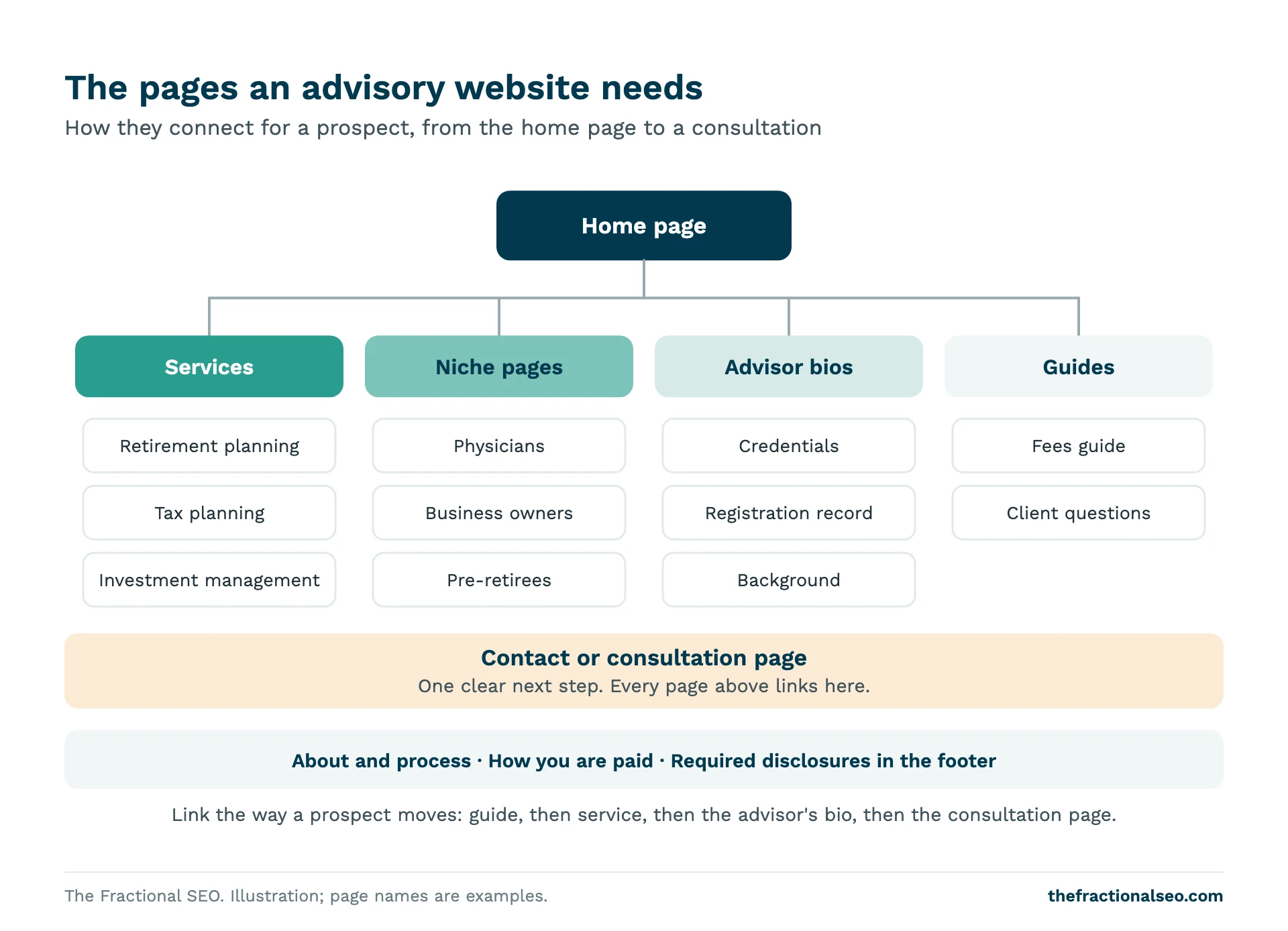
Link these pages to each other in the way a prospect would move: from a guide to the service it relates to, from a service to the bio of the advisor who runs it, from the bio to the consultation page. Internal links are how Google works out which pages matter and how a visitor finds the next step.
On-page basics
- Title tags. Say what the page is and where. Google does not set a length limit on titles; it shortens them to fit the screen, so lead with the words that matter. About 60 characters is a common rule of thumb, not a Google rule.
- Headings. One H1 per page, then H2s for the main sections, written the way a prospect would phrase the question.
- URLs. Short and readable:
/retirement-planning-for-physicians/, not/services?id=47. - Images. Real photos of your team and office beat stock. Describe each image in the alt text.
- Speed and mobile. Test with Lighthouse or PageSpeed Insights. Google retired its standalone Mobile-Friendly Test in December 2023.
- Calls to action. One per page, written as an invitation to talk, not a promise of results.
Content that earns trust
Advisor content works when it answers the question a prospect actually has and shows how you think. Good topics come from real conversations: how Social Security timing works, what to do with company stock, how to plan for a business sale, what happens to an IRA at death. Write them in plain language, name the trade-offs, and say who the advice does not suit.
Three rules keep content safe and useful:
- Educate, do not recommend. General guidance on a topic reads differently from a recommendation for a person. Include a short disclosure that the content is general information and not personalized advice, if your compliance team agrees.
- Label illustrations. Hypothetical client stories and examples are fine for teaching, but state that they are illustrations, not real clients or results.
- Date and review everything. Tax rules and limits change. Show the date and send updated pages back through compliance review.
A steady schedule you can keep beats a burst of posts you cannot. One reviewed article a month is a sound pace for most firms. For how this fits into your wider marketing, see our financial advisor marketing plan guide.
Local SEO for advisors
Most advisors serve a region, so a Google Business Profile, consistent firm details across the web and a location page can matter. Keep your firm’s name, address and phone number identical everywhere they appear, choose accurate categories, and publish a page for each office. Our local SEO guide for financial advisors covers the setup, including how reviews fit with compliance.
Authority and verification
Google looks for signs that a site is a real, trustworthy business, and prospects look for the same. For an advisor, the strongest signals are the ones that can be checked:
- Regulatory records. Prospects can look up broker-dealer reps on FINRA BrokerCheck and advisers on the SEC’s Investment Adviser Public Disclosure site. Link to your records from your bio pages, and keep them accurate.
- Credential listings. If you hold a designation such as CFP® or belong to a body such as NAPFA or FPA, make sure your profile on their site is current and links to your own site.
- Local and professional mentions. Chambers of commerce, local business associations, speaking engagements and interviews all produce links from real organizations.
- Things to avoid. Bought links and link networks. They can get a site penalized, and they are the opposite of the trust you are trying to show.
Search is changing: AI answers
People now ask ChatGPT, Perplexity and Google’s AI Overviews questions they used to type into a search box, and those tools sometimes name firms. Nobody can promise placement in an AI answer. The practical steps are the same ones that help in regular search:
- Make your site clear about who you are, what you do, who you serve and where. Put it in plain words on the page.
- Keep your firm details the same on your site, your Google Business Profile, your directory listings and your regulatory records.
- Publish pages that answer specific questions directly, with your own expertise and a named author.
- Check how you appear. Ask the major assistants the questions a prospect would ask and note what they say about your firm. Correct anything wrong at its source.
Measuring what matters
Rankings and traffic are not the goal. The goal is consultation requests from people who found you through search. Set up three things:
- A tracked conversion for your consultation form, phone calls and booked meetings, in Google Analytics.
- Google Search Console, to see which searches show your site and which pages earn clicks.
- A simple log that records, for each new inquiry, how they first found you. Ask them on the first call.
Be careful what the forms and analytics collect. Do not pass names, account details or financial information into analytics tools, and keep your privacy policy accurate about the tracking you use.
Review the numbers monthly and look for trends over quarters. Expect technical fixes to show within weeks and service and niche pages to take three to six months to rank. If you want to understand what a realistic timeline and payback looks like, we cover it in Is SEO worth it?.
Where to start: the first 30 days
- Week 1. Find out whether you control your site, and agree the page review process with compliance.
- Week 2. Run a basic audit: speed, mobile, broken pages, missing titles. Use our SEO audit checklist for financial advisors.
- Week 3. Write your keyword list and pick the first three pages: usually your main service, your best niche and your bio.
- Week 4. Set up Search Console, conversion tracking and your Google Business Profile. Send the first page for review.
Frequently asked questions
How long does SEO take for a financial advisor?
Technical fixes can show within weeks. New service and niche pages typically take three to six months to rank, and competitive terms take longer. Nobody can promise a date, and anyone who guarantees a ranking is not being straight with you. See our note on SEO guarantees.
Is SEO or paid advertising better for an advisory firm?
They do different jobs. Paid search can produce inquiries within days, and clicks stop when the budget does. Google Ads keyword data (October 2026) estimates about $25 a click for “financial advisor near me” and about $29 for “fee only financial advisor”. SEO takes longer to build and keeps working once pages rank. Many firms use paid search while their pages mature. Ask your compliance team how your ads and landing pages are reviewed.
Can I ask clients for Google reviews?
Google allows you to ask for genuine reviews without incentives. Whether your regulator treats a review you requested as a testimonial is a question for your compliance officer, and we recommend getting the answer in writing before you start. See the rules section above.
Do I need a blog?
Not first. Service pages, niche pages and a bio page do more for a new site than a blog does. A blog helps when you have specific, useful things to say and a compliance process that can keep up.
What should I measure?
Consultation requests that came from organic search. Traffic and rankings tell you whether the work is moving; inquiries tell you whether it is working.
Method and sources
This guide draws on the text of the SEC Marketing Rule and FINRA Rule 2210, Google’s published policies, a 2025 Wealthtender survey, and Google Ads keyword data for the US, October 2026. We checked every figure against its source page in October 2026. It is general information, not legal or compliance advice.
If you would like senior SEO help that treats compliance as a design constraint, see how fractional SEO works for financial advisors.
More guides
The whole Financial Advisors library- Keyword Research for Financial Advisors: How to Choose the Right Keywords How an advisory firm chooses keywords: start from client questions, sort by intent, add data and…
- Financial Advisor Marketing Plan: A Compliance-First Guide A nine-step marketing plan for an advisory firm, built around the review process regulators expect, with…
- Local SEO for Financial Advisors: A Practical Guide How an advisory firm appears in local search: eligibility, the Business Profile, consistent details, office pages…