
Guide HVAC
How to Build Backlinks for an HVAC Business
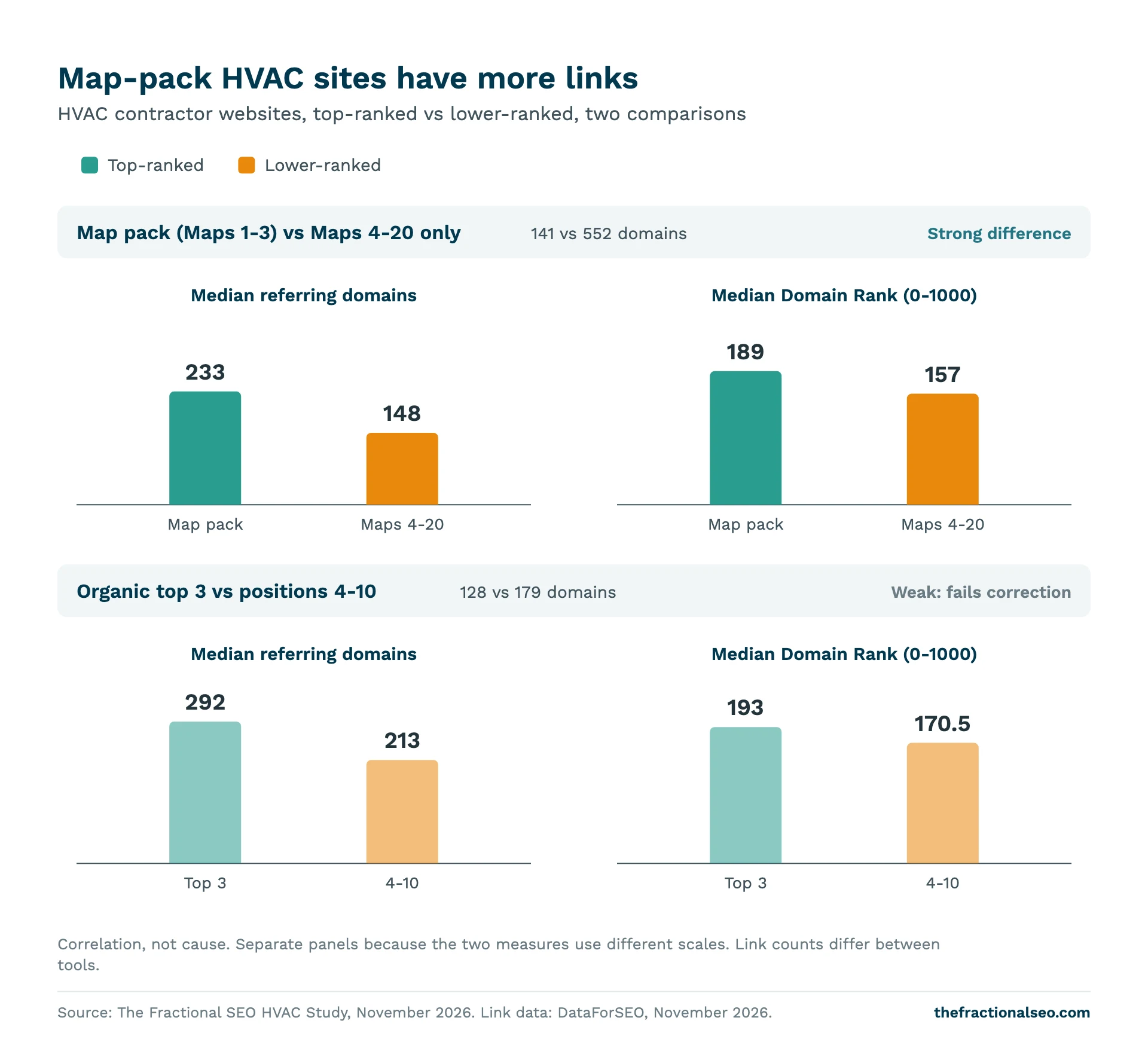
HVAC companies in the Google map pack tend to have more websites linking to them. In our study, map-pack HVAC businesses' websites had a median of 233 referring domains, against 148 for businesses only at Maps positions 4-20. We analyzed 100 local searches across 25 US metros and four HVAC search types, 853 HVAC contractor websites (768 crawled) and 797 Google Business Profiles, November 2026.
That’s a correlation, not a recipe. But it gives you a realistic benchmark, and it points to the kind of links worth working for. This guide covers what backlinks are, what HVAC link profiles actually look like, five link sources that fit an HVAC business, and what Google says not to do.
The short answer
- Most HVAC sites already have a lot of referring domains. The median HVAC contractor website has 175 referring domains.
- Map-pack companies have more. A median of 233 against 148 for companies only at Maps positions 4-20.
- Work for local, trade-relevant links: your manufacturer’s dealer page, associations, suppliers, local news.
- Never buy links for ranking. Google’s spam policies name it directly. For the wider picture, see local SEO for HVAC companies.
What backlinks are, and why they matter for an HVAC business
A backlink is a link from another website to yours. A referring domain is a website that links to you at least once. A dozen links from one supplier’s site still count as one referring domain, which is why this guide counts referring domains.
Links matter for an HVAC company in two ways. Google reads them as a sign a business is known: its local ranking help page says prominence is “based on info like how many websites link to your business and how many reviews you have” (Google Business Profile Help). So links can matter for the map pack as well as the organic results. And the right link sends people. If your manufacturer’s dealer page links to your site, a homeowner can click straight through to you.
What map-pack HVAC companies’ link profiles look like
We pulled link data from DataForSEO for the HVAC websites in our searches and compared groups.
Map pack vs lower in Maps. Map-pack HVAC businesses’ websites have more links: a median of 233 referring domains vs 148 for businesses only at Maps positions 4-20, and a higher DataForSEO Domain Rank (189 vs 157 on a 0-1000 scale). Both differences were statistically strong. That’s a correlation, not proof that links put anyone in the map pack. Established companies tend to have more reviews and other advantages too, such as age, budget and links.
| Comparison | Median referring domains | Median Domain Rank | Result |
|---|---|---|---|
| Map pack (Maps 1-3) vs Maps 4-20 only | 233 vs 148 | 189 vs 157 | Strong |
| Organic top 3 vs positions 4-10 | 292 vs 213 | 193 vs 170.5 | Weak after correction |
Organic top 3 vs positions 4-10. This is a different comparison. In organic results the link gap is smaller: sites in the organic top 3 have a median of 292 referring domains vs 213 at positions 4-10 (Domain Rank 193 vs 170.5), a weak result after correcting for the number of tests. Treat it as a hint, not a finding to plan around.
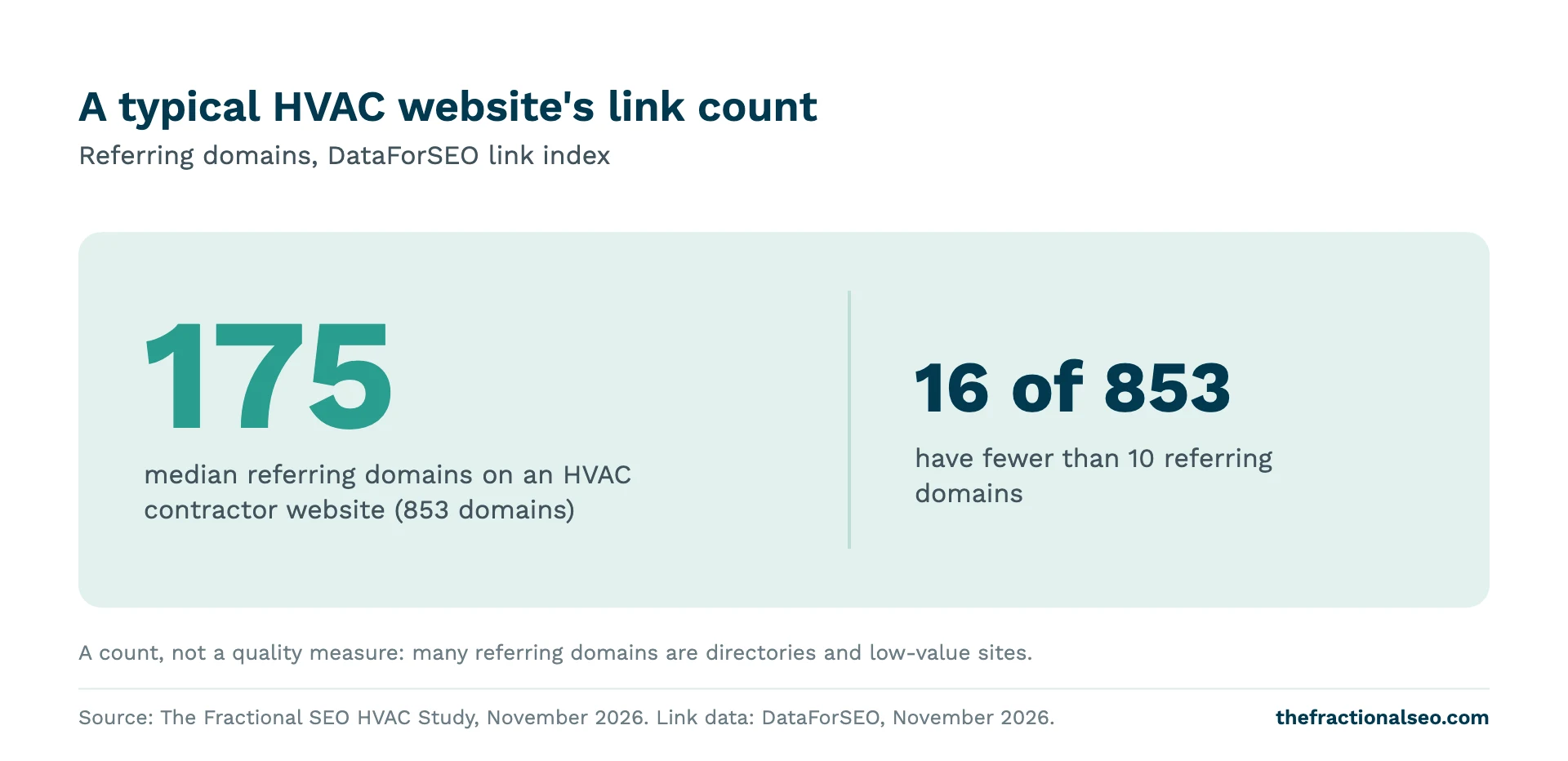
The typical HVAC site. The median HVAC contractor website has 175 referring domains; only 16 of 853 have fewer than 10. Many of those referring domains are directories and low-value sites, so this is a count, not a measure of quality.
The takeaway: a realistic benchmark, not a target to buy your way to. Raw count is common. In our view, relevant, local, earned links are what set a site apart. DataForSEO is a third-party index, so check competitors in the same tool you use for your own site. Our research on Google reviews and HVAC rankings covers the review side, and our flagship study shows what top-ranked HVAC companies do differently.
Link source 1: Manufacturer dealer locators
This is the most HVAC-specific link source we know of, and the guides that rank for this topic mostly skip it. What follows is best practice, not study data.
Dealer-locator pages rank on their own. Manufacturer or dealer-locator pages appeared 25 times in 22 of 100 searches in our study of who wins local HVAC searches (carrier.com 9, trane.com 6, lennox.com 5, bryant.com 5). People look for them too: “carrier dealer locator” gets about 880 searches a month and “trane dealer locator” about 480 (DataForSEO Google Ads, November 2026).
We checked one Carrier dealer detail page in November 2026. It links to the dealer’s own website with a plain link, with no nofollow in the page source. Carrier’s dealer locator shows listings with a website link and badges such as “Factory Authorized”. We couldn’t confirm the same for Trane, Lennox or Bryant, whose locators load dealer details by script. Trane’s Dealer Directory lets homeowners search by dealer name, state, city and ZIP.
If you’re a dealer for a brand, look up your own listing. Check that it shows the right website address, phone number and service area. If anything is wrong, ask your distributor or territory manager how to update it.
Link source 2: Directories and citations
The directories that already rank are worth a profile because they’re visibility in their own right. The directories HVAC contractors compete with most on page one: yelp.com (116), angi.com (38), thumbtack.com (26), local.yahoo.com (12), homeyou.com (5), hvacinformed.com (5) and bbb.org (4).
Keep your name, address and phone the same on every profile, and link each one to the right page on your site. Treat these as citations and referral paths. We didn’t check whether each platform’s links are followed, so don’t count on them as backlinks. Our guide covers how HVAC companies should use Yelp, Angi and Thumbtack in detail.
Link source 3: Trade associations, suppliers and local partners
This is local link building at its simplest: links that make sense for an HVAC business because the relationship already exists. Best practice, not study data.
- Your state or local HVAC contractors’ association. Check whether yours keeps a member directory that links to members’ websites, and if it does, make sure your listing is complete.
- Distributors and suppliers. Ask the reps you already buy from whether they list installers or preferred contractors.
- Builders, realtors and property managers. If you do their new installs or service their buildings, ask whether they list trade partners on their sites.
None of this needs a pitch. It’s asking people you already do business with to show it.
Link source 4: Local news, sponsorships and community
Local links tie your website to the area you serve. Best practice:
- Sponsor something real, such as a youth team or a community event, that lists sponsors on its website.
- Be the local expert in a heat wave or cold snap. Reporters covering extreme weather may want safety tips. Offer short, useful advice on staying cool or keeping pipes and furnaces safe.
Keep a short list of local reporters and community sites, and send them something useful before the season turns, not in the middle of it. When a story or event page mentions your company without a link, a polite note asking them to add your website is reasonable.
Google treats a link you paid for as fine only when it carries rel=”sponsored” or rel=”nofollow”. A sponsorship link is still worth having for the visibility and the referrals.
Link source 5: Content worth linking to
Some pages earn links because they’re useful to others in your area. Best practice ideas:
- A page on utility rebates available in your area, kept up to date.
- A guide to HVAC permits in your county.
- A seasonal maintenance checklist homeowners can print.
Use real local facts with sources, and keep them current. Never make up statistics to get attention.
A useful page still needs people to find it. Send it to the neighborhood associations, realtors and property managers in your area, and mention it when a reporter calls. A rebate page that a realtor shares with every buyer is the kind of link that brings both visits and trust.
Link sources at a glance
Here’s how the five sources compare. The ratings are our judgment, not study data.
| Source | Effort | What you get | Notes |
|---|---|---|---|
| Manufacturer dealer locator | Low | Link confirmed for Carrier; others unconfirmed | Only if you’re a dealer; check your listing |
| Directories | Low | Citation and referral; link value unconfirmed | Start with those in your own searches |
| Associations and suppliers | Low to medium | Link value unconfirmed; usually relevant | Ask people you already work with |
| Local news and sponsorships | Medium | Referral; sponsored links marked as such | Best in heat waves and cold snaps |
| Linkable content | Medium to high | Link value depends on who links | Keep it local and current |
What to avoid
Google’s spam policies define link spam as links made “primarily for the purpose of manipulating search rankings”. The examples include:
- Buying or selling links for ranking purposes.
- Excessive link exchanges (“link to me and I’ll link to you”).
- Using automated programs or services to create links.
- Low-quality directory or bookmark site links.
- Widely distributed links in the footers or templates of other sites.
- Forum comments with optimized links in the post or signature.
Paid links are fine “as long as they are qualified with a rel=”nofollow” or rel=”sponsored” attribute value”. So if a link-selling email offers links to help you rank, it’s offering something Google’s policy calls link spam.
Be just as wary of a marketing package that promises a set number of new links each month for a fee. If you can’t see where the links come from and why those sites would link to an HVAC company, assume they fall into one of the categories above.
Track your links
Use the Links report in Google Search Console to see who links to you. Once a quarter, check your referring domains in one third-party tool and compare with the competitors who outrank you. Use the 175 median as a count, not a quality score. Keep a simple sheet of the links you earn from the sources above, so you know which efforts paid off and which to drop.
FAQs
How many backlinks does an HVAC website need?
There’s no magic number. The median HVAC site has 175 referring domains; map-pack sites a median of 233 vs 148 for sites only at Maps positions 4-20. That’s correlation, not a target.
Are Yelp and Angi listings backlinks?
Treat them as citations and referral paths. They appear on page one, but we didn’t check whether their links are followed.
Should HVAC companies pay for backlinks?
No. Google’s spam policies name buying links for ranking as link spam.
How do I get backlinks for a local HVAC business?
Start with relationships you already have: your manufacturer’s dealer page, your association, your suppliers and local partners. Then add local news, sponsorships and one or two genuinely useful local pages.
Does a manufacturer dealer listing count as a backlink?
Carrier’s dealer pages linked to the dealer’s site when we checked. Other brands are unconfirmed, so check your own listing.
How do your links compare?
Want to see how your link profile compares with the HVAC companies in your city’s map pack? Start with how we approach HVAC SEO.
More guides
The whole HVAC library- Technical SEO for HVAC Websites Speed, page weight, schema and on-page benchmarks from 768 HVAC websites, what to fix first, and…
- SEO for HVAC Companies: A Beginner’s Guide What HVAC customers search for, which pages to build first and what 768 HVAC websites show,…
- Seasonal SEO for Heating and Cooling Companies When HVAC searches rise and fall through the year, and what to build, update and promote…