
Research & Benchmark Financial Advisors
Who Wins Local Financial Advisor Searches: A Benchmark of 36 Searches
Someone types "financial advisor" and the name of their city into Google. Who do they see? On page one, mostly not an advisory firm. In the map pack, mostly independent firms, and almost never the national names they know. We analyzed 36 local searches across 12 US metros and three financial advisor search types, 379 advisory firm websites (265 crawled) and 382 Google Business Profiles, November 2026. This page is about search: who holds page one and the map pack, and how the three wordings and metro sizes differ. If you came for advisor headcount, pay or assets under management, this isn't that report.
The financial advisor statistics pages that rank today cover the profession: how many advisors there are, what they earn, how many clients they serve. None we could read looked at what a prospective client sees when they search for an advisor near them. This page does.
Advisor searches barely move through the year: in Google Trends’ monthly profile (2022-2025), interest in “financial advisor” peaks in July at 1.32x its low. No season shapes the work, so this page carries no off-season caveat.
Key findings
- Most of page one isn’t advisory firms. Only 31% of page-one organic results for local financial advisor searches go to advisory firms’ own websites.
- The top spot usually goes to someone else. A site that is not an advisory firm holds the #1 organic spot in 25 of 36 searches (69%) and 72 of 108 top-3 organic spots (67%).
- Matching services sit on page one. Advisor-matching services take 36 page-one results. SmartAsset appears on 10 of 36 searches.
- The wording changes the field. Firms get almost half of page one on “wealth management firm” searches and about a quarter on the other two.
- National firms rank organically, not in Maps. Their 11 domains hold 1 of 108 map-pack spots and 18 of 100 advisory-firm organic results. Independent firms hold 85 of 108 pack spots (79%).
- Two different races. 11 of 108 map-pack listings (10%) also rank on page one organically for the same search.
The website side of the same study is in what 265 advisory firm websites do and don’t do.
Who holds page one
Across the 36 searches we recorded 319 organic results on page one. Only 31% of page-one organic results for local financial advisor searches go to advisory firms’ own websites: 100 of 319. Most of the rest went to directories (154), advisor-matching services (36), social sites (12) and media or regulators (11).
Six more results were first classed as advisor matching and turned out, on a closer look, to be an advisory firm’s own site. Counted as a firm, firms would hold 33% of page one. Either way, about two results in three are not a firm.
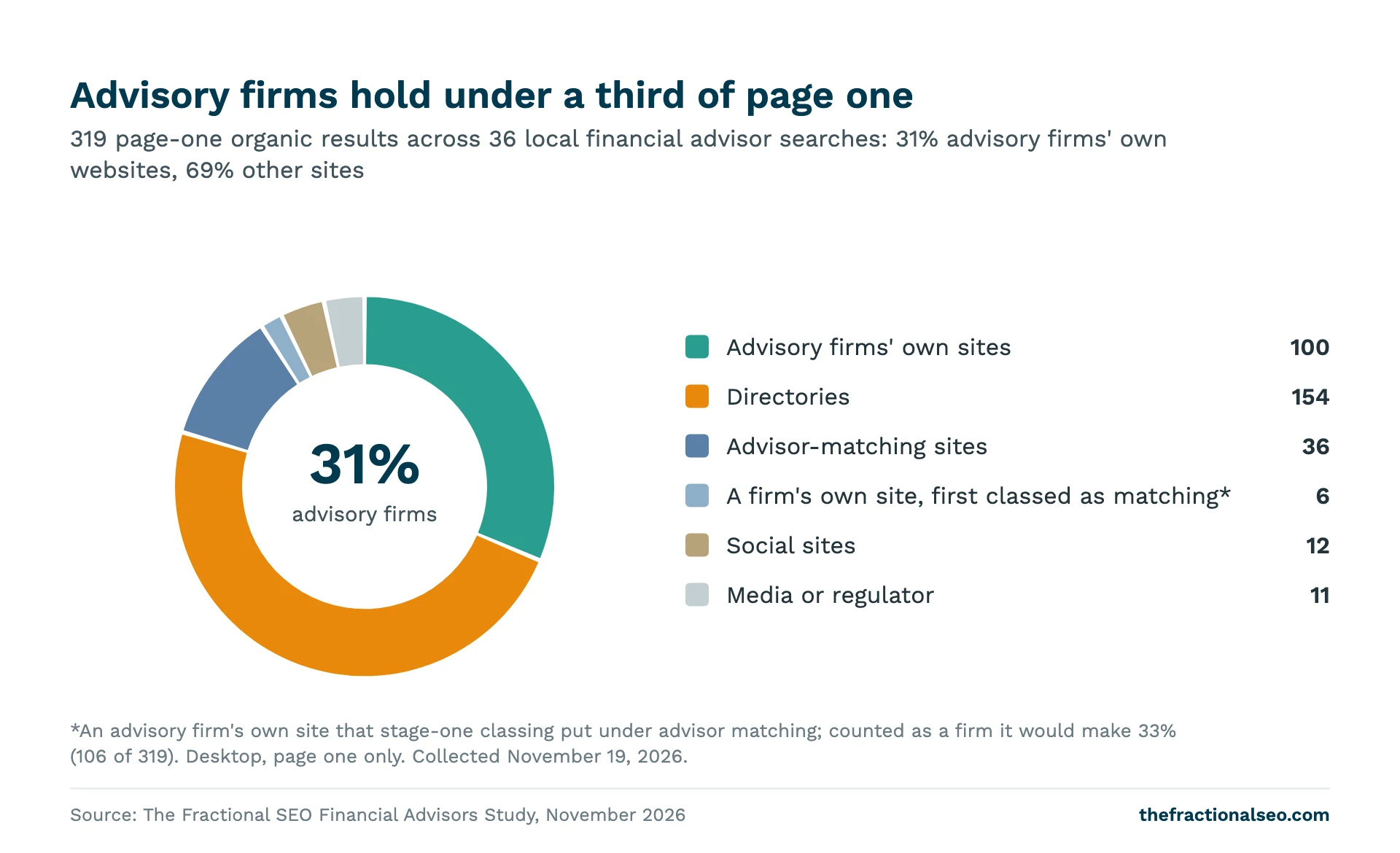
The very top is harder still. A site that is not an advisory firm holds the #1 organic spot in 25 of 36 searches (69%) and 72 of 108 top-3 organic spots (67%). In our Landscaping study, non-companies held 53% of #1 spots; in HVAC, 35%. In these samples, advisors face more third-party competition at the top than either trade.
The study shows who appears, not why. Our reading: people choosing an advisor want to compare several before they call anyone, and a list does that in one click. Some page-one spots aren’t realistically a firm’s to take.
The directories advisory firms compete with
The directories advisory firms compete with most on page one: Yelp (40 results, on 28 of 36 searches), Yahoo Local (9), the Garrett Planning Network’s advisor directory (9, on 5 searches), BBB (8) and a long tail of advisor and general directories. Facebook appears 9 times. The counts are appearances across the 36 searches.
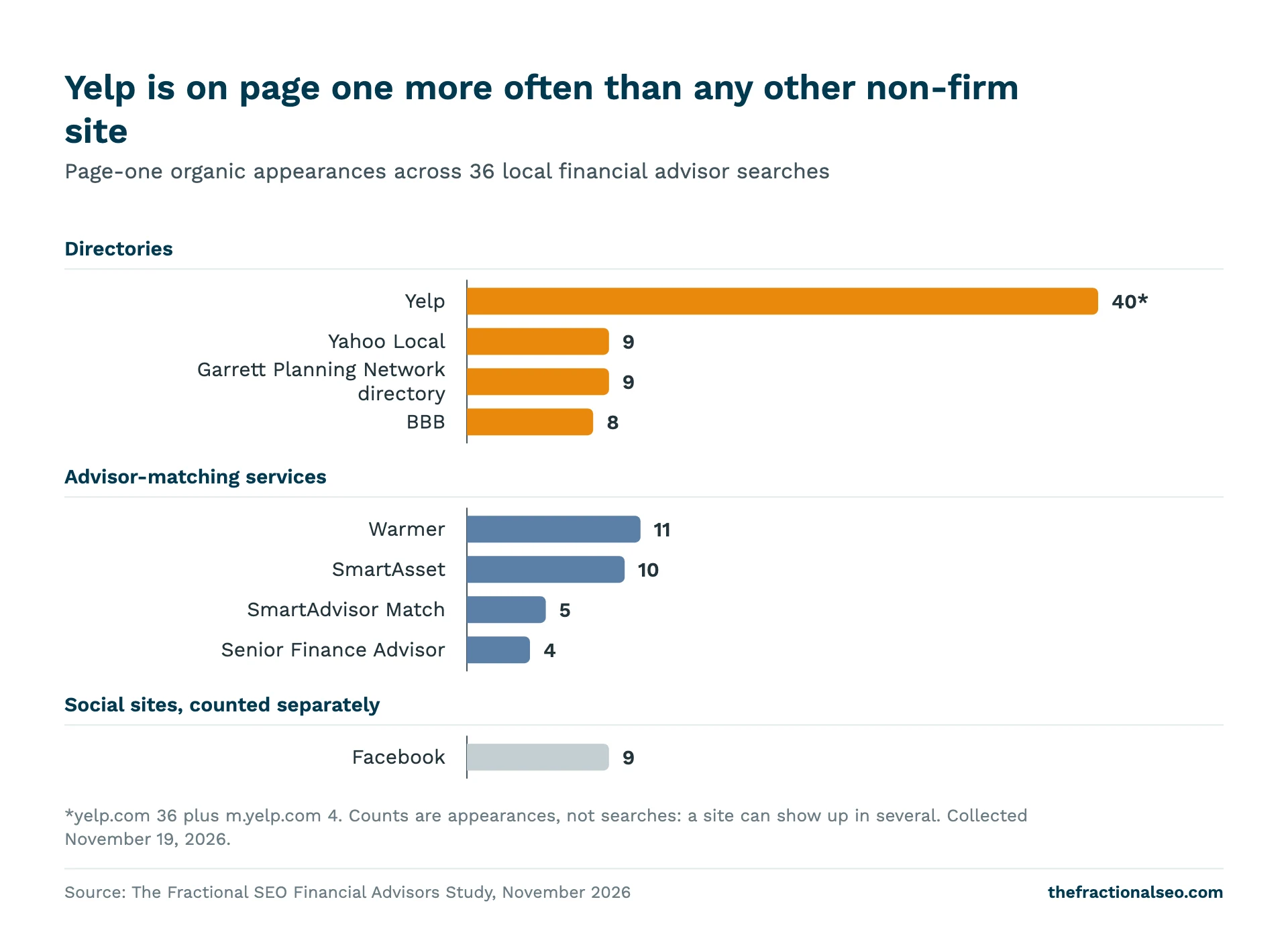
The long tail is wide and thin. Most of its sites have between 2 and 6 results each. Yelp is the only directory that shows up on most searches; BBB was on 7 and Yahoo Local on 8.
Being listed is not the same as ranking, and reviews on a directory raise the same rule questions as Google reviews. For who can list where, and what each charges, see Yelp, SmartAsset and the other advisor directories.
Advisor-matching services
Advisor-matching services take 36 page-one results: getwarmer.com (11), smartasset.com (10), smartadvisormatch.com (5), seniorfinanceadvisor.com (4), soradin.com (3). SmartAsset appears on 10 of 36 searches. These sites collect a searcher’s details and pass them to advisers. SmartAdvisor Match says on its own pages that the tool is brought to you by SmartAsset, so the two counts belong to one matching program.
These sites answer the comparison search well. Consumer searches like “best financial advisors near me” and “fiduciary financial advisor near me” (3,600 a month each, US, Google Ads data via DataForSEO, November 2026) are exactly what a matching questionnaire is built for. For a firm, the choice is to compete with those pages or to pay one of them for introductions.
If you pay for introductions, read the SEC Marketing Rule first. It says an adviser “may not provide compensation, directly or indirectly, for a testimonial or endorsement, unless the investment adviser complies with the conditions” the rule sets out. Whether a given matching arrangement falls under that is a question for your compliance officer, not for this page. Ask before you sign, and keep the answer with your records.
Three wordings, three markets
The three searches look alike but return different pages. Firms get almost half of page one on “wealth management firm” searches and about a quarter on the other two, where directories and advisor-matching sites dominate.
| Search | Advisory-firm share of page one | Firm results / all results | Directory results |
|---|---|---|---|
| financial advisor | 25% | 26 / 105 | 53 |
| financial planner | 24% | 26 / 107 | 57 |
| wealth management firm | 45% | 48 / 107 | 44 |
“Wealth management firm” is the only wording where firms outnumber directories. It is also the smallest search. Per metro, the median is 535 searches a month for “financial advisor <city>”, 170 for “financial planner <city>” and 45 for “wealth management firm <city>” (over the six with a volume), and Google returned no volume at all for 6 of the 12 wealth management wordings.
So the trade-off is plain. The big search is crowded with lists. The small one leaves more room for firms: a bigger share of page one, on far fewer searches.
Big, mid-size and small metros
By metro size, advisory firms hold 34% of page one in the large metros (46 of 134 results), 21% in the mid-size metros (22 of 106) and 41% in the small metros (32 of 79). Large = New York, Los Angeles, Chicago, Dallas and Houston; mid = Charlotte, Nashville, Austin and Columbus; small = Boise, Knoxville and Des Moines.
With 12 searches per wording and three small metros, these splits describe the sample. We did not test them, and the mid-size dip may not hold in other cities.
The map pack and page one are two different races
The map pack and the organic results are mostly different firms: 11 of 108 map-pack listings (10%) also rank on page one organically for the same search. In HVAC the overlap was 16%. Every map-pack listing showed a website (8 of 720 across Maps positions 1-20 did not).
Google says local results are mainly based on relevance, distance, and popularity. The study can’t say why the two lists differ, but a firm can win one and be absent from the other.
Reviews are the clearest marker in the pack. Advisory firms in the map pack have a median of 31.5 Google reviews at positions 1-3 vs 12 at positions 4-7, a gap that survives the correction for the number of tests. Across profiles, firms that reached a map pack in any study search have a median of 26 reviews vs 6 for those only seen at positions 4-20. That is correlation, not cause, and the numbers are small. The full picture, and what the rules say about asking for reviews, is in what 382 Business Profiles show about reviews.
A few pack listings carry only a city plus “financial advisors” or “wealth management” as a name and have few reviews: 12 of 108 map-pack spots. Many genuine firms carry a city name, so that flag is weak evidence of anything. For the profile itself, use the Google Business Profile checklist for financial advisors and our guide to local SEO for financial advisors.
National firms, chains and independents
National firms barely reach the map pack but do rank organically. Their 11 domains, advisor pages on Edward Jones, Northwestern Mutual, Thrivent, Wells Fargo Advisors and others, hold 1 of 108 map-pack spots and 18 of 100 advisory-firm organic results (18%). The one pack spot was Northwestern Mutual’s. In organic results Thrivent had 5, Edward Jones 3, Northwestern Mutual 3 and Wells Fargo Advisors 2, with one each for Stifel, BNY, J.P. Morgan, Merrill and RBC Wealth Management.
The 17 company chains (RIAs operating in more than one metro under one brand) hold 7 pack spots and 16 organic results. In the pack: Modern Wealth Management 4, EP Wealth Advisors 2 and Mariner 1. In organic results Mariner led with 4, then Bernstein and Bessemer Trust with 2 each.
Independent firms hold 85 of 108 pack spots (79%) but only 55 of 100 firm organic results. Among the 11 searches where a firm held the #1 organic spot, independents had 7, company chains 3, an unverified chain 1 and national firms none.
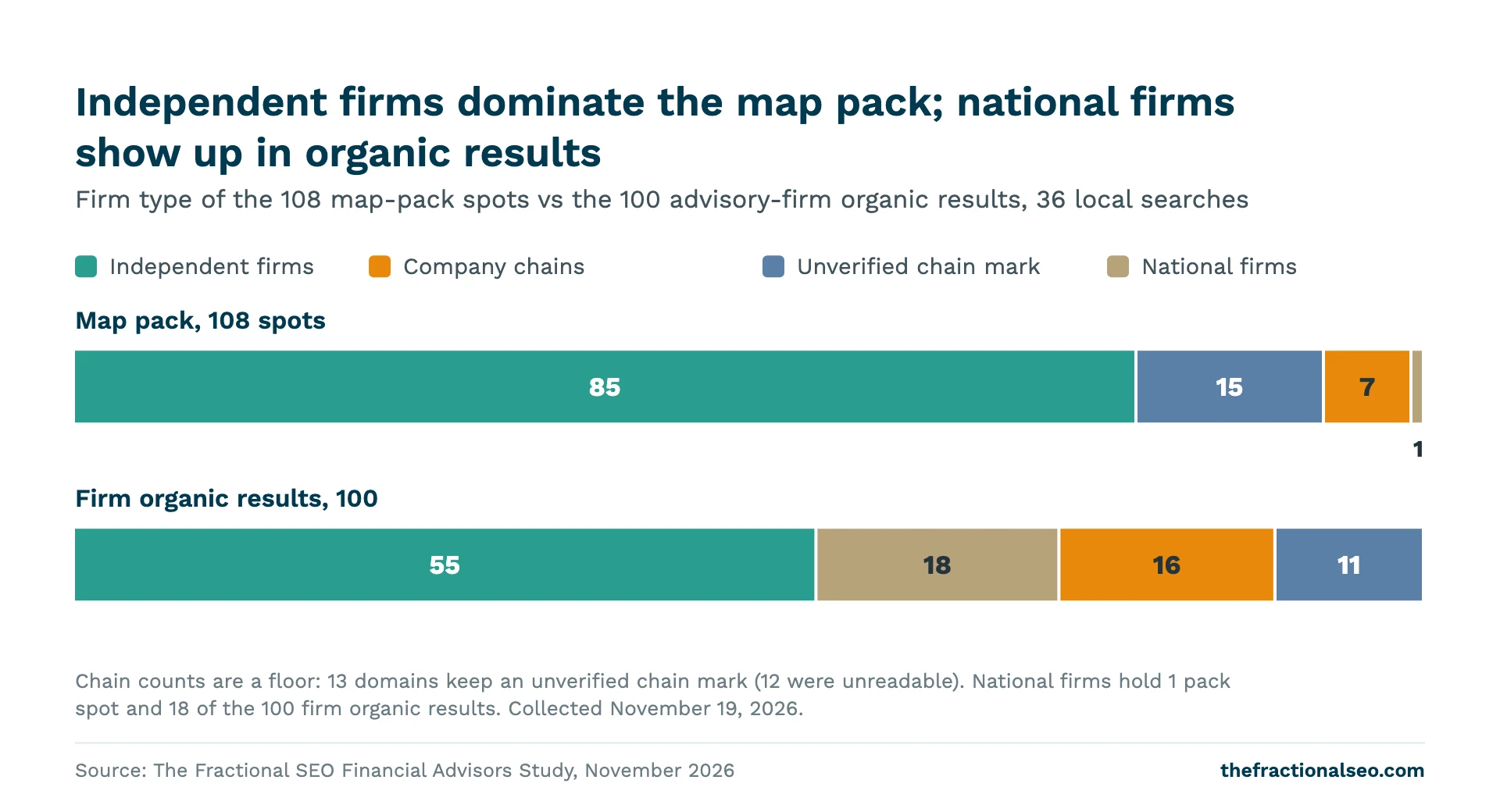
These counts are a floor. Another 13 domains with an unverified chain mark hold 15 pack spots and 11 organic results. Counting Morgan Stanley, UBS, Raymond James and Edelman Financial Engines with the national firms, national-type firms hold 24 of 100 firm organic results and still 1 pack spot. In all, 23 advisory-firm domains appear in Maps in two or more of the 12 study metros.
National brands also pull searches by name: “morgan stanley financial advisor” is searched 27,100 times a month across the US. An independent can’t match that, and doesn’t need to. The pack is where independents already win.
What sits above the organic results
Local advisor searches show a local pack on 33 of 36 searches and often an AI Overview: 15 of 36 (41.7%). AI Overviews appeared on 6 of 12 “financial advisor” searches, 2 of 12 “financial planner” and 7 of 12 “wealth management firm” searches. The wording that leaves firms the most organic room is also the one most likely to put an AI answer above it.
Ads were rare in this snapshot: text ads on 2 of 36 searches and Local Services Ads on none, and 15 of 379 advisory-firm sites (4%) show any paid-search activity in DataForSEO’s estimates. Read that with care. It is one desktop collection on one day, and ad presence varies by hour and device. Suggested bids of a median $23.70 a click for “financial advisor <city>” and $23.80 for “financial planner <city>” ($13.38 for “wealth management firm <city>”) mean advertisers do bid on these terms.
What people search for
Nationally, the biggest advisor-service searches include “certified financial planners cfp” (301,000 a month), “financial advisor for retirement planning” (74,000), “financial advisor for 401k” (27,100) and “retirement financial advisor” (18,100). Retirement is the theme that recurs. Of the five terms we pulled from Google Trends, it is also the only one with a season: “retirement planning” peaks in November, at 2.1x its May low in Google Trends.
Most advisor keyword ideas are informational (49%) or commercial research (28%); 1% are transactional. People do search what an advisor costs: “financial advisor cost” alone has 4,400 searches a month, and cost and fee questions together come to 30 keyword groups, about 9,920 a month.
Among the highest bids are “financial advisor estate planning” ($65.40), “high net worth financial advisors” ($56.55) and “ria registered investment advisor” ($44.87). The median bid across service keywords is $15.71. These are bid estimates, not what any firm pays. For turning this into a page plan, see keyword research for financial advisors.
Estimated traffic
Advisory-firm sites get little search traffic. The median estimated organic traffic is 89 visits a month; 52.2% are under 100 estimated visits and 20 show none. The top 10% are over 2,279 estimated visits. National-firm domains carry whole-firm traffic and sit in the same 379, so a typical independent is closer to the median than the top.
These are third-party estimates, not measured visits. Your own Search Console data beats any of them for your firm.
What this means for an advisory firm
- Expect to share page one. About two results in three go to directories, matching services and others. Claim the directory listings that rank in your metro, and treat any reviews on them as your compliance policy says.
- Treat the map pack as its own job. Only 10% of pack listings also rank organically for the same search, and independents hold 79% of the pack.
- Pick your wording on purpose. “Wealth management firm” leaves firms the most of page one on the fewest searches; “financial advisor” is the big, crowded one.
- Don’t try to outrank national brands on their own names. They take organic results; the pack is where independents already win.
- Write for retirement and cost questions. That is where national demand sits.
For what firm websites themselves get right and wrong, read what 265 advisory firm websites do and don’t do, and for the whole approach, our compliance-first guide to SEO for financial advisors.
This is not legal or compliance advice. The SEC Marketing Rule covers SEC-registered advisers, FINRA Rule 2210 covers broker-dealers and their registered representatives, and state-registered advisers follow their state’s rules. Check any listing, profile or paid arrangement with your compliance officer or counsel before it goes out.
How we did this
We analyzed 36 local searches across 12 US metros and three financial advisor search types, 379 advisory firm websites (265 crawled) and 382 Google Business Profiles, November 2026. We ran each of “financial advisor”, “financial planner” and “wealth management firm”, followed by the metro, on 19 November 2026: page one only, desktop. The map pack is positions 1-3 of the Google Maps list for the search (720 Maps rows, 108 pack spots). Traffic is DataForSEO’s modeled estimate, and volumes and bids are Google Ads planner figures. Chain counts are a floor.
What it can’t show: why anyone ranks, or anything about leads or revenue. It is one snapshot per search, and organic page one moves day to day, so we report shares and medians, never one firm’s position. Differences between wordings and metro sizes are described, not tested.
Frequently asked questions
Why do directories outrank advisory firm websites?
The study shows who ranks, not why. Directories took 154 of 319 page-one results, Yelp alone 40, on 28 of 36 searches. A list answers a comparison search in one click, and many people searching for an advisor want to compare.
What are advisor-matching sites?
Sites such as Warmer, SmartAsset and SmartAdvisor Match. By their own description they collect a searcher’s details and pass them to advisers. They took 36 page-one results in our searches. How each one works and charges is in our directories and matching services collection.
Do national firms like Edward Jones show up in the map pack?
Rarely. National-firm domains held 1 of 108 map-pack spots but 18 of 100 advisory-firm organic results. Independent firms held 85 of the 108 pack spots.
Is the map pack the same as the organic results?
No. Only 11 of 108 map-pack listings (10%) also ranked on page one organically for the same search.
Do financial advisor searches have a busy season?
Not really. Interest in “financial advisor” peaks in July at 1.32x its low. “Retirement planning” is the exception, peaking in November.
Want to see where your firm sits against these benchmarks in your own metro? Start with SEO for financial advisors, where we explain how we work with advisory firms.
More research & benchmarks
The whole Financial Advisors library- We Analyzed 265 Financial Advisor Websites: The SEO Gaps Most Firms Share Eight website gaps most advisory firms share, how often each occurs, why none of them separated…
- Google Reviews and Financial Advisor Rankings: What 382 Business Profiles Show What Google reviews look like on advisory firm profiles that reach the map pack, from 382…