
Research & Benchmark Insurance
Google Reviews and Insurance Agency Rankings: What 390 Business Profiles Show
The insurance agency review guides we read say the same thing: get more Google reviews. None of the guides we read shows what map-pack agencies actually have. We checked 390 insurance agency and broker profiles. Two review signals clearly separate the map pack: how many new reviews came in over the last few months, and having almost no low ratings. Total review count leans the same way, but not clearly once we correct for the number of comparisons.
We analyzed 36 local searches across 12 US metros and three insurance search types, 385 insurance agency and broker websites (337 crawled) and 390 Google Business Profiles, November 2026. For this article we looked at the review side of those profiles: total reviews, how many came in recently, star ratings, owner replies, photos and Google posts. Then we set out the review counts that map-pack agencies carry, by metro size and by search wording.
This data was collected on 19 November 2026, from one desktop search per query, so rankings and ads can differ by day, device and location.
Key findings
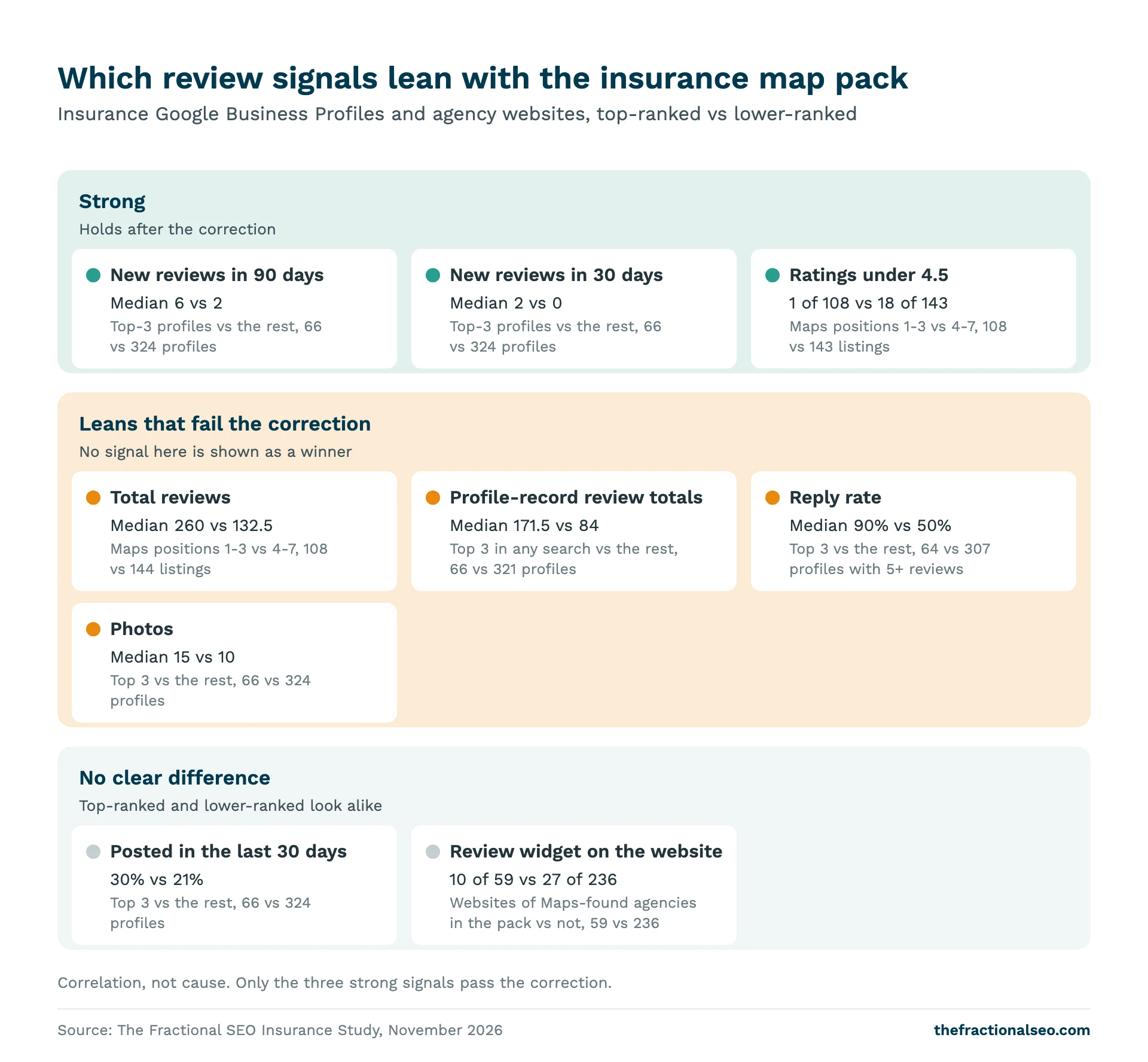
- New reviews (strong): profiles that reached the top 3 got a median 6 new Google reviews in the 90 days before collection vs 2 for the rest, and 2 vs 0 in 30 days.
- Low ratings (strong): 1 of 108 map-pack listings rate under 4.5 vs 18 of 143 at positions 4-7. The median is 4.9 in both groups.
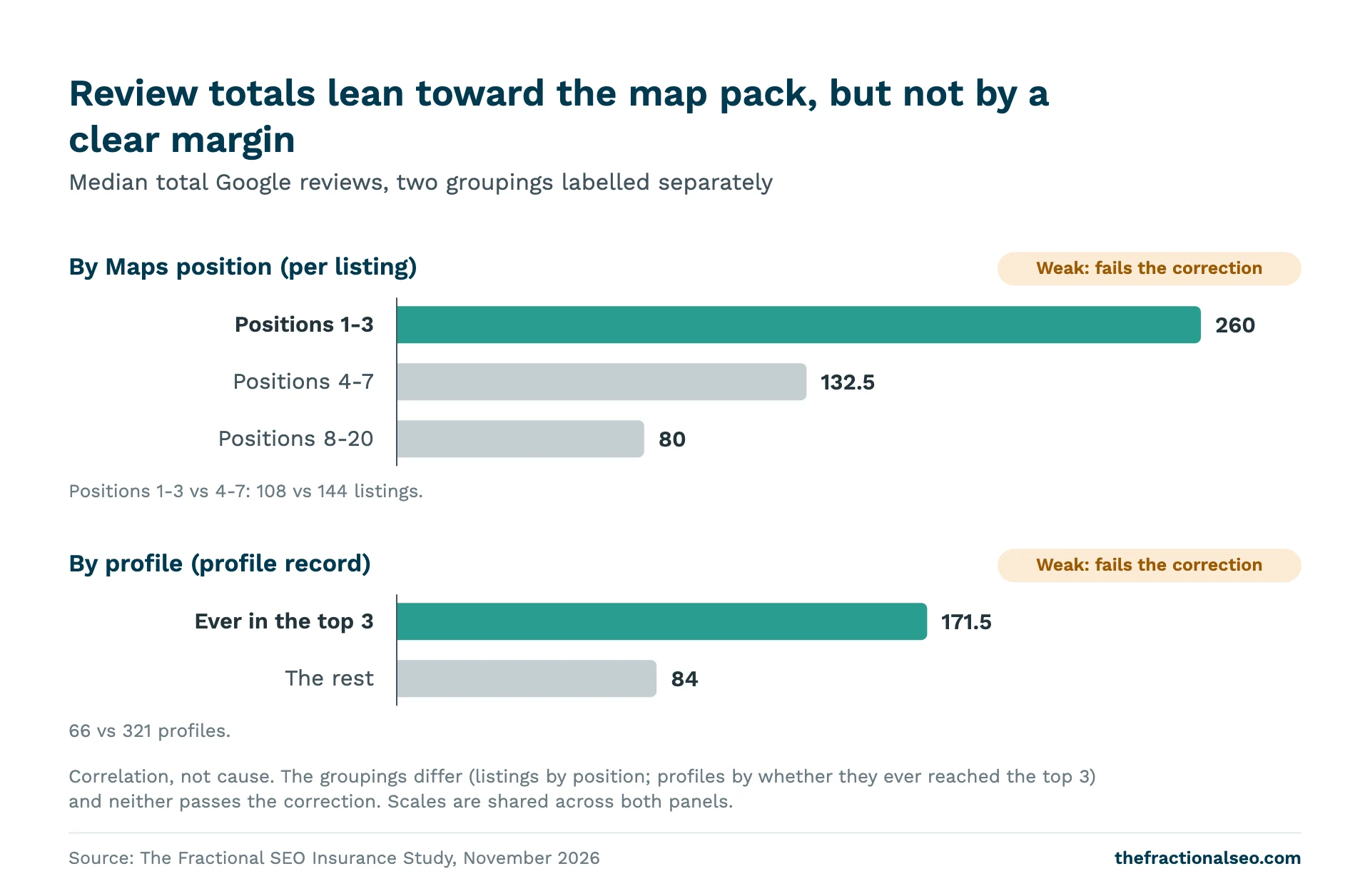
- Total reviews (a lean): a median of 260 at positions 1-3 vs 132.5 at positions 4-7, but the gap does not pass the correction for the number of tests.
- Replies and photos (leans): both point toward the pack and both fail the correction.
- Google posts: no clear difference.
The website findings from the same study are in our study of 337 insurance agency websites.
New reviews separate the map pack
Recent reviews separate the pack: profiles in the top 3 got a median 6 new Google reviews in the 90 days before collection vs 2 for the rest, and 2 vs 0 in 30 days. That compares 66 profiles that reached the top 3 in at least one study search with 324 that didn’t, each business counted once. Both windows were strong results that pass the correction.
11 of 66 top-3 profiles (17%) had none in 90 days vs 101 of 324 (31%). At the other end, 40 of the 66 top-3 profiles got 5 or more new reviews in 90 days, against 119 of the 324 others.
The lead holds within large, mid and small metros, with medians of 6 vs 2, 6 vs 2 and 5 vs 1. Each group is small, so read it as direction only.
One limit of the data works in the same direction. We collected each profile’s newest 40 reviews, and 23 profiles had 40 reviews inside 90 days, so their true count is higher. That can only shrink the gap, not create it.
In practice, an agency that asks every client, every month, looks more like the map pack than one that ran a review push once and stopped. Busy agencies also collect reviews faster, so this is a pattern, not a cause.
Low ratings are rarer in the pack
Star ratings are high everywhere (median 4.9 in the pack and at positions 4-7), but low ratings are rarer in the pack: 1 of 108 map-pack listings rate under 4.5 vs 18 of 143 at positions 4-7. The average rating is 4.86 vs 4.75. This compares Maps listings at positions 1-3 with positions 4-7, one row per search, and it was a strong result.
The difference is in the low tail, not the typical rating. A perfect score didn’t mark the pack out: 26 map-pack listings sit at exactly 5.0 against 20 at positions 4-7. The 25th percentile is 4.8 vs 4.7. So the pack isn’t flawless; very few of its agencies let their rating slide.
The practical point is to deal with the causes of bad reviews, such as slow claims help or a missed renewal call, and to reply to the ones you get. Never try to keep unhappy clients from posting. Google’s content policy says merchants may not “Discourage or prohibit negative reviews, or selectively solicit positive reviews from customers”. Asking only the clients you expect to be happy counts.
Total reviews: a lean, not a clear difference
Map-pack agencies have more Google reviews than agencies just below them, but in insurance the gap does not pass the multiple-test correction: a median of 260 reviews at positions 1-3 vs 132.5 at positions 4-7. That compares 108 map-pack listings with 144 just below, counting a listing once for each search it shows up in.
What the correction means in plain words: we ran many comparisons in this study, and some will look like differences by chance, so each result has to clear a higher bar. Total reviews didn’t: they lean toward the pack, but this sample can’t show a clear difference. In our HVAC study the same comparison was 1,576 vs 615 and passed.
The gap to the bottom of the list is much larger. Listings at positions 8-20 have a median of 80. On the profile record, counting each business once, total reviews also lean toward the pack: a median of 171.5 for profiles ever in the top 3 vs 84 for the rest, again failing the correction (66 vs 321 profiles). The two medians differ because the groupings differ: one counts a listing per search, the other each business once.
Google’s help page on local ranking says prominence is based partly on how many reviews a business has, and that more reviews and positive ratings can help local ranking. It gives no numbers, and it also names relevance and distance, which no review count changes.
Replies and photos lean; posts show no clear difference
Replying to reviews leans toward the pack but fails the correction: a median reply rate on the newest 20 reviews of 90% in the top 3 vs 50% for the rest. That counts 64 top-3 profiles and 307 others with 5 or more reviews. Across all profiles, 24% reply to none and 39% reply to 90% or more.
Reply anyway. Google’s ranking page says that replying to reviews “shows that you value their feedback”, and its help page on managing reviews notes that the reviewer is told when you reply. Keep policy details, claim details and anything personal out of a public reply.
Photos lean the same way but do not pass the correction: a median of 15 profile photos in the top 3 vs 10 for the rest (66 vs 324 profiles).
Google posts show no clear difference: 30% of top-3 profiles posted in the 30 days before collection vs 21% of the rest (39% vs 27% in 90 days). 35% of all profiles have no posts at all. No clear difference is not proof of no effect, but posting belongs below reviews. Our Google Business Profile checklist for insurance agencies covers posts, categories and the rest of the profile.
Do the results hold without chains, template sites and suspect listings?
- Chains and carriers. They hold few map-pack spots: 6 of 108.
- State Farm template sites. Ten are State Farm agents whose own domains run State Farm’s agent-site template. We kept them as separate businesses and also checked the results without them.
- Possible keyword-name listings. 9 Maps listings look like possible keyword-name listings (a name that is only a city plus insurance words, under 20 reviews); 2 of their rows sit in the map pack. That is a rule we applied, not proof a listing breaks Google’s guidelines, and we never name them.
The recency result holds. Without chains and State Farm template sites the medians are 6 vs 1; without suspect listings, 6 vs 2. Total reviews keep leaning the same way: 209 vs 131 without chains and template sites, 262 vs 138 without suspect listings. These re-runs are checks, not part of the corrected test set.
How many Google reviews do map-pack insurance agencies have?
Google doesn’t publish a minimum, and no review count guarantees a spot. Here is what the 108 map-pack listings in the study carry. The median is 260; a quarter have under 87.5; 12 of 108 have under 50 and 27 have 500 or more.
- Fewer than 10 reviews: 5 of 108.
- Fewer than 50 reviews: 12 of 108.
- 25th percentile: 87.5 (103.75 without suspect listings).
- Median: 260.
- 75th percentile: 472.5.
- 500 or more: 27 of 108.
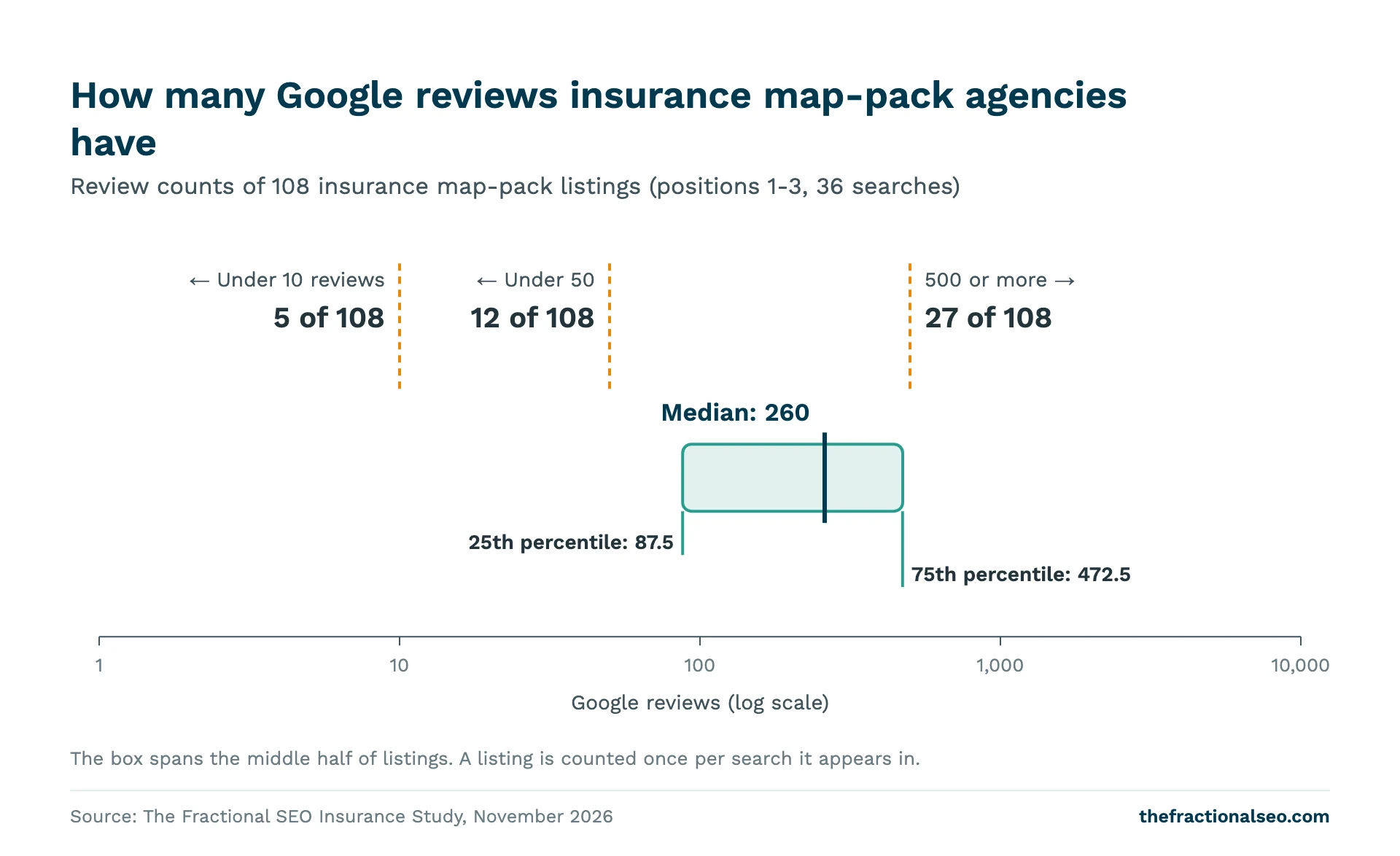
These are map-pack spots, so busy agencies count once per search they appear in.
By metro size
| Metro size | Metros in the study | Median reviews in the map pack | Map-pack listings |
|---|---|---|---|
| Large | New York, Los Angeles, Chicago, Dallas, Houston | 167 | 45 |
| Mid | Charlotte, Nashville, Austin, Columbus | 313 | 36 |
| Small | Boise, Knoxville, Des Moines | 293 | 27 |
The big-city median is the lowest of the three. We didn’t test why, and the groups are small (27 to 45 listings), so read this as a description of these 12 metros, not a rule for every city.
By search wording
| Search (plus the metro) | Map pack (positions 1-3) | Positions 4-7 | Map-pack listings |
|---|---|---|---|
| insurance agency | 299 | 218.5 | 36 |
| insurance broker | 260 | 135 | 36 |
| commercial insurance broker | 156 | 73.5 | 36 |
Commercial brokers in the pack carry about half the reviews of personal-lines agencies. That fits the work in our reading: a commercial book has fewer, larger clients, so there are fewer people to ask. We didn’t test that. These medians describe what map-pack agencies have; they are not targets. Our benchmark of who wins local insurance agency searches covers the rest of the results page.
Set your own target
Your real benchmark is your own market. Here’s the method we’d use. It’s our advice, not study data.
- Search the wording that matches your book in Google Maps with your city: insurance agency, insurance broker or commercial insurance broker. Search from inside the area you want to win, because results change with where the searcher is.
- Note the review counts of positions 1-3. The middle one of the three is your market’s map-pack figure for that search.
- Plan for a steady flow, not a one-time push. In our data the pack stands out on reviews from the last 90 days more clearly than on totals.
- Make asking routine. Google’s help page says you can share a review request link or QR code. Send it after a claim is settled, a policy is bound or a renewal review is done.
The local SEO checklist for insurance agencies puts reviews in order with the other local work.
Asking for reviews without rebating
Insurance has a problem other trades don’t: a thank-you gift can run into rebating rules. Google’s rule is the simpler one. Its Maps content policy says merchants may not “Offer incentives – such as payment, discounts, free goods and/or services – in exchange for posting any review”. It also says a business should not require or pressure people to leave reviews while on the premises. Asking for a genuine review, with no incentive, is allowed.
Insurance law points the same way. New York’s Insurance Law 2324 says no licensed agent or broker shall offer the insured, “either as an inducement to the making of insurance or after insurance has been effected, any rebate from the premium which is specified in the policy”, with a narrow exception for small items. The NAIC’s Model 880 lists rebates and other valuable inducements as an unfair trade practice; it is a model, and law only where a state adopts it. Whatever your state allows, Google’s policy bars any incentive for a review, so a gift card, a premium credit or a prize drawing is out.
This is not legal advice. Rebating rules differ by state and by line of business: check with your state insurance department, your carriers or your compliance contact. Our guide to website and advertising rules for insurance agencies covers the rule texts we read.
Showing reviews on your own website is a separate choice. 12% of agency sites carry a review widget, and it showed no clear difference: 10 of 59 sites of map-pack agencies vs 27 of 236 others. In our view a widget is for the person choosing an agent, not for rankings.
Want to see how your profile compares with your own market’s map pack? Talk to us about SEO for independent insurance agencies.
How we did this
We analyzed 36 local searches across 12 US metros and three insurance search types, 385 insurance agency and broker websites (337 crawled) and 390 Google Business Profiles, November 2026.
Searches were “insurance agency”, “insurance broker” and “commercial insurance broker”, each followed by the metro. Map pack means positions 1-3 of the Google Maps list for each search. Total reviews, ratings and the benchmarks use the 108 map-pack listings, counted once per search. The other profile comparisons count each business once: profiles that reached the top 3 in any study search vs the rest. New reviews come from each profile’s newest 40.
What it can’t claim: cause. Agencies that collect reviews steadily tend to be busier and better run in other ways. The groups by metro size are small, it is one snapshot, and there were no “near me” searches.
Questions, answered
Do Google reviews help an insurance agency rank?
Two review signals line up clearly with the map pack: new reviews in the last 90 days (a median 6 vs 2) and few low ratings (1 of 108 map-pack listings under 4.5 vs 18 of 143 just below). Total reviews lean the same way but don’t pass the correction. All of it is correlation, not proof.
How many Google reviews does an insurance agency need?
There’s no fixed number. Map-pack listings had a median of 260, and a quarter had under 87.5. Commercial broker searches had the lowest median (156). Check the top 3 in your own market.
Does replying to reviews help ranking?
It leans that way: map-pack profiles reply to a median of 90% of their newest reviews vs 50% for the rest, but the gap fails the correction. Reply anyway, for the next client reading them.
Can I give clients a gift card for leaving a review?
No. Google’s policy bans incentives for reviews, and rebating rules, such as New York’s, limit what agents and brokers can give clients. Check your own state’s rules with your insurance department or compliance contact.
Does one bad review hurt?
What stands out in our data is the tail: very few map-pack listings rate under 4.5. Reply, fix what went wrong and keep asking every client.
More research & benchmarks
The whole Insurance library- We Analyzed 337 Insurance Agency Websites: The Gaps Most Agencies Leave Open No website feature separates map-pack insurance agencies once we correct for the number of comparisons; here…
- Who Wins Local Insurance Agency Searches: A Benchmark of 36 Searches Who holds page one and the map pack when people search for an insurance agency, broker…