
Templates & Resource Insurance
Local SEO Checklist for Insurance Agencies
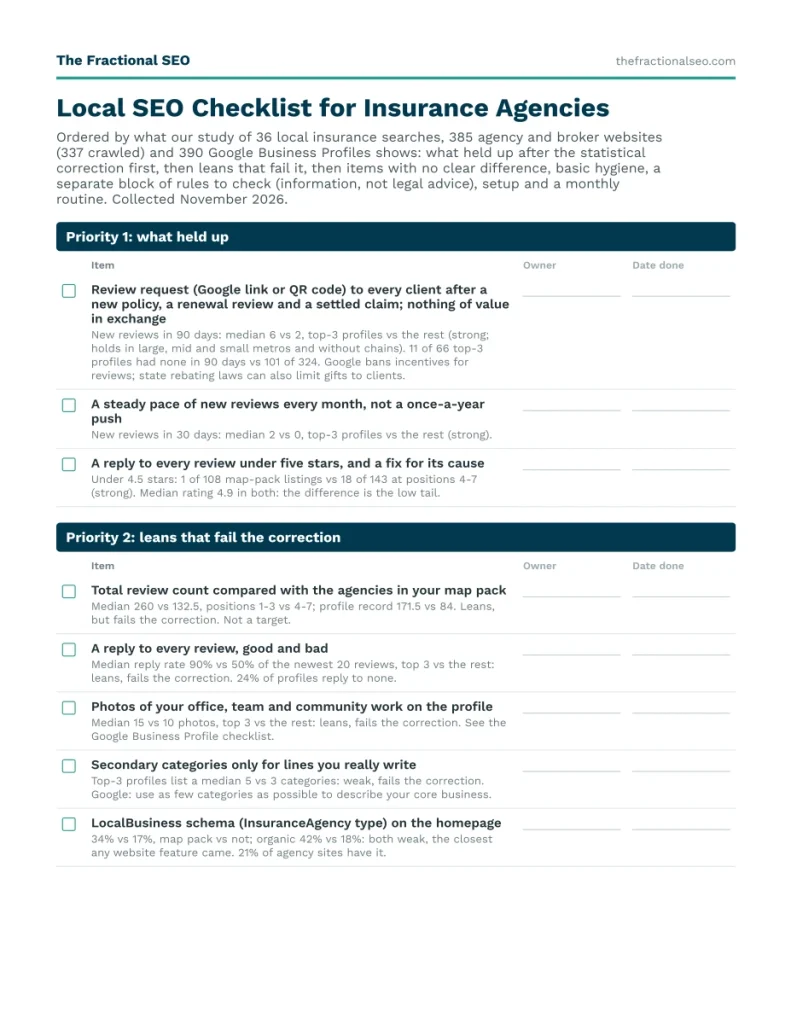
The local SEO checklists for insurance agents we read list Google Business Profile, reviews, keywords, content, links and speed side by side. None orders its tasks by insurance agency data, and none separates the advertising rules an agency's website sits under from ranking work. This one does both. All 37 items are free to download as a PDF or a Google Sheet.
Get the template No email required
What's inside
Priority 1: what separates the map pack
Recent reviews and a thin low-rating tail, the two items that held up after correction.
Leans worth having
Total reviews, replies, photos, categories and schema: they lean toward the pack but fail the correction.
Website gaps with no measured edge
Homepage forms, city titles, location pages, a live blog and speed, where many agency sites fall short.
Rules, not ranking factors
License numbers, the Medicare disclaimer, savings wording and quote-form consent, with links to the rule texts.
How to use it
-
Download the PDF or copy the Sheet
Print it, or make your own copy of the Google Sheet.
-
Work top to bottom
Start with Priority 1. Give every item an owner and a date.
-
Repeat the monthly tasks
The map pack from your market, new reviews in 90 days, replies, photos and links.
We analyzed 36 local searches across 12 US metros and three insurance search types, 385 insurance agency and broker websites (337 crawled) and 390 Google Business Profiles, November 2026. We compared what top-ranked agencies and brokers have with what lower-ranked ones have, and ordered the list from the answer. The data was collected on 19 November 2026, from one desktop search per query, so rankings can differ by day, device and location. The date fell inside Medicare’s fall Open Enrollment Period, which matters for the Medicare figures below. For the reasoning behind each task, read the full local SEO guide for insurance agencies.
If your Google Business Profile isn’t claimed yet, do items 9-12 first. Everything on the profile depends on them.
How we ordered this checklist
We searched “insurance agency”, “insurance broker” and “commercial insurance broker” in each metro and compared the map pack (the top 3 of the Google Maps list) with agencies lower down, correcting for the number of tests. The groups:
- Priority 1: what separates the map pack. Two review items where the gap held up after that correction.
- Priority 2: leans worth having. Items that lean toward the map pack but fail the correction. Not proven ranking factors on our evidence.
- Priority 3: profile basics. Near-universal profile items with no clear difference.
- Priority 4: website gaps with no measured edge. The usual checklist staples. Many agency sites lack them, and top-ranked sites don’t have them clearly more often.
- Priority 5: technical hygiene. How often agency sites get these wrong. No ranking comparison.
- Rules, not ranking factors. License numbers, the Medicare disclaimer, savings wording, quote-form consent and carrier names. These are about advertising rules, not Google.
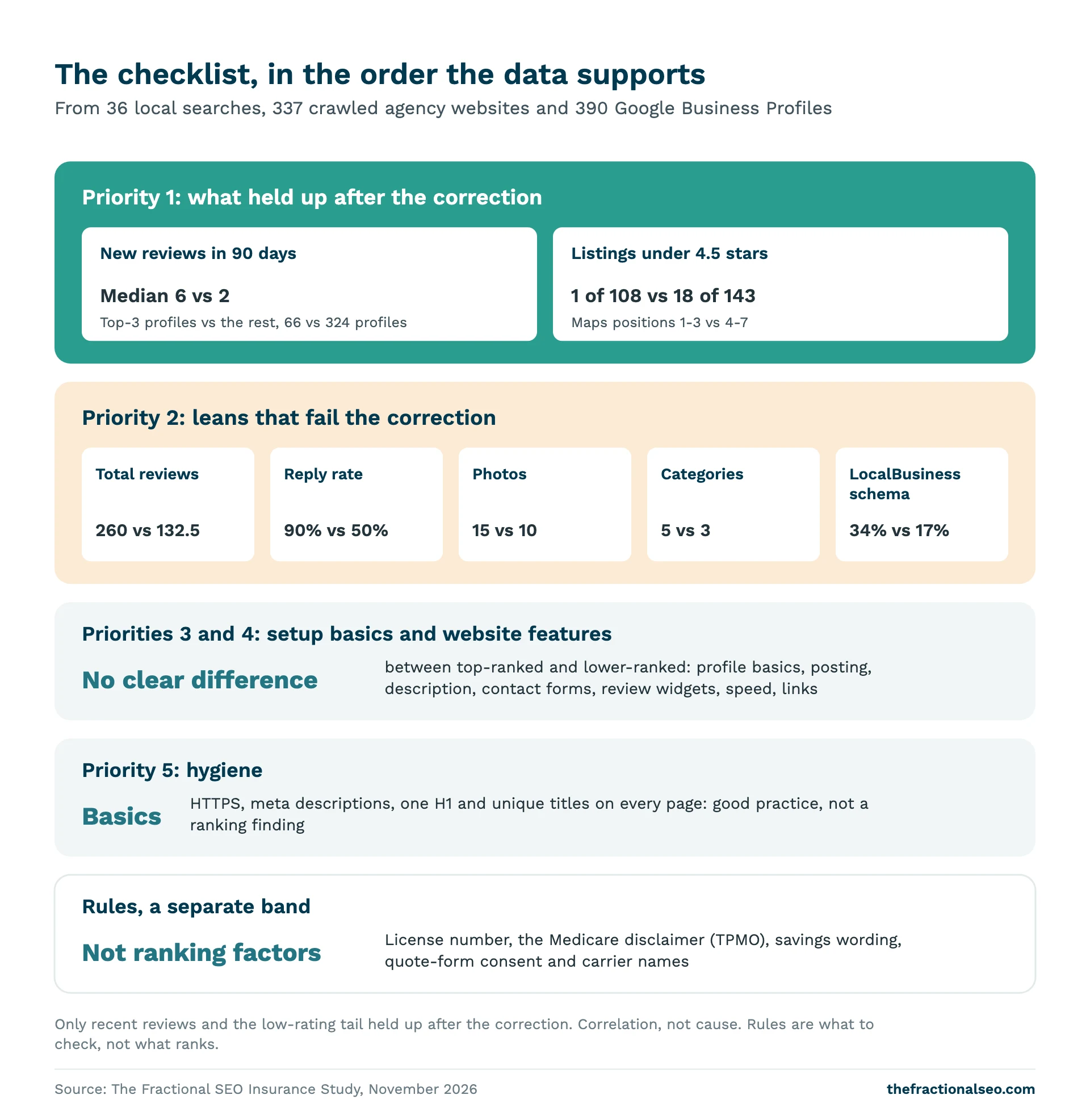
One honest note. This is a correlation study. Top-ranked agencies may also differ in ways we didn’t measure, so the list shows what top-ranked agencies tend to have. It can’t promise that any one item will move you up, and a missing edge is not proof that an item never matters. The website half comes from our study of 337 insurance agency websites.
Priority 1: What separates the map pack
Recent reviews
Profiles that reached the top 3 in any study search got a median of 6 new Google reviews in the 90 days before collection vs 2 for the rest, and 2 vs 0 in 30 days. 11 of 66 top-3 profiles (17%) had none in 90 days, against 101 of 324 (31%). The lead holds in large, mid and small metros (medians 6 vs 2, 6 vs 2 and 5 vs 1), and with chains and State Farm template sites taken out (6 vs 1). What separated the pack was the recent flow; totals only lean (Priority 2).
Ask at the moments clients are glad they called you: a new policy, a renewal review, a claim that got paid. Google’s review help page says you can share a review request link or QR code. Google’s content policy bans incentives such as payment, discounts or free goods in exchange for a review, and state rebating laws can limit what an agent may give a client, so ask and offer nothing. More on that in insurance agency websites and advertising rules, and more on the review data in what 390 insurance agency profiles show about reviews.
The low-rating tail
Star ratings are high everywhere: the median is 4.9 in the pack and at positions 4-7. The difference is in the low tail. 1 of 108 map-pack listings rates under 4.5, against 18 of 143 at positions 4-7. So the job is not chasing a perfect 5.0. It is keeping unhappy clients from piling up: answer every critical review calmly, take the detail offline, and fix what caused it, whether that’s slow callbacks, a missed renewal or a claim nobody explained.
- A review request, with your Google link or QR code, to every client after a new policy, a renewal review and a settled claim. Nothing of value in exchange.
- A steady pace of new reviews every month, not a once-a-year push.
- A reply to every review under five stars, and a fix for its cause.
Priority 2: Leans that fail the correction
These all point toward the map pack, but none passed the correction for the number of tests. Treat them as worth doing, not as proven ranking factors.
Total reviews. Map-pack agencies have more: a median of 260 at positions 1-3 vs 132.5 at positions 4-7. On the profile record, the medians are 171.5 for profiles ever in the top 3 vs 84 for the rest. Both lean, but not a clear difference once we correct for the number of comparisons. Compare yourself with your own map pack. It is not a target.
Replies. The median reply rate on the newest 20 reviews is 90% in the top 3 vs 50% for the rest. Across all profiles, 24% reply to none. Google says helpful replies show you’re responsive.
Photos. A median of 15 profile photos in the top 3 vs 10 for the rest. Your office, your team and the community events you sponsor are good subjects.
Categories. Top-3 profiles list more categories (median 5 vs 3). Google’s guidelines say to use as few categories as possible to describe your core business, so add a secondary category only for a line you really write. Step by step in our Google Business Profile checklist for insurance agencies.
LocalBusiness schema. The closest any website feature came: 34% of map-pack agencies’ sites have it vs 17% of the rest, and it also leans in organic results (42% vs 18%). Both are weak. Only 21% of agency sites have it at all. Schema.org has an InsuranceAgency type, so use that, and add the required properties Google lists.
- Your total review count compared with the agencies in your map pack.
- A reply to every review, good and bad.
- Photos of your office, team and community work on the profile.
- Secondary categories only for lines you really write.
- LocalBusiness schema, using the InsuranceAgency type, on the homepage.
Priority 3: Profile basics (no clear difference)
Agency profiles look alike on the basics. 375 of 390 profiles are claimed, and descriptions are near universal (91% vs 83%, no clear difference). Every one of the 108 map-pack listings showed a website link. For the primary category, “Insurance agency” leads in the pack (42 of 66 top-3 profiles), then “Auto insurance agency” (12) and “Insurance broker” (7), with about the same shares among the rest. Google posts show no clear difference (30% of top-3 profiles posted in 30 days vs 21% of the rest), and 35% of all profiles have no posts at all.
- Profile claimed and verified under your real business name. Google’s guidelines don’t permit unnecessary information in the name.
- A primary category that matches your main business.
- Website link, description and hours filled in.
- Phone number and office address that match your website.
- Google posts only if someone will keep them up.
Priority 4: Website gaps with no measured edge
How often agency sites have each staple, and how the two comparisons came out:
| Item | Agency sites with it | Map pack vs not (sites) | Organic top 3 vs 4-10 |
|---|---|---|---|
| Contact form on the homepage itself | 38% | 28 of 59 vs 89 of 236 | 33% vs 42% |
| Online quote form or rater link | 77% | 50 of 59 vs 179 of 236 | 67% vs 80% |
| Click-to-call phone link | 79% | 51 of 59 vs 179 of 236 | 79% vs 82% |
| Metro named in the homepage title | 51% | 30 of 59 vs 118 of 236 | 42% vs 60% |
| Service pages | 78% | 46 of 59 vs 181 of 236 | 88% vs 89% |
| Location or city pages | 43% | 44% vs 39% | 58% vs 60% |
| Blog or news section | 50% | 32 of 59 vs 111 of 236 | 54% vs 62% |
| Review widget | 12% | 10 of 59 vs 27 of 236 | 8% vs 16% |
| Says the agency is independent | 65% of independent agencies | 36 of 59 vs 147 of 236 | 67% vs 71% |
| Mobile speed score (median) | 61 | 61 vs 61 | 61.5 vs 58.5 |
No measured edge is not a reason to skip them. Most help a shopper call you, ask for a quote or trust you.
- Homepage form. Only 38% of agency sites have a contact form on the homepage itself, though 77% offer an online quote form or rater link.
- Location pages. 43% have location or city pages. Build one only for a town with an office or real clients, with something true to say about it. Google’s spam policies call pages created to rank for specific, similar searches doorway abuse.
- Blog. 50% of sites have a blog or news section, but only 10% posted in the 12 months before the crawl. A dead blog says more than no blog.
- Speed. The median mobile score is 61, the median largest contentful paint is 7.3 s, and only 12% load it within 2.5 s. 18% of homepages weigh over 5 MB. It didn’t separate rankings, but shoppers on phones are impatient.
- Links. In the map pack, links show no difference (median 112 vs 102 referring domains). Organic top-3 sites have more (357 vs 112), but the groups are small, carrier domains sit in that group, and it is not a clear difference.
- A contact form on the homepage itself.
- An online quote form or rater link.
- A click-to-call phone link in the header on every page.
- Your metro name in the homepage title.
- A page for each line you write: auto, home, business, life, benefits.
- A page for each town with an office or real clients. Never city-swapped copies.
- A blog only if someone will post to it.
- Real client reviews shown on the site, with permission.
- Say you’re independent, if you are.
- A homepage that loads fast on a phone.
- Local links: chamber, associations, sponsorships, local press.
Priority 5: Technical hygiene
All 337 crawled agency sites use HTTPS. On-page basics are missing on a minority: 32% of sites lack a meta description on a quarter or more of their pages, 22% lack an H1 on a quarter or more, and 6% repeat titles on a quarter or more. These show how common each problem is; they don’t compare rankings.
- HTTPS on every page.
- A meta description on every page.
- One H1 on every page.
- A unique title on every page.
Rules, not ranking factors
These items are on the list because an agency website is advertising, not because they help rankings. None of them separated the map pack: license numbers showed on 7 of 59 map-pack agencies’ homepages vs 23 of 236, no clear difference. What follows is what the rule texts say, not legal advice. Check your own situation with your state insurance department, your carriers or your compliance contact. The detail is in insurance agency websites and advertising rules.
- License number. 22 of 306 independent-agency homepages (7%) show a producer license number, but 11 of the 30 Los Angeles agencies do (37%), against 11 of the other 276 (4%). California’s Bulletin 96-08 (1996) says the license number goes on business cards, premium quotes and print advertisements, and reads print advertisements as printed words on paper. It does not mention websites. Rules differ by state.
- Medicare disclaimer. 28 of 306 independent-agency homepages say they sell Medicare plans, and 7 of those 28 show the CMS third-party marketing (TPMO) disclaimer on the homepage. 42 CFR 422.2260 names independent agents and brokers who are paid for lead generation, marketing, sales or enrollment as TPMOs, and 422.2267(e)(41) says the disclaimer is “Prominently displayed on TPMO websites.” Its standard text starts “We do not offer every plan available in your area.”
- Savings and price wording. 122 of 306 independent-agency homepages (40%) make a savings or price claim. The NAIC’s Model 880, a model that is law only where a state adopts it, treats untrue, deceptive or misleading statements about insurance, including internet advertisements, as an unfair trade practice.
- Quote-form consent. 77% of independent-agency homepages offer an online quote form or rater. We did not measure whether those forms ask for calling or texting consent. 47 CFR 64.1200(f)(9) defines prior express written consent as a signed written agreement that authorizes marketing calls or texts by autodialer or prerecorded voice to a named number, and says the agreement must disclose that the person need not sign it as a condition of purchase.
- Carrier names. 112 of 306 independent-agency homepages (37%) name the carriers they represent. In New York, Insurance Law 2122 says agent and broker ads that refer to an insurer must give its full name and the city, town or village of its principal office. Your carrier agreements set how you may use each carrier’s name and logo.
- License number shown where your state’s rules call for it.
- If you sell Medicare plans for more than one organization as a TPMO, the CMS disclaimer on the site.
- Savings and price wording checked against your state’s advertising rules.
- Quote forms: calling and texting consent wording reviewed.
- Carrier names and logos used only as your carrier agreements and state rules allow.
Setup and monthly tasks
Keep your name, address and phone the same everywhere, including your carriers’ find-an-agent listings. On local insurance searches, Yelp showed up 36 times on page one, on 26 of 36 searches. MapQuest (17), Facebook (14) and BBB (11) were among the others. See the directories in insurance agency search.
Then check the same few numbers each month. Google says local results are mainly based on relevance, distance, and popularity, so check from where your clients are, not from your desk.
- Name, address and phone the same on your site, profile, directories and carrier find-an-agent listings.
- Search Console and Google Analytics set up and verified.
- Monthly: check the map pack from a phone inside your market, and count new reviews in the last 90 days against the agencies in it.
- Monthly: answer any unreplied review, add new photos and note the links you earned.
Download the checklist
The Insurance Agency Local SEO Checklist. All 37 items in priority order, with columns for status, owner, date done and the benchmark from our study. Print the PDF, or copy the Google Sheet and give every item an owner and a date. For the profile step by step, pair it with the Google Business Profile checklist.
Rather hand the list to someone? Insurance agency SEO done for you.
Questions, answered
What should an insurance agency’s local SEO checklist include?
Start with what separates the map pack in our data: a steady flow of new reviews and few low ratings. Then the leans, the profile basics, the website gaps, hygiene, the advertising rules and a monthly routine.
What should I do first?
If your profile isn’t claimed, claim it. Then ask every client for a review after a new policy, a renewal and a claim. It costs nothing and you can start this week.
Do quote forms or location pages help an agency rank?
Not in a way we could measure. No website feature separated map-pack agencies after the correction. LocalBusiness schema came closest (34% vs 17%), and that is a weak lean. Build the pages for shoppers.
How many reviews does an insurance agency need?
There’s no target. The map-pack median is 260 at positions 1-3 vs 132.5 at positions 4-7, a lean that fails the correction. Recent reviews separated the pack more clearly, so compare your last 90 days with the agencies in your own map pack.
Is a license number or Medicare disclaimer an SEO task?
No. Neither separated the map pack. They are advertising-rule questions for your state insurance department or compliance contact.