
Guide Insurance
The Ultimate Guide to Local SEO for Insurance Agencies
Local SEO for insurance agencies is two contests, not one. The first is the map pack, the three Google Maps listings near the top of a search. The second is the organic results below it. Different agencies win each: in our study, only 8 of 108 map-pack listings (7%) also ranked on page one organically for the same search. This guide covers what lines up with winning each contest, and what to do first.
The short answer
- Two contests: the map pack and the organic results are almost entirely different businesses. Plan each one on its own.
- Map pack: recent reviews and a clean rating record line up most clearly with the top 3. Total review counts lean the same way but don’t pass our statistical check.
- Website: no website feature we measured separated map-pack agencies from the rest. The website matters most for the organic contest, where directories and carriers crowd in.
- Competitors: carriers are strong in organic results and weak in Maps. Captive agents compete in Maps under their own names.
- Commercial lines behave like a separate market, searched mostly by product name.
We analyzed 36 local searches across 12 US metros and three insurance search types, 385 insurance agency and broker websites (337 crawled) and 390 Google Business Profiles, November 2026. The data was collected on 19 November 2026, from one desktop search per query, so rankings and ads can differ by day, device and location.
The three searches were “insurance agency”, “insurance broker” and “commercial insurance broker”, each followed by the metro name. Where we compare higher- and lower-ranked agencies, the results show what tends to go together, not what causes a ranking. The full website results are in our study of 337 insurance agency websites.
What a local insurance search results page looks like
Search “insurance agency” or “insurance broker” with a city name and Google shows two blocks. A map pack appeared on 35 of 36 of our searches: a map and three businesses with star ratings, a call button and directions. In this guide, “map pack” means positions 1-3 of the Google Maps list for the search. Below it are the organic results, the web pages Google ranks with its normal search algorithm.
The guides we read treat these as one job. In insurance they are close to two separate lists. Only 8 of 108 map-pack listings (7%) also ranked on page one organically for the same search. An agency that holds a map-pack spot is usually missing from the organic list below it, and the other way round.
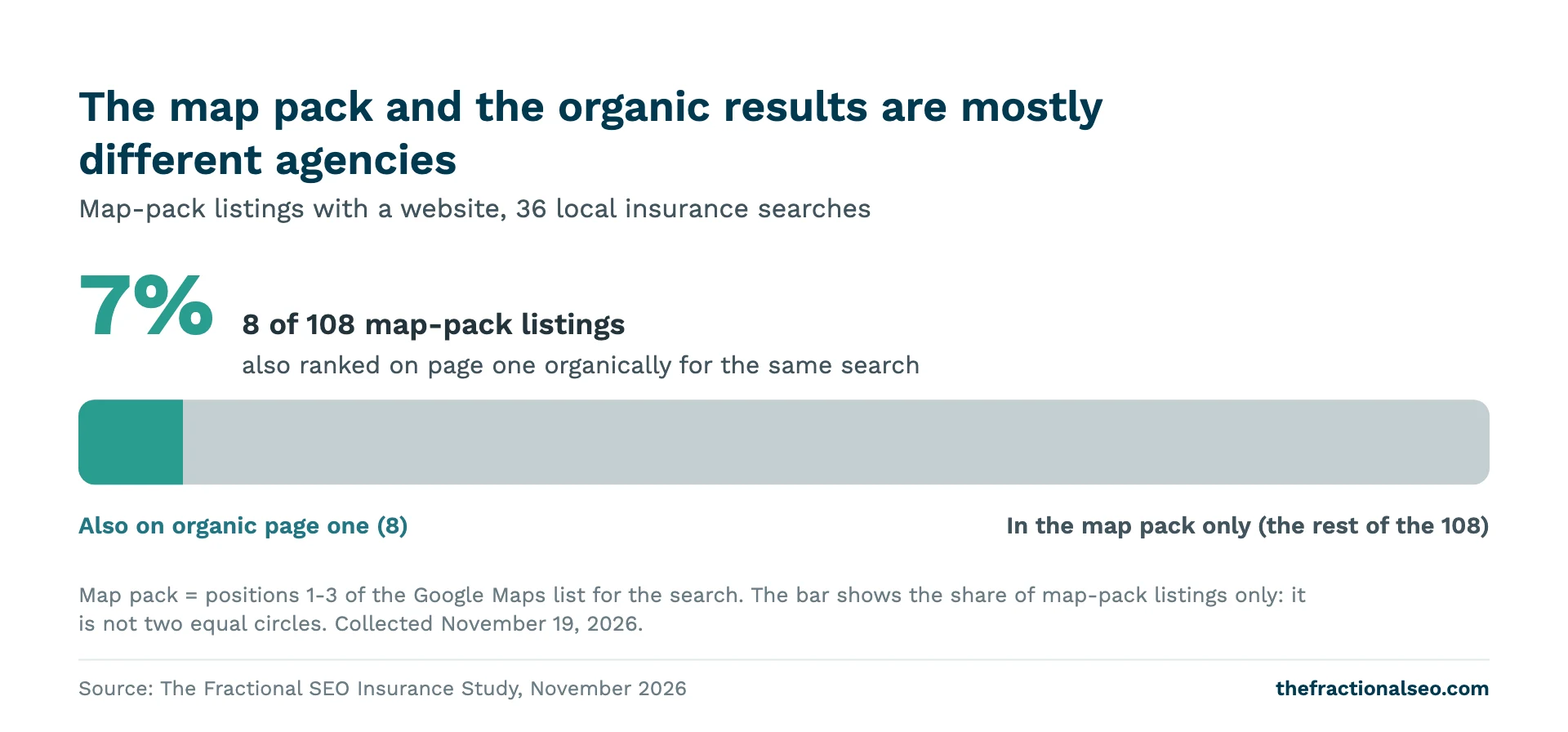
The organic half is crowded with sites that don’t sell insurance. Only 39% of page-one organic results for local insurance agency and broker searches went to agencies’ and brokers’ own websites, and that count includes carrier and chain sites. The other 61% went to directories, social sites, media, regulators and comparison sites.
| Type of page-one organic result | Results (of 311) |
|---|---|
| Directories | 153 |
| Agency and broker websites (carriers and chains included) | 122 |
| Social sites | 22 |
| Media and regulators | 10 |
| Comparison or lead sites | 3 |
| Wholesale broker | 1 |
A site that is not an agency or broker held the #1 organic spot in 20 of 36 searches (56%) and 61% of all top-3 organic spots. The most frequent #1 was topseobrands.com, a ranked-list site, on 5 searches. Nationwide’s agent-locator pages were #1 on 3.
Why bother with the organic half? Agency sites (carrier and chain sites included) that ranked only organically had a median of about 302 estimated visits a month, those found in both about 177, and those found only in Maps about 71. Across all agency websites the median was 90, and 52% got under 100. These are DataForSEO estimates, not measured visits, and they describe who turns up where, not what turning up would do for you. More is in our benchmark of 36 local insurance searches.
Personal lines and commercial lines are different searches
The three wordings behaved like different markets. Agency and broker sites held 34% of page one on “insurance agency” searches, 38% on “insurance broker” and 46% on “commercial insurance broker”. Metro size ran the opposite way from the home-service trades: agencies held 45% of page one in large metros, 39% in mid-size metros and 31% in small ones. With 12 searches per wording, read these as a description, not a test.
| Search wording | Agency and broker share of page one | Typical monthly searches per metro |
|---|---|---|
| insurance agency <city> | 34% | 190 (volume in 12 of 12 metros) |
| insurance broker <city> | 38% | 210 (volume in 11 of 12 metros) |
| commercial insurance broker <city> | 46% | Volume in only 2 of 12 metros |
So commercial broker searches give agencies the most of page one, but few people type them. Business owners search for the product instead: “commercial insurance” (33,100 a month, Google Ads via DataForSEO, November 2026), “general liability insurance” (27,100), “small business insurance” (22,200) and “commercial auto insurance” (22,200), with suggested bids near or above $100. If you write commercial lines, build pages around those products, not around the word “broker”.
The map pack looks different too. Commercial brokers in the pack carry about half the reviews of personal-lines agencies. And local clicks are expensive on every wording: the median suggested bid is $23.59 for “insurance agency <city>” and $34.71 for “insurance broker <city>”. Those bids are Google’s estimate, not what an agency pays, but they show that advertisers compete for these searches.
How Google ranks local results
Google's help page on local ranking says “Local results are mainly based on relevance, distance, and popularity.” Relevance is how well your profile matches the search. Distance is how far you are from the searcher. The page explains prominence as “how well-known a business is”, based on things like “how many websites link to your business and how many reviews you have.”
Distance is outside your control: a searcher across town sees a different map pack from the one you see at your desk. The same page is plain about shortcuts: “There’s no way to request or pay for a better local ranking on Google.” What you can work on is relevance and prominence.
Part 1: The map pack
The map pack runs on your Google Business Profile, the free listing Google keeps for your agency, plus what clients say there and how well-known you are around the web.
Set up the Business Profile properly
Claim and verify the profile first.
Business name. Use your real agency name, as it appears on your sign and your policy documents. Google's guidelines say “Including unnecessary information in your business name isn’t permitted, and could result in the suspension of your Business Profile.” Our study flagged 9 Maps listings that look like possible keyword-name listings (a name that is only a city plus insurance words, with under 20 reviews), and 2 of their rows sat in the map pack. The flag is rule-based, not proof that any listing breaks Google’s rules.
Address. If clients come to a staffed office, show that address. If you work from home and meet clients at their place, Google treats you as a service-area business: “If you’re a service-area business, you should hide your business address from customers.” The same guidelines say “Service-area businesses can’t list a “virtual” office unless that office is staffed during business hours.”
Category. “Insurance agency” led in the pack (42 of 66 top-3 profiles), then “Auto insurance agency” (12) and “Insurance broker” (7). The shares were about the same among the rest, so the category alone didn’t set the pack apart in our data. Google asks you to “Choose the fewest number of categories it takes to describe your overall core business.” Our Google Business Profile checklist for insurance agencies covers categories, photos and the rest of the setup.
Website link. Every one of the 108 map-pack listings showed a website link. Use the same phone number on the profile and the site.
Reviews: recent first, then the low ratings
Reviews are where our data shows the clearest map-pack differences, and the order matters.
- Recent reviews (strong). Profiles in the top 3 in any study search got a median of 6 new Google reviews in the 90 days before collection, against 2 for the rest, and 2 against 0 in 30 days. 11 of 66 top-3 profiles (17%) had none in 90 days, against 101 of 324 (31%). The lead held within large, mid and small metros.
- The low-rating tail (strong). Star ratings are high everywhere, a median of 4.9 in the pack and at positions 4-7. But low ratings are rarer in the pack: 1 of 108 map-pack listings rated under 4.5, against 18 of 143 at positions 4-7.
- Total reviews (leans only). Agencies at positions 1-3 had a median of 260 reviews against 132.5 at positions 4-7. That leans the same way, but it is not a clear difference once we correct for the number of comparisons we ran.
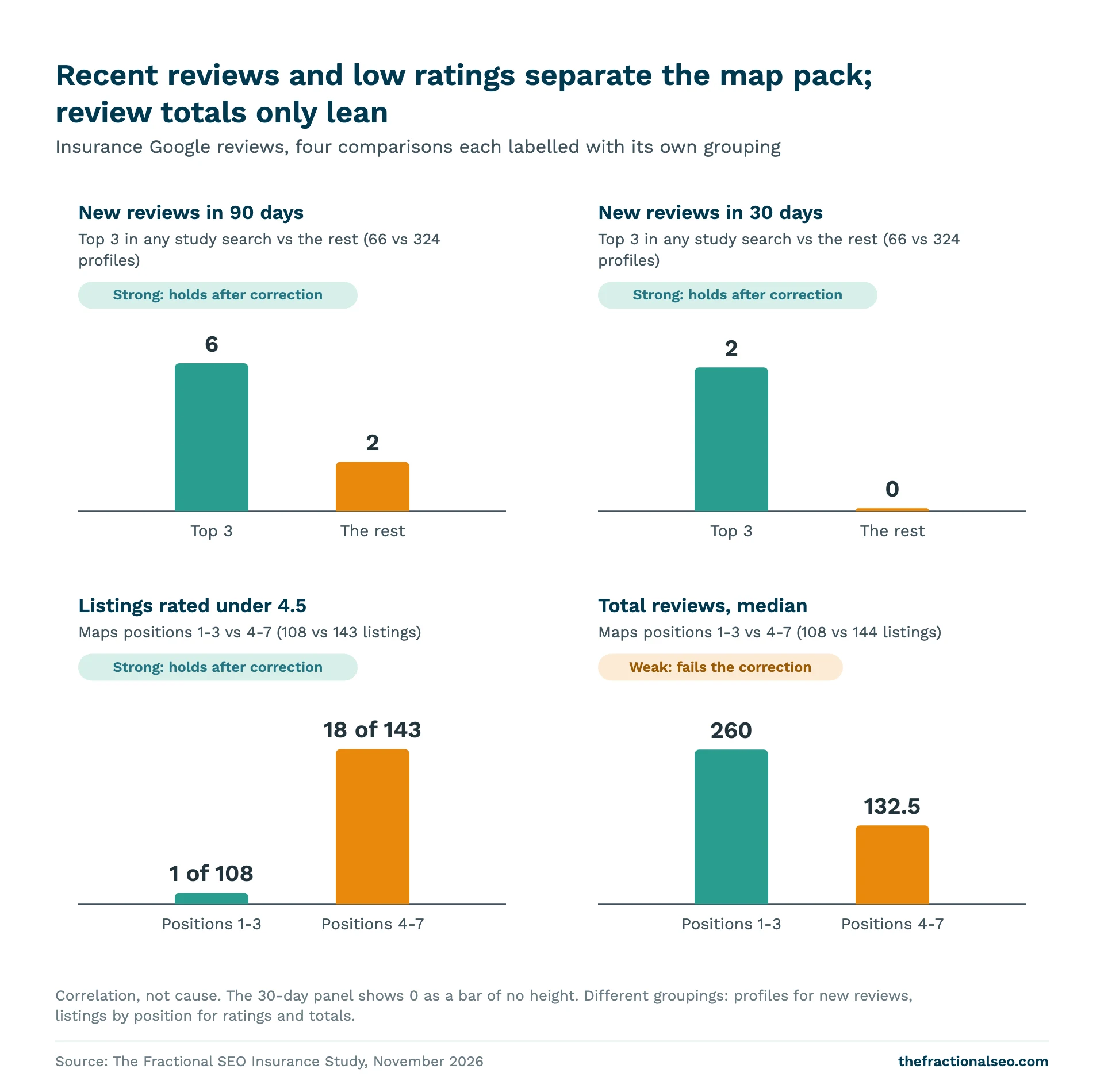
These are correlations, not causes. An agency that writes a lot of new business collects more reviews, and it has other advantages too. Still, a steady review habit is the cheapest thing in this guide:
- Ask at the moments clients are happiest: a new policy bound, a renewal that went smoothly, a claim handled well. Google lets you share a review link or a QR code, so put the link in your follow-up email.
- Spread the asks across the year. Recent reviews separated the pack; a burst once a year won’t keep that measure up.
- Never offer a gift card, a discount or a drawing for a review. Google's content policy prohibits offering “payment, discounts, free goods and/or services” in exchange for a review. Insurance adds its own layer: state anti-rebating rules, covered in our guide to insurance agency websites and advertising rules.
- Reply to reviews, good and bad. Google calls replying a best practice. In our data, reply rates leaned toward the pack but didn’t pass the correction.
For review benchmarks by metro size and search wording, see our research on Google reviews and insurance agency rankings.
Carriers and captive agents
Independent agencies face two kinds of big-brand competitor, and they show up in different places.
Carriers win organic spots, not map-pack spots. Chains and carriers held just 6 of 108 map-pack spots: company chains 4 (Inszone 3, Acceptance 1), a captive-carrier domain 1 (American Family) and a franchise or unverified brand 1 (Freeway). Carrier domains did better organically, with 24 of 122 provider results, 10 of them Nationwide agent pages. Chain counts are a floor, because a few rows could not be checked.
Captive agents compete in Maps under their own names. 33 Maps listings named a carrier in the business name, 18 of them on a domain that is not the carrier’s. Ten were State Farm agents whose own domains run State Farm’s agent-site template. Listings naming a carrier held 1 of 108 map-pack spots. A carrier in the name doesn’t prove an agency is captive, since some independents are authorized agents of a carrier.
A lot of “near me” demand names a carrier. Carrier-name “near me” searches total about 414,300 a month nationally (“state farm near me” alone 135,000), against about 565,360 for generic ones such as “car insurance near me” (74,000) and “insurance near me” (60,500). It’s tempting to build pages around the carriers you write. Don’t assume you can use a carrier’s name in your marketing: that is set by your carrier agreement, and New York, for one, has a rule on how an agent’s or broker’s ads name an insurer. Our compliance guide covers what we read.
Part 2: Local organic results
The organic list is where directories and carriers crowd in, and where most map-pack agencies don’t appear. It runs on your website and the links pointing to it.
Website basics, and the gaps most agencies leave
Most agency sites have the basics: a clickable phone link (79%), service pages (78%, a median of 16), an online quote form or rater link on the homepage (77%) and HTTPS (all 337 sites we crawled).
The gaps are elsewhere. Only 38% have a contact form on the homepage itself, 21% have LocalBusiness schema, 51% name the metro in the homepage title, 43% have location or city pages and 12% show a review widget.
Be clear about what this means for the map pack. No website feature we measured separated map-pack agencies from the rest after the correction for multiple comparisons. The closest was LocalBusiness schema (34% vs 17%), a weak lean. Location or city pages (44% vs 39%), quote forms, blogs and saying you’re independent showed no clear difference. Fix the gaps for the organic contest and for the people who land on your site, not because our data shows they move you in Maps. Our study of 337 insurance agency websites has every measure.
Service pages and the independent pitch
Give each line you sell its own page: auto, home, renters, life, business owners policies, general liability, commercial auto, workers’ comp. Write them in the words clients search, and say which towns you serve.
Some searchers ask for independence by name. “Independent insurance agents” gets 12,100 searches a month nationally and “independent insurance agents near me” 9,900, and keywords naming “independent” total about 25,340 a month. On independent-agency homepages, 65% say the agency is independent and 37% name the carriers they represent. Neither separated the map pack, but both answer the question an independent-agency searcher came with: can you shop my policy across several companies?
City in the title and LocalBusiness schema
Half of agency sites (51%) name their metro in the homepage title, and 21% have LocalBusiness schema. Both are cheap. Schema was the closest thing to a website lean in our map-pack data (34% vs 17%) and also leaned in organic results (42% vs 18%), though both leans are weak.
Google's local business structured data page says to use “the most specific LocalBusiness sub-type possible”. For an agency that is InsuranceAgency, which schema.org files under LocalBusiness and FinancialService.
Links
Links made no clear difference in our data. Sites in the organic top 3 had more referring domains than those at positions 4-10 (a median of 357 vs 112), but the groups were small and it is not a clear difference. In the map pack, links showed no difference (112 vs 102). Real local links are still worth having: your state’s independent agents association, the chamber, local sponsorships and carriers’ agent locators.
Directories and listicle sites
The sites agencies compete with most on page one are Yelp (36 results, on 26 of 36 searches), MapQuest (17), Facebook (14), BBB (11), mployeradvisor.com (9), topseobrands.com (6), Expertise.com and insuranceproviders.com (5 each) and Reddit (5). Some are directories and some are ranked lists, and topseobrands.com is a ranked list of SEO and marketing agencies, not an insurance directory. Claim the free listings that rank for your searches and keep your name, address and phone identical on each. Our guide to the directories in insurance agency search covers each one.
AI Overviews
Google showed an AI Overview on 17 of our 36 searches (47%), most often on “commercial insurance broker” searches (8 of 12). Google's guidance for site owners says “There are no additional requirements to appear in AI Overviews or AI Mode, nor other special optimizations necessary.” Clear pages that answer what a commercial buyer asks, such as what a policy covers and who needs it, are the same work as good service pages.
The rules that shape what your site says
Insurance is a regulated business, so some of what goes on an agency website is set by rules, not by SEO. These are rules, not ranking factors, and none of them showed a map-pack edge in our data.
- License numbers. 22 of 306 independent-agency homepages (7%) show a producer license number. Whether your state expects one on your website is a question for your state insurance department.
- Medicare. 28 of 306 independent-agency homepages say they sell Medicare plans, and 7 of those 28 show the CMS third-party marketing (TPMO) disclaimer on the homepage. The collection date fell inside Medicare’s fall Open Enrollment Period. The federal definition (42 CFR 422.2260) says a TPMO includes “independent agents and brokers, who are compensated to perform lead generation, marketing, sales, and enrollment related functions”.
- Savings claims. 122 of 306 independent-agency homepages (40%) make a savings or price claim. A savings claim is not by itself a violation, but state rules restrict misleading ones.
This is not legal advice. Check with your state insurance department, your carriers or your compliance contact. Our guide to insurance agency websites and advertising rules sets out what the official rule texts we read say, including quote-form consent for calls and texts.
A 90-day local SEO plan
Here is the order we’d work in. The profile and the review habit come first because they’re quick and cost nothing but time.
Days 1-30: Business Profile and review habit
- Verify the profile, use your real agency name and check the address and hours.
- Choose the primary category that matches your main work, usually “Insurance agency”.
- Reply to every review you haven’t answered, then make replying a weekly habit.
- Add the review link to new-policy, renewal and claim follow-up emails. No gifts or drawings.
Days 31-60: Website pages
- Build or fix a page for each line you sell, with commercial products on their own pages.
- Say plainly whether you’re independent and which carriers you can name under your agreements.
- Put your main service and city in the homepage title, add InsuranceAgency schema and a contact form on the homepage.
- Check license, Medicare and savings wording with your compliance contact.
Days 61-90: Directories, links and a monthly routine
- Claim the directories that rank for your main searches and make your details match.
- Ask your state association, chamber and local partners for a link.
- Set a monthly routine: review replies, a ranking check, one page improved.
For a printable task list, use the local SEO checklist for insurance agencies.
How to measure local SEO
A ranking check from your office tells you little, because Google weighs distance. Track these instead, once a month:
- Map-pack position for your main searches, checked from a phone in several parts of the area you serve.
- Business Profile actions: calls, website clicks and direction requests.
- Search Console clicks for searches that include a town, a line of insurance or “independent”.
- New reviews per month, since recent reviews were the clearest map-pack measure.
Insurance agency search is not strongly seasonal: Google Trends’ monthly profile moves about 1.2-1.4x between the lowest and highest month. A slow month is more likely your own pace than the calendar. Judge the plan by quotes and policies written over two quarters, not by one month.
Questions, answered
How do I get my insurance agency into the Google map pack?
Google names relevance, distance and popularity. In our study, top-3 profiles got more new reviews (a median of 6 in 90 days vs 2) and had fewer low ratings than the agencies below them. Total reviews leaned the same way but didn’t pass our correction. These are correlations, not causes, and distance is outside your control.
Can an independent agency outrank State Farm or Nationwide?
In Maps, carriers and chains held only 6 of 108 map-pack spots, so the pack is mostly local agencies, captive and independent. In organic results carriers are stronger: carrier domains had 24 of 122 provider results.
Does my website help me rank in Maps?
Not in a way we could measure. No website feature separated map-pack agencies after correction; LocalBusiness schema was the closest, a weak lean. The website matters most for the organic results and for the clients who visit it.
Is local SEO different for commercial lines?
Yes. “Commercial insurance broker” searches gave agencies 46% of page one but had volume in only 2 of 12 metros. Business owners search for products such as “general liability insurance” instead.
Can I pay Google to rank higher in Maps?
No. Google says “There’s no way to request or pay for a better local ranking on Google.”
Want to know which contest you're losing?
We look at where your agency shows up in Maps and in the organic results for your city’s insurance agency and broker searches, and tell you what to fix first. See how fractional SEO for insurance agencies works.
Sources
- TFS Insurance Agency Study, November 2026: our study of 337 insurance agency websites
- Google Business Profile Help, Tips to improve your local ranking on Google
- Google Business Profile Help, Guidelines for representing your business on Google
- Google Business Profile Help, Tips to get more reviews
- Maps User Generated Content Policy, Prohibited and restricted content
- Google Search Central, Local business (LocalBusiness) structured data
- Schema.org, InsuranceAgency
- Google Search Central, AI features and your website
- eCFR, 42 CFR 422.2260, Definitions (Medicare Advantage communications and marketing)