
Templates & Resource Construction
Local SEO Checklist for Construction Companies
Most local SEO checklists give every item the same weight: claim your profile, add schema, get reviews, fix your citations. This one is ordered by what the data shows. We put the items that line up with the map pack first, the weaker signals and upkeep second, and the basics last. The basics still matter for turning visitors into calls; they just aren't what separates the firms at the top.

Get the template No email required
What's inside
Priority 1: clearest signals
Location pages and review count, the two items that line up most with the map pack.
Priority 2: weaker signals and upkeep
Service pages, Google posts, review replies, category and photos.
Priority 3: the basics
Click-to-call, forms, schema, title tags and directory listings that turn visits into calls.
Monthly tasks
Three checks to repeat each month, with a column for owner and date done.
How to use it
-
Download the PDF or copy the Sheet
Print it, or make your own copy of the Google Sheet.
-
Work top to bottom
Start with Priority 1. Assign an owner and a date to each item.
-
Repeat the monthly tasks
Check rank and profile performance and add a project page each month.
We analyzed 100 local searches across 25 US metros and four contractor types, 1,034 contractor websites (965 crawled) and 457 Google Business Profiles, October 2026. We compared what map-pack contractors have with what lower-ranked contractors have, and ordered the checklist from the answer. The website side draws on our analysis of 965 construction websites. The full checklist is free to download as a PDF or a Google Sheet at the bottom of this page.
How we ordered this checklist
Every item on the list falls into one of three tiers.
- Priority 1, the clearest signals. Things map-pack contractors are more likely to have, by a margin that held up under statistical testing.
- Priority 2, weaker signals and upkeep. Things where the gap was small or not reliable, plus the routine profile work that keeps a listing current.
- Priority 3, the basics. Things top-ranked and lower-ranked contractors have at about the same rate. They show no measurable ranking edge, but a website without them loses calls.
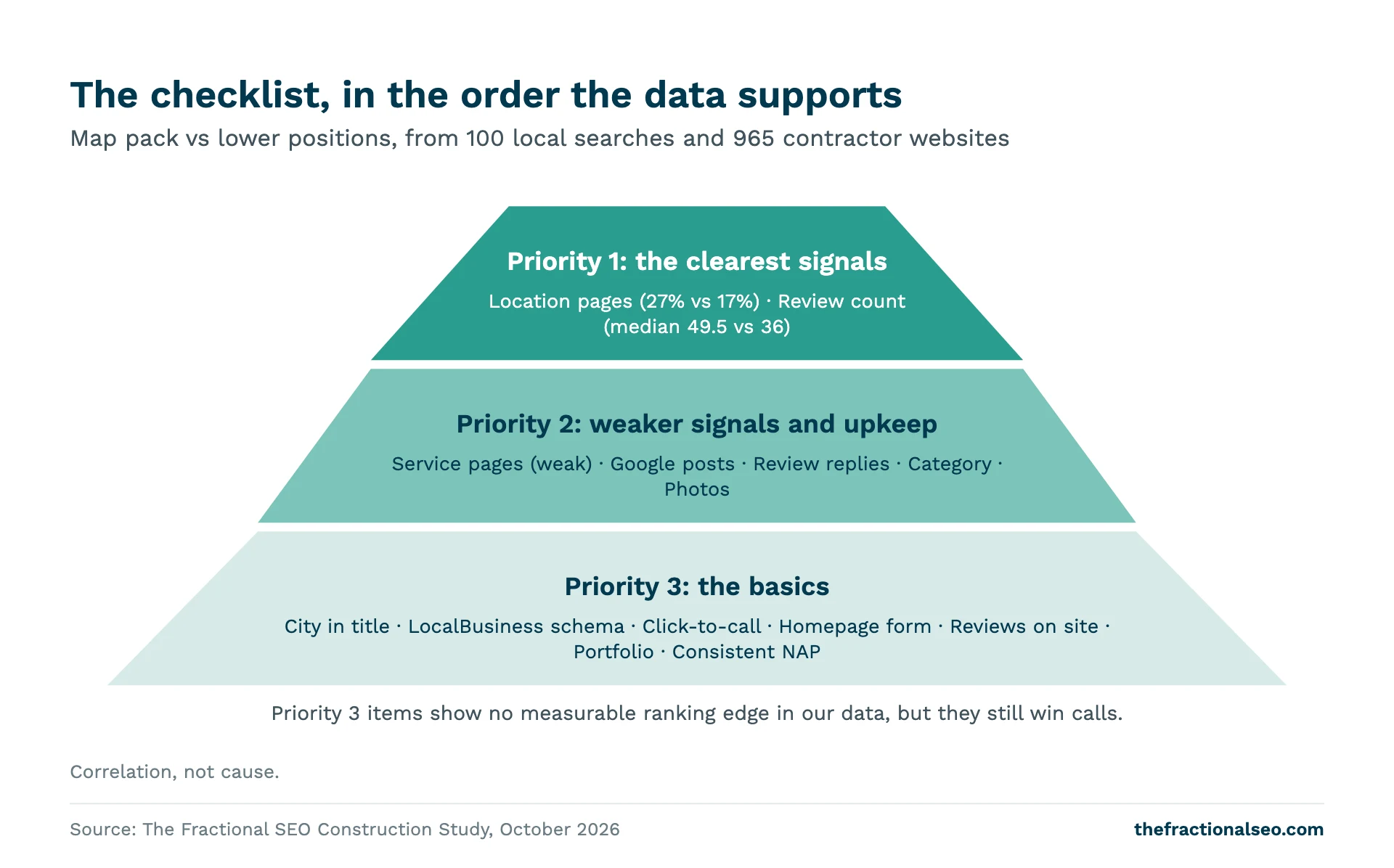
One honest note. This is a correlation study. It tells you what top-ranked contractors tend to have. It can’t promise that adding any item will move you up, and a firm with location pages and 50 reviews may also have years of history and links that we didn’t isolate. We think ordering by the data beats ordering by habit, which is how most checklists are built. But treat the order as a guide to where to spend time first, not a guarantee.
Priority 1: The clearest signals
Location or service-area pages
Contractors in the map pack are more likely to have location or service-area pages: 27% of map-pack sites vs 17% of sites at local positions 4+. We compared a set of website features at the same time, and this was the only one whose gap held up after correcting for the number of tests.
Note that it’s still a minority, even in the map pack. Most map-pack contractors don’t have these pages, which is exactly why they’re worth having. A location page is a page for a city or area you serve, with real local content: projects you built there, photos, a review from a customer in that town. A list of town names on one page doesn’t count, and neither does the same page copied with the city swapped.
- A location or service-area page for each main city or area you serve.
- Each page has unique local content: projects, photos, testimonials from that area.
- Location pages linked from a service-area hub page and from the main navigation or footer.
For how map-pack contractors build these, see our research on contractor location pages.
Review count
Map-pack businesses have more reviews: a median of 49.5 reviews for positions 1-3 vs 36 for positions 4-7. Of everything on a Google Business Profile, the number of reviews is the measure that differs most between the two groups. Star rating and recent review volume showed no clear difference.
- Review count compared with the local map-pack median for your type of work.
- A review request built into every job closeout.
To find the median for your trade and market size, see how many Google reviews a contractor needs for the map pack.
Priority 2: Weaker signals and upkeep
A page for each core service
Map-pack contractors are a little more likely to have dedicated service pages (81% vs 72%), but the gap is weak once you account for the number of comparisons run. It’s a lean, not a result. We’d still build them: a page for each core service gives Google and buyers a clear answer to “do you do this?”, and it’s where your location pages should link.
Google posts
About 3 in 10 contractor profiles returned no Google posts at all, and only 24% posted in the last 30 days. Posting is cheap and most firms skip it. A short post with a photo of a finished project, once a month, keeps your profile looking active to the buyers who see it.
Review replies
Contractors split on replying to reviews: 26% replied to none of their newest reviews, while 29% replied to 90% or more. We didn’t find a reliable ranking gap for replies. Do it anyway, because buyers read them.
Category and photos
Your profile’s primary category should match your main service, and the photos should be recent projects, not stock images. Both are covered step by step in our Google Business Profile guide for contractors.
- A dedicated page for each core service.
- A Google post published at least monthly.
- Replies to new reviews.
- Google Business Profile primary category matches your main service.
- Recent project photos on your profile.
Priority 3: The basics
This is where most checklists start. In our data it’s where the ranking edge runs out. Click-to-call links, homepage forms, review widgets, portfolios, LocalBusiness schema and a city in the title tag show no measurable ranking edge: top-ranked contractors have them at about the same rate as lower-ranked ones. Treat them as conversion basics, not ranking levers.
“No measurable edge” is not the same as “no effect”, and it’s certainly not a reason to skip them. A visitor who can’t tap to call from their phone, can’t find a quote form or can’t see your past work is a lead you lose after you’ve already won the click. These items turn traffic into calls.
Many contractors still don’t have them. 51% of contractor websites have their city in the homepage title tag. 46% of contractor websites have LocalBusiness structured data. If you’re missing either, it’s a quick fix for whoever manages your site.
- City in the homepage title tag.
- LocalBusiness schema on the homepage and location pages.
- Click-to-call phone link in the header.
- Contact or quote form on the homepage.
- Reviews or testimonials embedded on the site.
- Project portfolio or gallery.
- Name, address and phone consistent across your profile, website and top directories (Houzz, Yelp, BBB). See our guide to construction directories.
- Website linked from your Google Business Profile.
Ongoing monthly tasks
Local SEO isn’t a one-time setup. Once the list above is done, these three tasks keep it working. Put them on the calendar for the same day each month.
- Check your map-pack position for your top three searches, from a phone in your service area.
- Check your profile’s performance: calls, website clicks and direction requests.
- Add one new project page or update a location page with a recent job.
Each month, also send review requests for every job you closed. That keeps the Priority 1 work moving without a separate push.
Download the checklist
The Construction Local SEO Checklist. All 21 items in priority order, with a column for status, owner, date done and the benchmark from our study. Print the PDF, or copy the Google Sheet and track it with your team.
Rather have someone work through it with you? Talk to us about construction SEO.
Questions, answered
What should a local SEO checklist include for contractors?
Location or service-area pages and a growing review count first: those are the two clearest signals in our data. Then service pages, Google posts and review replies. Then the basics, like click-to-call, a quote form, schema and a city in your title tag, which show no measurable ranking edge but help convert visitors.
What should I do first for local SEO?
Build a location page for each main area you serve, and start asking for a review at every job closeout. Map-pack contractors are more likely to have location pages (27% vs 17%) and have more reviews (a median of 49.5 vs 36).
How often should I update my local SEO?
Monthly. Check your map-pack position and profile performance, publish a Google post, and add or update one project or location page. Review requests go out after every job.