
Research & Benchmark Construction
Do Contractors Need Location Pages? What 965 Contractor Websites Show
Only 28% of contractor websites have location or service-area pages. Yet in our study of 965 contractor sites, they were the one website feature that clearly leaned with map-pack rankings. Here is what the data shows, what it can't show, and how to build location pages that aren't thin copies.
We analyzed 100 local searches across 25 US metros and four contractor types, 1,034 contractor websites (965 crawled) and 457 Google Business Profiles, October 2026. Location pages were part of a wider look at the SEO mistakes most contractors make, and they turned out to be the most interesting result in it.
The short answer
- Few contractors have them: 28% of contractor websites have location or service-area pages; median among those that do: 5.
- Map-pack contractors are more likely to: 27% of map-pack sites vs 17% of sites at local positions 4+.
- It’s the one website feature that held up: of 18 comparisons, only this one survived a correction for the number of tests.
- It’s a correlation, not a cause. Even in the map pack, most contractors don’t have location pages.
- Build them only if you can make each one useful. Copied city-swap pages are a risk, not a shortcut.
How many contractor sites have location pages
28% of contractor websites have location or service-area pages; median among those that do: 5. In raw numbers, that’s 266 of the 965 sites we crawled.
By location page we mean a page built around a place: “Kitchen Remodeling in Frisco”, “Service Area: Cary, Apex and Holly Springs”, or a /locations/ section with a page per town. We found them by patterns in the page addresses (URLs). Checked against a hand review, that method agreed 78% of the time. So treat the 28% as close, not exact. Some sites have location pages our rules missed, and some pages we counted may be thinner than the name suggests.
Five pages is a modest number. Half the contractors with location pages have five or fewer, not a page for every suburb in the metro. That matches how contractors work: a home builder sells in a few communities, a remodeler drives 30 or 40 minutes from the shop and no further.
Compare that with the features nearly everyone has. 77% of contractor websites have dedicated service pages, and 70% have a project portfolio or gallery. Contractors are used to describing what they do and showing what they’ve built. Far fewer describe where.
Map-pack contractors are more likely to have them
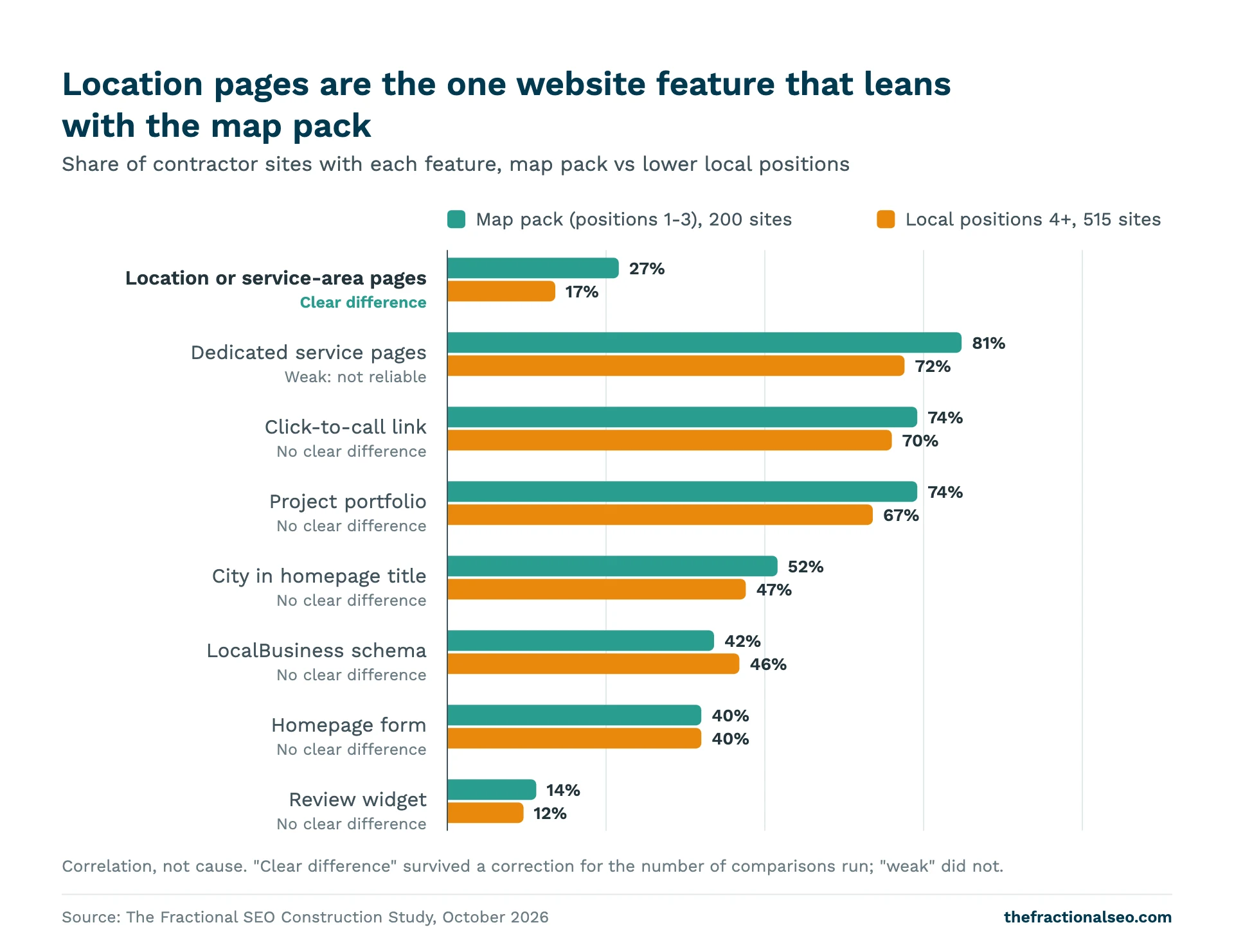
Contractors in the map pack are more likely to have location or service-area pages: 27% of map-pack sites vs 17% of sites at local positions 4+.
The map pack is the block of three business listings with a map that Google shows above the regular results for searches like “general contractor Denver”. For a local contractor it’s often the most valuable spot on the page. We compared 200 contractor sites that appeared in a map pack with 515 that showed up at local positions 4 and below.
Three things to keep in mind when you read that result.
First, it’s a correlation. We didn’t add location pages to sites and watch what happened. Contractors who take the time to build a page per town are often the same ones who have been in business longer, ask for reviews after every job and keep their Google Business Profile current. Any of those could be doing the work. The study can only say that location pages and map-pack rankings tend to go together.
Second, location pages are still a minority even in the pack. 27% means most map-pack contractors don’t have them. You can rank without them. They’re not a requirement, and nobody should sell them to you as one.
Third, the detection method has some noise in it (78% agreement with the hand-check), which applies to both groups equally. It blurs the numbers. It doesn’t create the gap.
With those limits stated, a 27% vs 17% split is a meaningful gap, and it’s consistent with what location pages are for: showing Google and the searcher that you work in a particular place.
Why this result stands out from the rest
We didn’t test location pages alone. We compared top-ranked and lower-ranked contractors on nine website features, in the map pack and in the organic results: 18 tests in all.
When you run 18 tests, one or two will usually look significant by chance. To guard against that we used a stricter bar, a Bonferroni correction. The study’s note puts it plainly: “18 tests at once: only location_pages in the map-pack comparison survives a Bonferroni correction (p<0.0028). Treat the others as weak."
Here’s what didn’t make it. Click-to-call links, homepage forms, review widgets, portfolios, LocalBusiness schema and a city in the title tag show no measurable ranking edge: top-ranked contractors have them at about the same rate as lower-ranked ones. Treat them as conversion basics, not ranking levers.
That contrast is the useful part. Most “local SEO checklist” advice treats every item as equally important. In our data, the items most contractor sites already have, or could add in an afternoon, did not separate top-ranked contractors from the rest. The one that did is the one that takes real work, which may be exactly why it separates them.
No difference found is not proof of no effect, and a few hundred sites can miss a small edge. But if you’re choosing where to spend the next month of website effort, the data points to location pages before schema or a review widget.
It’s a map-pack signal, not an organic one
The gap shows up in the map pack and not in the regular organic results. In the organic comparison, top-3 sites vs positions 4-10, 55% vs 50% had location pages, and that difference was not statistically meaningful (p=0.41).
Notice that both organic figures are much higher than the map-pack ones. Sites that rank on page one organically tend to be bigger, more built-out websites, so more of them have location pages whether they’re at the top or not.
It also helps to know that the map pack and the organic results are mostly different businesses: only 29% of map-pack contractors with a website also rank on page one organically for the same search. They’re two different races. Google ranks map-pack listings mainly on its own local factors, which Google describes as relevance, distance and prominence. A location page can feed relevance by making it clear that your business does this work in this place.
So if the goal is the map pack, location pages are worth the effort. If you’re chasing organic rankings for a broad term like “general contractor”, don’t expect location pages alone to move you.
What about service pages?
Map-pack contractors are a little more likely to have dedicated service pages (81% vs 72%), but the gap is weak once you account for the number of comparisons run. In the organic results there was no gap at all: 82% vs 84%.
Service pages are common already. Most contractors have them, so they don’t separate the top from the rest much. That doesn’t make them optional. A page per service you want to be hired for is the foundation that location pages build on. The best structure for many contractors is a set of service pages and a set of location pages, linked to each other. Our guide to on-page SEO for home builders and remodelers covers how to write the service side.
How to build location pages that aren’t thin
This part is best practice from our own work, not study data.
The failure mode is well known. Someone builds one page, copies it 30 times, swaps “Plano” for “Frisco” and “Allen”, and publishes. Each page says the same thing about a different town. Google’s spam policies name “multiple domain names or pages targeted at specific regions or cities that funnel users to one page” as an example of doorway abuse. Those pages tend to get ignored, and they make the whole site look lower quality.
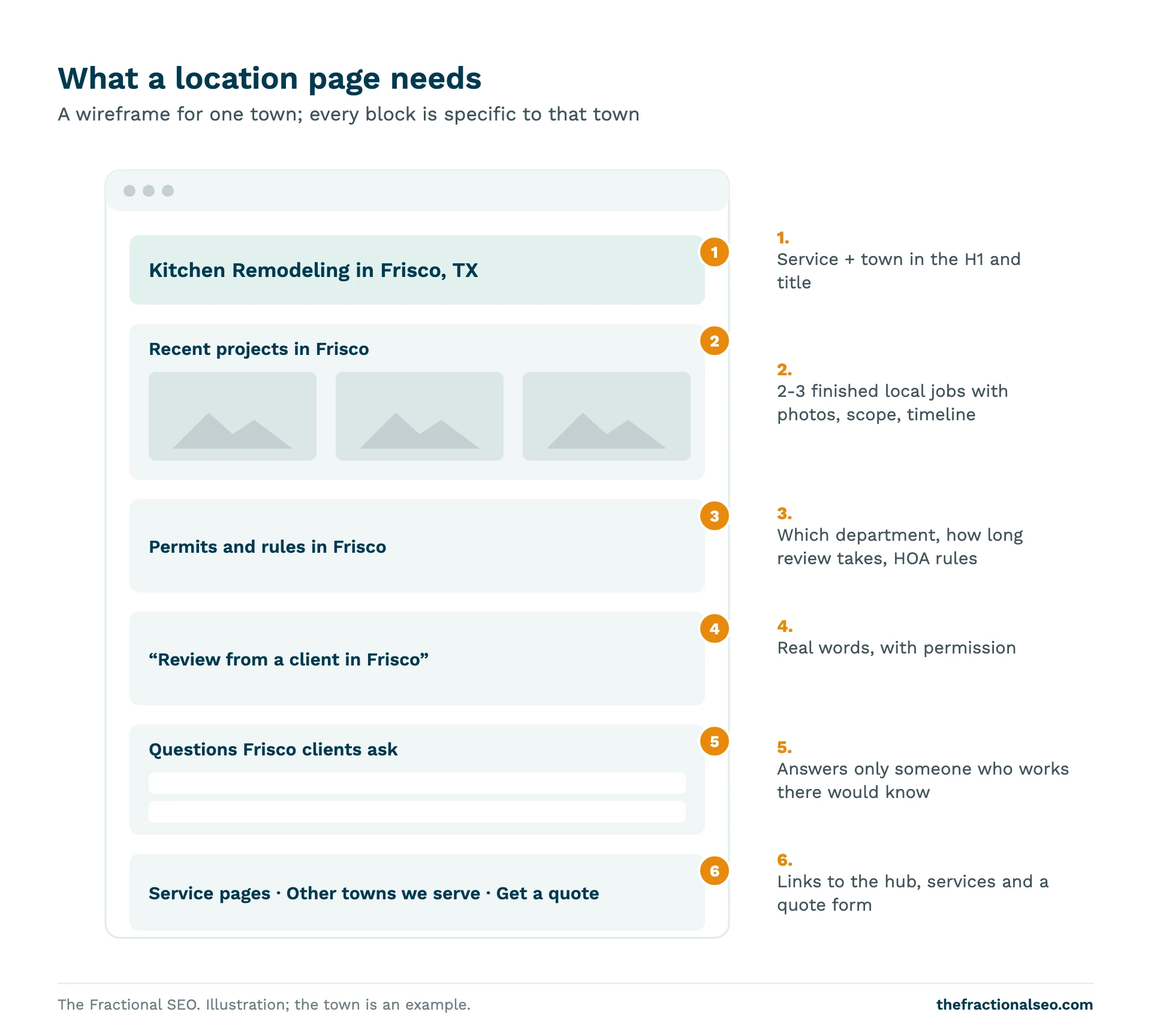
A useful location page answers the question a homeowner or developer in that town actually has: have you done work like mine, here? Give each page things only that town can have:
- Projects in that town. Two or three finished jobs with photos, the scope, the timeline and the neighborhood or street name if the client agrees. This is the strongest proof you can offer, and it’s the content your competitors can’t copy.
- Local permits and rules. Which building department handles permits, how long plan review usually takes, HOA or historic-district rules that affect what can be built. Write what you know from doing the work there.
- A review from a client in that town. Real words, with permission, ideally linked to your Google Business Profile.
- Questions people there ask. Lot sizes in a new subdivision, basement rules near the river, whether you work on older homes in the historic district.
- The crew and the logistics. Which office serves the town, typical drive time, who the site supervisor would be.
Then structure the pages so they link sensibly. A common setup is hub and spoke: one “Areas we serve” page that lists every town and links to each location page, and each location page linking back to the hub and to the relevant service pages. Link to location pages from project write-ups in that town too.
Two practical rules. Give every location page its own title tag and H1 naming the service and the town. And if you can’t think of anything specific to say about a town, don’t build a page for it yet. Go do a job there first.
For the rest of the local picture, from your Google Business Profile to citations, see our guide to local SEO for construction companies and the local SEO checklist.
How many location pages should you make?
The study can’t give you a number. Among contractors that have location pages, the median is 5, but that describes what contractors have built, not what works best.
A better way to decide: list the towns where you want more work and where you’ve already completed projects. That overlap is your first set of pages. For most contractors it’s a handful. Add a town when you have a real project there to show. Five good pages beat 40 thin ones.
If you’d like help planning your service-area pages, talk to The Fractional SEO about construction SEO.
FAQs
Do location pages help local SEO?
In our study, contractors in the map pack were more likely to have location or service-area pages: 27% vs 17% of sites at local positions 4+. It was the only website feature that held up after correcting for the number of tests. That’s a correlation, not proof they cause higher rankings.
How many contractor websites have location pages?
28% of the 965 contractor websites we crawled have location or service-area pages. Among those that do, the median is 5.
Do location pages help Google Maps rankings?
The gap we found was in the map pack, the listings shown with Google Maps. In the organic results the difference was small (55% vs 50%) and not statistically meaningful.
Can location pages hurt my site?
Copied pages with only the city name changed can. Google’s spam policies treat city-targeted pages that funnel users to one page as doorway abuse. Build pages with real local projects and information, or don’t build them.
More research & benchmarks
The whole Construction library- Who Wins Local Construction Searches in 2026: A Benchmark of 100 Searches Who holds page one and the map pack for local construction searches, by contractor type, across…
- How Many Google Reviews Does a Contractor Need to Make the Map Pack? Review benchmarks from 300 map-pack listings, by contractor type and market size, and how to set…
- We Analyzed 965 Construction Websites: The SEO Mistakes Most Contractors Make Eight SEO mistakes measured across 965 contractor websites, and the one website feature that clearly leans…