
Research & Benchmark Construction
Who Wins Local Construction Searches in 2026: A Benchmark of 100 Searches
When a homeowner searches for a remodeler, or a developer looks for a commercial contractor, who actually shows up? We ran 100 local construction searches to find out. The short version: contractors aren't only competing with each other. Directories, social sites and other non-contractor pages hold a large share of page one, and the businesses in the map pack are mostly not the ones ranking in the organic results below it.
We analyzed 100 local searches across 25 US metros and four contractor types, 1,034 contractor websites (965 crawled) and 457 Google Business Profiles, October 2026.
There’s plenty of data on the size of the construction market. There’s very little on how construction firms show up when buyers search. That matters for a simple reason: a buyer who searches “general contractor” plus their city sees a page of options, and only some of them are contractors. If you know who holds those spots, you know who you’re really up against, and which parts of the page are worth fighting for.
Each search was a contractor type plus a metro name, for four types (general contractor, remodeler, home builder, commercial contractor) across 25 US metros: 10 large, 10 mid-sized and 5 small. We recorded the top 10 organic results and the Google Maps list for each search, then crawled and measured the contractor websites we found.
Key findings
- 43% of page one isn’t contractors. Only 57% of page-one organic results for local construction searches go to contractor websites; 43% go to directories, social sites, news, government pages, trade associations and chambers of commerce.
- The top spot often isn’t either. A non-contractor site holds the #1 organic spot in 28% of searches, and 40% of all top-3 spots.
- Map pack and organic are different races. Only 29% of map-pack contractors with a website also rank on page one organically for the same search.
- General contractor searches are the most crowded. Contractor sites hold 50% of page one for general contractor searches, 62% for commercial contractor searches.
- Local firms dominate. Franchises and national brands are 35 of 1,034 contractor domains (3%).
Who holds page one
Across the 100 searches we recorded 984 organic results on page one. Only 57% of page-one organic results for local construction searches go to contractor websites; 43% go to directories, social sites, news, government pages, trade associations and chambers of commerce.
In counts: 558 of the 984 results were contractor sites. Directories took 239, social sites 95, news sites 21, government pages 3, and trade associations, chambers of commerce and “best contractors in” listicles 68.
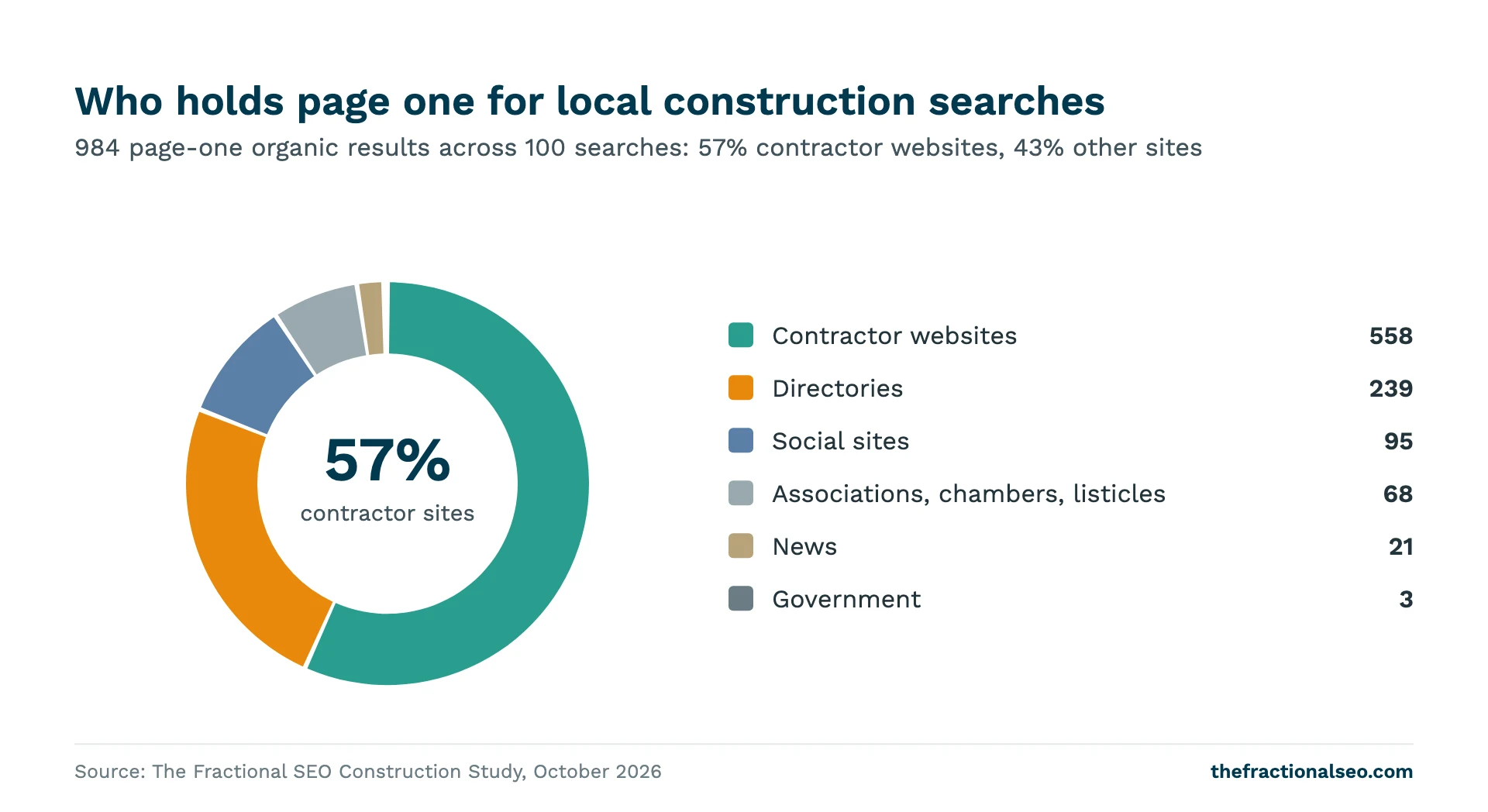
The top of the page is no better. A non-contractor site holds the #1 organic spot in 28% of searches, and 40% of all top-3 spots. In 28% of these searches, the first organic result a buyer sees is a directory, a forum thread or a list rather than a firm that could build the job.
This isn’t a sign that contractor websites are doing something wrong. Google shows directories because many searchers want to compare several firms at once, and a directory page answers that better than any single contractor’s homepage. It does mean two things for a contractor’s marketing. First, your organic competition includes Houzz and Yelp, which have far more authority than a local firm’s site. Second, those directory pages are themselves a place to be seen: a buyer who clicks the Houzz result may still find you, if your profile there is complete and well reviewed.
It also means some page-one spots aren’t realistically available. A contractor site can outrank a weak directory page, but it usually won’t outrank all of them. The spots that are realistically available are the remaining organic positions and, for most searches, the map pack.
Which non-contractor sites show up most
The directories contractors compete with most often on page one: houzz.com (66), yelp.com (65), bbb.org (17), homeadvisor.com (13), procore.com (12), thumbtack.com (12), clearlyrated.com (9), newhomesource.com (8). The counts are appearances across the 100 searches.
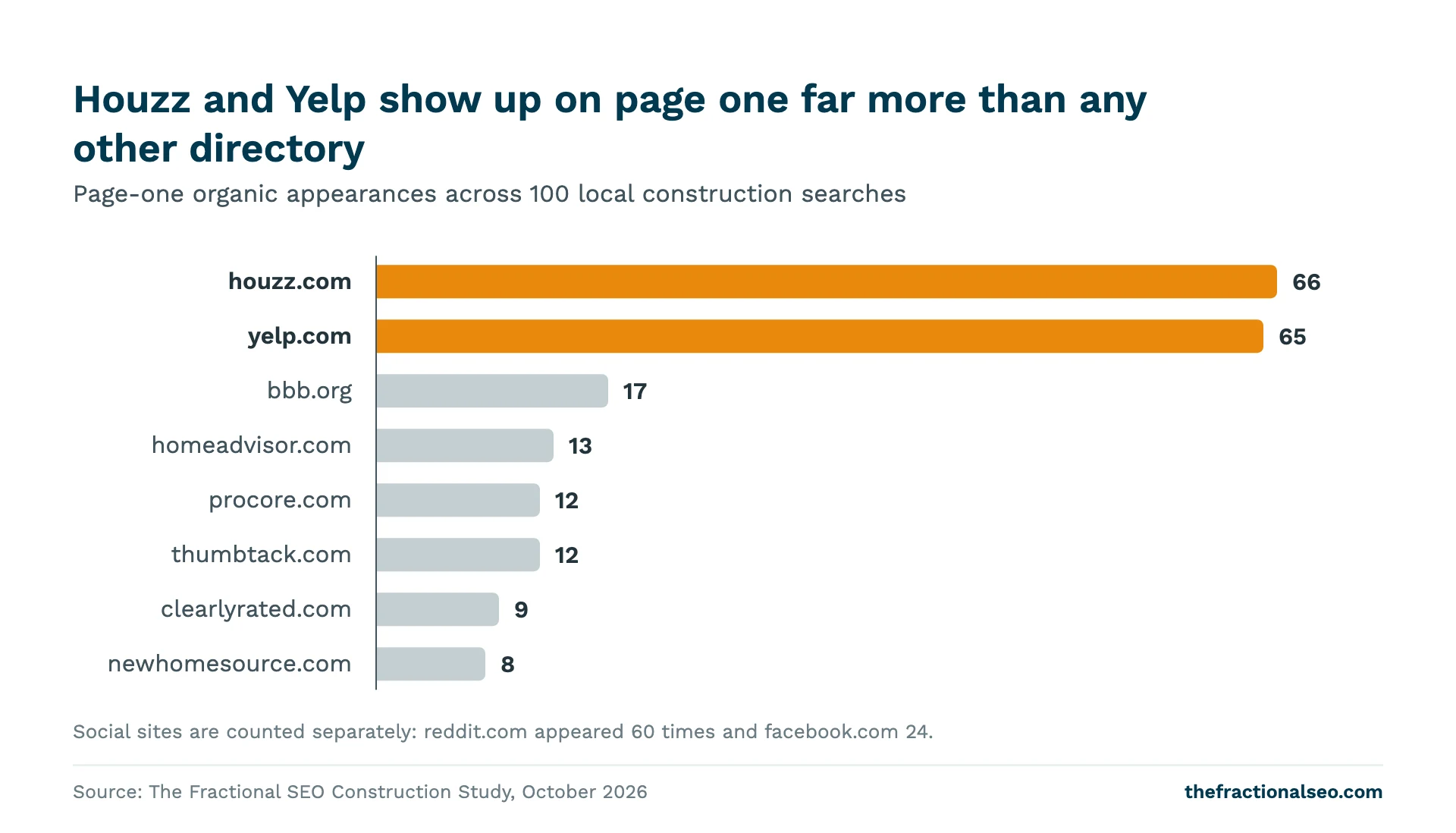
Social sites are counted separately from directories. Reddit appeared 60 times and Facebook 24; if they were on the same list, they’d rank third and fourth among all non-contractor domains. Reddit’s presence is worth noticing: buyers asking “who’s a good remodeler in my city” on a forum now get that thread shown back to them in search.
The list also says something about the buyers. Houzz, Yelp and BBB are homeowner-facing. Procore and ClearlyRated lean toward commercial work. NewHomeSource is for new homes. Which directories you see depends on which kind of contractor the searcher wants, which is a good guide to which profiles a firm should keep up.
For which directories are worth your time and how to set them up, see our guide to Houzz, Yelp, BBB and other construction directories.
How it changes by contractor type
The share of page one that goes to contractor sites varies by the kind of search.
| Search type | Share of page-one results that are contractor sites |
|---|---|
| General contractor | 50% |
| Remodeler | 56% |
| Home builder | 60% |
| Commercial contractor | 62% |
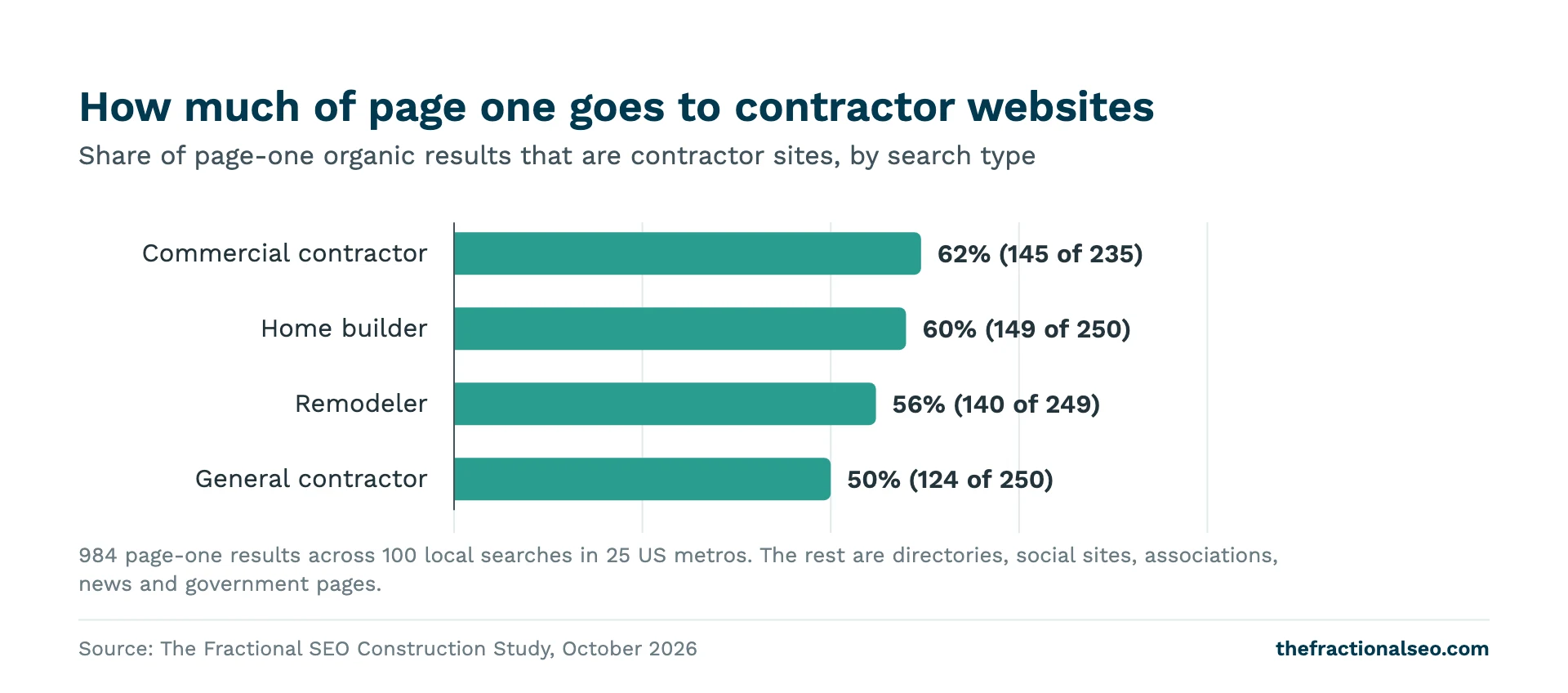
General contractor searches are the most crowded with non-contractor results. Only half of page one goes to contractors. That’s the broadest term of the four, and broad terms attract directories and lists that try to cover every kind of job. Commercial contractor searches have the highest contractor share, partly because the big homeowner directories have less to offer a commercial buyer.
Two practical notes. If general contractor is your main search, the organic results are the hardest of the four to break into, and the map pack and directory profiles carry more of the load. If you can describe your work with a more specific term (a home builder, a commercial contractor, a remodeler for kitchens), you’re competing on a page with more room for contractor sites. Each percentage is a share of roughly 250 results per type, so treat differences of a few points as rough.
Map pack and organic are two different races
Many owners assume that ranking well in one part of Google means ranking well in the other. Our data says they’re mostly different businesses. Only 29% of map-pack contractors with a website also rank on page one organically for the same search.
Put the other way, most of the firms in the map pack for a search don’t appear in the organic results below it. That fits how the two work. The map pack leans heavily on the Google Business Profile, the firm’s location relative to the searcher, and reviews. Organic rankings lean on the website itself: its pages, its content and the links pointing to it. A firm can be strong on one and weak on the other.
Another detail: 16% of map-pack listings show no website link on the Maps list card. Some of those firms may have a website that Maps didn’t show on the card, but a buyer scanning the list sees no link either way. If your listing is one of them, check that your profile has a website set.
The practical takeaway is to treat these as two jobs. The profile work (category, reviews, posts, photos) is for the map pack. The website work (service pages, location pages, links) is for organic. Our research on contractor location pages found location pages are the one website feature that lines up with the map pack too, which makes them a rare piece of work that serves both.
Local firms vs national brands
In some local trades, national franchises crowd out independents. Construction isn’t one of them. Franchises and national brands are a small share of local construction results: 35 of 1,034 contractor domains (3%).
That count covers both franchise networks and national firms large enough to have offices in many metros, the kind of names that show up on big commercial projects. Even with both included, nearly every contractor a buyer sees in a local search is a local or regional firm.
For a local contractor that’s good news. Your competition on page one is mostly other local firms of similar size, plus the directories. The firms beating you usually don’t have a national marketing budget behind them. They’ve just done more of the local work.
Traffic benchmarks
How much search traffic does a contractor website get? The median contractor website gets an estimated 507 organic visits a month; 21% get fewer than 100.
By contractor type, the median estimated organic traffic is: home builder 833; commercial contractor 461; general contractor 438; remodeler 531. Home builders lead, which fits the keyword data: searches like “new construction homes near me” are high-volume compared with most contractor terms.
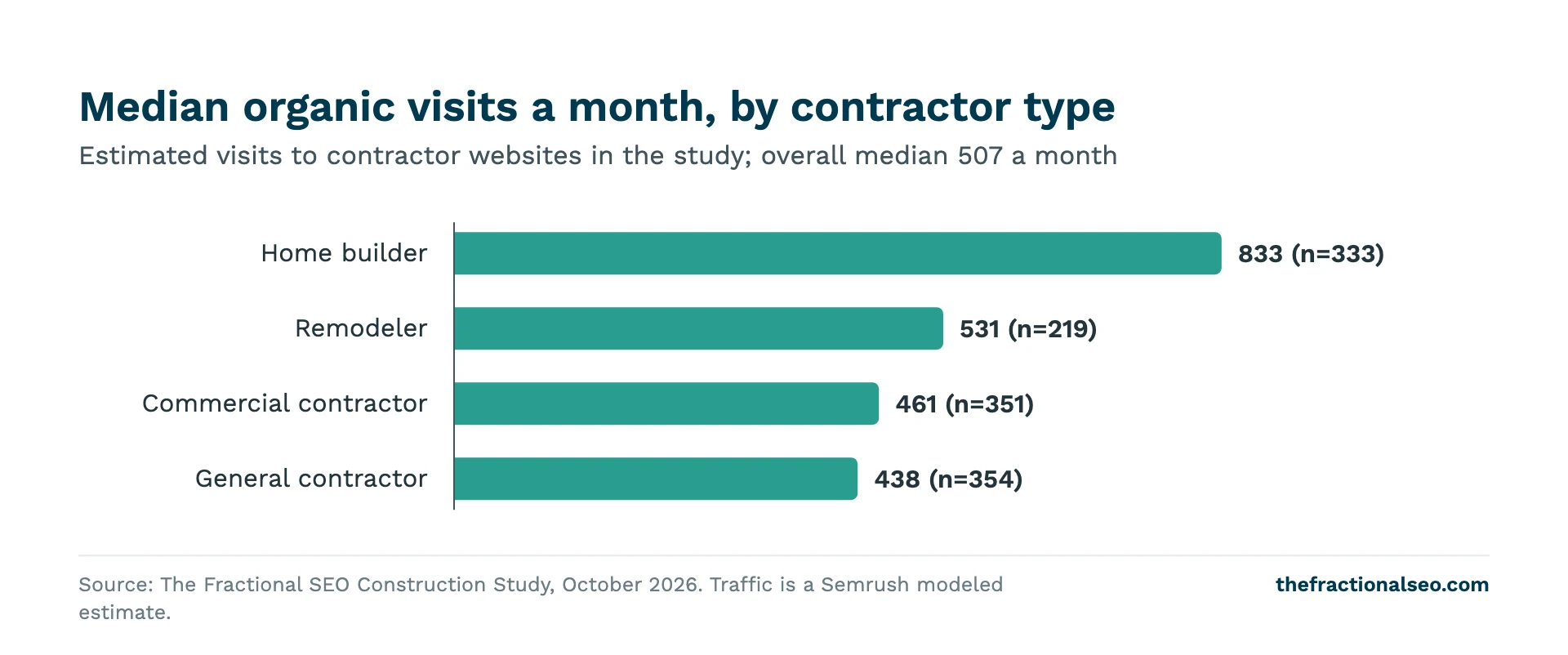
These are Semrush estimates, which are modeled rather than measured. They’re good for comparing sites with each other and less good as an exact count of your own visitors. Your own Google Analytics or Search Console figures will differ. Use the medians as a rough benchmark: if your estimate is under 100 a month, you’re in the 21% at the bottom of the range.
Website and Google Business Profile benchmarks
Our flagship study of 965 construction websites covers websites in depth. Three numbers from it are worth having here, because they show how much routine work most firms skip.
Blogs: 50% of contractor sites have a blog, but only 14% published anything in the last 12 months and 6% averaged one post a month. Most contractor blogs are abandoned.
Platforms: WordPress runs 80% of contractor sites where the platform could be identified; next are Wix 9%, GoDaddy 3%, Webflow 2%, HubSpot 1%, Homefiniti 1%. Whatever your platform, the firms you compete with are probably on WordPress.
Google posts: about 3 in 10 contractor profiles returned no Google posts at all, and only 24% posted in the last 30 days. Posting is cheap and most firms don’t do it.
None of these numbers says that blogging or posting will move you up. They describe how the field behaves. But when only 24% of profiles posted in the last 30 days, a steady routine is an easy way to look more active than the firm next to you.
What a click costs
Some firms skip organic search and buy their way onto page one with Google Ads. Here’s what that costs at the top end. The most expensive construction clicks on Google Ads: commercial roofing contractors near me $31.65; commercial roofing contractors $29.00; shower remodel contractors $26.09; roof contractor near me $26.01; commercial painting contractors near me $24.43.
These are average cost-per-click estimates from Semrush across 242 construction keywords. What you pay depends on your bids, your ad quality and your competition. But they show why organic and map-pack visibility are worth the effort: at prices like these, every click you earn without paying is a click you didn’t buy.
What this means for contractors
The study describes who ranks. It doesn’t prove what makes them rank. With that caution, here’s how we’d read it.
- Plan for two races. Map pack and organic are mostly different businesses. Decide which one matters most for your main searches, and do the work for each.
- Count directories as competition and as channels. Houzz, Yelp and BBB hold page-one spots you probably won’t take. Make sure your profiles there are complete, so buyers who click them can still find you.
- Use the most specific term that fits. General contractor searches leave the least room for contractor sites. Pages built around the specific work you do face less directory competition.
- Do the routine work most firms skip. Recent Google posts and an active blog are rare. Doing them won’t guarantee a ranking, but it sets you apart from firms that look inactive.
- Check your Maps listing has a website link. 16% of map-pack listings show none.
For the full playbook, see our construction local SEO guide, and our study of how local reviews line up with rankings.
Want to see where your firm stands in your own market? Book a local search review.
How we did this
We analyzed 100 local searches across 25 US metros and four contractor types, 1,034 contractor websites (965 crawled) and 457 Google Business Profiles, October 2026.
Searches were a contractor type plus a metro name, for four types across 25 US metros (10 large, 10 mid-sized, 5 small), page one only. Organic results came from Semrush’s top 10; map-pack results from the Google Maps list, sponsored listings excluded.
Samples: 984 organic results across 100 searches (who holds page one, directories, contractor type); 300 map-pack listings (map pack vs organic, website links); 1,032 domains with a traffic estimate (traffic benchmarks); 1,034 contractor domains (franchises); 457 profiles (Google posts); 798 sites with a known post count (blogs); 681 sites with an identified platform (platforms); 242 keywords (click costs). Traffic and cost-per-click are Semrush estimates, modeled rather than measured.
What it can’t claim: this describes who ranks in October 2026. It doesn’t show why they rank, and results vary by city, by searcher location and over time.
Questions, answered
Why do directories outrank contractor websites?
Because many searchers want to compare several firms, and a directory page does that in one click. Houzz (66 appearances) and Yelp (65) were the most common across our 100 searches. Directories and other non-contractor sites hold 43% of page one.
Is the map pack the same as the organic results?
Mostly not. Only 29% of map-pack contractors with a website also rank on page one organically for the same search. The map pack leans on your Google Business Profile; organic leans on your website.
Which contractor type has the most competition from directories?
General contractor searches. Only 50% of page one goes to contractor sites, compared with 62% for commercial contractor searches.
How much organic traffic does a typical contractor website get?
The median contractor website gets an estimated 507 organic visits a month, and 21% get fewer than 100. These are Semrush estimates, so compare them with each other rather than with your own analytics.
More research & benchmarks
The whole Construction library- How Many Google Reviews Does a Contractor Need to Make the Map Pack? Review benchmarks from 300 map-pack listings, by contractor type and market size, and how to set…
- Do Contractors Need Location Pages? What 965 Contractor Websites Show Only 28% of contractor sites have location pages, yet they were the one website feature that…
- We Analyzed 965 Construction Websites: The SEO Mistakes Most Contractors Make Eight SEO mistakes measured across 965 contractor websites, and the one website feature that clearly leans…