
Guide Construction
The Ultimate Guide to Local SEO for Construction Companies
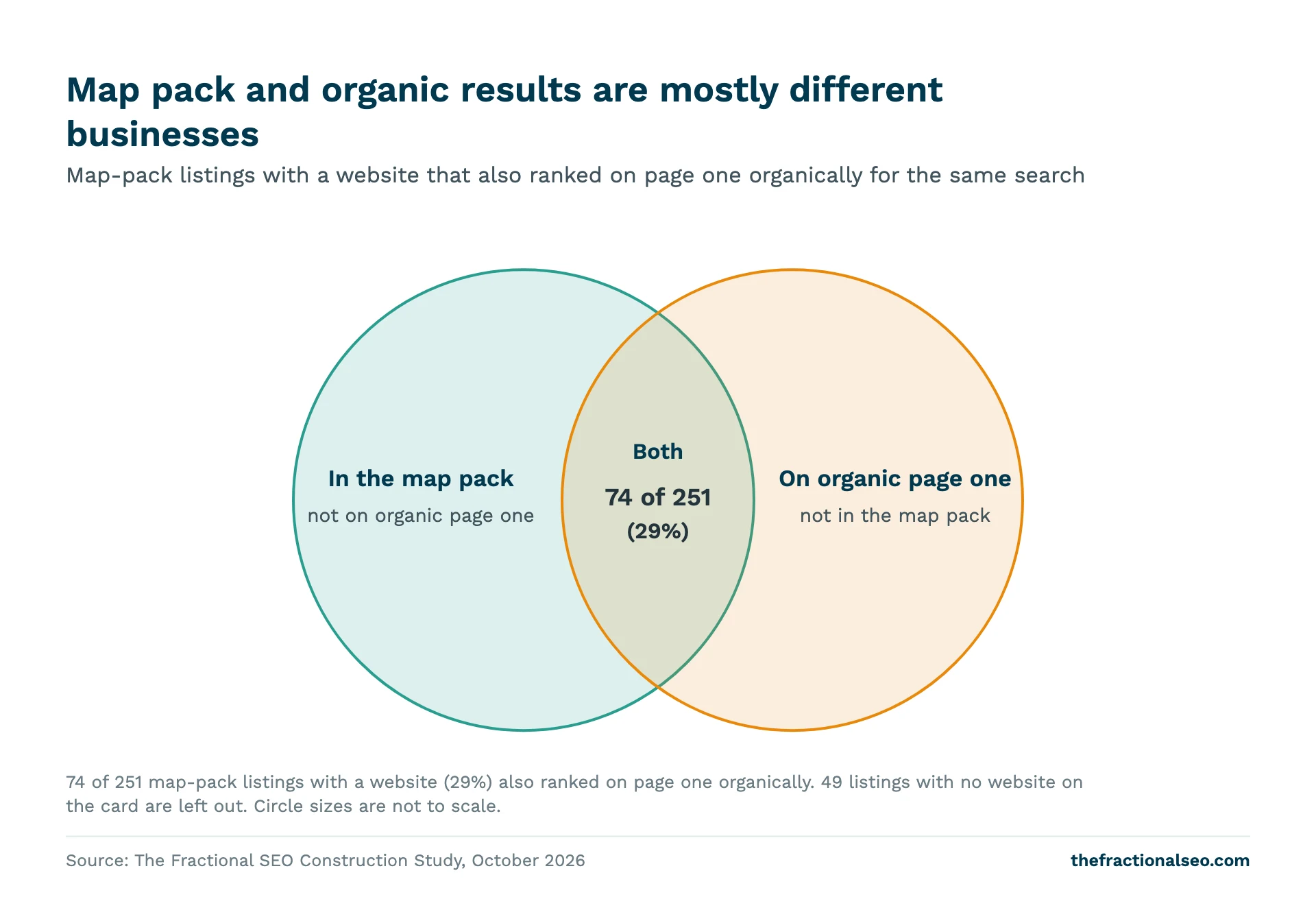
Local SEO for a construction company is two jobs, not one. In our study, only 29% of map-pack contractors with a website also ranked on page one organically for the same search. And 43% of page-one organic results went to directories, social sites and other pages that weren't contractors at all. You need a plan for the map pack and a separate plan for the organic results. This guide gives you both, ordered by what the data shows.
The short answer
- Two races: the map pack and the organic results are mostly different businesses (29% overlap).
- Map pack: a complete Google Business Profile and a steady flow of reviews. Map-pack businesses had a median of 49.5 reviews vs 36 just below.
- Organic: location and service-area pages, the clearest website signal (27% of map-pack sites have them vs 17% below).
- Directories: Houzz and Yelp show up on page one more than any other site. Claim and complete them.
- Table stakes: schema, a city in the title and click-to-call help buyers but showed no ranking edge.
About the data: We analyzed 100 local searches across 25 US metros and four contractor types, 1,034 contractor websites (965 crawled) and 457 Google Business Profiles, October 2026. Where we compare higher- and lower-ranked contractors, the results show what tends to go together, not what causes a ranking. Full results: We Analyzed 965 Construction Websites and Who Wins Local Construction Searches in 2026.
If you’re new to SEO, start with A Beginner’s Guide to SEO for General Contractors. If you want a printable list, use the Local SEO Checklist for Construction Companies. This is the long reference.
What the local results page looks like for construction
Search “general contractor” or “home builder” with a city name and Google shows two blocks. The map pack sits near the top: three businesses, a map, star ratings and buttons to call or get directions. Below it are the organic results, ten web pages ranked by Google’s normal search algorithm.
Most contractors treat these as one thing. Our data says they aren’t. Of the map-pack contractors that had a website, only 29% also ranked on page one organically for the same search. Most of the firms you see in the map pack are not the firms you see in the blue links below it, and the other way round.
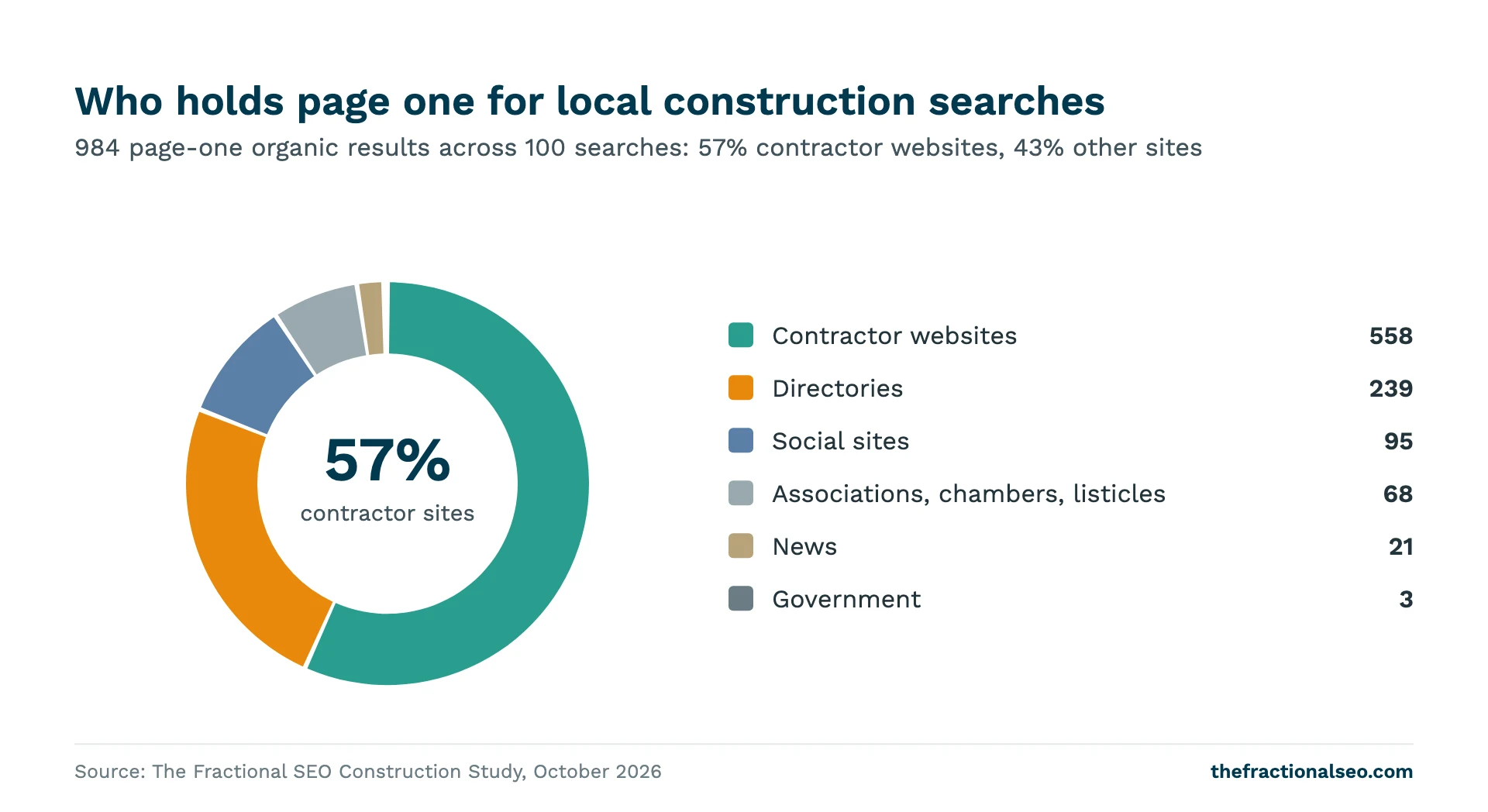
The organic half is also crowded with sites that aren’t contractors. Only 57% of page-one organic results went to contractor websites. The other 43% went to directories, social sites, news, government pages, trade associations and chambers of commerce. A non-contractor site held the #1 organic spot in 28% of searches, and 40% of all top-three spots.
| Type of page-one organic result | Results (of 984) |
|---|---|
| Contractor websites | 558 |
| Directories | 239 |
| Social sites | 95 |
| Associations, chambers and listicles | 68 |
| News | 21 |
| Government | 3 |
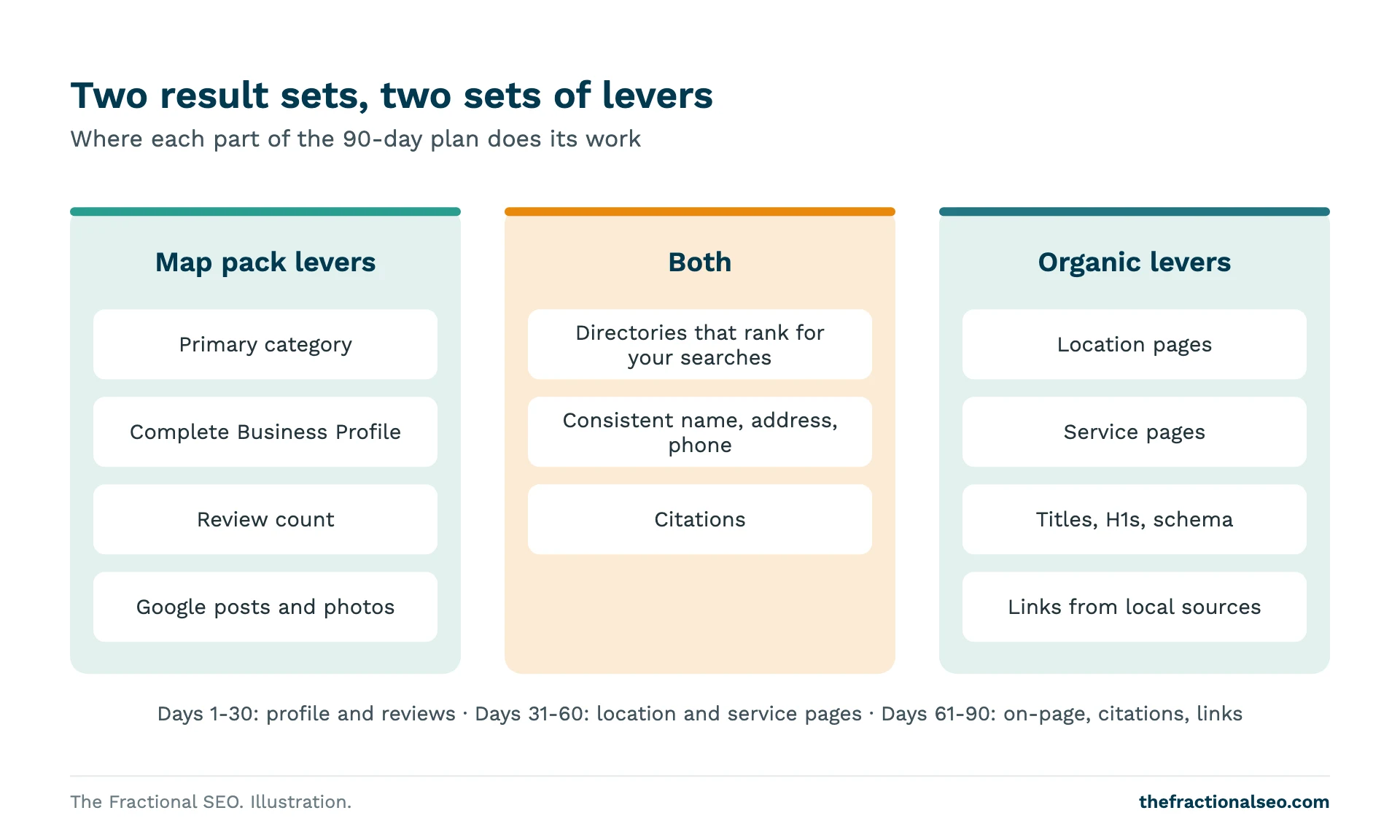
Google says local results depend mainly on relevance, distance and how well-known a business is. Distance is out of your hands: a searcher across town sees a different pack. Relevance and prominence are the parts you can work on, and they’re built in different places for the two blocks. The map pack runs on your Business Profile and reviews. The organic results run on your website and the links pointing to it. That’s why the plan below has two parts, plus a third for the directories that sit in between.
Part 1: Winning the map pack
Set up and complete your Google Business Profile
Your Business Profile is the map-pack entry. Get the fundamentals right before anything else.
Primary category. This is the single most important field for relevance. Among map-pack contractors in our sample, the most common primary categories were general contractor (99), construction company (64), home builder (36), custom home builder (34), remodeler (12) and contractor (8). Pick the one that describes most of your revenue. Google’s guidelines say to use as few categories as possible, choose ones that are specific but representative, and not to use categories as keywords. Add secondary categories only for work you genuinely do.
Business name. Use your real name, exactly as it appears on your signs and paperwork. The same guidelines say unnecessary information in the name isn’t permitted, and it can get a profile suspended. “Smith Construction” is fine. “Smith Construction | Best General Contractor Denver” is not.
Address and service area. If clients don’t come to your office, Google says a service-area business should hide its address and set a service area. Keep that area realistic: the guidelines say it shouldn’t extend farther than about two hours’ driving from your base, though larger areas may suit some businesses.
Website link. In our sample, 16% of map-pack listings showed no website link on the Maps list card. Some of those businesses may have a site that Maps didn’t show. Either way, a listing without a visible website sends every curious buyer back to Google. Fill in the field, and point it at your homepage or, for a multi-office company, the page for that office.
Everything else. Services that match your service pages, accurate hours, a plain description of what you build and where, and real photos of your projects and crew. Keep the phone number the same as on your website. The step-by-step version is in the Google Business Profile Optimization Guide for Contractors.
Build your review count
Review count was the clearest map-pack signal in our data. Businesses in positions 1-3 had a median of 49.5 Google reviews. Those at positions 4-7 had a median of 36. The difference was strong statistically, but it’s still a correlation: firms that have been around longer tend to have more reviews and other advantages too.
The bar was similar across market sizes. The median map-pack business had 50 reviews in large metros, 51 in mid-size metros and 45 in small metros. A smaller city doesn’t mean a much lower bar.
Star rating, on the other hand, didn’t separate anyone. The median was 4.8 both in the map pack and at positions 4-7, because nearly every contractor sits between 4.7 and 5.0. Chasing a perfect 5.0 matters less than getting more clients to leave a review at all.
A review routine that works on construction jobs:
- Ask at the high points: the final walkthrough, handover, or the day a punch list closes.
- Make it one tap. Google suggests sharing a review link or a QR code; put it on a leave-behind card and in the closeout email.
- Have the person the client dealt with do the asking, not an automated email from someone they’ve never met.
- Ask every client, not just the ones you expect to be happy.
- Reply to reviews, good and bad, in a sentence or two that sounds like a person.
Two things to avoid. Google’s content policy prohibits offering incentives such as discounts or gifts in exchange for reviews, and prohibits selectively asking for positive reviews. Both can cost you the reviews you have.
For the review benchmarks by trade and market, see How Many Google Reviews Does a Contractor Need to Make the Map Pack? and The Impact of Local Reviews on Construction Company Rankings.
Posts, photos and replies
These get a lot of attention in local SEO advice. Our data says to keep them in proportion. Recent Google posts were more common in the map pack: 28% of map-pack businesses had posted in the last 30 days, against 19% at positions 4-20. That’s a moderate result. Map-pack profiles had somewhat more photos (median 67 vs 56), and their owners replied to more reviews (median 60% of their newest 20 vs 40%), but neither gap was statistically reliable in our sample.
Our read: post when you have a real project to show, keep adding project photos, and reply to reviews because buyers read the replies. Don’t expect any of these to make up for a thin review count. The detail is in the Business Profile guide.
Part 2: Winning organic results
Location and service-area pages
This is where the website side of local SEO starts. Only 28% of contractor websites had location or service-area pages, with a median of 5 among those that did. Contractors in the map pack were more likely to have them: 27% of map-pack sites against 17% of sites at local positions 4 and below. Of all the website features we tested, this was the only difference that held up after correcting for the number of tests.
Two cautions. First, it’s a correlation, and most map-pack sites still had no location pages, so they are not a requirement for the pack. Second, in the organic comparison the gap was small and not reliable (55% of top-three sites vs 50% at positions 4-10). Location pages track with map-pack visibility more than with organic rankings in our data. They’re still the page an organic searcher in that town should land on.
A location page that earns its place includes:
- A title and H1 with the service and the town: “General Contractor in Arvada, CO”.
- Projects you finished in that town, with photos and a short scope.
- Local detail a competitor couldn’t copy: the permit office, common housing stock, soil or code issues you deal with.
- Reviews from clients in that area.
- Links to your relevant service pages, and a call or form.
What it can’t be is a copy of another page with the town swapped. Google’s spam policies list pages targeted at specific regions or cities that funnel users to one page as doorway abuse. Start with the towns where you do the most work. The data is in Do Contractors Need Location Pages?
On-page local signals
Two basics most guides list first: a city in your title tag and LocalBusiness structured data. In our crawl, 51% of contractor websites had their city in the homepage title tag (a lower bound, since we matched the metro name only), and 46% had LocalBusiness structured data.
Here’s the expectation-setting part. In our ranking comparison, click-to-call links, homepage forms, review widgets, portfolios, LocalBusiness schema and a city in the title tag showed no measurable ranking edge. Top-ranked contractors had them at about the same rate as lower-ranked ones. No difference found isn’t proof of no effect, but it does mean these won’t lift a site on their own.
Do them anyway, for the right reasons:
- Title tags: name the service and the place on every key page. It helps searchers pick your result, and Google asks for descriptive, unique titles.
- LocalBusiness schema: mark up your name, address, phone, URL and hours. Google’s documentation requires name and address and is clear that it doesn’t guarantee any search feature.
- Name, address and phone: show them in the footer, exactly as on your Business Profile.
- Click-to-call and a quote form: they turn visits into leads, which is the point of ranking.
Page-by-page detail for titles, headings and project pages is in Mastering On-Page SEO for Home Builders and Remodelers, and the conversion side is in How to Generate Construction Leads with SEO.
Local links
Links from other websites are one of the ways Google judges how well-known a business is, and Google’s local ranking page mentions links by name. For a construction company, the best ones are local and earned through work you already do:
- Suppliers and manufacturers that list certified or preferred installers.
- Trade associations, builder associations and your chamber of commerce.
- Subcontractors and architects you work with regularly.
- Local news coverage of a notable project, a community build or a sponsorship.
- Schools, teams and charities you support.
Ask for the link at the moment you’re already in contact. The full approach is in How to Build Backlinks for Your Construction Business.
Part 3: Directories and citations
Directories are both competition and opportunity. They take page-one spots you’d like, and a buyer who finds you on one can still call you. These are the directories that appeared most often on page one across our 100 searches:
| Directory | Page-one appearances |
|---|---|
| houzz.com | 66 |
| yelp.com | 65 |
| bbb.org | 17 |
| homeadvisor.com | 13 |
| procore.com | 12 |
| thumbtack.com | 12 |
| clearlyrated.com | 9 |
| newhomesource.com | 8 |
Which ones matter depends on your trade and your market, so check rather than guess. Search your own main terms with your city name and note which directories rank on page one. Those are the profiles to claim first.
For each one: claim the listing, use the same business name, address and phone as your Business Profile, pick the right category, add real project photos and link to your website. Consistent details across directories help Google and buyers confirm they’re looking at the same company. Then ask some clients to review you there as well as on Google.
Whether paid tiers on these platforms are worth it is a separate question. We cover it in Houzz, Yelp and BBB: Why Directories Outrank Contractors, and How to Use Them.
A 90-day local SEO plan
The order matters more than the speed. Start with the work closest to the evidence.
Days 1 to 30: Business Profile and reviews
- Audit and complete your Business Profile: category, name, service area, website link, services, hours, photos.
- Set up a review routine and ask every client who finished a job in the last year.
- Reply to every review that doesn’t have a reply.
Days 31 to 60: Location and service pages
- List your top towns by revenue and build a real page for the first three to five.
- Make sure each core service has its own page with linked projects.
- Link service, location and project pages to each other.
Days 61 to 90: On-page, citations and links
- Fix titles, H1s and meta descriptions on your key pages; add LocalBusiness schema.
- Claim and clean up the directories that rank for your main searches.
- Ask five suppliers, associations or partners for a link.
Keep the review routine running the whole time. It’s the one item that never finishes.
How to measure local SEO
A single rank check from your office tells you little, because the map pack changes with the searcher’s location. Measure three things instead.
- Grid rank tracking: a grid tracker checks your map-pack position from many points across your service area, so you can see where you show up and where you drop out.
- Business Profile performance: the Performance report shows calls, website clicks, direction requests and the search terms people used to find you.
- Leads: track calls and form submissions from the website by source, and match them to jobs won.
Look monthly, judge quarterly. Local rankings move around week to week; the trend in leads is what tells you whether the plan is working. If you’d like a second opinion, ask us for a local SEO audit. We’ll tell you which part of the plan to start with.
Questions, answered
What is local SEO for construction companies?
It’s the work that gets you found when someone nearby searches for a contractor: your Business Profile and reviews for the map pack, and your website for the organic results. They’re largely separate. Only 29% of map-pack contractors with a website also ranked organically for the same search.
How do I get my construction company in the Google map pack?
Complete your Business Profile with the right primary category, then build reviews steadily. Map-pack businesses had a median of 49.5 reviews against 36 just below. Map-pack sites were also more likely to have location pages (27% vs 17%). Both are correlations, not guarantees.
Do I need a different strategy for Maps and organic?
Yes. The map pack runs on your Business Profile and reviews; organic runs on your website and links. With only 29% overlap between the two in our study, treat them as two plans.
Which directories should contractors list on?
Start with the ones that rank for your searches. Across our 100 searches, Houzz (66 appearances) and Yelp (65) showed up most, then BBB (17), HomeAdvisor (13), Procore and Thumbtack (12 each). Keep your name, address and phone identical on each.
Sources
- TFS Construction Study, October 2026: We Analyzed 965 Construction Websites
- Google Business Profile Help, Tips to improve your local ranking on Google
- Google Business Profile Help, Guidelines for representing your business on Google
- Google Business Profile Help, Tips to get more reviews
- Google Maps user contributed content policy, Prohibited and restricted content
- Google Search Central, Spam policies for Google web search
- Google Search Central, Influencing your title links in search results
- Google Search Central, Local business structured data
- Google Business Profile Help, Understand your Business Profile performance
More guides
The whole Construction library- Technical SEO Basics for Construction Benchmarks from 965 contractor websites for speed, page weight, on-page gaps and schema, and the order…
- Houzz, Yelp and BBB: Why Directories Outrank Contractors, and How to Use Them Houzz and Yelp appeared on page one 66 and 65 times across 100 construction searches. Which…
- Mastering On-Page SEO for Home Builders and Remodelers A page-by-page on-page SEO guide for home builders and remodelers: titles, headings, service, community and portfolio…