
Guide Construction
How to Build Backlinks for Your Construction Business
Contractor websites that rank in the organic top 3 have more links pointing at them than the ones just below. In our study, top-3 contractor sites had a median of 582 referring domains against 501 for sites at positions 4 to 10, and a higher Authority Score (23 against 19). We analyzed 100 local searches across 25 US metros and four contractor types, 1,034 contractor websites (965 crawled) and 457 Google Business Profiles, October 2026.
That’s a modest gap, and it’s a correlation: bigger, older firms tend to have more links and rank better for other reasons too. But it fits what Google says about local rankings, and it gives you a realistic benchmark. This guide covers what backlinks are, what ranking contractors have, and five places a construction business can actually earn them.
The short answer
- Benchmark: top-3 contractor sites had a median of 582 referring domains; sites at positions 4 to 10 had 501.
- Easiest sources: the directories that already outrank you, such as Houzz (66 page-one appearances in our searches) and Yelp (65).
- Best-fit sources: trade associations, chambers of commerce, suppliers, manufacturers and local news.
- Don’t buy links. Google’s spam policies name buying or selling links for ranking purposes.
What backlinks are and why they matter for contractors
A backlink is a link from another website to yours. A referring domain is a website that links to you at least once. Twenty links from one supplier’s site count as one referring domain, which is why most SEO tools, and this guide, talk about referring domains.
Links matter for two reasons. First, Google reads them as a sign that a business is known. Its local ranking help page says prominence is based partly on “how many websites link to your business and how many reviews you have” (Google Business Profile Help). So links can matter to the map pack as well as the organic results. Second, a link from the right site sends people: a homeowner reading your local builders association’s member list can click straight through to you.
Not every link counts the same. A link from your state’s home builders association means more than one from a random blog in another country. Relevance and locality matter more than raw numbers for a contractor.
What top-ranked contractors have
We pulled backlink data from Semrush for the contractor sites in our searches and compared the ones in the organic top 3 with the ones at positions 4 to 10.
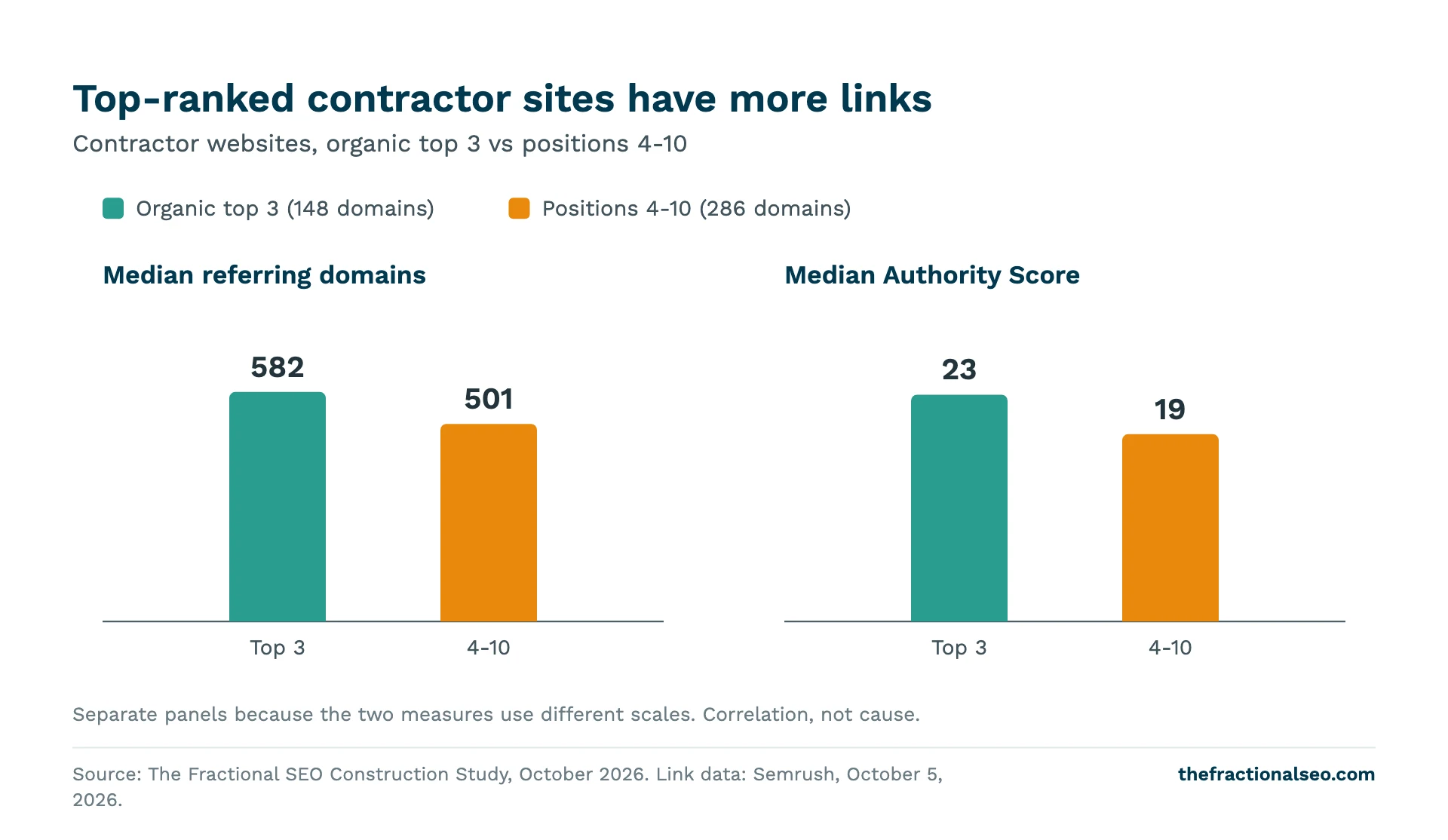
| Organic top 3 | Positions 4 to 10 | |
|---|---|---|
| Median referring domains | 582 | 501 |
| Median Authority Score | 23 | 19 |
Both differences were statistically strong. Three things to keep in mind when you read them:
- Correlation, not cause. Links also follow size and age. A firm that has been around for 30 years has had 30 years to collect links, along with more reviews, more projects and more brand searches.
- The gap is modest. 582 against 501 isn’t a different league. A contractor at position 6 isn’t usually hundreds of links away from the top 3.
- Authority Score is a Semrush metric, not a Google one. It’s useful for comparing sites, not as a target in itself.
The useful benchmark is local. Look at the contractors who outrank you for your main searches, check their referring domains in the same tool you use for your own, and close the gap with links that make sense for your business.
Link source 1: Directories and citations
Directories are the easiest place to start because they already rank. Across our 100 searches, these directories appeared on page one most often: houzz.com (66 times), yelp.com (65), bbb.org (17), homeadvisor.com (13), procore.com (12), thumbtack.com (12), clearlyrated.com (9) and newhomesource.com (8).
Each profile is a citation, a listing of your name, address and phone number, and most let you add your website. Some directories mark outbound links with rel=”nofollow” or similar attributes, which Google says it generally won’t follow. Those links still send visits and back up your business details, so they’re worth having, but check before you count them as backlinks.
What to do:
- Claim the free profiles on the directories that appear for your own searches.
- Use one name, one phone number and one address format everywhere, matching your Google Business Profile.
- Add your website, real project photos and a description of the work you do.
- Commercial contractors: claim your profile on the Procore Construction Network, a free public directory for contractors and suppliers.
Our guide to Houzz, Yelp and BBB covers which directories suit which contractor and which paid plans to skip.
Link source 2: Trade associations and chambers of commerce
Associations and chambers don’t just link to members. They rank. Trade associations and chambers of commerce were among the non-contractor sites that took 43% of page one in our study, alongside directories, social sites, news and government pages.
Most publish a member directory with a link to each member’s website. That’s a relevant, local link from a site Google already trusts for construction searches. Where to look:
- Home builders associations. NAHB says more than 600 state and local home builders associations make up its federation. Your local HBA is usually the one with the member directory.
- AGC chapters. Commercial contractors join AGC of America through a local chapter (AGC), and AGC runs a member directory.
- Specialty trade associations for your trade, such as remodeling, roofing or concrete groups.
- Your chamber of commerce and any local business association.
Membership costs money, so join for the business reasons first: referrals, events, bid notices. The listing and link come with it. After you join, check that your profile has your website on it. Many members never fill it in.
Link source 3: Suppliers, manufacturers and subcontractors
You already have business relationships with companies that run websites. Many of them list the contractors they work with.
- Manufacturer installer programs. Roofing, window, siding, decking and flooring manufacturers often have “find a certified installer” pages. If you hold a certification, make sure you’re listed with your website.
- Supplier partner pages. Local lumber yards, stone suppliers and cabinet shops sometimes feature contractors or projects.
- Architects, designers and subcontractors. Firms you work with regularly may credit you on project pages. Offer the same in return when it’s true.
How to ask: email your rep with your company name, website and the certification or project in question, and ask whether they list partners. Keep it simple. Avoid setting up a page that exists only to swap links. Google’s spam policies name excessive link exchanges and partner pages made only for cross-linking.
Link source 4: Local news and community
Local news sites were among the non-contractor sites on page one in our searches, and a mention from one is a strong local link. Contractors have more news than they think:
- A notable project: a school, a church restoration, a historic renovation, a big local employer’s new building.
- Milestones: a groundbreaking, a ribbon cutting, a 25th anniversary.
- Community work: a build for a veteran, a Habitat project, a scholarship for trades students.
- Hiring: a new apprenticeship program or a training partnership with a local school.
Send a short note with photos to the local paper, business journal or TV station’s community desk. Post the same story on your own site so there’s a page to link to.
Sponsorships are different. A link you get because you paid for it is a paid link in Google’s eyes, and Google asks for paid links to be marked rel=”sponsored”. Sponsor the Little League team for the local goodwill and the name on the banner, not for ranking credit.
Link source 5: Content worth linking to
The hardest source, and the one that scales. People link to pages that answer a question better than anything else. For a contractor, that usually means local, practical information:
- Cost guides: what an addition, a basement finish or a new build costs in your area, with ranges from your own jobs.
- Permit guides: how permits work in your county, what needs one, how long approval takes.
- Local data: anything you know about your market that nobody else has written down.
- Project case pages: a well-documented project with photos can earn links from the architect, the supplier and local press.
This takes real time. Write one piece properly before you write ten thin ones, and send it to the people who’d use it: your HBA, real estate agents, local reporters.
Link sources at a glance
| Link source | Effort | Typical value for a contractor (our judgment) |
|---|---|---|
| Directories and citations | Low | Citation and referral path; link value varies by directory |
| Trade associations and chambers | Low to medium (membership dues) | Relevant local link from a site that ranks |
| Suppliers, manufacturers, subs | Low | Relevant trade link; often from established sites |
| Local news and community | Medium | Strong local link when it happens; not predictable |
| Content worth linking to | High | Builds over time; the only source that scales |
What to avoid
Google’s spam policies list the link tactics it treats as spam. The ones contractors get pitched most often:
- Buying links for ranking purposes, including “guest post packages” sold by the dozen.
- Guest posts or press releases with keyword-stuffed anchor text placed on other sites.
- Low-quality directory or bookmark sites: the hundreds of directories nobody visits.
- Automated link-building programs or services.
- Link exchanges and partner pages that exist only for cross-linking.
Google also warns against SEOs who talk about link popularity schemes. If someone offers you hundreds of backlinks for a flat fee, that’s what you’re buying. A few dozen relevant, local links are worth more to a contractor and carry no risk.
Track your links
Google Search Console is free and shows the top linking sites, top linked pages and top linking text for your site. Check it once a quarter.
For competitor comparisons you need a paid tool such as Semrush or Ahrefs, since Search Console only shows your own site. Use one tool consistently: link counts differ between tools, so compare like with like. Keep a simple list of the links you’ve earned and the ones you’ve asked for. For the rest of your site’s health, see technical SEO basics for construction.
FAQs
How many backlinks does a contractor website need?
There’s no fixed number. As a benchmark, contractor sites in the organic top 3 in our study had a median of 582 referring domains, against 501 at positions 4 to 10. The more useful target is the contractors who outrank you in your own market.
Are directory listings backlinks?
Often, but not always in the way that counts. Most directory profiles let you add a website link, and some mark it nofollow. Either way they’re citations and referral paths, and the directories that appear most for construction searches, Houzz (66 appearances) and Yelp (65), are worth being on.
Should contractors pay for links?
No. Google’s spam policies name buying or selling links for ranking purposes. Paying for a sponsorship or an ad is fine if the link is marked rel=”sponsored”, but it won’t pass ranking credit.
How do I get links from suppliers?
Ask. Check whether your manufacturers have a certified installer directory and whether your suppliers list partners or feature projects. Email your rep with your website and the certification or project, and ask to be listed.
How do your links compare?
We’ll compare your referring domains with the contractors who outrank you locally and list the links you’re missing. Ask for a backlink gap review.
Related: a beginner’s guide to SEO for general contractors, the local construction search benchmark, and the full study, We Analyzed 965 Construction Websites.
Sources
- Google Business Profile Help, Tips to improve your local ranking on Google
- Google Search Central, Spam policies for Google web search
- Google Search Central, Qualify your outbound links
- Search Console Help, Links report
- Google Search Central, Do you need an SEO?
- NAHB, Directories
- AGC, Membership
- Procore Support, Procore Construction Network
More guides
The whole Construction library- Technical SEO Basics for Construction Benchmarks from 965 contractor websites for speed, page weight, on-page gaps and schema, and the order…
- Houzz, Yelp and BBB: Why Directories Outrank Contractors, and How to Use Them Houzz and Yelp appeared on page one 66 and 65 times across 100 construction searches. Which…
- Mastering On-Page SEO for Home Builders and Remodelers A page-by-page on-page SEO guide for home builders and remodelers: titles, headings, service, community and portfolio…