
Templates & Resource Contractors
Local SEO Checklist for Specialty Contractors
None of the local SEO checklists for contractors we read orders its tasks by contractor data, and none says which trade an item applies to. This one does both. The few things map-pack roofers, electricians, concrete and fence companies clearly have more of come first, each marked with the trades where the gap held. Website extras come last, marked honestly as showing no measured edge. All 31 items are free to download as a PDF or a Google Sheet.
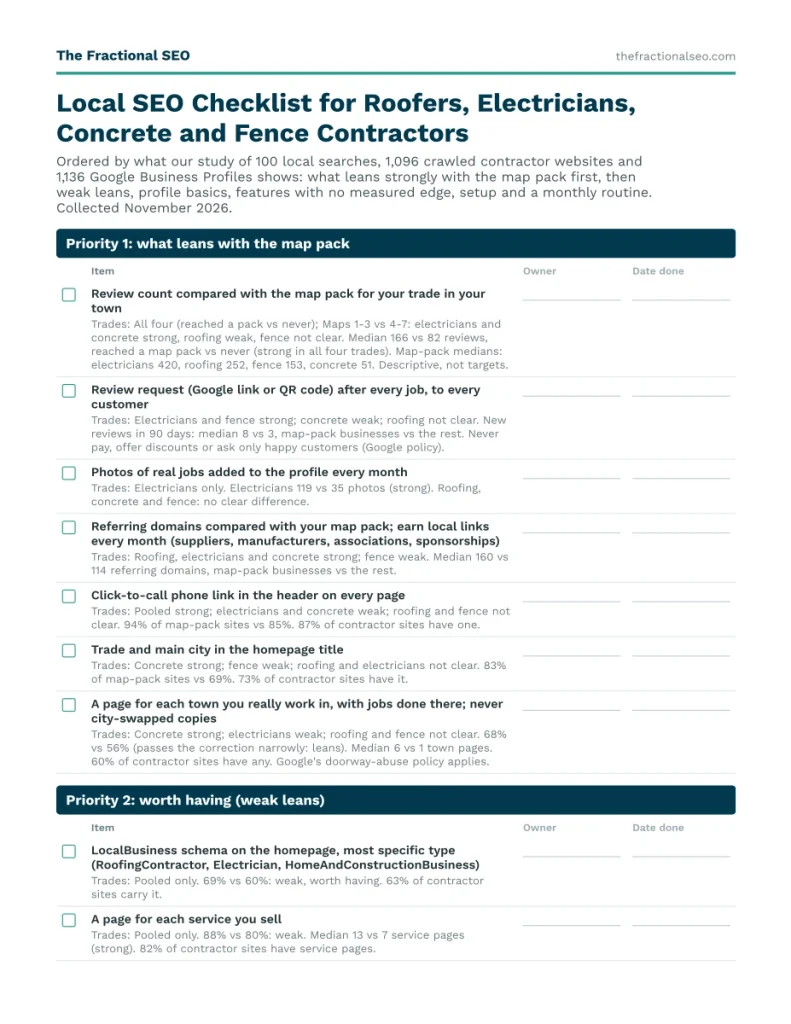
Get the template No email required
What's inside
What leans with the map pack
Reviews, new reviews, links and three website basics, marked by trade.
Worth having
Schema, service pages, warranty and 24/7 wording: weak leans, not ranking factors.
No measured edge
Profile basics, booking, financing, forms and free-estimate offers.
Setup and monthly tasks
Directory listings, tracking and the checks to repeat each month.
How to use it
-
Download the PDF or copy the Sheet
Print it, or make your own copy of the Google Sheet.
-
Filter by your trade
The trades column shows where each lean held in our data.
-
Work top to bottom
Give every item an owner and a date, then repeat the monthly tasks.
We analyzed 100 local searches across 25 US metros and four specialty trade search types, 1,191 contractor websites (1,096 crawled) and 1,136 Google Business Profiles, November 2026. We compared what map-pack businesses have with what the rest have, trade by trade, and ordered the list from the answer. We collected this data on 16 November 2026, past the summer peak for roofing, concrete and fence work, so rankings, review pace, Google posting and ad activity may look different in season. For the reasoning behind each task, read the full local SEO guide for specialty contractors.
If your Google Business Profile isn’t claimed yet, do items 12-14 first. Everything on the profile depends on them.
How we ordered this checklist
Every item sits in one of four priority groups, plus setup and a monthly routine:
- Priority 1: what leans with the map pack. Items where businesses that reached a map pack in any study search differ strongly from the rest, by a margin that held up after correcting for the number of tests.
- Priority 2: worth having. Website items that lean toward the map pack but fail that correction. Weak leans, not ranking factors.
- Priority 3: profile basics. Profile items with no clear difference, or only a weak one.
- Priority 4: no measured edge. Offers and features many checklists push, which show no clear difference between map-pack sites and the rest.
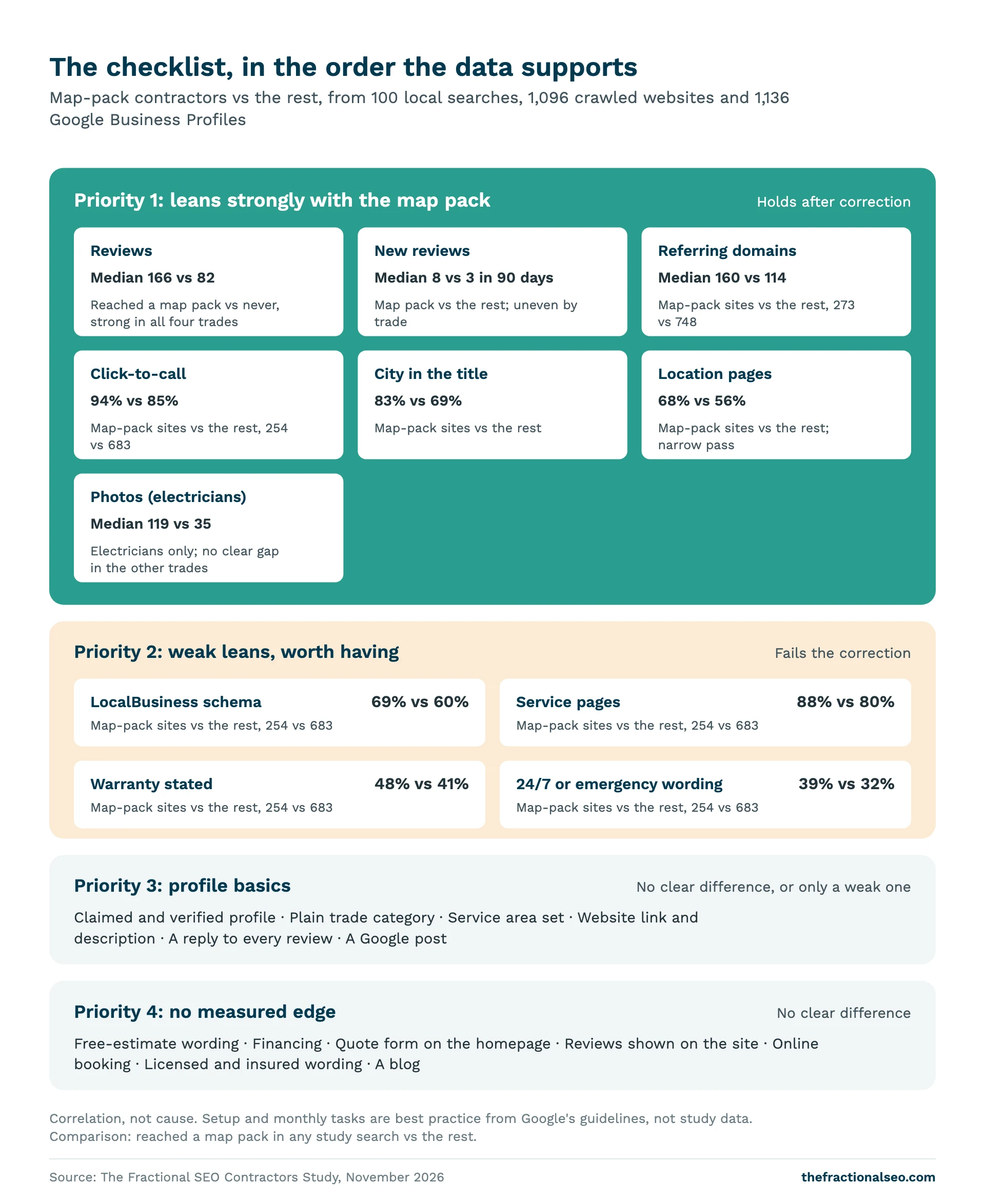
The download has a trades column. The four trades sit at very different levels and don’t lean on the same things, so a pooled result can mislead. Where the gap held only in some trades, the column says which.
One honest note. This is a correlation study. Larger firms tend to have more of everything, and a missing edge is not proof that an item never matters. The data shows what map-pack contractors tend to have; it can’t promise that any one item will move you up. The website half comes from our study of 1,096 contractor websites.
Priority 1: What leans with the map pack
Reviews and new reviews
Businesses that reach a map pack in any search have about twice the reviews of those that never do: median 166 vs 82. The gap is strong in all four trades. The level differs a lot by trade, so compare yourself with your own trade:
| Trade | Median reviews in the map pack | Maps 1-3 vs 4-7 gap | New reviews gap (90 days) |
|---|---|---|---|
| Electricians | 420 | Strong | Strong (18 vs 4) |
| Roofing | 252 | Weak | No clear difference (9 vs 7) |
| Fence | 153 | No clear difference | Strong (8 vs 3) |
| Concrete | 51 | Strong | Weak (2 vs 1) |
Pooled, map-pack businesses had a median of 8 new reviews in the 90 days before collection vs 3 for the rest. More in our research on contractor reviews and rankings.
- Your review count compared with the map pack for your trade in your town.
- A review request after every job, to every customer, with your Google review link or QR code (Google’s how-to). Google’s content policy bans incentives and asking only happy customers.
Photos: electricians only
Pooled, map-pack profiles show more photos (median 116 vs 70), but inside the trades only electricians show a clear gap: 119 vs 35. For roofing, concrete and fence there is no clear difference. Roofers, concrete and fence companies should still post job photos for customers; just don’t expect them to separate you in Maps.
- Electricians: photos of real jobs added to the profile every month.
Links to your website
Map-pack businesses’ sites have a median of 160 referring domains vs 114 for the rest. The gap is strong for roofing, electricians and concrete, and weak for fence. Think local and real: supplier and manufacturer contractor listings, trade associations, sponsorships, the chamber of commerce. Our backlinks guide for contracting businesses lists sources by trade.
- Your referring domains compared with the businesses in your map pack, and a plan to earn local links every month.
Three website basics
Two website basics lean strongly with the map pack: a click-to-call link (94% of pack sites vs 85%) and the city in the homepage title (83% vs 69%). Location or service-in-city pages (68% vs 56%) lean too, but pass the correction only narrowly, so they lean rather than clearly separate. Map-pack sites also have more town pages: a median of 6 vs 1.
Inside the trades the title and location-page gaps are strong only for concrete contractors; for roofers none of the three shows a clear gap. Across all contractor sites, 87% already have a click-to-call link, 73% put the city in the homepage title and 60% have location or service-in-city pages.
| Lean | Roofing | Electricians | Concrete | Fence |
|---|---|---|---|---|
| Total reviews (reached a pack vs never) | Strong | Strong | Strong | Strong |
| New reviews | No clear difference | Strong | Weak | Strong |
| Profile photos | No clear difference | Strong | No clear difference | No clear difference |
| Links | Strong | Strong | Strong | Weak |
| Click-to-call link | No clear difference | Weak | Weak | No clear difference |
| City in homepage title | No clear difference | No clear difference | Strong | Weak |
| Town pages | No clear difference | Weak | Strong | No clear difference |
- A click-to-call phone link in the header on every page.
- Your trade and main city in the homepage title.
- A page for each town you really work in, with jobs done there. Never city-swapped copies: Google’s spam policies treat pages “created to rank for specific, similar search queries” as doorway abuse.
Priority 2: Worth having (weak leans)
Four features lean only weakly with the map pack and fail the correction: LocalBusiness schema (69% vs 60%), service pages (88% vs 80%), a stated warranty (48% vs 41%) and 24/7 or emergency wording (39% vs 32%). Treat them as worth having for the customer, not as ranking factors. These were tested across all four trades together.
One count does lean strongly: map-pack sites have a median of 13 service pages vs 7. 24/7 wording is mostly an electrician thing; only use it if someone really answers the phone at night. For schema, Google says to use “the most specific LocalBusiness sub-type possible”: schema.org has RoofingContractor and Electrician, and concrete and fence companies can use HomeAndConstructionBusiness.
- LocalBusiness schema on the homepage, using the most specific type for your trade.
- A page for each service you sell.
- Your warranty stated in plain terms, if you offer one.
- 24/7 or emergency wording, only if you really answer.
Priority 3: Profile basics (no clear difference)
Contractor profiles look alike on the basics. Almost every profile is claimed (1,108 of 1,136, 98%), and the primary categories are the plain trade names. More than one category (46% vs 51%) and a website link (97% vs 96%) show no clear difference. A business description leans weakly (95% vs 89%), not a reliable difference. Review replies don’t separate the map pack (median reply rate 82% vs 80%), and Google posts lean only weakly (44% vs 36% posted in the last 30 days). Do these because they’re quick and customers see them. Our Google Business Profile guide for specialty contractors covers each one.
- Profile claimed and verified under your real business name, with no added keywords (Google’s guidelines).
- Primary category: your plain trade name (Roofing contractor, Electrician, Concrete contractor, Fence contractor).
- Address hidden if you work at customers’ properties, and your service area set.
- Website link and business description filled in.
- A reply to every review, good and bad.
- A Google post when you have something worth saying.
Priority 4: No measured edge
Free estimates, financing, licensed-and-insured wording, online booking, review widgets and forms show no clear difference either way. Here is how common each one is on contractor homepages: free estimate 71%, licensed and insured 60%, financing 22% and online booking 7%. 53% have a form on the homepage and 21% show a review widget.
Blogs are mostly dead: 47% of contractor sites have a blog, but only 11% published a post in the 12 months before collection, and a blog shows no clear link with the map pack. None of this means skip them. A form, a financing note or a license number helps the homeowner who is already on your site. It just isn’t what separates map-pack contractors in our data. Technical basics are in our technical SEO guide for contractor websites.
- Free estimate wording, if you offer one.
- Financing, if you offer it.
- A quote form on the homepage.
- Real customer reviews shown on the site, with permission.
- Online booking, if your office can keep the calendar honest.
- Licensed and insured wording, with your license number, if true.
- A blog only if someone will post to it.
Setup, timing and monthly tasks
Keep your name, address and phone the same everywhere. On our searches yelp.com showed up 92 times on page one, angi.com 23, thumbtack.com 20 and bbb.org 18, so those listings are worth getting right; see our directories guide. Google ranks local results partly by distance, so check rankings from where your customers are, not from the shop.
Fence companies have one more task. In Google Trends for 2022-2024, “fence company” interest peaks in April at 2.17 times its December low. Pages and links take time to show up, so finish them in winter. The other three trades vary much less across the year.
- Name, address and phone the same on your site, profile and directory listings.
- Search Console and Google Analytics set up and verified.
- Monthly: check your map-pack position from a phone inside your service area.
- Monthly: check profile calls, website clicks and direction requests.
- Monthly: count new reviews against the same month last year.
- Monthly: list the new links you earned.
- Fence companies: finish pages and links before the April peak.
Download the checklist
The Specialty Contractor Local SEO Checklist. All 31 items in priority order, with columns for status, owner, date done, the trades each lean holds for and the benchmark from our study. Print the PDF, or copy the Google Sheet and give every item an owner and a date.
Rather hand the list to someone? Contractor SEO done for you.
Questions, answered
What should a contractor’s local SEO checklist include?
Start with what leans with the map pack: total reviews, new reviews, links, and three website basics (click-to-call, city in the title, town pages). Then the weak leans worth having, the profile basics, and a monthly routine.
What should I do first?
If your profile isn’t claimed, claim it. Then a review request after every job, the click-to-call link and the homepage title, which are quick. Links and town pages take longer.
Does my trade change the checklist?
Yes. Total reviews lean in all four trades. Photos lean only for electricians. The city-in-title and town-page gaps are strong only for concrete, and for roofers none of the three website basics shows a clear gap. Links lean strongly for roofing, electrical and concrete, and only weakly for fence.
Do online booking, financing or a free-estimate offer help rankings?
Not in a way we could measure. None showed a clear difference between map-pack sites and the rest. Offer them if they help customers book you.