
Guide Contractors
The Ultimate Guide to Local SEO for Roofers, Electricians, Concrete and Fence Contractors
Local SEO for roofers, electricians, concrete and fence contractors is two jobs, not one. The first is the map pack: the three Google Maps listings near the top of a search like "roofing contractor" plus your city. The second is the organic results below it. Mostly different businesses win each: only 20% of map-pack contractors with a website also ranked on page one organically for the same search. And the four trades don't play by one set of numbers. The median map-pack electrician has 420 Google reviews; the median map-pack concrete contractor has 51.
The short answer
- Two jobs: the map pack and the organic results are mostly different businesses. Plan each one separately.
- Map pack: businesses that reach it tend to have more Google reviews in every trade we studied, and more links to their websites in roofing, electrical and concrete (only a weak lean for fence). How many reviews depends heavily on the trade.
- Photos show a clear map-pack gap for electricians only. Roofing, concrete and fence profiles show no clear difference.
- Website: a click-to-call link, the city in the homepage title and pages for the towns you serve lean with the map pack. Inside the trades, the title and town-page gaps are strong only for concrete.
- Organic: contractors’ own websites hold 44% of page-one organic results. Directories, social sites and other non-contractor sites take the rest.
We analyzed 100 local searches across 25 US metros and four specialty trade search types, 1,191 contractor websites (1,096 crawled) and 1,136 Google Business Profiles, November 2026. We collected this data on 16 November 2026, past the summer peak for roofing, concrete and fence work, so rankings, review pace, Google posting and ad activity may look different in season.
Where we compare higher- and lower-ranked businesses, the results show what tends to go together, not what causes a ranking. The full website results are in our study of 1,096 contractor websites.
What a local contractor results page looks like
Search “electrician” or “fence company” with a city name and Google shows two blocks. The map pack sits near the top: a map and a short list of businesses with star ratings, a call button and directions. In this guide, “map pack” means positions 1-3 of the Google Maps list for the search. Below it are the organic results, the web pages Google ranks with its normal search algorithm.
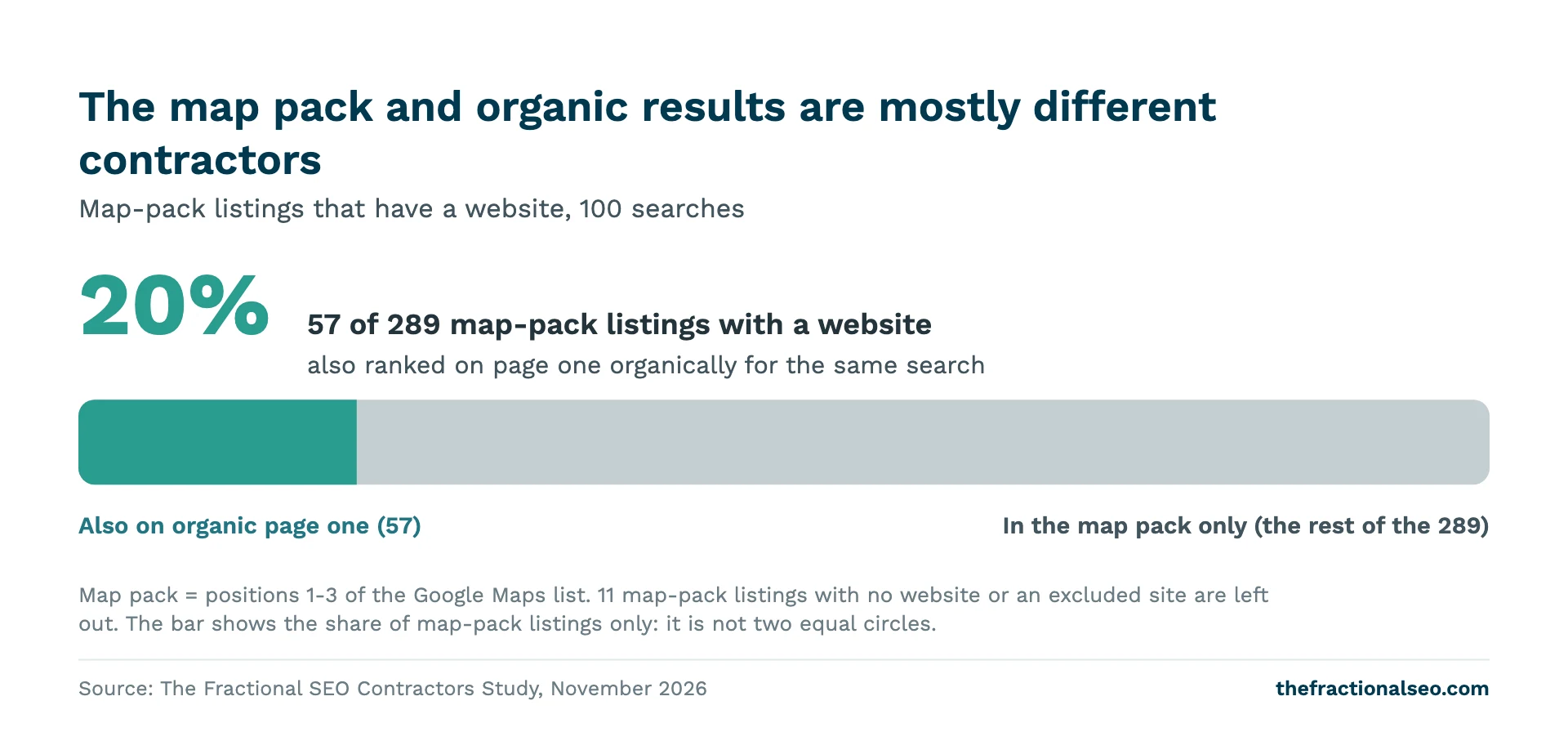
Most owners treat the two as one thing. Our data says they aren’t. Of the map-pack contractors that had a website, only 20% also ranked on page one organically for the same search (57 of 289 listings). Our HVAC study found 16% and our Painting study 11%. The contractors in the map pack are mostly not the contractors in the blue links below.
The organic half is crowded with sites that don’t do the work. Only 44% of page-one organic results for local roofing, electrician, concrete and fence searches went to the contractors’ own websites. A site that is not a contractor held the #1 organic spot in 53 of 100 local trade searches, and 61% of all top-3 organic spots.
| Type of page-one organic result | Results (of 845) |
|---|---|
| Contractor websites | 372 |
| Directories and lead marketplaces | 249 |
| Social sites | 124 |
| Lead-generation sites | 25 |
| Manufacturer and dealer locators | 15 |
The share differs a little by trade. Contractor sites held 42% of page one on roofing searches, 42% on electrician searches, 40% on concrete and 51% on fence. Fence companies keep half of page one; the other three trades keep about two in five. More on who wins these searches is in our benchmark of 100 local contractor searches.
How Google ranks local results
Google’s help page on local ranking says local results are mainly based on relevance, distance and how well-known a business is. (The page calls the last one “popularity” in its summary and “Prominence” in its heading.) Relevance is how well your profile matches the search. Distance is how far you are from the searcher. Prominence, the page says, draws on things like “how many websites link to your business and how many reviews you have.”
Distance is outside your control: a homeowner across town sees a different map pack from the one you see at the shop. The same page is blunt about shortcuts: “There’s no way to request or pay for a better local ranking on Google.” What you can work on is relevance and prominence.
Part 1: The map pack
The map pack runs on your Google Business Profile, the free listing Google keeps for your company, on what customers say about you there, and on how well-known your business is around the web.
Set up the Business Profile properly
Almost every profile in our study was claimed (1,108 of 1,136, 98%), so claiming it is the entry fee, not an edge. Get the basics right next.
Business name. Use your real name, as it appears on your trucks and invoices. Google’s guidelines say “Including unnecessary information in your business name isn’t permitted, and could result in the suspension of your Business Profile.”
Address and service area. Roofers, electricians, concrete crews and fence installers work at the customer’s property. Google’s guidelines say: “If you’re a service-area business, you should hide your business address from customers.” Set the area you serve instead.
Category. The primary categories in our study were the plain trade names: Roofing contractor 284, Electrician 273, Fence contractor 271 and Concrete contractor 258. Google asks you to “Use as few categories as possible to describe your overall core business from the provided list.”
Website link. Almost every contractor in the map pack shows a website: 9 of 300 map-pack listings (3%) had no website link. Fill it in, and use the same phone number on the profile and the site. Our Google Business Profile guide for specialty contractors covers the rest of the setup.
Reviews: the bar depends on your trade
Reviews are where the map-pack gap holds in every trade. Businesses that reached a map pack in any study search had about twice the reviews of those that never did: a median of 166 against 82. That gap is strong in all four trades.
The level is another matter. How many reviews the map pack holds depends on the trade, and a pooled “contractors need N reviews” figure would mislead every trade:
| Trade | Median reviews, Maps positions 1-3 | Median reviews, positions 4-7 | Gap inside the trade |
|---|---|---|---|
| Electricians | 420 | 131 | Strong |
| Roofing | 252 | 169 | Weak |
| Fence | 153 | 107 | No clear difference |
| Concrete | 51 | 26 | Strong |
New reviews follow the same uneven pattern. Map-pack businesses had a median of 8 new reviews in the 90 days before collection against 3 for the rest. The gap is strong for electricians and fence companies, weak for concrete and not clear for roofers. Star rating made no clear difference at all: the median was 4.9 stars both at positions 1-3 and at 4-7.
Both are correlations. Established companies have more reviews and other advantages too. Still, a steady review habit costs nothing but time:
- Ask every customer at the end of the job, when the roof is on or the fence is up. Google’s content policy says merchants may not “selectively solicit positive reviews from customers”.
- Make it one tap. Google lets you share a review link or a QR code. Put the link in the final invoice text.
- Never offer a discount or gift for a review. Google calls incentives for reviews “strictly prohibited”.
For the full benchmarks, see our research on Google reviews and contractor rankings.
Photos: a clear gap for electricians only
Pooled, map-pack businesses showed more photos on their profile (median 116 against 70). But inside the trades only electricians show a clear gap: 119 against 35. For roofing, concrete and fence there is no clear difference, and the pooled gap comes mostly from electricians. So if you run a roofing, concrete or fence company, add job photos because customers look at them, not because our data ties them to the map pack.
Lead sellers and keyword-named listings
Contractor searches carry many sites that look like contractors and are not. Screening the 1,256 sites in our study found 65 non-providers (5%), among them 15 lead-generation sites and 10 concrete and fence suppliers. Four of the lead sellers had their own Google Maps listing, with page wording that says they pass homeowners on to other contractors. Screened sites held 51 page-one organic results, 13 of them in the top 3.
The map has its own version. Keyword-named listings with few reviews, a name that is only a city and a trade, are common: about 60 in the Maps results, about 10 of them in the map pack, most in the largest metros. The flag is rule-based, not proof that any listing is fake, and we don’t name any of them.
What a real contractor can do is be plainly real: your own name, your own reviews, photos of your own jobs, and a website that shows your license and the towns you serve. A lead seller that outranks you passes the homeowner on to other contractors. Proof that you are the business doing the work is the one thing it can’t copy. Our research on lead sellers and look-alike listings shows how to spot one, and the lead platforms vs SEO calculator compares the cost per won job.
Franchises and chains
Franchises are a small force in these four trades. 8 franchise websites (1% of 1,191) held 19 of 300 map-pack spots (6%): Mr. Electric 9, Superior Fence & Rail 5, Sam The Concrete Man 3 and Mister Sparky 2. Electricians meet franchises most: 11 of the franchise pack spots were on electrician searches. Company-owned multi-metro chains (17 sites) held 8.
Part 2: Local organic results
The organic list is where directories crowd in, and where most map-pack contractors don’t appear. It runs on your website and the links pointing to it.
Three website basics that lean with the pack
Two website basics lean strongly with the map pack: a click-to-call link (94% of pack sites against 85% of the rest) and the city in the homepage title (83% against 69%). A third, location or service-in-city pages (68% against 56%), leans too. Map-pack sites also have more of these pages: a median of 6 location or service-in-city pages against 1, and 13 service pages against 7.
Read the town-page gap carefully. It passes our correction for multiple tests only narrowly, so it leans; it doesn’t clearly separate. And inside the trades the title and location-page gaps are strong only for concrete contractors. For roofers none of the three shows a clear gap. Bigger firms have more of everything, so these are correlations, not a recipe.
They are cheap to do well. Put your trade and main city in the homepage title. Put a tap-to-call phone number in the header. Build a page for each town you really work in, with jobs done there. Never city-swapped copies: Google’s spam policies list “Having multiple domain names or pages targeted at specific regions or cities that funnel users to one page” as doorway abuse. For schema, Google says to use “the most specific LocalBusiness sub-type possible”. Schema.org has RoofingContractor and Electrician types; concrete and fence companies can use HomeAndConstructionBusiness.
Links
Links separate the map pack too. Map-pack businesses’ sites had a median of 160 referring domains against 114 for the rest, and a higher domain rank (169 against 140). The gap is strong for roofing (245 against 170), electricians (180 against 113) and concrete (97.5 against 80), and weak for fence (163 against 116.5).
Good contractor links are local and real: supplier and manufacturer contractor listings, your trade association, the chamber of commerce, a youth team you sponsor, a general contractor you sub for. Never buy them. Our backlinks guide for contracting businesses goes source by source.
Directories and lead marketplaces
The sites contractors compete with most on page one are yelp.com (92), facebook.com (66), reddit.com (45), angi.com (23), thumbtack.com (20), bbb.org (18), mapquest.com (14), homeadvisor.com (13) and Procore’s contractor network (12). On roofing searches the shingle maker GAF appears 10 times. When one of them outranks you, your listing there is another way for a homeowner to find you. Keep your name, address and phone identical on each. Our guide to why directories outrank roofers, electricians and fence companies covers which ones to claim.
Your trade, in short
One note on paid results first. In November, Local Services Ads appeared on 38 of 100 searches and text ads on 24; an AI Overview on 31. The trades differ sharply: Local Services Ads showed on 23 of 25 electrician searches, 9 fence, 6 roofing and 0 concrete; AI Overviews on 11 electrician searches and 5 roofing. This is one snapshot per search, ads change by the hour and the season, and concrete may have no Local Services Ads category in these metros (we didn’t check). We’ll re-run these searches in April 2027.
Click prices below are Google Ads estimates for the “<trade> <city>” searches we studied, not what you will pay.
Roofing
The median map-pack roofer has 252 reviews, against 169 at positions 4-7: a weak gap. Roofers who reached a map pack at all had 252 against 150 for those who never did, which is strong. New reviews, photos and the three website basics show no clear gap for roofers. Links do: 245 referring domains against 170. Demand per metro is the lowest of the four (a median of 170 searches a month) and clicks cost a median of $12.27, and “roofing contractor seattle” at $185.29. Only 18 of 25 roofing searches had a click price, and single-metro prices swing widely. For roofers, the data points at total reviews and links.
Electricians
Electricians are where the review, photo and link gaps all hold strongly; the website basics lean only weakly or not clearly. The median map-pack electrician has 420 reviews against 131 at positions 4-7, and 18 new reviews in 90 days against 4. Photos (119 against 35) and links (180 against 113) are strong gaps too. Demand is the highest: a median of 1,300 searches a month per metro and $20.30 a click. Franchises show up most here. Our SEO guide for electricians covers emergency searches and the paid side.
Concrete
Concrete has the lowest review bar: a median of 51 in the map pack against 26 at positions 4-7, a strong gap. New reviews lean only weakly (2 against 1 in 90 days). This is the trade where the website basics lean hardest: the city in the homepage title (89% against 69%) and town pages (66% against 42%) are both strong gaps for concrete. Links lean too (97.5 against 80). Demand is a median of 480 searches a month per metro, at $10.10 a click.
Fence
The median map-pack fence company has 153 reviews against 107 at positions 4-7, no clear difference. But fence companies that reached a map pack had 153 against 84 for those that never did (strong), and new reviews are a strong gap: 8 against 3 in 90 days. Links lean only weakly. Fence companies keep half of page one, the most of any trade. Demand is a median of 480 searches a month per metro, at $11.57 a click.
Fence is also the one seasonal trade. In Google Trends for 2022-2024, “fence company” interest peaks in April at 2.17 times its December low; the other trades vary by 12-31% across the year. That is the shape of the year, not growth. Pages and links take time to show up, so a fence company’s local SEO work goes in during winter, before the spring rush.
A 90-day local SEO plan
Here is the order we’d work in. The profile and the review habit come first because they are quick. Keep the review habit running the whole time.
Days 1-30: Business Profile and review habit
- Fix the name, hide the address if you’re a service-area business, set the service area and choose your plain trade name as the primary category.
- Add the website link and the same phone number as the site.
- Add a review request to the end of every job: a text with the direct link.
- Electricians: upload photos of recent jobs.
Days 31-60: Website pages
- Put your trade and main city in the homepage title.
- Add a click-to-call number to the header on every page.
- Build or fix a page for each service you sell.
- Write a real page for the towns that bring the most work, with jobs done there.
Days 61-90: Directories, links and a monthly routine
- Claim the directories that rank for your main searches and make your details match.
- Ask suppliers, manufacturers, associations and general contractors you work with for a link.
- Set a monthly routine: new reviews, a ranking check and one page improved.
For a printable task list, marked by trade, use the local SEO checklist for specialty contractors.
How to measure local SEO
A ranking check from your office tells you little, because Google weighs distance. Track these once a month:
- Map-pack position for your main searches, checked from a phone in several parts of your service area.
- Business Profile actions: calls, website clicks and direction requests.
- Search Console clicks for searches that include your city or a service.
- New reviews per month, compared with the same month last year.
Write the numbers in one place with a line on what changed that month. Judge the plan by the trend in calls and booked jobs over several months.
Questions, answered
How do I get my contracting company into the Google map pack?
Google names relevance, distance and prominence. In our study, businesses that reached a map pack had about twice the reviews of those that never did (a median of 166 against 82, strong in all four trades) and more links (160 against 114 referring domains; strong for roofing, electrical and concrete, weak for fence). Those are correlations, not causes.
How many Google reviews does a roofer, electrician, concrete or fence company need?
It depends on the trade. The median map-pack listing had 420 reviews for electricians, 252 for roofing, 153 for fence and 51 for concrete. These describe our sample; compare yourself with the map pack in your own town.
Is local SEO different from regular SEO for a contractor?
Yes. Only 20% of map-pack contractors with a website also ranked on page one organically for the same search. Treat Maps and your website as two jobs.
Do photos help a contractor’s Google ranking?
For electricians, map-pack profiles had far more photos (119 against 35). For roofing, concrete and fence we found no clear difference. Post job photos for customers either way.
Can I pay Google to rank higher in Maps?
No. Google says “There’s no way to request or pay for a better local ranking on Google.” Local Services Ads are a separate paid placement, not a ranking boost.
Want to know which half of local search you’re losing?
We look at where your company shows up in Maps and in the organic results for your trade in your city, and tell you what to fix first. See how fractional SEO for contractors works.
Sources
- TFS Contractors Study, November 2026: our study of 1,096 contractor websites
- Google Business Profile Help, Tips to improve your local ranking on Google
- Google Business Profile Help, Guidelines for representing your business on Google
- Google Business Profile Help, Tips to get more reviews
- Maps User Generated Content Policy, Prohibited and restricted content
- Google Search Central, Spam policies for Google web search
- Google Search Central, Local business (LocalBusiness) structured data
- Schema.org, HomeAndConstructionBusiness
More guides
The whole Contractors library- SEO for Specialty Contractors: A Beginner’s Guide A beginner's guide to SEO for roofing, electrical, concrete and fence contractors: what customers search for…
- How to Generate Contractor Leads with SEO Where roofing, electrical, concrete and fence leads come from on Google, what clicks cost by trade,…
- How to Build Backlinks for a Contracting Business: Roofers, Electricians, Concrete and Fence What map-pack contractors' link profiles look like by trade, and six link sources that fit a…