
Research & Benchmark Dental
Who Wins Local Dental Searches: A Benchmark of 36 Searches
A patient with a broken tooth at 9 p.m. types "emergency dentist" and the name of their city into Google. Who do they see? Mostly dental practices, far more than in the home-service trades we have studied. But not only practices, and the exceptions sit in the places that matter. We analyzed 36 local searches across 12 US metros and three dental search types, 584 dental practice websites (499 crawled) and 568 Google Business Profiles, November 2026. The searches were collected on 17 November 2026. This page is about search: who holds page one and the map pack. If you came for market size, dentist pay or oral-health figures, this isn't that report.
The dental industry statistics pages that rank today are roundups of other people’s numbers: market size, workforce, oral health. None of the ones we read looked at the results page a patient actually sees. For a practice owner that page is the market. If you know who holds its spots, you know who you are really up against.
Key findings
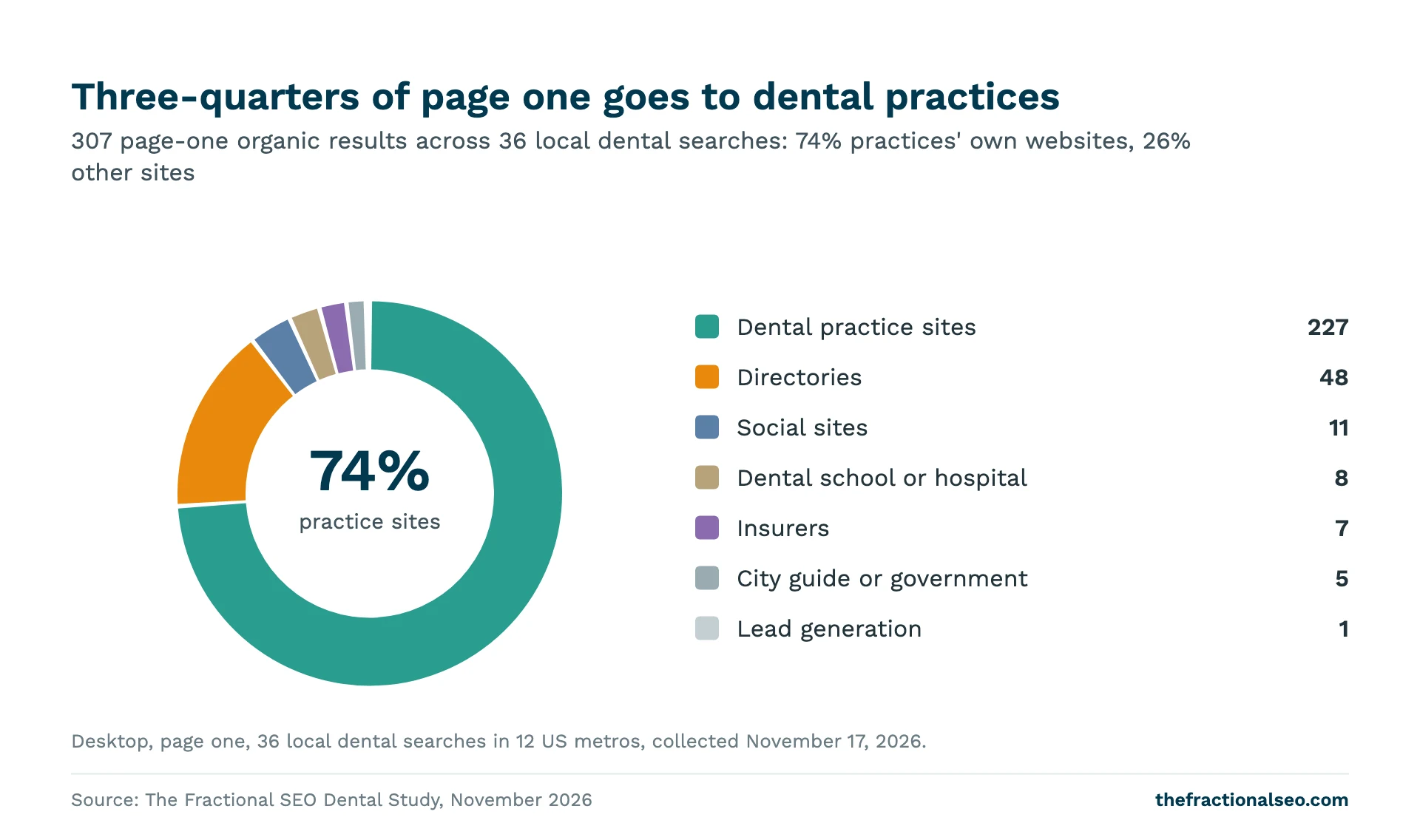
- Practices hold most of page one. 74% of page-one organic results (227 of 307) went to dental practices’ own websites, against 53% in our HVAC study and 37% in Landscaping.
- Three searches, three different pages. Practices held 89% of page one on “emergency dentist”, 78% on “dental implants” and 54% on “dentist”.
- Lead sellers sit inside emergency Maps. 33 of 205 Maps listings on “emergency dentist” searches (16%) belonged to 1-800-Dentist, a teledentistry service or a referral network’s listings, not to a practice. They held 7 of 35 emergency map-pack spots.
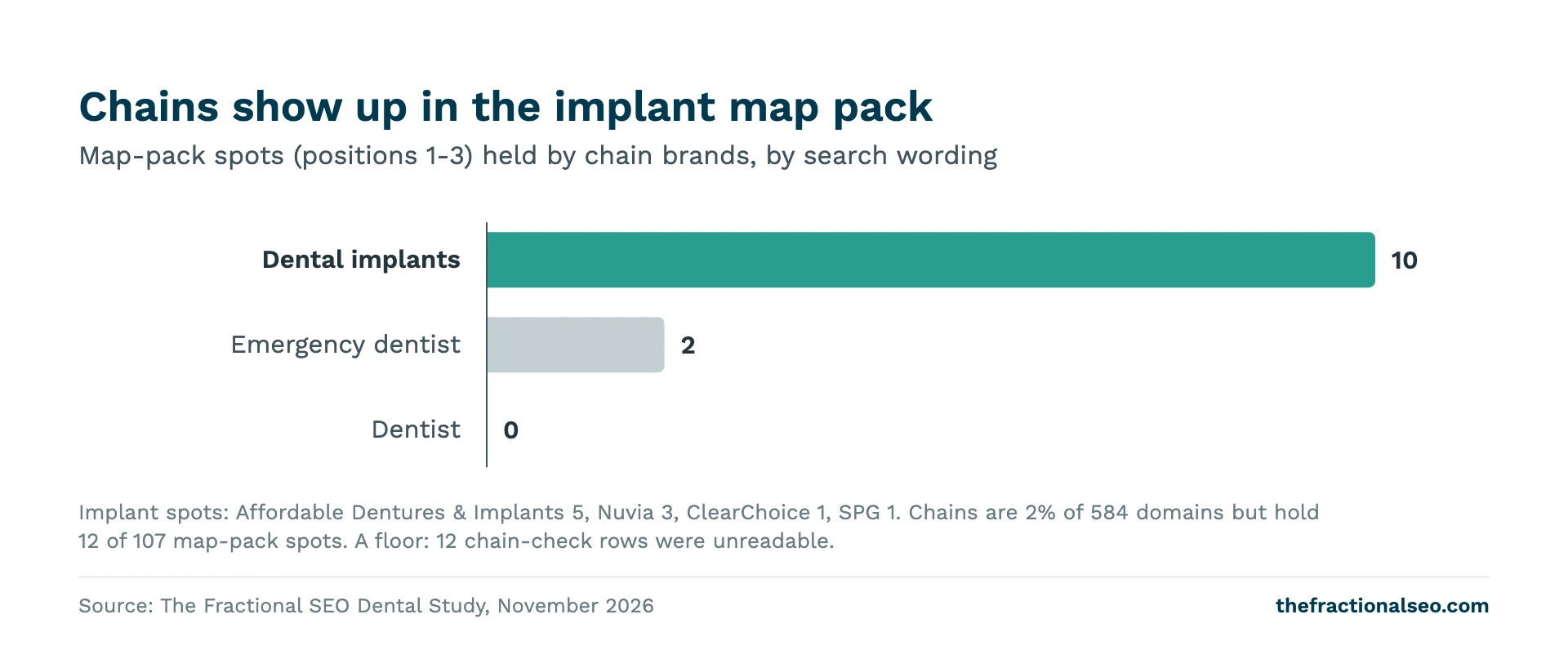
- Chains hold a slice of the implant pack. Chains are 2% of the websites in the study but held 10 of 36 implant map-pack spots. On “dentist” searches they held none.
- Map pack and organic are mostly different practices. Only 39% of map-pack practices with a website (38 of 98) also ranked on organic page one for the same search.
- AI Overviews show most on emergencies. Google showed one on 15 of 36 searches, and on 8 of 12 emergency searches.
Who holds page one
Across the 36 searches we recorded 307 organic results on page one. 74% of them (227 of 307) went to dental practices’ own websites, far more than in the home-service studies (HVAC 53%, Landscaping 37%). The rest went to directories (48), social sites (11), dental school or hospital pages (8), insurer pages (7), city guide or government pages (5) and one lead-generation site.
The top of the page follows the same pattern. A site that is not a dental practice held the #1 organic spot in 6 of 36 local dental searches (17%), and 20% of top-3 organic spots (22 of 108). In our HVAC study, 35% of #1 spots went to a site that was not a contractor.
The study shows who appears, not why. Our reading: a patient is choosing a person and a chair they will sit in, and Google answers with practices. So on the organic side, a practice mostly competes with other practices, not with directories.
Hospitals, dental schools and an insurer
Not every result that isn’t a practice is a directory. Eight page-one results went to dental school or hospital pages: health-system and university clinics, which we report apart from chains and independent practices. Seven went to an insurer, and all seven were Delta Dental pages. That fits what patients type: “delta dental” is searched about 673,000 times a month nationally (Google Ads via DataForSEO, US). A patient who searches with their insurance in mind may land on the insurer’s own dentist finder before any practice site.
Three searches, three pages
We ran three searches in every metro: “dentist”, “emergency dentist” and “dental implants”, each followed by the city. They return very different pages.
| Search | Practice sites on page one | Directory and social results seen most | AI Overview | Median monthly searches for the keyword (US) | Median cost per click |
|---|---|---|---|---|---|
| Dentist | 54 of 100 (54%) | Facebook 7, Practo 5, Yelp 4 | 4 of 12 | 4,900 | $14.19 |
| Emergency dentist | 95 of 107 (89%) | Yelp 3, Zocdoc 2 | 8 of 12 | Volume returned for 3 of 12 metros only | $18.21 (3 metros) |
| Dental implants | 78 of 100 (78%) | Yelp 11 | 3 of 12 | 720 | $30.26 |
“Dentist” is the crowded one. Directories and social pages take the rest of that page, led by Facebook and Practo. “Emergency dentist” is almost all practices on the organic side. The competition on that search sits in Maps instead, as the next sections show.
Market size shows a pattern too. Large metros are the most crowded (63% practices, 81 of 129 results) against 82% in mid-size metros (84 of 103) and 83% in small ones (62 of 75). These are groups of 9 to 15 searches each, so read them as a description, not a tested difference.
Directories and social pages
Yelp is the directory dental practices meet most: 18 page-one results, one in each of 18 of 36 searches. Zocdoc (5 results) and Practo (5) follow; Facebook pages appear 9 times. Healthgrades appears once. Most of Yelp’s appearances were on implant searches (11), while Facebook and Practo showed up on “dentist” searches. For what each platform offers and charges, see directories and referral services in dental search.
Lead sellers and referral listings in emergency Maps
This is the part of dental search that stands out. Lead sellers and referral networks sit inside the emergency dentist map results. 33 of 205 Maps listings on “emergency dentist” searches (16%) belong to 1-800-Dentist, a teledentistry service or a referral network’s doorway listings, not to a practice. They appear in 10 of the 12 emergency searches and hold 7 of 35 emergency map-pack spots, including 2 #1 spots. The two emergency searches without one, Austin and Des Moines, returned only 2-3 Maps rows.
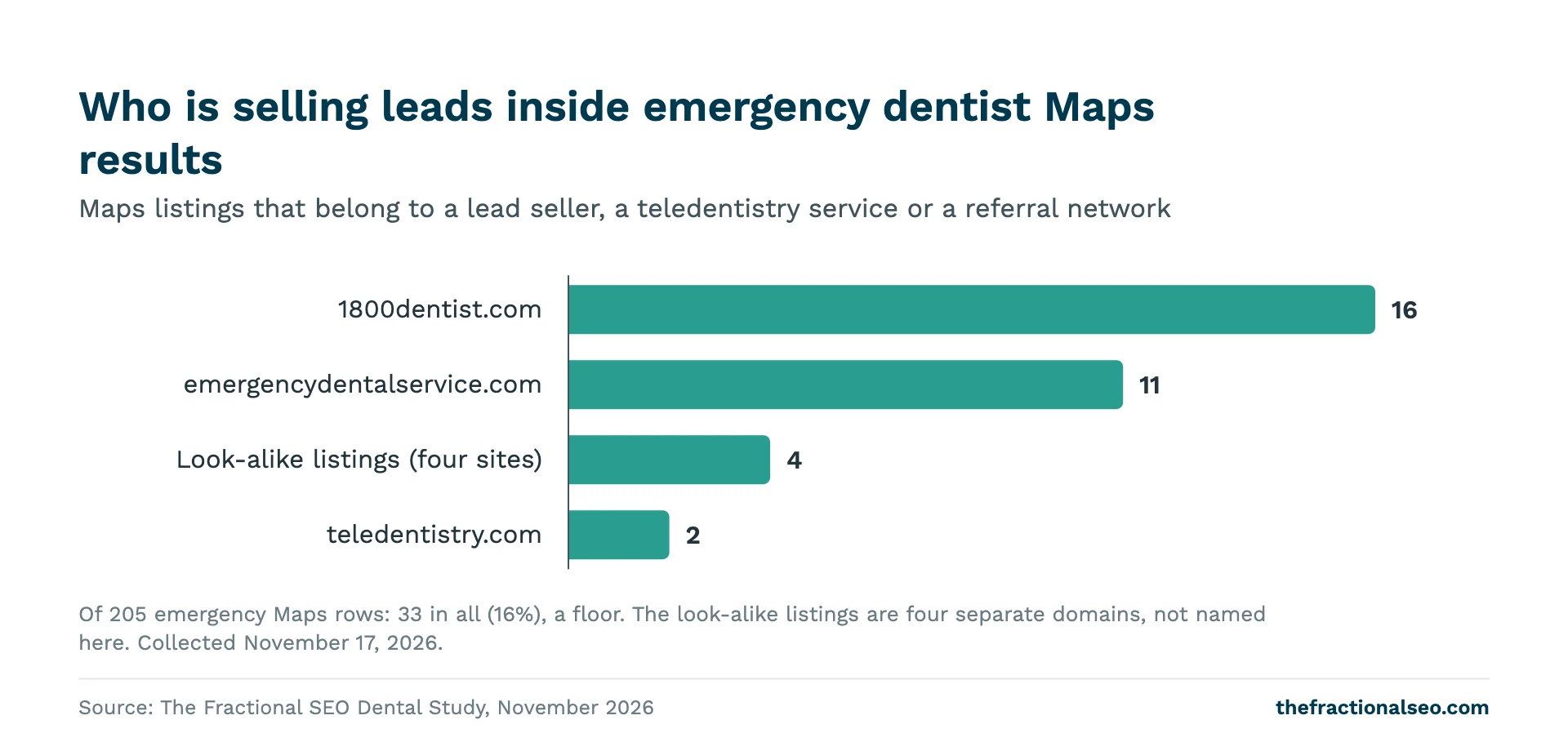
Who they are: 1-800-Dentist had 16 of those listings and 4 map-pack spots; its site invites patients to “Find a Dentist 24/7”. emergencydentalservice.com had 11 and 2 map-pack spots. Its about page calls it “a patient referral marketing tool for dentists and DSO’s” (Emergency Dental Service). Teledentistry.com, a virtual dental care service, had 2. Four more were look-alike “Emergency Dental Service” listings on other domains, one of them in a map pack. We don’t name those.
33 is a floor. Ten further look-alike listings at positions 11-19 were not excluded, because their sites could not be read when we checked. Outside emergency searches there was only one such listing in the whole study, a 1-800-Dentist row on a “dentist” search.
What it means for a practice: on an emergency search, some patients reach a dentist through a middleman, and some never see your listing at all. If a referral service offers you a spot, ask whose name, phone number and address the Google listing uses. Google’s own guidelines say: “Do not create more than one page for each location of your business” (Google Business Profile Help). Our directories and referral services page covers each service’s terms.
Map pack and organic are mostly different practices
Only 39% of map-pack practices with a website (38 of 98) also rank on page one of the organic results for the same search. Almost every map-pack practice has a website, though: 2 of 107 map-pack listings have none, and 34 of 685 Maps rows overall. Review totals didn’t set the pack apart either: a median of 486 Google reviews in positions 1-3 against 471 at positions 4-7, no clear difference.
Google says local results are “mainly based on relevance, distance, and popularity”, and that prominence means “how well-known a business is” (Google Business Profile Help). Our reading: the map pack leans on the profile and on where the patient is standing, the organic list leans more on the website, so a practice can be strong in one and missing from the other. Our guide to local SEO for dental practices covers both halves, and our study of what 568 Business Profiles show about reviews covers the profile side.
Chains in the implant pack
We sorted every practice into three groups. A franchise is a location of a franchise brand. A company chain is one brand operating in more than one metro, unless its own pages say a location is franchised. Everyone else is independent. Hospital and dental-school clinics are counted apart.
Chains are 2% of dental websites in the study but hold 12 of 107 map-pack spots (11%), nearly all on implant searches: 10 of 36 implant map-pack spots go to chain brands (Affordable Dentures & Implants 5, Nuvia 3, ClearChoice 1, SPG 1). On “dentist” searches chains hold none. The other 2 chain spots were on emergency searches.
- Franchises (Comfort Dental, Emergency Dental Care USA): 2 domains, 2 map-pack spots, 5 organic results.
- Company chains (Aspen Dental, ClearChoice, Dental365, DentalWorks, Emergency Dental of America, Priority Emergency Dental Care, SPG Dental Implants, Tend): 8 domains, 2 map-pack spots, 14 organic results. Aspen Dental and ClearChoice say their offices are owned by licensed dentists under a management company; we count them as company chains.
- Multi-metro brands we could not verify: 3 domains, 8 map-pack spots, 3 organic results. Affordable Dentures & Implants (8 metros) and Nuvia (4) count as chain brands by the multi-metro rule, but their sites could not be read to say whether offices are franchised or company-run.
These counts are a floor: 12 rows in our chain check could not be read. For an independent implant practice, the point is simple. In the implant map pack you may be up against a national brand with a dedicated implant name, not just the practice down the road. The data shows that they appear, not why.
Suspect listings
10 Maps listings have names made only of a city and dental words, under 20 reviews and no company suffix: the pattern of a suspect listing. 5 of them sit in a map pack. That is a rule-based flag, not proof a listing is fake, and we don’t name them. If you see one in your area, our Google Business Profile checklist covers what to check.
AI Overviews and ads
Google showed an AI Overview on 15 of 36 local dental searches (42%), most often on emergency searches (8 of 12), against 4 of 12 “dentist” and 3 of 12 “dental implants” searches. A map pack block appeared on 34 of 36 search pages.
Ads barely showed up. SerpAPI recorded text ads on 2 searches and no Local Services Ads. That is one desktop collection on one day, and ads vary by time, user and budget, so it tells you nothing about how many practices advertise. Third-party data has the same limit: only 2% of practice domains show any paid-search keywords in DataForSEO’s index, although 13% of homepages carry a Google Ads tag, which also serves remarketing and conversion tracking. Paid-keyword data is a sample of ads the index saw, not ad spend.
What a click costs
Implant clicks cost the most: median $30.26 a click against $14.19 for “dentist <city>”, up to $72.91 in Los Angeles. In DataForSEO’s modeled keyword data (US), emergency searches as a group run to about half a million a month at a median $16.23 a click, double the median dental keyword ($8.07).
Those emergency searches are mostly not “emergency dentist <city>”. Google Ads returns volume for only 3 of 12 of those. “Near me” dominates: “dentist near me” has about 1,830,000 searches a month nationally, and “nearest emergency dentist to me” 246,000. Those two volumes are Google Ads figures via DataForSEO, national and rounded. None of these figures is an auction price.
Traffic benchmarks
The median dental practice website gets an estimated 299 organic visits a month (HVAC: 214); the top 10% get 1,970 or more. Implant practices (249) and emergency practices (264) get fewer than general dentists (405).
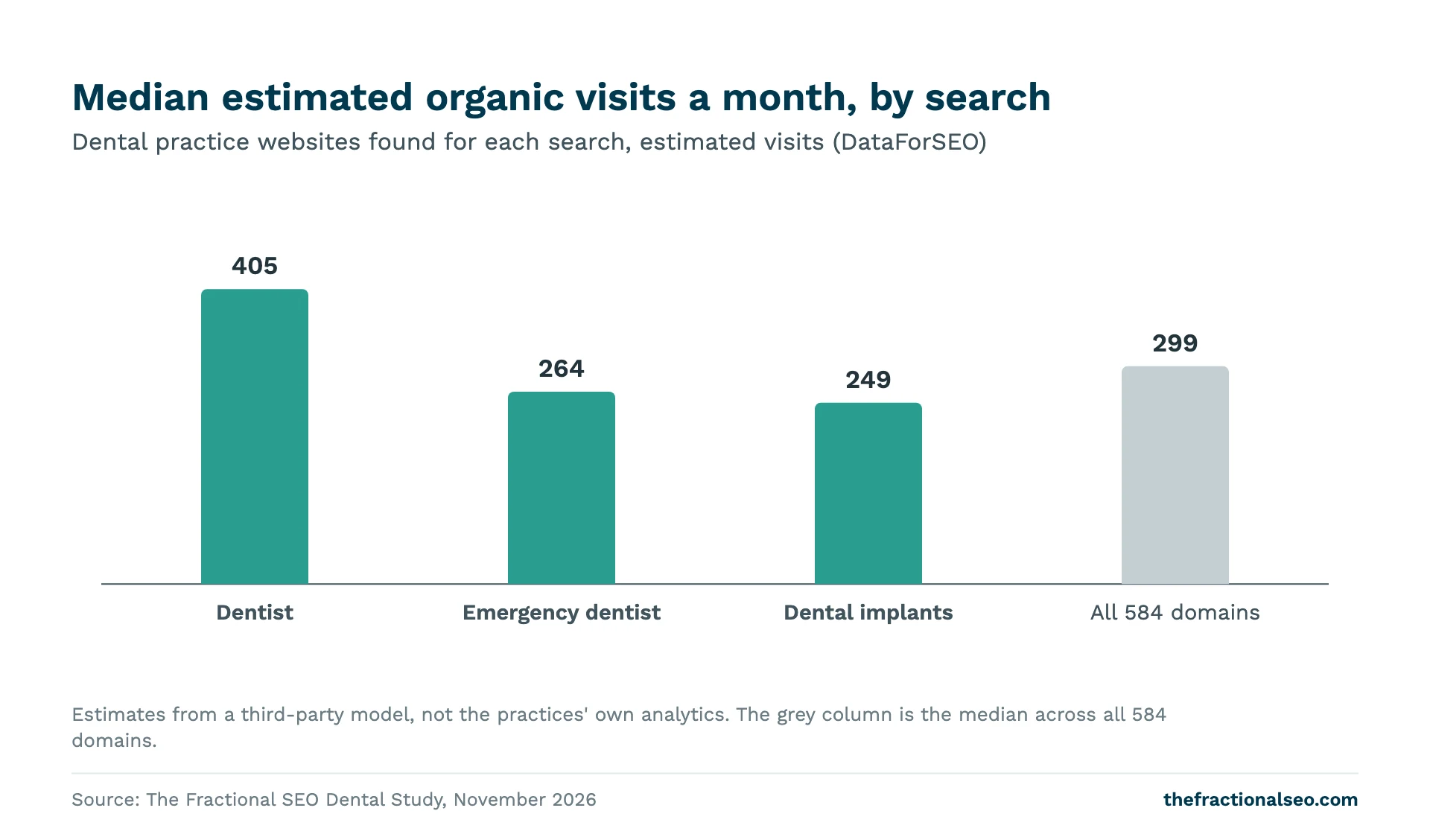
These are estimates from DataForSEO’s traffic model, not the practices’ analytics. Use them to compare sites with each other, not to judge your own numbers.
What this means for dental practices
The study describes who appears. It doesn’t prove what makes anyone rank. With that caution, here’s how we read it.
- Organic page one is mostly a contest between practices. 74% of results were practice sites. “Dentist” is the exception, where directories and social pages take much of the page.
- Check your own emergency Maps results. In 10 of 12 emergency searches, lead sellers or referral listings sat among the practices. See our directories and referral services page.
- Implant practices face brands. Chain brands held 10 of 36 implant map-pack spots.
- The map pack and the website are separate jobs. Only 39% of map-pack practices with a website were also on organic page one for the same search.
- Look at your website too. Our flagship study covers the website gaps most dental practices leave open.
How we did this
We analyzed 36 local searches across 12 US metros and three dental search types, 584 dental practice websites (499 crawled) and 568 Google Business Profiles, November 2026.
Searches were “dentist”, “emergency dentist” and “dental implants”, each followed by a metro name, in 12 metros: New York, Los Angeles, Chicago, Dallas, Houston (large); Charlotte, Nashville, Austin, Columbus (mid-size); Boise, Knoxville, Des Moines (small). Page one only, desktop, SerpAPI, collected 17 November 2026 (12:12-12:20 UTC). Business Profile data was collected the same day, and on 25-26 November for the 169 lowest-ranked profiles. The map pack is positions 1-3 of the Google Maps list for the same search: 685 Maps rows and 107 map-pack spots (one emergency search had 2).
Samples: 307 organic results across 36 searches; 48 directory results; 98 map-pack listings with a practice website; 205 emergency dentist Maps rows; 584 domains for chains, traffic and paid keywords; 497 homepages for ad tags. A company chain is one brand with locations in more than one metro unless its own pages say a location is franchised. Traffic is DataForSEO’s modeled estimate. Volumes and click costs for the 36 study searches and the national keywords we quote are Google Ads figures via DataForSEO (US); keyword-group totals and their median click costs are DataForSEO’s modeled estimates.
What it can’t claim: one snapshot per search, so it shows who appeared, not why. 107 map-pack spots is a small sample. Lead-seller and chain counts are floors. Ads vary by time, user and budget. Organic page one moves from day to day, which is why we report shares and medians, never one practice’s position. For what the websites themselves do and don’t have, see our study of 499 dental practice websites.
Questions, answered
Why do directories rank for “dentist” searches?
We measured who ranks, not why. On “dentist” searches practices held 54% of page one, and directories and social pages took the rest, led by Facebook (7) and Practo (5). On “emergency dentist” practices held 89%.
Is 1-800-Dentist in the Google Maps results?
Yes, on emergency searches. It had 16 of 205 emergency Maps listings and 4 map-pack spots in our searches.
Do chains dominate local dental search?
Not overall. Chains are 2% of the websites and held 12 of 107 map-pack spots, none on “dentist” searches. The exception is the implant map pack, where chain brands held 10 of 36 spots.
How often do AI Overviews show on dental searches?
On 15 of our 36 searches (42%), and on 8 of 12 emergency searches.
How much organic traffic does a typical dental website get?
An estimated 299 visits a month at the median, and 1,970 or more for the top 10%. These are modeled estimates, not measured visits.
Where does your practice sit?
Want to know who holds the map pack and page one in your own market? See how we approach SEO for dental practices.
More research & benchmarks
The whole Dental library- We Analyzed 499 Dental Practice Websites: The Gaps Most Practices Leave Open Eight website gaps on dental practice sites, how often each occurs, and why none of them…
- Google Reviews and Dental Rankings: What 568 Business Profiles Show What 568 dental Google Business Profiles show about review counts, ratings, recent reviews and replies in…