
Guide Dental
The Ultimate Guide to Local SEO for Dental Practices
Local SEO for a dental practice is three searches, not one. "Dentist", "emergency dentist" and "dental implants" followed by your city each bring up a different results page, with different competitors. Each page also has two halves, the map pack and the organic results, and different practices tend to show in each. This guide is built on our own data. We analyzed 36 local searches across 12 US metros and three dental search types, 584 dental practice websites (499 crawled) and 568 Google Business Profiles, November 2026. The searches were collected on November 17, 2026.
The short answer
- Three searches, three pages: practices hold 89% of page one on “emergency dentist”, 78% on “dental implants” and 54% on “dentist”, where directories and social pages take the rest.
- Two jobs on each page: only 39% of map-pack practices with a website also rank on page one of the organic results for the same search. Plan Maps and the website separately.
- No formula: nothing we measured separated the map pack. Review totals were a median of 486 in positions 1-3 against 471 at positions 4-7, no clear difference, and no website feature passed our test either.
- Two dental traps: lead sellers and referral listings sit inside the emergency map results, and chain brands hold 10 of 36 implant map-pack spots.
- Fix what patients notice: only 34% of practice sites have a homepage form, 39% of homepages mention insurance and 15% show a price, while dental cost searches run to about 1.3 million a month nationally.
Where we compare higher- and lower-ranked practices, the results show what tends to go together, not what causes a ranking. The website results are in our study of 499 dental practice websites, and the full results pages are in our benchmark of 36 local dental searches.
What a local dental results page looks like
Search “dentist” plus a city and Google shows two blocks. The map pack sits near the top: a map and a few practices with star ratings and a call button. In this guide, “map pack” means positions 1-3 of the Google Maps list for the search. Below it are the organic results, the web pages Google ranks with its normal search algorithm. A map pack appeared on 34 of our 36 searches.
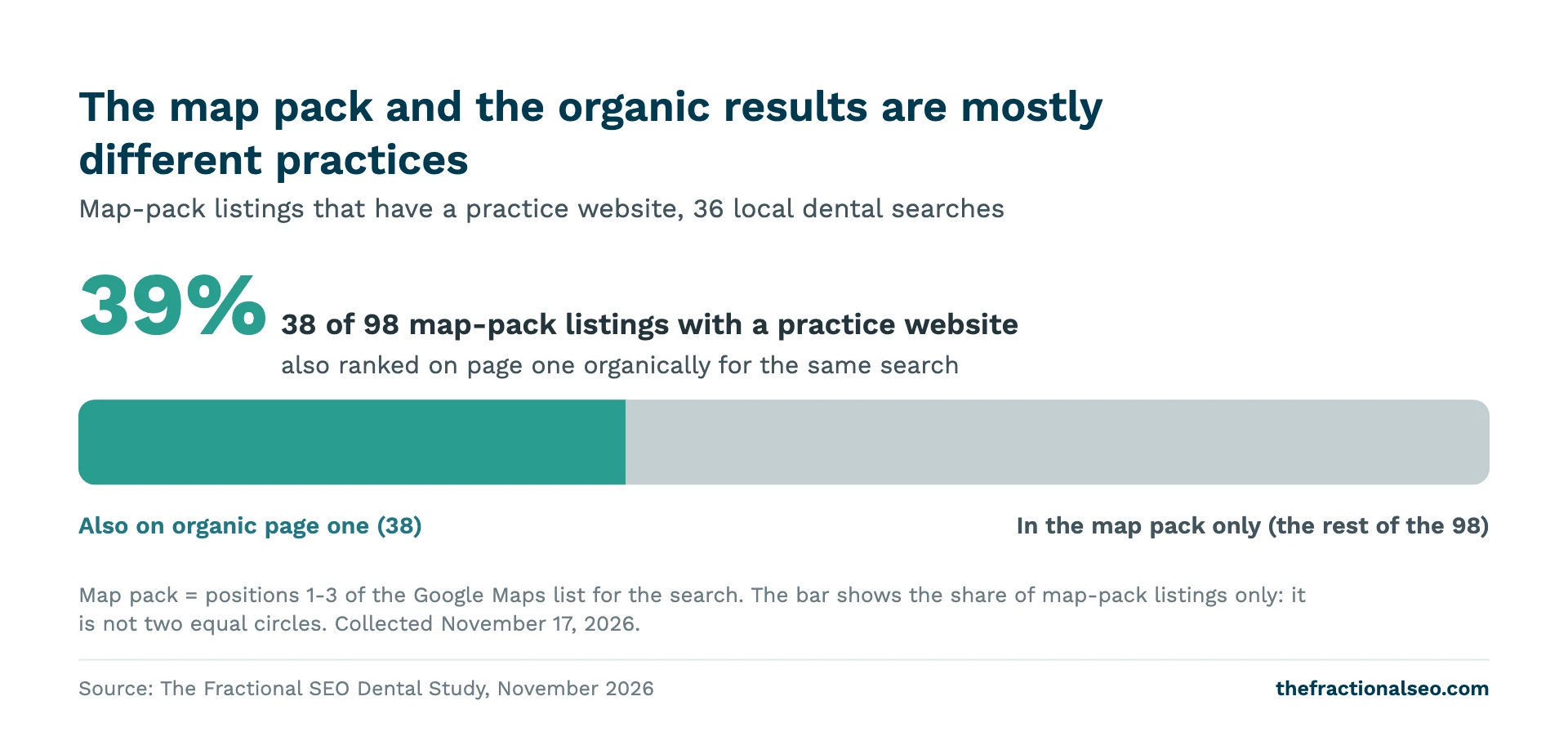
The two halves reward different practices. Only 39% of map-pack practices with a website (38 of 98) also ranked on page one of the organic results for the same search. A practice can own Maps and be missing from the page below it, or the other way round.
Dental page one is friendlier to practices than the home-service trades we studied: 74% of page-one organic results go to dental practices’ own websites, against 53% in HVAC and 37% in Landscaping. The other 26% are directories, social sites, hospital and dental-school pages, insurers and city pages. Even so, a site that is not a dental practice holds the #1 organic spot in 6 of 36 searches (17%), and 20% of top-3 organic spots.
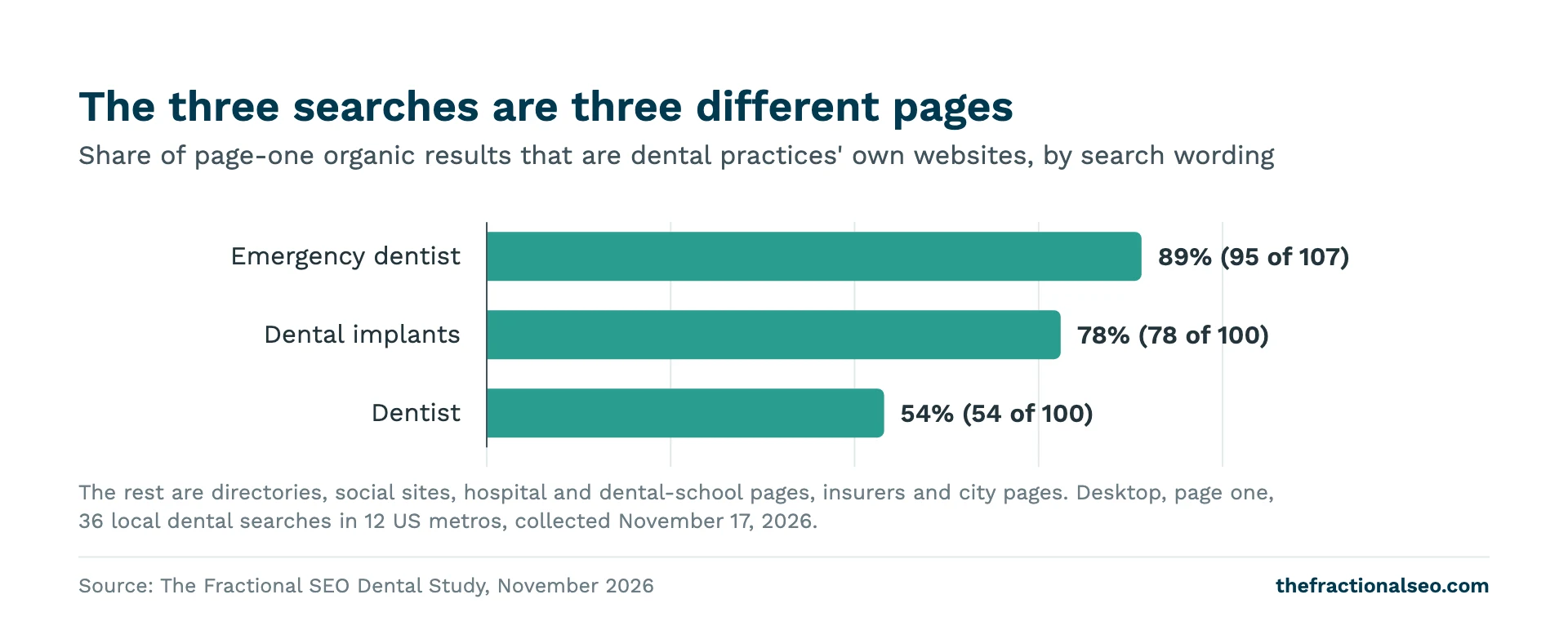
The bigger difference is between the three searches. Practices hold 89% of page one on “emergency dentist”, 78% on “dental implants” and 54% on “dentist”, where directories and social pages take the rest. Large metros are the most crowded (63% practices) against 82% in mid-size and 83% in small metros.
Almost every map-pack practice has a website: only 2 of 107 map-pack listings had none. And Google showed an AI Overview on 15 of 36 local dental searches (42%), most often on emergency searches (8 of 12), so a clear, plain answer to the question a patient typed is worth having on your site.
How Google ranks local results
Google says local results are “mainly based on relevance, distance, and popularity” (Google Business Profile Help). Relevance is how well your profile matches the search. Popularity, which Google also calls prominence, is how well known you are. Distance is “how far each business is from the customer who’s searching”, and you can’t change it.
That changes how you should check your rankings. A practice can sit first in Maps for patients near the office and not show at all a few miles away. Check from the neighborhoods your patients come from, not from the front desk. And Google is plain: “There’s no way to request or pay for a better local ranking on Google.”
Part 1: The map pack
Most local SEO guides list profile tactics as if each one moves you up. Our data doesn’t support that for dentists. In our sample, nothing separated practices in the map pack from the rest: not review totals, not star ratings, not reply rates, not any of 21 website features. That doesn’t mean the work is wasted. It means the basics are table stakes, most competitors have them, and the gaps are where you can still get ahead.
Pick the primary category for the search you want
Your primary category tells Google which searches you belong in. “Dentist” is the primary category on 48 of 98 map-pack profiles. The pack also holds “Dental implants provider” (20), “Emergency dental service” (11), “Dental implants periodontist” (6), “Cosmetic dentist” (5) and “Oral surgeon” (4). Extra categories show no difference (84% vs 80% list more than one).
So the choice is real. A general practice that does a few implants is a “Dentist”. A practice that is mostly implants, or truly offers same-day emergency care, may fit a narrower primary category better. Google’s rule is to “Choose the fewest number of categories it takes to describe your overall core business”, and to keep the name to your real name: “Including unnecessary information in your business name isn’t permitted, and could result in the suspension of your Business Profile” (Google Business Profile guidelines). Adding “Emergency Dentist” and a city to your name is a quick way to lose a profile. Our Google Business Profile checklist for dental practices covers the rest of the profile.
Reviews: keep them coming
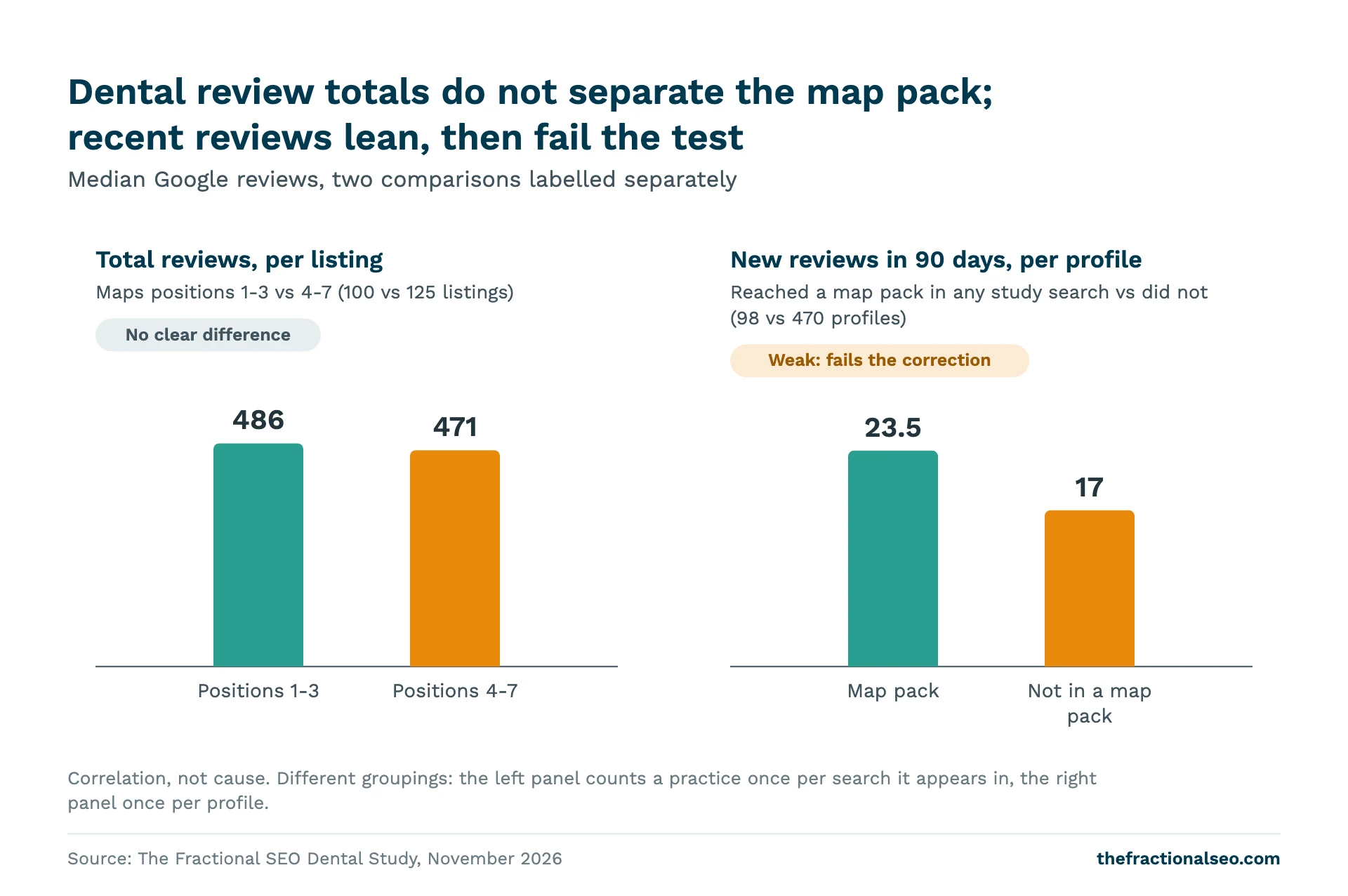
Dental review counts are high everywhere. Practices in positions 1-3 have a median of 486 Google reviews against 471 at positions 4-7: no clear difference. That is unlike HVAC, where the map pack had more than twice the reviews of the next four (1,576 vs 615). The middle half of map-pack practices have between 207 and 1,043 reviews, and 8 of 100 have fewer than 50. Our data doesn’t point to a review count that gets you in.
The profile data does lean in places. Practices that reached a map pack in any study search got a median 23.5 new reviews in the 90 days before collection against 17 for the rest, and had 31.5 vs 26 profile photos, but both gaps fail the correction for testing many things at once, so treat them as a lean, not a rule. Our reading: aim for a steady flow of reviews rather than a big total from years ago; patients see the dates. The detail is in what 568 Business Profiles show about reviews.
Ask every patient, every day, with a link or QR code at checkout and in the follow-up text. Don’t pay for reviews or trade them for a discount: Google’s policy bars merchants from offering “incentives – such as payment, discounts, free goods and/or services – in exchange for posting any review” (Google Maps content policy).
Reply to reviews without confirming anyone is a patient
Replying showed no difference either (median reply rate 70% for practices that reached a map pack vs 55% for the rest), but practices split: 22% of profiles replied to none of their newest 20 reviews and 32% replied to 90% or more.
For a dental practice, the reply itself is the risk. A reply that confirms someone is a patient, or talks about their treatment, can disclose protected health information. In 2019 a Dallas dental practice agreed to pay $10,000 to the HHS Office for Civil Rights after the office found it had disclosed patients’ information in replies to Yelp reviews (California Dental Association). A safe reply thanks the reviewer, says nothing about whether they were seen or what was done, and invites them to call the office. Write two or three approved replies and let the front desk use them.
Lead sellers in the emergency map results
Emergency searches have a competitor most guides don’t mention. 33 of 205 Maps listings on “emergency dentist” searches (16%) belong to 1-800-Dentist, a teledentistry service or a referral network’s doorway listings, not to a practice. They appear in 10 of the 12 emergency searches and hold 7 of 35 emergency map-pack spots, including 2 #1 spots. Outside emergency searches there is one such listing. The brands are 1-800-Dentist, emergencydentalservice.com (which its about page describes as a patient referral marketing tool for dentists) and teledentistry.com, and 33 is a floor.
Our reading: these listings go after emergency patients, many of whom search “near me”: “nearest emergency dentist to me” has about 246,000 searches a month nationally (Google Ads via DataForSEO, US, November 2026). If you think a listing near you misrepresents a business, you can suggest an edit to Google, but don’t build your plan around it disappearing.
What you can do (our view): if you truly see emergency patients the same day, say so on your profile and your homepage, keep your hours current, answer the phone when you say you’re open, and get reviews from emergency visits. The full count is in the benchmark, and the referral services are covered in directories and referral services in dental search.
Chains in the implant map pack
Implant searches have a different competitor. Chains are 2% of dental websites in the study but hold 12 of 107 map-pack spots (11%), nearly all on implant searches: 10 of 36 implant map-pack spots go to chain brands (Affordable Dentures & Implants 5, Nuvia 3, ClearChoice 1, SPG 1). On “dentist” searches chains hold none. Affordable Dentures & Implants and Nuvia are multi-metro brands whose sites we could not read to tell whether their offices are franchised or company-run. The chain counts are a floor: 12 rows in our chain check could not be read.
| Search | Who else holds map-pack spots |
|---|---|
| Emergency dentist | Lead sellers and referral listings: 7 of 35 spots |
| Dental implants | Chain brands: 10 of 36 spots |
| Dentist | Chains: none |
What an independent can do (our view): make the implant page about your own practice. Say who places the implants, what a consultation involves, how financing works and what affects the price, with real photos of your office and team. A chain’s page can’t say any of that about your town. Don’t promise outcomes or a price you can’t stand behind.
Part 2: Local organic results
The website side has no formula either. No website feature separated map-pack practices from the rest, and map-pack and other practices have the same number of service pages (median 14.5 vs 15) and location pages (1 vs 1). What the data does show is where most practice sites fall short.
Site basics most practices skip
93% of practice sites have a tap-to-call phone link, but only 34% have a form on the homepage. A form catches patients who find you after hours. 25% of practice sites carry LocalBusiness (or Dentist) schema, the code that tells Google your name, address and hours, and 29% show a review widget. Most already put their city in the homepage title (84%).
Service pages are common: 89% of sites have them (median 17 among those that do), and 56% have location or service-in-city pages. Blogs are mostly abandoned: 59% of practice sites have a blog, but only 14% published a post in the last 12 months and 6% posted at least monthly. A blog whose newest post is years old tells a patient the site isn’t looked after. Either keep it current or take it off the homepage.
Speed is the other gap. The median mobile Largest Contentful Paint is 6.7 seconds, and only 12% of dental sites load their main content within Google’s 2.5-second line. Large images and video are common causes, and Google’s PageSpeed Insights shows which parts of your page are slow.
Answer what patients ask before they book
Patients pick a dentist on practical questions: do you take my insurance, can I pay over time, are you taking new patients, what will it cost. Most homepages don’t answer them.
| What the homepage mentions | Share of 497 homepages |
|---|---|
| Online booking | 41% |
| Insurance accepted or named | 39% |
| Financing | 37% |
| A new-patient offer | 27% |
| Accepting new patients | 18% |
| A price | 15% |
40% mention none of insurance, a membership plan or financing. The searches are there. Dental cost searches run to about 1.3 million a month nationally, led by implants (“dental implant cost” 135,000), crowns (74,000), Invisalign (74,000) and bridges (60,500), in DataForSEO’s modeled keyword data (US). Yet only 19 of 195 (10%) implant practices show any price on the homepage, and 61 of 195 (31%) mention financing. Patients also search “dentist accepting medicaid near me” (27,100 a month), “dentist open on saturday” (9,900), “dentist accepting new patients near me” (8,100) and “dental payment plans” (6,600) (Google Ads via DataForSEO, US, November 2026).
Put the answers where patients look: a plain insurance page that names the plans you take (including Medicaid if you do), a financing page, a “new patients” page with your hours, and price ranges with what changes them for your main treatments. Ranges and “from” prices are honest; a guaranteed price or result is not.
Directories
Sites that aren’t practices take less of dental page one than in the trades, but directories still show up. Yelp is the directory dental practices meet most: 18 page-one results, one in each of 18 of 36 searches. Zocdoc (5 results) and Practo (5) follow; Facebook pages appear 9 times. Claim the ones that appear in your city’s results and keep your details the same on each. More in our directories guide.
Know what a click is worth
Google Ads (via DataForSEO, November 2026) reports a median 4,900 monthly searches for “dentist <city>” and 720 for “dental implants <city>”, but returns volume for only 3 of 12 “emergency dentist <city>” searches. National “near me” searches are large instead: “dentist near me” has about 1,830,000 searches a month (Google Ads via DataForSEO, US), and emergency searches as a group run to about half a million a month in DataForSEO’s modeled keyword data.
Clicks are expensive, and that is the case for ranking without paying for every visit. Implant clicks cost the most: median $30.26 a click against $14.19 for “dentist <city>”, up to $72.91 in Los Angeles. Among dental keywords with 1,000+ searches a month, “invisalign consultation” costs $51.98 a click and “dental implants consultation” $41.38 in DataForSEO’s modeled keyword data (US); Google Ads figures for the same keywords can differ. Dental search is not seasonal in any way that should change a practice’s plan: Google Trends interest in “dentist” moves only 1.23x between its August high and December low, so keep the work steady.
Tracking tags and HIPAA
Local SEO brings patients to your site, and many sites hand their visits to ad platforms. 110 of 497 (22%) dental homepages carry an advertising pixel in their HTML: the Meta (Facebook) pixel on 62, a Google Ads tag on 63. That is a floor, because tags loaded by Google Tag Manager can’t be seen in the page source. A tag on a homepage is not by itself a HIPAA problem. It depends on what is sent, from which pages and under what agreement.
The rules have moved. HHS issued a bulletin on online tracking technologies on December 1, 2022 and later revised it. On June 20, 2024 a federal court in Texas, in American Hospital Association v. Becerra, vacated the part covering an IP address combined with a visit to a public page about health conditions or providers (Hunton Andrews Kurth summary). Tracking on booking, form and patient-login pages is a different matter, and a vendor that handles protected health information for you needs a business associate agreement (BAA). Talk to your compliance adviser or attorney. Our guide to tracking pixels and HIPAA covers what to check and safer setups.
A 90-day local SEO plan
Days 1-30: the profile
- Check the primary category against the search you want most.
- Fix the name, hours (including emergency hours, if real) and phone to match your site.
- Start asking every patient for a review with a link or QR code.
- Write approved review replies that never confirm anyone is a patient.
Days 31-60: the website
- Add a short form to the homepage.
- Publish or fix insurance, financing and new-patient pages.
- Add LocalBusiness or Dentist schema.
- Fix mobile speed on the homepage and your main service pages.
Days 61-90: the gaps your competitors leave
- Write an honest cost page for your main treatment, with ranges and what changes them.
- Build or rewrite the implant or emergency page with your own team and office.
- List every tag your site loads, and take ad pixels off booking and form pages until you’ve checked them.
- Work through the local SEO checklist for dental practices.
How to measure local SEO
Track three things each month: calls, direction requests and website clicks in your Business Profile performance report; new-patient calls and bookings by source; and your map position checked from the neighborhoods your patients come from, for each of the three searches. For a sense of scale, the median dental practice website gets an estimated 299 organic visits a month, and the top 10% get 1,970 or more. Measure new patients, not visits.
Questions, answered
How do I get my dental practice into the Google map pack?
Google ranks local results on relevance, distance and popularity. You control relevance (the right primary category and a complete profile) and some of popularity (steady reviews). Nothing in our data guaranteed a spot: no review total or website feature separated the pack.
How many Google reviews does a dental practice need?
There’s no target. Map-pack practices had a median of 486 and the next four places 471. The middle half of map-pack practices have between 207 and 1,043. Keep new reviews coming rather than chasing a number.
Why does 1-800-Dentist show up for “emergency dentist” in my city?
Lead sellers and referral listings held 7 of 35 emergency map-pack spots in our searches. They compete for the same “near me” calls you do. The best answer is a profile and page that show you really see emergency patients.
Should we put prices on our website?
Our view is yes, as ranges with what changes them. Only 15% of homepages show a price, while cost searches run to about 1.3 million a month. Never promise a price or result you can’t stand behind.
Can I pay Google to rank higher in Maps?
No. Google says there’s no way to request or pay for a better local ranking.
Want to know which of your three searches you’re losing? We look at your map position, your site and your profile for “dentist”, “emergency dentist” and “dental implants” in your city. See how we work with dental practices.
Sources
- Study data: We analyzed 36 local searches across 12 US metros and three dental search types, 584 dental practice websites (499 crawled) and 568 Google Business Profiles, November 2026.
- Google Business Profile Help: tips to improve your local ranking
- Google Business Profile guidelines
- Google Maps user-generated content policy
- California Dental Association: dental practice settles over Yelp replies (2019)
- Hunton Andrews Kurth: court ruling on the HHS tracking bulletin (2024)