
Templates & Resource Dental
Local SEO Checklist for Dental Practices
Most local SEO checklists give every task the same weight, or put first whatever the author thinks helps a practice rank. We tried to order this one by data, and in dental the data gave no ranking order: nothing we measured on websites, speed or review totals separated the map pack from the practices below it. So this list starts with what most practices leave undone, the things a new patient looks for and often can't find. Then speed, your Business Profile and reviews, and a check of the tracking tags on your site. All 41 items are free to download as a PDF or a Google Sheet.

Get the template No email required
What's inside
Priority 1: website gaps
Homepage form, insurance, financing, prices, schema and a live blog: the things most practice sites still leave out.
Priority 2: speed and technical
Mobile load time, page weight, meta descriptions, H1s, titles and HTTPS.
Priority 3: profile and reviews
Category, basics, steady review requests and replies that never confirm someone is a patient.
Priority 4: check your tags
Find every pixel and tag on your site, and decide what belongs near booking and forms.
How to use it
-
Download the PDF or copy the Sheet
Print it, or make your own copy of the Google Sheet.
-
Work top to bottom
Start with the website gaps. Give every item an owner and a date.
-
Repeat the monthly tasks
Count new reviews, check Maps from near the office and re-check your tags after changes.
We analyzed 36 local searches across 12 US metros and three dental search types, 584 dental practice websites (499 crawled) and 568 Google Business Profiles, November 2026. The searches were “dentist”, “emergency dentist” and “dental implants” in each metro, collected on November 17, 2026. For the reasoning behind each task, read the full local SEO guide for dental practices. The website numbers come from our study of the gaps 499 dental websites leave open.
If your Business Profile isn’t claimed yet, do item 21 first. The review items depend on it.
How this checklist is ordered
Every item sits in one of six groups.
- Priority 1: website gaps. Things a new patient looks for that most practice sites still leave out: a form, insurance, financing, prices, schema, a blog that is alive.
- Priority 2: speed and technical basics. Most dental sites are slow on phones. The rest is hygiene that a minority of sites get wrong.
- Priority 3: profile and reviews. Basics nearly every practice already has, plus a steady review habit and replies written with patient privacy in mind.
- Priority 4: check your tags. Ad pixels and recording tools on your site, and where they sit next to booking and forms.
- Setup. Best practice from Google’s own guidelines, not study data.
- Monthly tasks. Best practice, with one benchmark from the study.
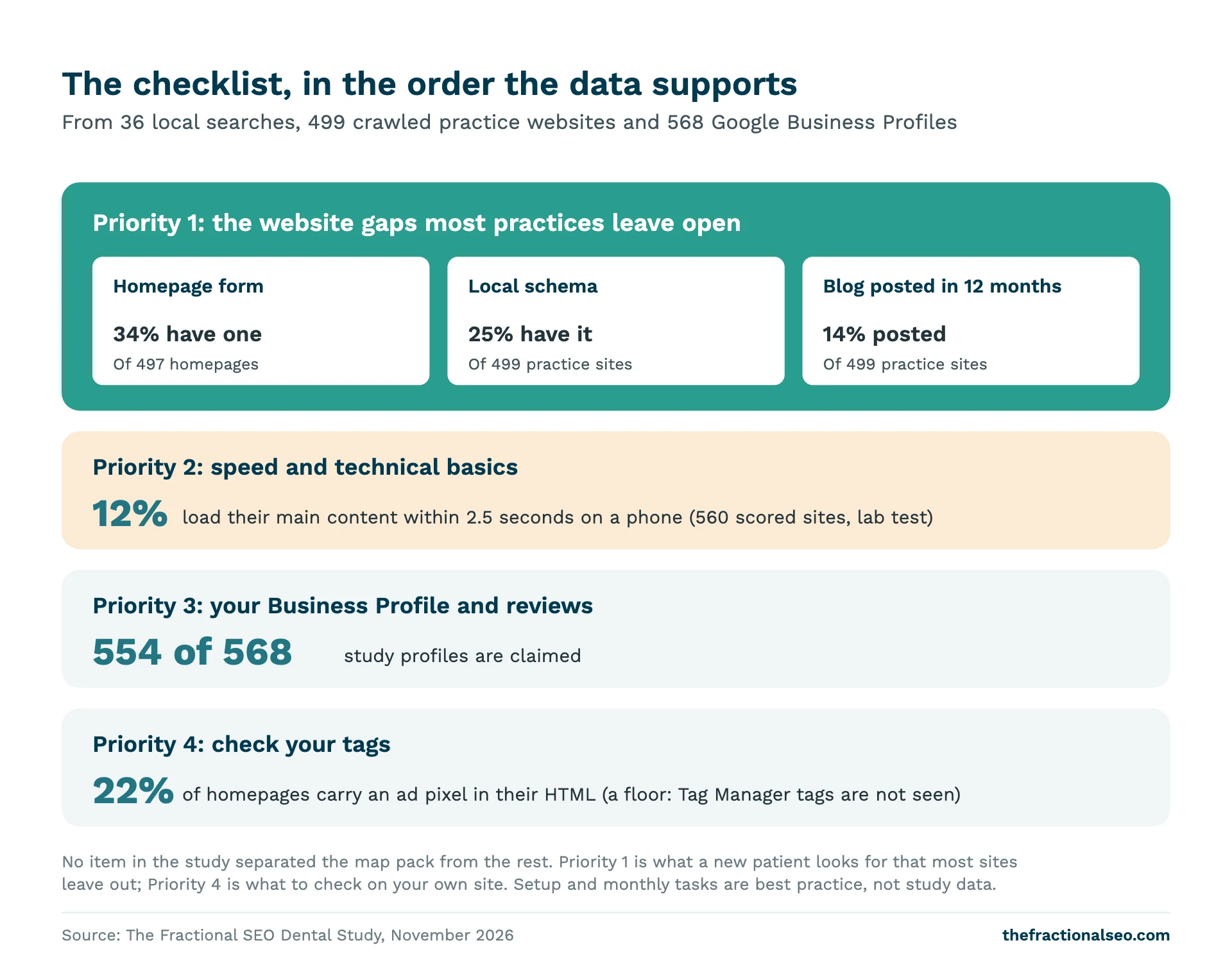
One honest note before the list. No item on it was shown to move rankings in our data. We compared 21 website features between practices in the map pack and the rest, and between the organic top 3 and positions 4-10. None passes the correction for the number of tests we ran, and neither did page speed. Review totals made no clear difference either: a median of 486 Google reviews at positions 1-3 against 471 at positions 4-7. That is a small sample showing no clear difference, not proof that these things don’t count. Be wary of anyone who says they know which item will move you up.
So the order follows the patient. Someone who found you still has to decide to book, and the first group covers what they look for and often don’t find.
Priority 1: The website gaps most practices leave open
93% of practice sites have a tap-to-call phone link, but only 34% have a form on the homepage. That is the first gap. Some patients would rather write than call.
| What the homepage or site has | Share of practices |
|---|---|
| Tap-to-call phone link | 93% |
| Form on the homepage | 34% |
| Emergency or same-day care mentioned | 64% |
| Online booking | 41% |
| Insurance mentioned | 39% |
| Financing mentioned | 37% |
| In-house membership plan | 23% |
| Says it accepts new patients | 18% |
| Shows a price | 15% |
| LocalBusiness (or Dentist) schema | 25% |
| Review widget | 29% |
| City in the homepage title | 84% |
| Service pages | 89% |
| Location or service-in-city pages | 56% |
| Blog posted to in the last 12 months | 14% |
Look at the money rows. 40% of homepages mention none of insurance, a membership plan or financing. Patients search for these answers: “dentist insurance” has about 201,000 searches a month nationally (DataForSEO Google Ads, November 2026). If you take their plan, name it. If you offer financing or a membership plan, say so near the top of the page.
Prices show the sharpest mismatch with what patients search for. The pages people search for prices are the pages practices don’t price: 19 of 195 (10%) implant practices show any price on the homepage, while dental cost searches run to about 1.3 million a month nationally. You don’t have to publish a fee schedule. A “starting at” price for a cleaning, a crown or an implant consultation, one you will actually honor, answers a question most of your competitors leave open. Never promise an outcome, and keep any price current.
Build an area page only for a place you truly serve, with something real to say about it. Google’s spam policies say “doorway abuse is when sites or pages are created to rank for specific, similar search queries.” For schema, Google asks for “the most specific LocalBusiness sub-type possible”, which for most practices is Dentist. Only 25% of practice sites carry LocalBusiness or Dentist schema. If you keep a blog, keep it alive: 59% of practice sites have a blog, but only 14% published a post in the last 12 months and 6% posted at least monthly.
- A short contact or appointment-request form on the homepage.
- A tap-to-call phone link in the header on every page.
- The insurance plans you accept, named on the homepage.
- Financing or payment options stated, if you offer them.
- Your in-house membership plan stated, if you have one.
- “Starting at” prices for common treatments, only ones you will honor.
- A clear line saying whether you accept new patients.
- Emergency or same-day care stated, if you offer it.
- LocalBusiness schema, using the Dentist sub-type.
- Real patient reviews shown on the site, with permission.
- A page for each treatment you offer: implants, crowns, Invisalign, emergency care and the rest.
- A page for each area you really serve. Never city-swapped copies.
- A blog that is kept current, or taken out of the menu.
- Your city in the homepage title tag. 84% of practice sites already do this, so check yours is not the exception.
Priority 2: Speed and technical basics
Dental sites are slow on phones: median mobile PageSpeed score 62, median Largest Contentful Paint 6.7 seconds, and only 12% load their main content within Google’s 2.5-second line. That line comes from Google’s web.dev guidance, which says sites “should strive to have Largest Contentful Paint of 2.5 seconds or less.” Speed did not separate the map pack (median score 62 vs 63), so treat this as a patient problem, not a ranking trick. Homepages are heavy, too: median 3.1 MB, and 31% weigh more than 5 MB. Large, uncompressed images are a good first thing to check.
The rest is hygiene. 19% of sites are missing a meta description on a quarter or more of their pages, 10% are missing an H1 on a quarter or more, and 5% duplicate titles that widely. Every crawled site uses HTTPS. Google’s SEO starter guide says a good meta description is “short, unique to one particular page”.
- A mobile PageSpeed check of the homepage, and a fix for whatever pushes the main content past 2.5 seconds.
- A lighter homepage: compressed photos, saved as WebP, no autoplay video at the top.
- A meta description on every page.
- One H1 on every page.
- A unique title on every page.
- HTTPS on every page, including booking and form pages.
Priority 3: Your Business Profile and reviews
The basics are near universal: 554 of 568 profiles are claimed, 96% of map-pack profiles and 89% of the rest have a description, and 98% vs 93% link a website. None of these separates the pack. The real choice is the primary category. “Dentist” is the primary category on 48 of 98 map-pack profiles; the pack also holds “Dental implants provider” (20) and “Emergency dental service” (11). Google’s guidelines say to “choose the fewest number of categories it takes to describe your overall core business.” Pick the one that matches your core work. Step by step in our Google Business Profile checklist for dental practices.
On reviews, totals made no clear difference (486 vs 471). Recent reviews leaned toward the map pack, a median 23.5 new reviews in 90 days against 17, but that gap fails the correction, so it is not a difference we can stand behind. A steady habit of asking still makes sense: patients read reviews. Ask every patient, not only the happy ones. Google’s content policy does not allow businesses to “offer incentives – such as payment, discounts, free goods and/or services – in exchange for posting any review”. More in what 568 Business Profiles show about reviews and rankings.
Replies need care in dental. Replying to reviews shows no clear difference (median reply rate 70% in the map pack vs 55%), but practices split: 22% of profiles with 5 or more reviews replied to none of their newest 20 reviews and 32% replied to 90% or more. A reply is public text. A reply that confirms someone is a patient, or talks about their treatment, can itself disclose health information. Thank the reviewer, don’t confirm they were seen, and take any complaint offline by phone.
Posting showed no edge: 35% of map-pack practices posted in the last 30 days against 40% of the rest, and 23% of profiles have never posted. Post when you have something real to say.
- Your Business Profile claimed and verified.
- A primary category that matches your core work, and extra categories only where they truly apply.
- A business description and your website link filled in.
- A review request to every patient, every week, by text or email after the visit. No incentives.
- Review replies that thank the reviewer, never confirm treatment, and take problems offline.
- Photos of the office, team areas and equipment. No patient photos without the patient’s written authorization.
- A Google post when you have news, a new service or changed hours.
Priority 4: Check your tags
110 of 497 (22%) dental homepages carry an advertising pixel in their HTML: the Meta (Facebook) pixel on 62, a Google Ads tag on 63. 20 carry a session-recording tool (Microsoft Clarity 16, Hotjar 4). Ad pixels sit next to the pages where patients hand over details: 48 of 202 (24%) homepages with online booking also carry an ad pixel, and 46 of 170 (27%) homepages with a form.
These counts are a floor. Google Tag Manager is on 61% of dental homepages, and on 24% Tag Manager is the only tag in the HTML, so what it loads cannot be seen from the page source. We only read homepages, so a pixel on the same homepage as a booking button is not proof it fires on the booking page itself. A tag on a homepage does not by itself mean health information is shared. Whether tracking data is protected health information depends on what is sent, from which pages, and under what agreement. Call tracking is on 16% of homepages, and call recordings and transcripts can hold health information too.
Our guide to tracking pixels and HIPAA for dental websites covers what the rules say and safer setups. For your own practice, talk to your compliance adviser or attorney.
- A list of every tag on your homepage and inside Tag Manager, with who added each one and why.
- A decision, made with your compliance adviser, on any ad pixel near booking, forms or treatment pages.
- For any session-recording tool: know what it records, and on which pages.
- For call tracking: know where recordings and transcripts are kept and who can hear them.
Setup: best practice
These come from Google’s guidelines and common practice, not our study. Google says your name “should reflect your business’s real-world name” and asks you to “make sure your address and/or service area is accurate and precise.” Directories and referral services rank for dental searches too; see directories and referral services in dental search.
- Your practice name on the profile exactly as on your sign and paperwork, with no added keywords or cities.
- Your address, or service area, accurate.
- Name, address and phone identical on your website, profile and the directories that rank for your searches.
- Google Search Console set up and verified.
Monthly tasks
Six checks to repeat each month. The review count has a benchmark, with a warning: map-pack practices got a median 23.5 new reviews in 90 days against 17, a lean that fails the correction. Our review data only covered each profile’s newest 40 reviews, so the busiest practices’ counts are floors. Use it to check your flow is steady, not as a target.
- Count new reviews this month against last month.
- Check your Maps position for your main searches from a phone near the office.
- Check profile calls, website clicks and direction requests.
- Check Search Console clicks for treatment and city searches, and look at any page that dropped.
- Re-check your tags after any website, booking or ad change.
- Check that every new review has a reply that follows item 25.
Want someone to work through this list with you? See how we work with dental practices.