
Guide Landscaping
The Ultimate Guide to Local SEO for Landscaping Companies
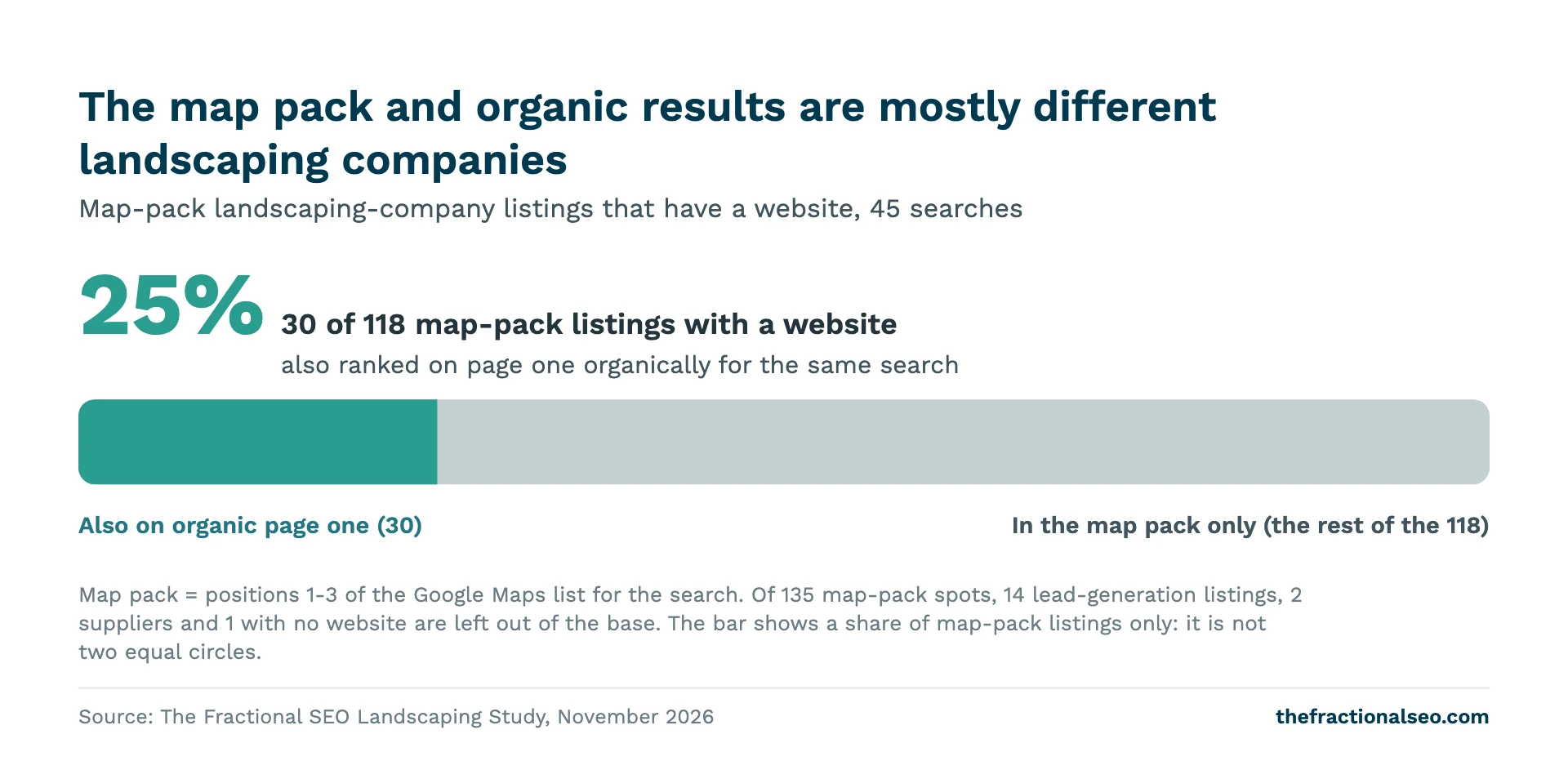
Local SEO for landscaping companies is three markets and two jobs. The markets are lawn care, landscaping and hardscaping, and each search shows different winners. The jobs are the map pack, the three Google Maps listings near the top of a search, and the organic results below it. Mostly different companies win each: in our study, 25% of map-pack landscaping companies with a website also ranked on page one organically for the same search.
The short answer
- Three markets: lawn care, landscaping and hardscaping searches show different winners, and marketplaces hold part of the lawn care map pack.
- Two jobs: the map pack and the organic results are mostly different businesses. Plan each one separately.
- Map pack: businesses that reach it tend to have more reviews, more recent reviews, a higher reply rate, more photos and more links.
- Website: location pages are the one feature with a measured map-pack edge, though they may mark an established company rather than cause the ranking.
- Timing: searches climb from February to April. Winter is when the work goes in.
We analyzed 45 local searches across 15 US metros and three landscaping search types, 577 landscaping company websites (537 crawled) and 582 Google Business Profiles, November 2026. We collected this data in mid-November 2026, after the spring and summer landscaping season, so rankings, review pace, Google posting and ad activity may look different in season.
Where we compare higher- and lower-ranked companies, the results show what tends to go together, not what causes a ranking. The full website results are in our study of 537 landscaping websites.
What a local landscaping results page looks like
Search “landscaping company” or “lawn care service” with a city name and Google shows two blocks. The map pack sits near the top: a map and three businesses with star ratings, a call button and directions. In this guide, “map pack” means positions 1-3 of the Google Maps list for the search. Below it are the organic results, the web pages Google ranks with its normal search algorithm.
It's easy to treat the two as one thing. Our data says they mostly aren’t. Of the map-pack landscaping companies that had a website, 25% also ranked on page one organically for the same search (30 of 118 listings).
The organic half is crowded with sites that don’t mow or plant anything. Only 37% of page-one organic results for local landscaping searches went to landscaping companies’ own websites. The other 63% went to directories, social sites, lead-generation sites, listicles and city guides. A site that is not a landscaping company held the #1 organic spot in 24 of 45 local landscaping searches (53%), and 68% of all top-3 organic spots.
| Type of page-one organic result | Results (of 393) |
|---|---|
| Directories | 168 |
| Landscaping company websites | 144 |
| Social sites | 40 |
| Lead-generation sites | 18 |
| Listicles and other content sites | 10 |
| City guides and media | 7 |
| Associations | 3 |
| News | 2 |
| Manufacturers | 1 |
Why does the organic job matter? Companies found only in Maps had little estimated organic traffic (a median of 37 visits a month); those that ranked only organically got 118, and those found in both about 263. These are DataForSEO estimates, not measured visits, and they describe who turns up where, not what turning up would do for you. More is in our benchmark of 45 local landscaping searches.
Three markets: lawn care, landscaping and hardscaping
We ran three wordings in every metro, and they behaved like three different markets. Landscaping companies held 29% of page one on “landscaping company” searches, 34% on “lawn care service” and 47% on “hardscaping company”. Shares also differed by metro size: companies held 25% of page one in the six large metros, 42% in mid-size metros and 49% in small ones. The groups are small, so read these as a description, not a test.
| Search wording | Landscaping-company share of page one | Typical monthly searches per metro |
|---|---|---|
| landscaping company <city> | 29% | 325 (12 of 15 metros with a volume) |
| lawn care service <city> | 34% | 320 (14 of 15 metros) |
| hardscaping company <city> | 47% | No volume returned in any metro |
“Landscaping company <city>” and “lawn care service <city>” are searched about equally. Lawn care clicks cost more, though: the median suggested bid is $10.15 for “lawn care service <city>” vs $7.17 for “landscaping company <city>”. Lawn care is also where the marketplaces sit (more on that below).
Hardscaping is its own case. Google returned no volume for “hardscaping company <city>” in any of the 15 metros (the searches still returned full results pages). Houzz is mostly a hardscaping competitor (13 of its 20 page-one results), and an AI Overview appeared on 13 of 15 hardscaping searches. A hardscaping page should name the work: patios, retaining walls, pavers, outdoor kitchens.
If you sell all three, give each its own page and plan.
How Google ranks local results
Google's help page on local ranking says “Local results are mainly based on relevance, distance, and popularity.” Relevance is how well your profile matches the search. Distance is how far you are from the searcher. Prominence, which the page defines as how well-known a business is, draws on things like “how many websites link to your business and how many reviews you have.”
Distance is outside your control: a homeowner across town sees a different map pack from the one you see at the shop. The same page is plain about shortcuts: “There’s no way to request or pay for a better local ranking on Google.” What you can work on is relevance and prominence.
Part 1: The map pack
The map pack runs on your Google Business Profile, the free listing Google keeps for your company, what customers say there and how well-known you are around the web.
Set up the Business Profile properly
Claim and verify the profile first.
Business name. Use your real name, as it appears on your trucks, trailers and estimates. Google's guidelines say “Including unnecessary information in your business name isn’t permitted, and could result in the suspension of your Business Profile.” Keyword-named Maps listings with few reviews (a listing named only “<city> lawn care”, for example) are rare in landscaping: our study flagged 13 listings, and they held 1 of 135 map-pack spots. The flag is rule-based, not proof that any listing is fake.
Address and service area. Crews work at the customer’s property, so most landscaping companies are service-area businesses. Google’s guidelines say “If you’re a service-area business, you should hide your business address from customers.” Set the towns you serve instead.
Category. This is a real choice in landscaping. Map-pack profiles split across three primary categories: “Landscaper” (39 of 88), “Lawn care service” (29) and “Landscape designer” (16). Pick the one that matches your main work. Google asks you to “Choose the fewest number of categories it takes to describe your overall core business.” Our Google Business Profile checklist for landscaping and lawn care companies covers categories, photos and the rest of the setup.
Website link. Almost every business in the landscaping map pack shows a website: 1 of 135 map-pack listings had no website link. Use the same phone number on the profile and the site.
Reviews: how many, how recent, and replies
Reviews show the clearest map-pack difference in our data, on three measures. All three gaps survive the correction for the number of tests.
- Total reviews. Landscaping companies at Maps positions 1-3 had a median of 99 Google reviews against 63 at positions 4-7.
- Recent reviews. Businesses that reached a map pack in any study search got a median of 5 new reviews in the 90 days before collection, against 2 for those only seen at Maps positions 4-20. Over 30 days the medians are 1 vs 0 and the gap is weak: in late autumn most companies collect very few.
- Replies. Map-pack companies replied to a median of 90% of their newest 20 reviews against 70% for the rest. Across all profiles, 39% reply to 90% or more and 14% reply to none.
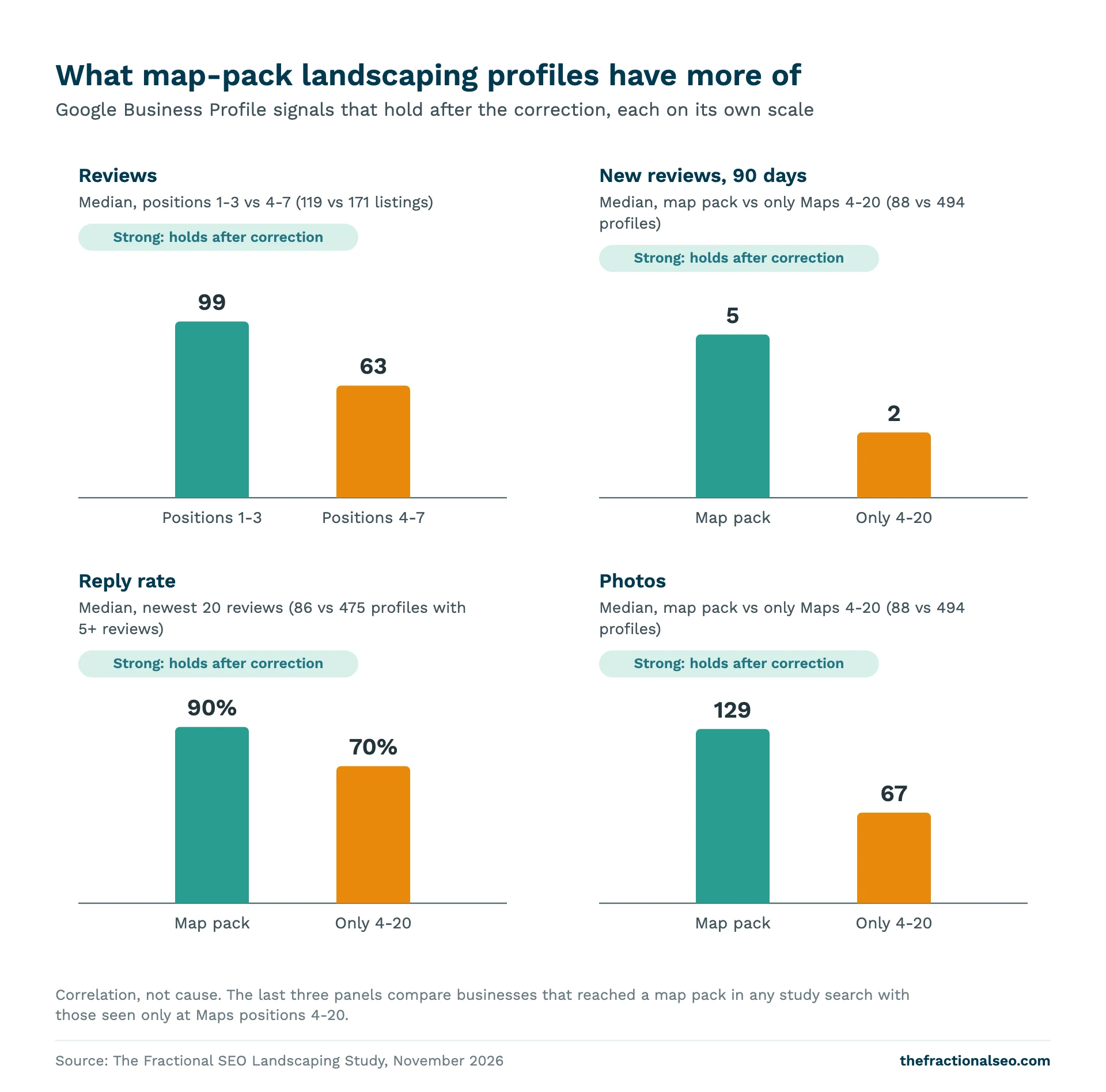
These are correlations, not causes. Established companies tend to have more reviews and other advantages too: age, budget and links. Replying may be a sign of a well-run profile rather than a cause of ranking. Still, a review habit is the cheapest thing in this guide:
- Ask every customer, at the end of an install or after the first few visits on a maintenance account. Google's content policy says merchants may not “selectively solicit positive reviews from customers”.
- Make it one tap. Google lets you share a direct review link or a QR code. Put the link in the invoice text or email, and the QR code on the leave-behind card or door hanger.
- Never offer a discount, a free mow or a gift for a review. Google says incentives for reviews are strictly prohibited.
- Reply to every review in plain words, good and bad. Google’s advice is to reply as best practice.
Spread the asks across the year, since recent reviews are one of the measures that separated the pack. For benchmarks by metro size and search wording, see our research on Google reviews and landscaping rankings.
Photos and posts
Photos are another clear gap. Map-pack landscaping profiles have about twice as many photos: a median of 129 against 67, a strong gap. Photo counts include customer photos, and busier companies collect more of both, so it’s a correlation. Use your own work: a finished patio, a new planting bed, a before-and-after of a cleanup.
Posting is different. 30% of landscaping profiles posted on Google in the 30 days before collection and 27% have no posts at all. Map-pack businesses post a little more often (41% vs 28% in 30 days), but the gap is weak and fails the correction. Post when you have news, such as spring booking opening, and don’t expect posts to carry the profile.
Marketplaces in the lawn care pack
Lawn care has an unusual feature: lead-generation marketplaces inside the map pack. LawnStarter and Lawn Love city listings held 13 of the 45 map-pack spots on “lawn care service” searches (29%), including 7 of the 15 #1 spots. Across all three wordings they held 14 of 135 map-pack spots (10%) and appeared in Maps in all 15 metros. They pass jobs to independent providers, so we left them out of every landscaping-company measure in this guide.
You can’t remove a marketplace from the pack. What you can do is be the strongest real company next to it: more recent reviews, replies, your own job photos and a site with a page for the towns you serve. The full story is in our search benchmark and our guide to directories and lead sellers in landscaping search.
Chains, by contrast, are a small part of landscaping search: franchise brands and company-owned chains make up 14 of 577 landscaping-company websites (2%). Franchises held 6 of 135 map-pack spots (4%) and company chains none.
Part 2: Local organic results
The organic list is where directories crowd in, and where most map-pack companies don’t appear. It runs on your website and the links pointing to it.
Location pages: the one website feature with an edge
A location page is a page for a city or area, or a service-in-city page such as “lawn care in Frisco”. 47% of landscaping-company websites have them; among those that do, the median is 7 such pages.
In our data, location pages separate map-pack landscaping companies from the rest, and the gap survives the correction: 65% of map-pack businesses’ sites have city or service-in-city pages against 42% for businesses only seen at Maps positions 4-20 (a median of 3 such pages vs 0). It holds with chain sites removed (63% vs 42%), and it runs the same way within each search wording, though those groups are too small to pass on their own.
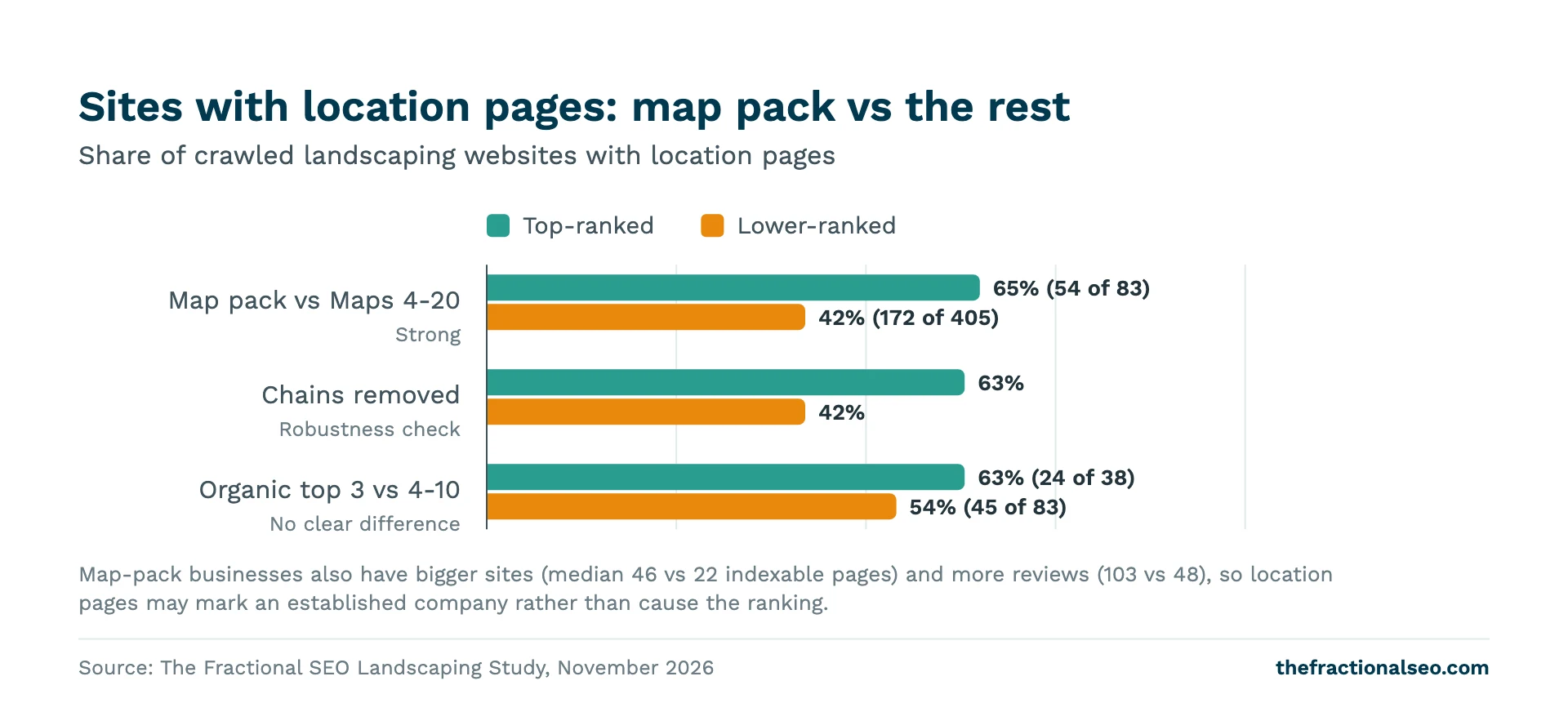
Two limits keep this honest. Map-pack businesses also have bigger sites (a median of 46 vs 22 indexable pages) and more reviews (103 vs 48), so location pages may mark an established company rather than cause the ranking. And the gap does not show in organic results (63% vs 54%, no clear difference). Our study of 537 landscaping websites has the detail.
So build them properly: a page for each town that brings real work, with jobs and photos from there. Never city-swapped copies: Google’s spam policies list “Having multiple domain names or pages targeted at specific regions or cities that funnel users to one page” as doorway abuse.
Service pages
76% of landscaping-company websites have dedicated service pages (lawn care, patios, irrigation and so on), with a median of 9 among those that do. Map-pack companies have more of them: a median of 11 against 5, a strong gap, though simply having any service page is only a weak lean (88% vs 73%). Bigger sites have more of every page type, so read it as a mark of a fuller site.
Nationally, the biggest landscaping service searches in our keyword set include “landscaping” (165,000 a month), “lawn care services” (110,000), “lawn care” (90,500) and “landscape design” (33,100). Give each service you sell its own page, in the words customers use.
Price pages
People search for landscaping prices. In our keyword set, 19 cost-related keyword groups total about 12,590 searches a month, led by “landscaping costs” (2,400), “sprinkler system cost” (1,900) and “sprinkler system repair cost” (1,600). Irrigation wording is about half of that volume. Yet only 2% of landscaping homepages show a price.
Showing prices on the homepage made no clear difference to the map pack (4% vs 2%), so our data shows no ranking edge for it. It’s a gap in what customers can find. A page that explains what drives the cost of a sprinkler system, a patio or a season of mowing answers a question people already ask Google.
City in the title tag and LocalBusiness schema
64% of landscaping-company websites have their metro’s name in the homepage title tag (a floor, since suburbs weren’t counted). 48% have LocalBusiness structured data or a subtype. Neither passes the correction. City in title leans toward the map pack (72% vs 60%), but the lean is weak. LocalBusiness schema shows no clear difference (55% vs 49%).
Do both because they’re cheap and tell Google plainly where you work. Google's local business structured data page says to use “the most specific LocalBusiness sub-type possible”. Schema.org has no landscaping type, so the options are LocalBusiness itself or HomeAndConstructionBusiness, a LocalBusiness “that provides services around homes and buildings.”
Links
Links line up with the map pack too. Map-pack landscaping businesses’ websites have a median of 119 referring domains against 98 for businesses only at Maps positions 4-20, and a higher DataForSEO Domain Rank (150 vs 113 on a 0-1000 scale). Both gaps are strong, and chains are too few here to drive them.
In organic results links do not separate them: sites in the organic top 3 have a median of 139 referring domains against 148 at positions 4-10. The median landscaping-company website has 102 referring domains, and only 16 of 577 have fewer than 10. Good links are local and real: the nursery or stone yard you buy from, your state landscape association, a builder you work with.
Directories
The sites landscaping companies compete with most on page one are Yelp (50 results, on 40 of 45 searches), Facebook (21), Houzz (20, on 19 searches), Thumbtack (17), Reddit (15), MapQuest (11), Angi (10), BBB (9) and the lawn-mowing marketplace GreenPal (9, all on lawn care searches). Keep your name, address and phone identical on each. Our guide to directories and lead sellers covers which ones matter.
Plan for spring
Landscaping demand is strongly seasonal. “Landscaping” interest peaks in April at about 2.9 times its December low, and “lawn care” in April at 3.0 times, with the biggest steps from February to April. Google Ads volumes show the same year: “lawn care” ran from 49,500 searches a month in November 2025 to 135,000 in April 2026.
That sets the calendar. Pages, photos and links take time to show up in search, so the work goes in between November and February: the profile, the location and service pages, and reviews from last season’s customers. Our seasonal SEO guide for landscaping and lawn care companies has the month-by-month plan.
Keep the calendar in mind when you read your own numbers. In November, when this study was collected, “landscaping” is at 44% of its peak and “lawn care” at 42%. Compare each month with the same month last year.
A 90-day local SEO plan
Here is the order we’d work in, ideally starting in late fall. The profile and the review habit come first because they’re quick and cost nothing but time.
Days 1-30: Business Profile and review habit
- Verify the profile, fix the name, hide the address and set the towns you serve.
- Choose the primary category that matches your main work: “Landscaper”, “Lawn care service” or “Landscape designer”.
- Reply to every review you haven’t answered, then make replying a weekly habit.
- Send last season’s customers the review link, and add the QR code to your leave-behind cards.
- Upload project photos: patios, plantings, cleanups, before and after.
Days 31-60: Website pages
- Build or fix a page for each service you sell, and a separate one for each market (lawn care, landscaping, hardscaping) you work in.
- Write a real page for each town that brings the most work, with jobs done there.
- Put your main service and city in the homepage title, and add LocalBusiness schema.
- Add a cost page for the service people ask about most, irrigation if you do it.
Days 61-90: Directories, links and a monthly routine
- Claim the directories that rank for your main searches and make your details match.
- Ask suppliers, builders and local groups you work with for a link.
- Set a monthly routine: review replies, new photos, a ranking check and one page improved.
For a printable task list, use the local SEO checklist for landscaping companies.
How to measure local SEO
A ranking check from your office tells you little, because Google weighs distance. Track these instead, once a month:
- Map-pack position for your main searches, checked from a phone in several parts of your service area.
- Business Profile actions: calls, website clicks and direction requests.
- Search Console clicks for searches that include a town or a service.
- New reviews and replies per month. Expect fewer in winter, so compare each month with the same month last year.
Judge the plan by booked estimates and signed maintenance accounts over a full season, not by one month.
Questions, answered
How do I get my landscaping company into the Google map pack?
Google names relevance, distance and popularity. In our study, map-pack businesses had more reviews (a median of 99 at positions 1-3 vs 63 at 4-7), more recent reviews, a higher reply rate and more links than the businesses below them. Those are correlations, not causes, and distance is outside your control.
Is local SEO different for lawn care and for landscaping?
Yes, in our data. “Lawn care service” and “landscaping company” are searched about equally, but lawn care clicks cost more and marketplaces held 29% of lawn care map-pack spots. Hardscaping searches gave companies the most of page one (47%) but returned no Google volume at metro level.
Do landscaping companies need location pages?
They are the one website feature with a measured map-pack edge here: 65% of map-pack businesses’ sites have them against 42% for those at Maps positions 4-20. They may mark an established company rather than cause the ranking.
Should I put prices on my website?
Prices on the homepage showed no clear difference to rankings. But people search for costs, about 12,590 times a month across 19 groups in our keyword set, and only 2% of homepages show a price.
Can I pay Google to rank higher in Maps?
No. Google says “There’s no way to request or pay for a better local ranking on Google.” Local Services Ads are a separate paid placement, not a ranking boost.
Want to know which half of local search you’re losing?
We look at where your company shows up in Maps and in the organic results for your city’s landscaping and lawn care searches, and tell you what to fix over winter, before the spring climb. See how fractional SEO for landscaping companies works.
Sources
- TFS Landscaping Study, November 2026: our study of 537 landscaping websites
- Google Business Profile Help, Tips to improve your local ranking on Google
- Google Business Profile Help, Guidelines for representing your business on Google
- Google Business Profile Help, Tips to get more reviews
- Maps User Generated Content Policy, Prohibited and restricted content
- Google Search Central, Spam policies for Google web search
- Google Search Central, Local business (LocalBusiness) structured data
- Schema.org, HomeAndConstructionBusiness