
Guide Landscaping
Seasonal SEO for Landscaping and Lawn Care Companies
The landscaping marketing lists we read say to plan ahead for spring. None of them measures when spring starts in search. The data does. "Landscaping" interest peaks in April at about 2.9 times its December low, and "lawn care" at 3.0 times. Interest rises from the December low, with the biggest steps from February to April. This guide turns those curves into a plan for each season: what to build, fix and promote on your website and Google Business Profile, and when.
We analyzed 45 local searches across 15 US metros and three landscaping search types, 577 landscaping company websites (537 crawled) and 582 Google Business Profiles, November 2026. For this guide we also used Google Trends (US, weekly, 2022-2025) and Google Ads monthly search volumes for the US from October 2025 to September 2026. We collected this data in mid-November 2026, after the spring and summer landscaping season, so rankings, review pace, Google posting and ad activity may look different in season. Everything below is about when people search, not when jobs are sold or paid. Your own estimate and sign-up log will tell you how closely the two match in your market.
The short answer
- Winter (December to February): build and fix. Update your Business Profile, add location and service pages, upload last season’s project photos and ask last season’s customers for reviews.
- Spring (March to May): be ready for the climb. Offers live, quote requests easy, a review request after every cleanup and install.
- Summer (June to August): answer every call, photograph every job and keep the site stable.
- Fall (September to November): push fall services, check your review flow and plan the winter build.

What the landscaping year looks like in search
Google Trends shows how interest in a search changes over time. It doesn’t show how many people searched. Google explains that each result is normalized to the time and location of the query and scaled on a range of 0 to 100. We pulled five landscaping terms on one shared scale, weekly, and averaged each month across 2022 to 2025. That gives the shape of a typical year.
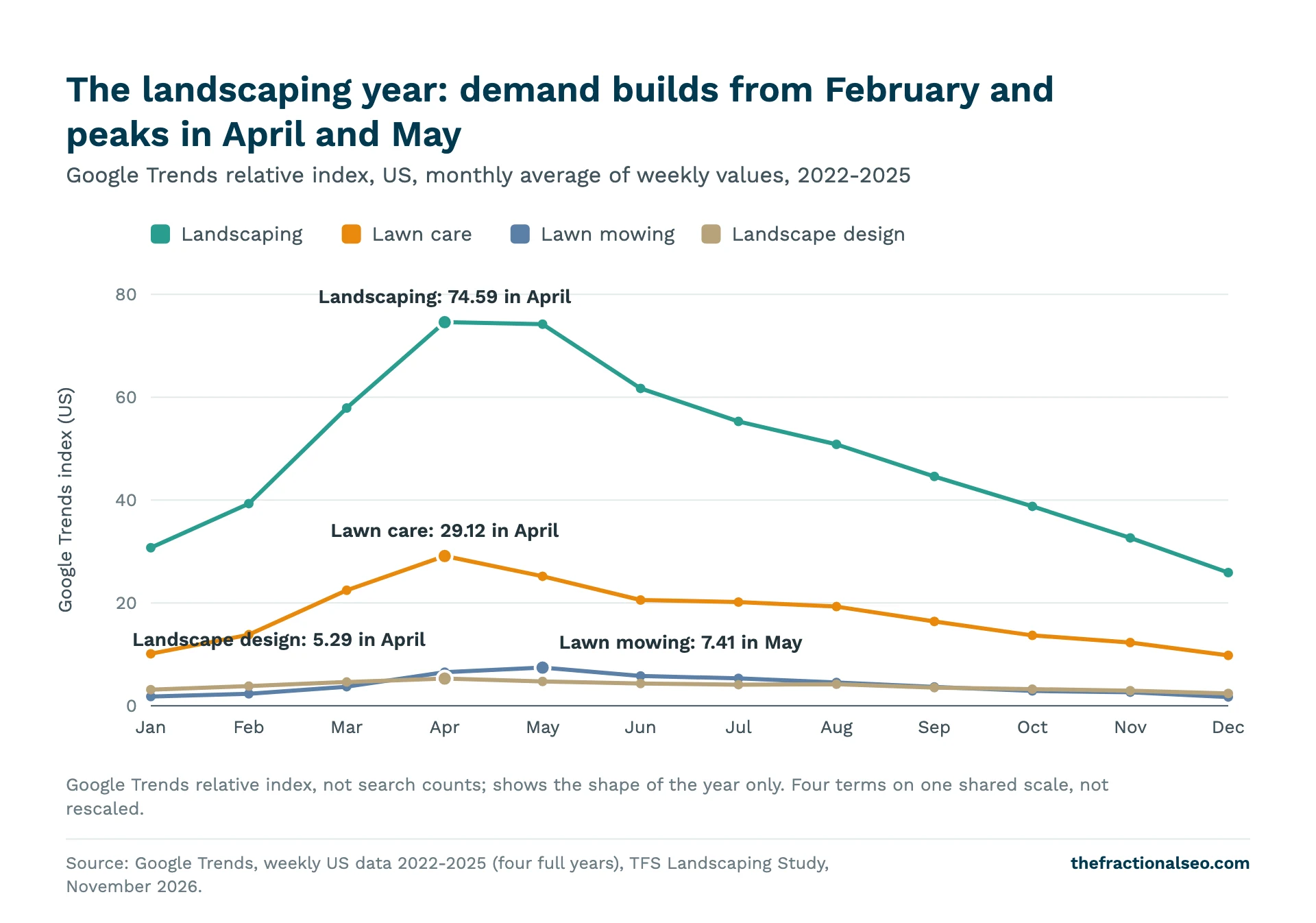
Four patterns stand out.
- “Landscaping” interest peaks in April at about 2.9 times its December low.
- “Lawn care” also peaks in April, at 3.0 times its low.
- “Lawn mowing” peaks a month later, in May, at 4.3 times its low. It has the sharpest swing of the four.
- “Landscape design” is steadier, at 2.2 times. Design and planning searches don’t go quiet the way mowing does.
Interest rises from the December low, and the biggest steps come from February to April. That is the window that matters for planning. Anything that takes time to show up in search (a new page, a batch of photos, a run of new reviews, links from local sites) has to be in place before February ends. A page you start in April is chasing a season that is already at its peak.
Three cautions. These are national curves. A Texas lawn wakes up long before a Minnesota one, and our data has no regional split, so shift the calendar to your own climate. A Trends index shows shape only: the level rises in the most recent data for every term because of a scaling change, so it says nothing about whether landscaping searches are growing. And “hardscaping” is too small on this scale to read, so it isn’t charted.
What the search counts show
Trends gives the shape. Google Ads volumes give counts, rounded into bands. They show the same year: “lawn care” ran from 49,500 searches a month in November 2025 to 135,000 in April 2026, and “landscaping” from 110,000 (November-December 2025) to 201,000 (March-May 2026).
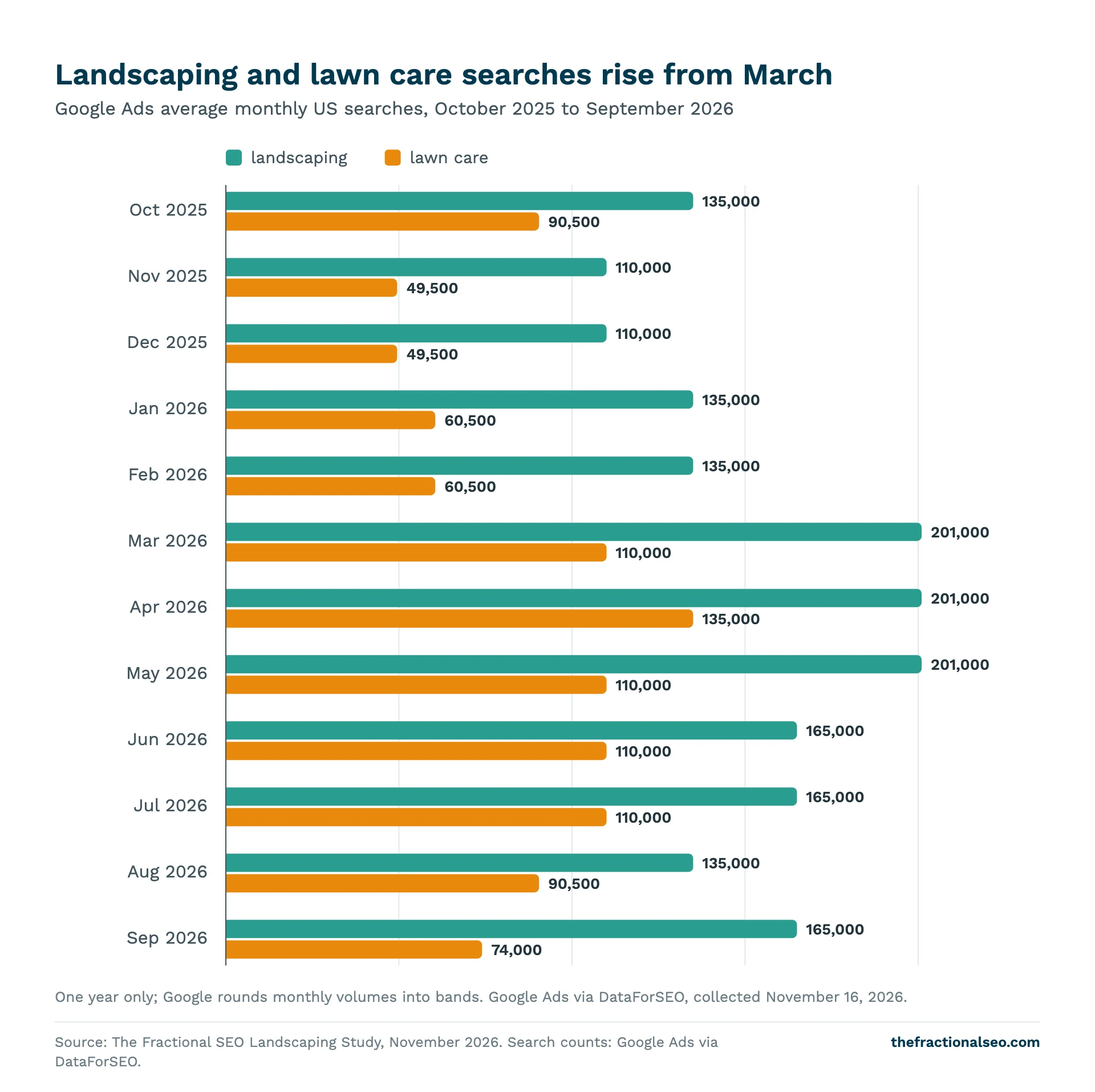
The lawn care climb is easy to see month by month. It sat at 60,500 in January and February 2026, jumped to 110,000 in March and reached 135,000 in April. “Landscaping” held at 201,000 from March through May, then eased in summer. This is one year of data only, and Google rounds monthly volumes into bands, so use it for timing and don’t read it as a trend.
These are single searches. Homeowners type many other versions too, so one line on a chart is not the total for the month. What matters for planning is that the Trends index and the Google Ads counts point the same way: low in winter, climbing through March, highest in April.
Each service has its own season
“Lawn care” and “landscaping” are the big curves, but you sell services, and each one has its own window. These are national Google Ads volumes for homeowner searches, one year only (most run October 2025 to September 2026), rounded into bands.
| Search | Average a month | Highest month | Lowest month |
|---|---|---|---|
| “spring clean up landscaping” | 480 | 1,900 (Mar 2026) | 40 (Jul and Aug 2026) |
| “lawn overseeding service” | 720 | 1,900 (Mar 2026) | 110 (Oct 2026) |
| “landscape mulch” | 9,900 | 27,100 (Apr and May 2026) | 1,600 (Oct 2026) |
| “paver patio” | 12,100 | 27,100 (Apr 2026) | 5,400 (Dec 2025) |
| “sod installation” | 8,100 | 12,100 (Apr 2026) | 4,400 (Dec 2025) |
| “winterize sprinkler system service” | 1,600 | 6,600 (Oct 2025) | 50 (Jul 2026) |
| “sprinkler blowout service” | 590 | 4,400 (Oct 2025) | 40 (Jun 2026) |
Spring cleanups and overseeding are searched hardest in March, a month before the big lawn care peak. Mulch, patios and sod top out in April. Sprinkler winterization and blowouts are a fall business, searched most in October, when lawn care searches are already falling. So “plan for spring” really means a page for each service, live before that service’s own month. Your local timing will differ.
Winter (December to February): build before the climb
Winter is when the crews are off the mowers and the office has time. Use it for the work you’ll want in place by March.
- Your Business Profile. Check your primary category, the services you list, your service area and your hours. Then upload the best project photos from last season: patios, plantings, cleanups, before and after. Map-pack landscaping profiles have about twice as many photos: median 129 vs 67 for profiles only seen at positions 4-20. Photo counts include customer photos, and busier companies collect more of both, so treat that as a sign of an active profile, not a target.
- Location pages. 65% of map-pack businesses’ sites have city or service-in-city pages vs 42% for businesses only seen at Maps positions 4-20. That’s a correlation. Map-pack businesses also have bigger sites (median 46 vs 22 indexable pages) and more reviews (103 vs 48), so location pages may mark an established company rather than cause the ranking, and the gap doesn’t show in organic results. Still, a real page for each town you serve is worth building in the quiet months.
- A page for each service, before its month. Spring cleanup and overseeding pages by February, mulch, sod and patio pages by March, winterization by September. “Landscaping company <city>” and “lawn care service <city>” are searched about equally, so cover both. Google returned no volume for “hardscaping company <city>” in any of the 15 metros, so build hardscaping pages around the project (patios, walls, walkways) instead.
- Reviews from the season just ended. Map-pack landscaping companies got more new reviews in the 90 days before collection: a median of 5 vs 2 for businesses only seen at positions 4-20. That 90-day window ran from mid-August to mid-November, the end of the season. Send a review link to the customers you finished in the fall while the work is still fresh, and reply to every review you get.
Design and hardscape selling doesn’t stop in winter. “Landscape design” in Google Ads volumes was 33,100 searches in November 2025 and 27,100 in December, against 40,500 in March and April 2026. For homeowners planning a patio in January, show your past work, a rough process and a way to book a design visit.
Then look at the blog, if you have one. 43% of landscaping-company sites have a blog, but only 10% published anything in the last 12 months and 5% averaged a post a month. You don’t need a post a week. A few useful pages written in winter (when to aerate in your area, what a spring cleanup includes, how a patio install runs) will do more than a blog that stopped two years ago. More on what landscaping websites leave out is in our study of 537 landscaping websites, and our local SEO checklist for landscaping companies is a good list to work through in these weeks.
Spring (March to May): ready for the climb
By March the climb is under way. Lawn care searches take their biggest steps between February and April, and the pages and profile should already be in place. The work now is turning searches into quotes.
- Offers as posts. Google says Business Profile posts can share “announcements, offers, updates, and event details” (Google Business Profile Help). A spring cleanup booking window or an early sign-up offer for weekly mowing is a good use. Post for customers, not for rankings: map-pack businesses post a little more often, but the gap is weak and fails the correction for multiple tests.
- A review request after every cleanup and install. Send customers a Google review link or QR code. Never offer a discount for a review: Google says incentives are strictly prohibited.
- Fast quotes. A short quote form and a tap-to-call number on every page. Say how soon you can come out, and when the first mowing slots open.
Lawn care clicks cost more than landscaping clicks, which is one more reason to have pages ranking before spring. The median suggested bid is $10.15 for “lawn care service <city>” vs $7.17 for “landscaping company <city>”. Those are Google Ads planner bids collected in November, and auction prices are likely higher in spring. A page that ranks for those searches brings in some of that traffic without paying for each click.
Check your Business Profile once more in March. The photos should show spring work, the services should match what you’re selling this year, and the hours should match what the office can answer once the phones pick up. Our Google Business Profile checklist for landscaping and lawn care companies has the full setup.
Summer (June to August): answer every call
“Lawn mowing” interest peaks in May, and landscaping searches stay high into summer before they ease. Most of your marketing work for the year is already done. Summer is about not losing what it brings in.
- Answer the phone, or call back within the hour. A homeowner who can’t reach you may try the next company in the map pack.
- Ask every finished customer for a review. Summer is when you finish the most jobs, so it’s when your review count can grow fastest.
- Photograph every job. Those photos are next winter’s profile and page material.
- Don’t plan big site changes for July. A broken quote form in peak weeks costs more than it would in January.
If your routes are full, say so on the site and give a start date. Keep a short list of which pages and searches brought calls this summer and which towns they came from. That list is where next winter’s pages start.
Fall (September to November): fall services and a review check
Interest falls through the autumn. In November, when we collected the data, “landscaping” is at 44% of its peak and “lawn care” at 42%. But fall has its own services. Winterization and blowout searches peak in October, and overseeding has a second, smaller rise in July and August. Have the overseeding page live by July and the winterization and blowout pages by September, move them up on the homepage in their months, then shift your posts toward fall cleanups, winterization and next year’s design work.
Check your review flow too. Over the 30 days before collection, map-pack landscaping companies had a median of 1 new review vs 0 for the rest, and that gap is weak: in late autumn most companies collect very few. Posting slows down as well. 30% of landscaping profiles posted on Google in the 30 days before collection and 27% have no posts at all, and November is a quiet month for lawn and landscape posts. So a slow November isn’t a problem. A summer that didn’t show up as a jump in reviews is. Fix the ask before spring. Our research on Google reviews and landscaping rankings has the benchmarks.
A note on ads. Paid results were thin on our November landscaping searches: Google Local Services Ads appeared on 12 of 45 searches (27%, most on lawn care: 6 of 15) and text ads on 2. Lawn and landscape companies cut ad budgets after the mowing season, so that is likely a November effect, not a sign that landscaping searches carry few ads. We’ll re-run these searches in April 2027. The full picture of who wins these searches is in our benchmark of 45 local landscaping searches.
What to do all year
Seasonal timing only works on top of the basics. Keep these going every month:
- Keep your Business Profile current: services, photos, winter hours and special hours for holidays.
- Ask for a review after every job, in every season, and reply to the ones you get.
- Keep a complete page for each service you sell and each town you serve.
- Track calls and quote requests by source, so you can see which season’s work paid off.
For the full local plan, see our guide to local SEO for landscaping companies.
Want a seasonal plan built on your own market’s search data, in place before the February climb? Talk to us about SEO for landscaping companies.
FAQs
When is the busy season for landscaping companies?
In search, “landscaping” and “lawn care” both peak in April, and “lawn mowing” in May, with the biggest steps up from February to April. That’s search interest, not jobs or revenue, which depend on your climate and your mix of mowing, installs and hardscaping.
When should a landscaping company start marketing for spring?
In winter. Searches climb from the December low and take their biggest steps from February to April, and new pages take time to show up. Have your pages, photos and profile ready by the end of February, and your spring cleanup page live before March.
What should landscapers do in the off-season?
Do the website and profile work you can’t fit in during summer: location and service pages, project photos and review requests to last season’s customers. Keep selling design and hardscape projects, since “landscape design” interest is steadier through the year.
Do I need to post on my Google Business Profile all winter?
Not every week. Posting showed only a weak edge for map-pack businesses, and November is a quiet month for lawn and landscape posts across the board. Post when you have something real to say, such as a spring booking window or holiday hours.
Sources
- TFS Landscaping Study, November 2026: our study of 537 landscaping websites
- Google Trends Help, FAQ about Google Trends data
- Google Business Profile Help, Create and manage posts on your Business Profile
- Google Business Profile Help, Tips to get more reviews
- Google Business Profile Help, How to set Special hours