
Templates & Resource Pest Control
Google Business Profile Guide for Pest Control Companies
The Google Business Profile guides we read give pest control owners much the same list: claim it, pick categories, add photos, post, get reviews. None of them had looked at real pest control profiles. We looked at 305 of them. This guide walks through each step in order, shows what the profiles actually look like, and ends with a checklist you can work through.
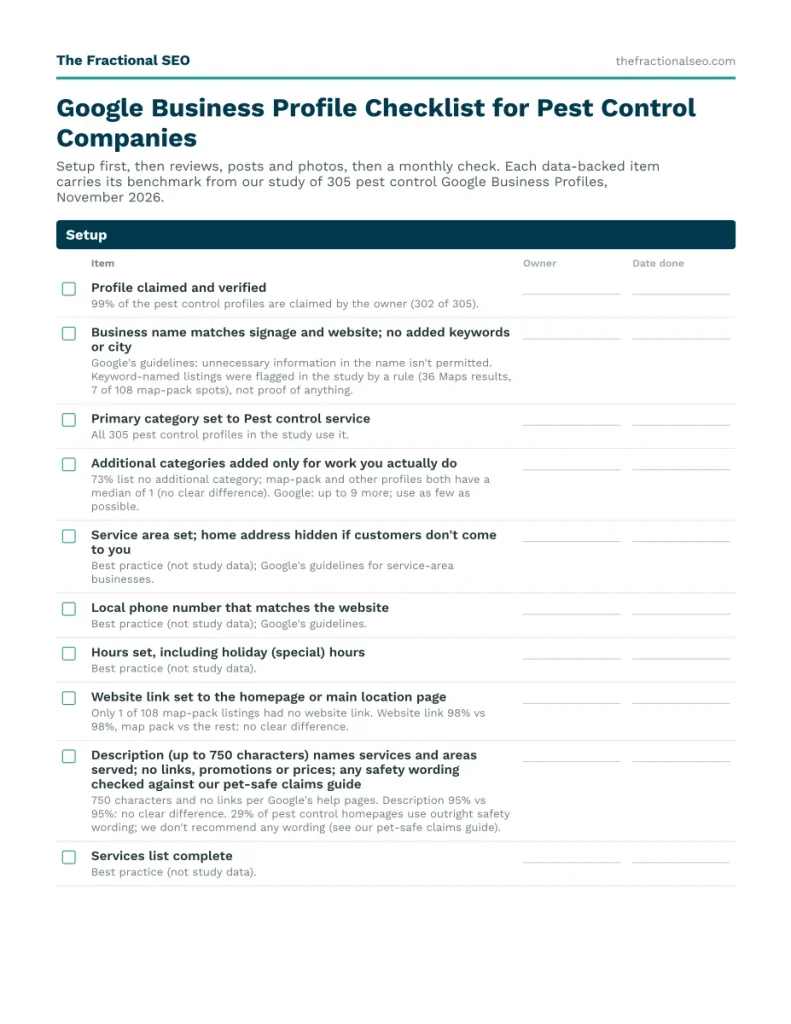
Get the template No email required
What's inside
Setup
Claim, name, category, service area, hours, website link and description.
Reviews
A review request after every job, replies, and your count against the local pack.
Posts and photos
A monthly post routine and real photos of your work.
Benchmarks
Each data-backed item carries its figure from our study of 305 pest control profiles.
How to use it
-
Download the checklist
Print the PDF or copy the Google Sheet.
-
Finish setup in one sitting
Most setup items take minutes once you're logged in.
-
Set the monthly routine
Review requests, replies, a post and a performance check, every month.
We analyzed 36 local searches across 12 US metros and three pest control search types, 283 pest control company websites (243 crawled) and 305 Google Business Profiles, November 2026. For this guide we compared the profiles of businesses that reached a map pack in any study search with those that only appeared at Maps positions 4-20, counting each business once. We collected this data on November 17, 2026, outside the pest season: in Google Trends, US interest in “pest control” in November averages 56% of its July peak, so rankings, ads, review and posting activity may look different in spring and summer. The website side of the same study is in our study of 243 pest control websites.
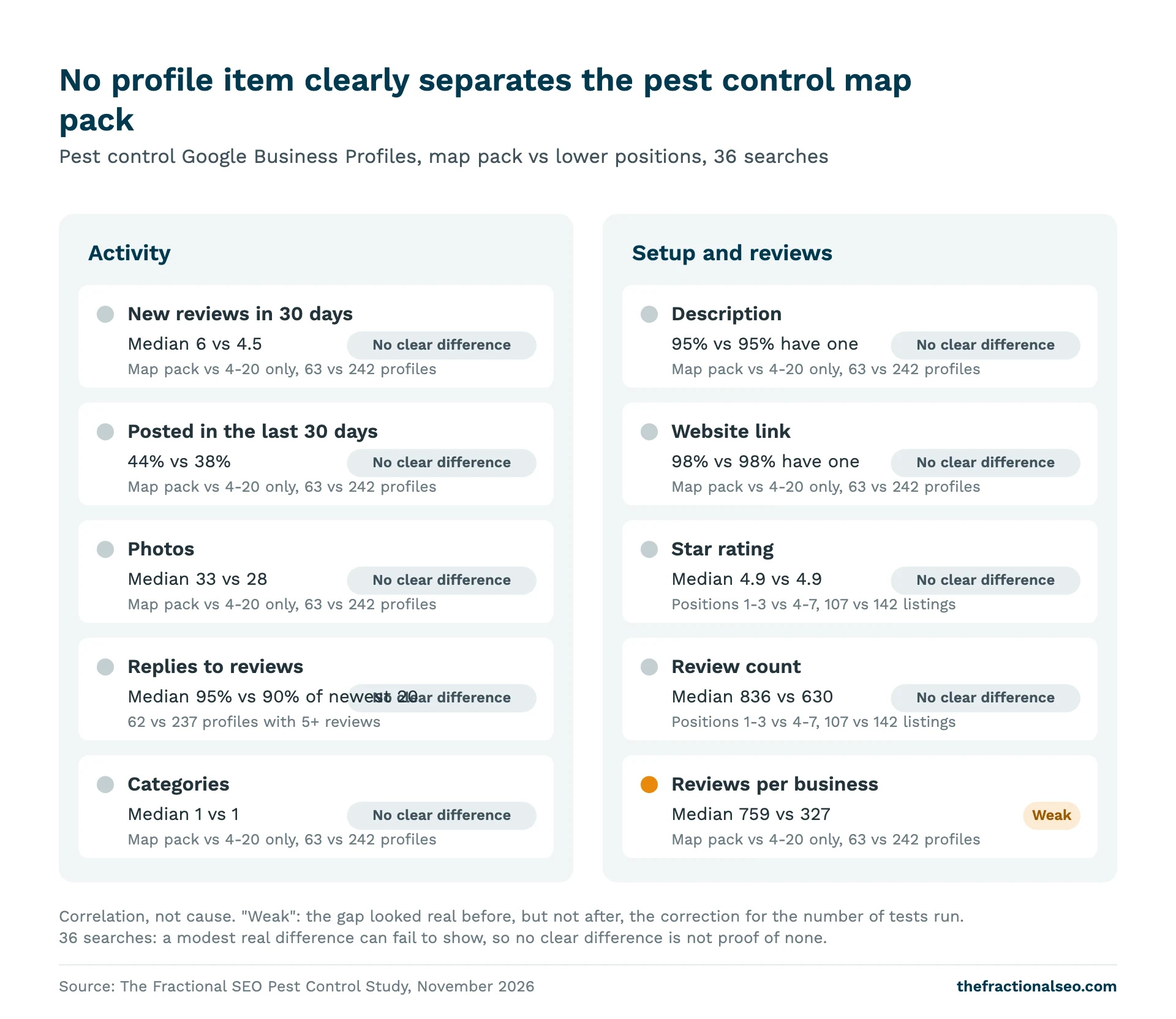
The short version: the setup basics are near-universal, and no single profile item clearly separates the companies in the map pack from the ones below them. That makes the profile a foundation to get right and keep active, not a ranking trick.
What 305 pest control profiles show
Two things describe almost every profile:
- Claimed: 99% of the pest control profiles are claimed by the owner (302 of 305).
- One category: every one of the 305 profiles uses the same primary category, “Pest control service”, and 73% list no additional category.
These showed no clear difference between map-pack businesses and the rest:
- New reviews: a median of 6 new Google reviews in the 30 days before collection for map-pack businesses and 4.5 for the rest.
- Recent posts: 44% posted in the last 30 days in the map pack vs 38% below it.
- Photos: median 33 for map-pack profiles vs 28 for the rest.
- Replies: owners reply to almost all reviews whether or not they rank: median 95% of the newest 20 for map-pack businesses vs 90% for the rest.
- Categories: map-pack and other profiles both have a median of 1 category.
- Description and website link: description 95% vs 95%, website 98% vs 98%.
- Star rating and review count: comparing listings per search, the median rating is 4.9 in the map pack and 4.9 at positions 4-7, and the median review count is 836 at positions 1-3 vs 630 at 4-7, a gap that could be chance.
One gap looks large but is weak: across all 305 profiles, map-pack businesses have a median of 759 reviews vs 327 for those only at positions 4-20, and that gap does not survive the correction for the number of tests we ran.
Two cautions. First, this is 36 searches in 12 metros. A modest real difference can fail to show in a sample that size, so “no clear difference” is not proof that there is none. Second, it is a correlation either way: the study shows what map-pack profiles have, not what put them there. In our HVAC study several profile habits did lean with the map pack; in pest control, chains carry thousands of reviews at every position, which blurs the review comparison. For the review side in detail, see what 305 pest control Business Profiles show about reviews.
Download the checklist
The free checklist turns this guide into 20 items: setup, reviews, posts and photos, and a monthly check. Each data-backed item carries its figure from our study, on two printable pages or a Google Sheet you can copy. Because no profile item clearly leans with the map pack, the priorities follow what customers see and what keeps the profile accurate, not ranking evidence. For your website and the rest of local SEO, use the pest control local SEO checklist.
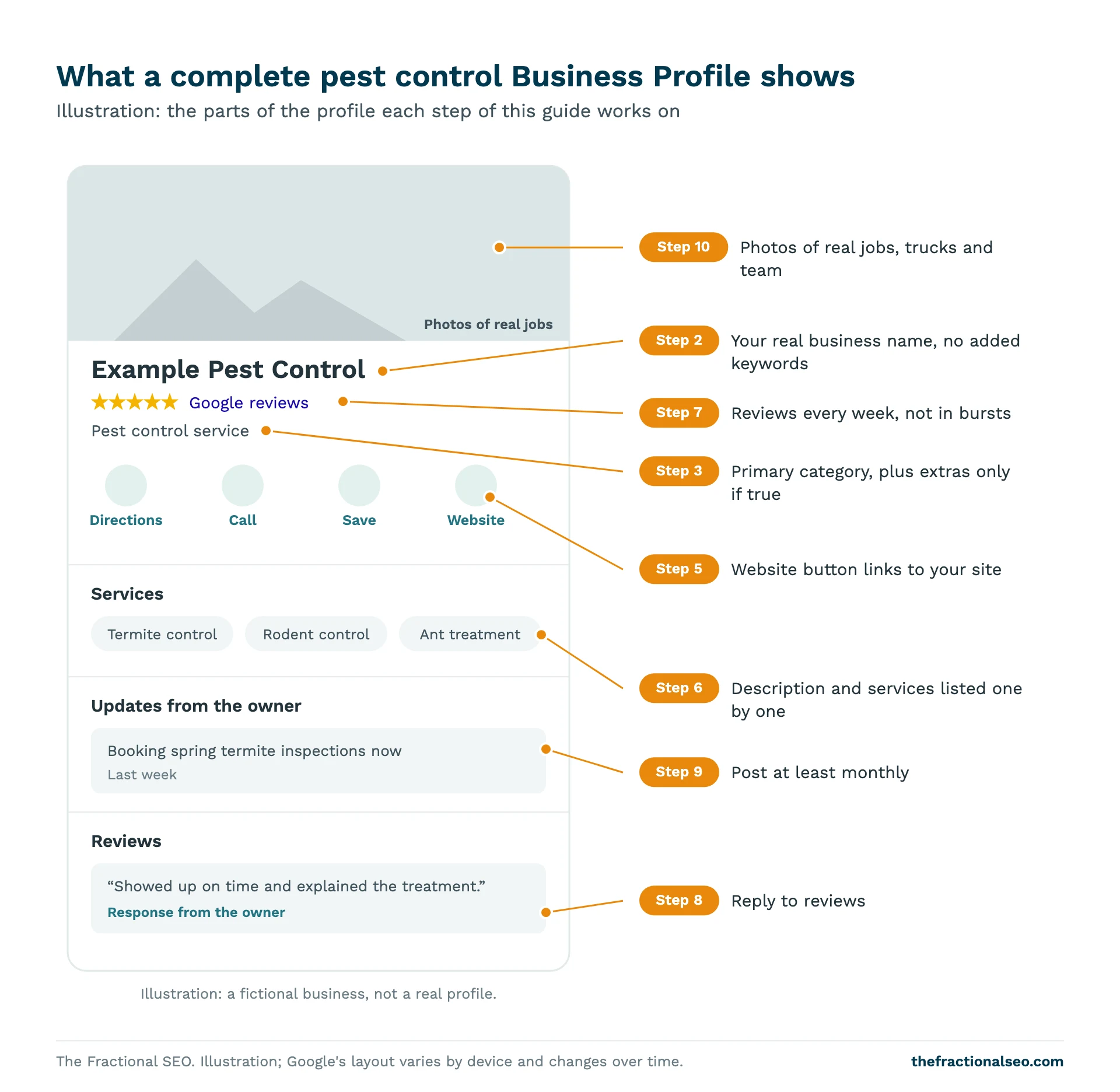
Step 1: Claim and verify your profile
99% of the pest control profiles are claimed by the owner (302 of 305). Among pest control companies that show up in local searches, a claimed profile is close to universal. If yours isn’t claimed, nothing else here is possible.
Search for your business on Google Maps and claim the profile, or create one, then verify it using the method Google offers you. Add a second owner or manager from your company so the profile isn’t tied to one person’s login. If an agency manages it, make them a manager, not the owner. That is best practice, not study data.
Step 2: Use your real business name
Use your name exactly as it appears on your trucks, uniforms and website. Google’s guidelines for representing your business say the name should reflect your real-world name, and that including unnecessary information in your business name isn’t permitted and could get the profile suspended. That rules out adding “Pest Control Dallas” or “Termite Experts” to the end.
You may see listings that seem to break this rule. In our data, keyword-named Maps listings (a name that is only a city plus service words) showed up 36 times in the Maps results and held 7 of 108 map-pack spots. Our flag is a rule, not proof that any listing is fake, and we don’t name them. But copying the pattern would break Google’s guidelines and put your own profile at risk. Use your real name.
Step 3: Choose your primary and additional categories
Every one of the 305 pest control profiles uses the same primary category, “Pest control service”, and 73% list no additional category; the most common extras are Animal control service (40), Bird control service (37), Home inspector (14), Insulation contractor (12), Lawn care service (12). We only collected listings Google returned for pest control searches, so the single primary category is partly how the sample was drawn. Still, if you sell general pest control, “Pest control service” is the category your competitors use.

Do extra categories go with ranking? Listing more categories shows no edge: map-pack and other profiles both have a median of 1 category. 21% of map-pack profiles list more than one, against 29% of the rest, and that difference is not clear either.
Google’s profile editing help says you can select up to 9 more categories. Its guidelines also say to use as few categories as possible to describe your core business, to choose categories as specific as possible, and not to use categories solely as keywords. Google’s category help adds that the categories you select affect your local ranking.
So add a category only for work you actually sell, such as wildlife removal if you do it. Some guides suggest pest-specific categories; open the category list in your own profile editor and pick from what Google offers there.
Step 4: Set your service area, hours and phone
Most pest control companies go to the customer. Google’s guidelines say a service-area business should hide its address and set a service area instead, and a home-based business should clear the address from the profile. Use a local phone number rather than a central call center line where you can, and make it match the number on your website.
Set regular hours, then add special hours for holidays so customers don’t call a closed office. No study data here: these are Google’s rules and plain good practice.
Step 5: Link your website
Almost every pest control business in the map pack shows a website: 1 of 108 map-pack listings had no website link. Across all profiles the link is near-universal, 98% vs 98% for map-pack businesses and the rest, so it separates nobody. Link to your homepage, or to the location page for that office if you have several. Add UTM tags so visits from the profile show up separately in your analytics, for example utm_source=google, utm_medium=organic, utm_campaign=gbp. The link advice is best practice, not study data.
Step 6: Write the description and services
Google’s editing help says not to exceed 750 characters in the description. Its guidelines say to use the description for useful information on your services, history and mission, and that it must not focus on special promotions, prices and sales, and must not contain links of any type.
A description showed no edge in our data: description 95% vs 95%. Write it for the customer, name the pests you treat and the areas you serve, and move on.
Be careful with safety wording. 56% of pest control homepages make a pet, family or eco claim, and 29% use outright safety wording such as “pet-safe”, “safe for your family” or “non-toxic”, the kind of wording EPA label rules treat as false or misleading. How far those rules reach a company’s own advertising differs by state. We don’t recommend any wording here. Before you put a safety claim in your description, read what pest control companies can say about pet-safe and eco claims.
Fill in the services list too, one entry per service you sell: general pest plans, termites, rodents, mosquitoes, bed bugs, wildlife. That is best practice, not study data.
Step 7: Get reviews every week, not in bursts
Reviews are where pest control differs most from our HVAC study. Review counts do not clearly separate the pest control map pack from the listings just below it: a median of 836 Google reviews at positions 1-3 vs 630 at positions 4-7, a gap that could be chance. Counting each business once, map-pack businesses have a median of 759 reviews vs 327, but that gap is weak and does not survive the correction for the number of tests.
Pest control companies were still collecting reviews in the off-season: a median of 6 new Google reviews in the 30 days before collection for map-pack businesses and 4.5 for the rest, with no clear difference between them. Star rating does not separate them either: the median is 4.9 in the map pack and 4.9 at positions 4-7.
So this data shows no review number that separates the pack from the rest. A steady flow of new reviews still matters to the homeowner reading them, and Google lists review count as part of prominence. Ask after every completed job. Google’s review help lets you share a review request link or QR code; put it in the technician’s job-complete text or on the invoice.
Stay inside Google’s review policy: you may not offer incentives such as payment, discounts or free service in exchange for a review, and you may not discourage negative reviews or selectively ask only happy customers. Ask everyone. For more on reviews and the map pack, see our reviews study.
Step 8: Reply to reviews
Pest control owners already reply a lot: 58% reply to 90% or more of their newest reviews, and 11% reply to none. Owners reply to almost all reviews whether or not they rank: median 95% of the newest 20 for map-pack businesses vs 90% for the rest. With most owners already replying there is little room for a gap, and replies showed no clear difference by ranking.
Reply anyway. Google says that when you reply, you show customers that you value their feedback, and the next homeowner reads your replies too. Keep it short, thank the customer, and take any problem offline. Never repeat a customer’s personal details in a reply.
Step 9: Post at least monthly
40% of pest control profiles posted on Google in the last 30 days and 15% have never posted. Recent Google posts are about as common in the map pack (44% posted in the last 30 days) as below it (38%). Those figures are from November, outside the season, so posting may be busier in spring and summer.
Google’s posts help lists three types: updates, offers and events. Posts older than 6 months are archived unless a date range is set. A post a month keeps the profile looking current. Pest control has an easy calendar: termite swarm season, mosquito season, rodents moving indoors as it cools, and your recurring plan when people are thinking about it. That calendar is our view, not study data.
Step 10: Add photos of real jobs, trucks and team
Photo counts are similar: median 33 for map-pack profiles vs 28 for the rest. The counts include customer photos. Add your own real photos: technicians in uniform, branded trucks, an inspection in progress, a sealed entry point. Skip stock photos and pictures of pests in a customer’s home. The photo ideas are best practice, not study data.
Step 11: Check performance monthly
Once a month, look at calls, website clicks and direction requests in your profile’s performance view, and compare with the same month last year, since pest control is seasonal. This is best practice, not study data.
What the profile can’t do on its own
Google says local results are mainly based on relevance, distance and popularity, and that there’s no way to request or pay for a better local ranking. A complete, active profile covers the parts you control. Your website, links and reviews cover the rest: see the full local SEO guide for pest control companies.
FAQs
What Google Business Profile category should a pest control company use?
“Pest control service”. Every one of the 305 pest control profiles we collected uses it as the primary category. Our sample came from pest control searches, which partly explains that, but it is the category your local competitors use.
Should a pest control profile list more categories?
Only for work you actually do. 73% of profiles list no additional category, and map-pack and other profiles both have a median of 1. Google allows up to 9 more but says to use as few as possible.
How often should a pest control company post on Google?
At least monthly. 40% of profiles posted in the last 30 days and 15% have never posted. Posting showed no clear difference between map-pack businesses and the rest, so post for customers, not for rankings.
Can I say “pet-safe” in my Google Business Profile description?
Many pest control companies use that kind of wording on their websites, but EPA’s labeling rule treats safety claims as false or misleading on a pesticide label, and how far that reaches advertising differs by state. We don’t recommend wording. Read our guide to pet-safe and eco claims first.
Work through the checklist, then talk to us about the rest of your local SEO. SEO for pest control companies.