
Guide Real Estate
The Ultimate Guide to Local SEO for Real Estate Agents
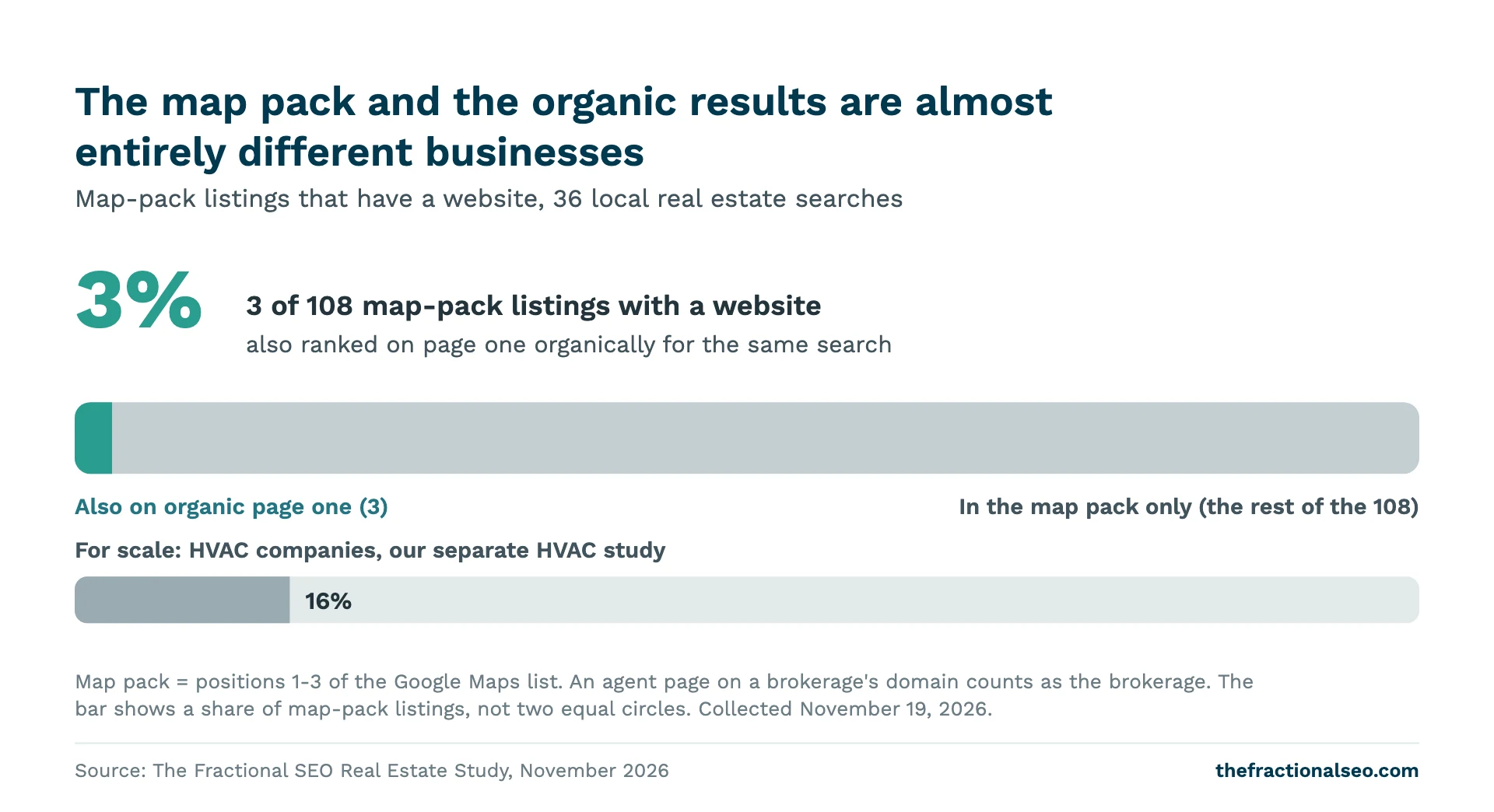
Local SEO for real estate agents is two races, and on the plainest search the portals are ahead. The first race is the map pack, the three Google Maps listings near the top of a local search. The second is the organic results below it. Almost entirely different businesses win each: in our study, 3 of 108 map-pack listings also ranked on page one organically for the same search. And on "real estate agent" plus a city, agents' and brokerages' own sites held only 15% of page one.
The short answer
- Two races: the map pack and the organic results are almost entirely different businesses. Treat the profile and the website as two jobs.
- Pick the search: portals and directories hold most of page one on “real estate agent <city>”. Luxury and neighborhood searches are where agents’ own sites rank.
- Reviews are a floor: most agents in the map pack are well reviewed, and so are the agents just below them. Review counts showed no clear difference in the pack.
- Website: neighborhood and location pages are the lean worth having, though no website feature passed our test for the number of comparisons.
- Paid clicks are dear: seller searches carry some of the highest suggested bids in the keyword set.
We analyzed 36 local searches across 12 US metros and three real estate search types, 461 agent and brokerage websites (261 crawled) and 412 Google Business Profiles, November 2026. We collected this data in mid-November 2026, when real estate search interest is near its low point of the year, so a spring snapshot may look somewhat different.
We ran 73 comparisons between higher- and lower-ranked agents, and none passed the correction for the number of tests. So this guide says “a lean” where we saw one and “no clear difference” where we didn’t. Both describe what tends to go together, not what causes a ranking. The website results are in our study of 261 real estate websites.
What a local real estate results page looks like
Search “real estate agent” with a city name and Google shows two blocks. The map pack sits near the top: a map and three agents or brokerages with star ratings, a call button and directions. In this guide, “map pack” means positions 1-3 of the Google Maps list for the search. Below it are the organic results, the web pages Google ranks with its normal search algorithm.
In the home-service trades we have studied the two blocks overlap more. In real estate they barely touch. Of 108 map-pack listings, 3 (3%) also ranked on page one organically for the same search. For HVAC companies it was 16%. An agent page on a brokerage’s domain counts as the brokerage here, so an agent whose page ranks on the brokerage site isn’t counted as overlap.
The organic half belongs mostly to sites that don’t sell homes themselves. Only 30% of page-one organic results for local real estate searches went to agents’ or brokerages’ own websites. The other 70% went to directories and listing portals, social sites, agent-matching lead sites, city guides and commercial brokerages.
| Type of page-one organic result | Results (of 308) |
|---|---|
| Directories and listing portals | 156 (listing portals 42 of them) |
| Agent and brokerage websites | 92 |
| Social sites | 39 |
| Agent-matching lead sites | 10 |
| City guides, MLS and media | 8 |
| Commercial brokerages | 3 |
Most agent sites get little search traffic anyway. The median agent or brokerage site has an estimated 97 organic visits a month, and 51% get under 100. Sites found only in Maps had a median of 103 estimated visits, those found only in organic results 27, and the 11 found in both 1,214. These are DataForSEO estimates, not measured visits, and they describe who turns up where, not what turning up would do for you. More is in our benchmark of 36 local real estate searches.
Three searches, three different fights
We ran three wordings in every metro, and each gave agents a very different share of the page. The groups are small (12 searches each), so read this as a description, not a test.
| Search wording | Agent and brokerage share of page one | #1 organic held by an agent or brokerage | Typical monthly searches per metro | Median suggested bid |
|---|---|---|---|---|
| real estate agent <city> | 15% | 2 of 12 | 1,600 (12 of 12 metros) | $7.71 |
| real estate brokerage <city> | 36% | 8 of 12 | 590 (8 of 12 metros) | $8.58 |
| luxury real estate agent <city> | 37% | 11 of 12 | 20 (7 of 12 metros) | Too few bids |
The plain search is the big one and the hardest. “Real estate agent <city>” had a median of 1,600 searches a month per metro, and directories and portals took most of its page one. Agents’ own sites held #1 on only 2 of those 12 searches.
Luxury searches are the reverse. They are small, a median of 20 searches a month in the 7 metros with data, but agents’ own sites held #1 on 11 of 12. Google’s AI Overview appeared on every luxury search we ran (12 of 12), so a luxury page also has to read well as a source Google can quote. And luxury agents reached the map pack with fewer reviews: a median of 64 for a luxury pack spot, against 226 on the plain agent search.
The point is to pick your fights. A solo agent is unlikely to beat Realtor.com for “real estate agent” in a big metro. A page about the neighborhoods, price bands and property types you actually sell has a real chance.
How Google ranks local results
Google’s help page on local ranking says “Local results are mainly based on relevance, distance, and popularity.” Relevance is how well your profile matches the search. Distance is how far you are from the searcher. On prominence, the page says “Prominence means how well-known a business is”, and that it draws on info like “how many websites link to your business and how many reviews you have.”
Distance is outside your control: a buyer across town sees a different map pack from the one you see at your office. The same page is plain about shortcuts: “There’s no way to request or pay for a better local ranking on Google.” What you can work on is relevance and prominence.
Part 1: The map pack
The map pack runs on Google Business Profiles: the free listing Google keeps for an agent or a brokerage, what clients say there and how well-known the business is around the web.
The listing name, and who holds the profile
Real estate listing names have their own habits. 21% of real estate Maps listings put a brokerage brand in the listing name (most often Compass, 22 listings, and Keller Williams, 21), and 37% put a city and a service word in it (“<name> | Dallas Luxury Real Estate”). Neither is more common in the map pack: 22% vs 21% for the brand, and 42% vs 36% for city and service words.
Google’s guidelines say “Your name should reflect your business’s real-world name, as used consistently on your storefront, website, stationery, and as known to customers.” They add: “Including unnecessary information in your business name isn’t permitted, and could result in the suspension of your Business Profile.” The examples of what a name must not include list location information and service or product information. Our data shows city and service words are common, and no more common in the pack.
Google also has a rule that names agents. It says “Doctors, dentists, lawyers, financial planners, and insurance or real estate agents are all individual practitioners”, who can have their own profile. Where several practitioners share a location, “The title of the Business Profile for the practitioner should include only the name of the practitioner, and shouldn’t include the name of the organization.” Where one agent is the only public-facing practitioner at a branded office, Google says it’s best to share one profile with the organization, named “[brand/company]: [practitioner name]”. Which setup fits you depends on your office, so check with your broker before you change a profile.
Every listing in the map pack showed a website (0 of 108 without one). Our Google Business Profile checklist for real estate agents and brokerages covers categories, photos and the rest of the setup.
Reviews: a floor, not a lever
This is the biggest difference from home-service trades. In HVAC, companies at Maps positions 1-3 had far more reviews than those just below (a median of 1,576 vs 615). In real estate there was no clear difference: a median of 137 reviews at positions 1-3 vs 133 at positions 4-7.
Across all profiles with a review count there was a lean. Agents that reached a map pack in any study search had a median of 125 reviews vs 73 for those only seen at positions 4-20, a lean that fails the correction for the number of tests. With 108 vs 144 listings in the first comparison a small effect could be missed, so this is “no clear difference”, not “reviews don’t matter”.
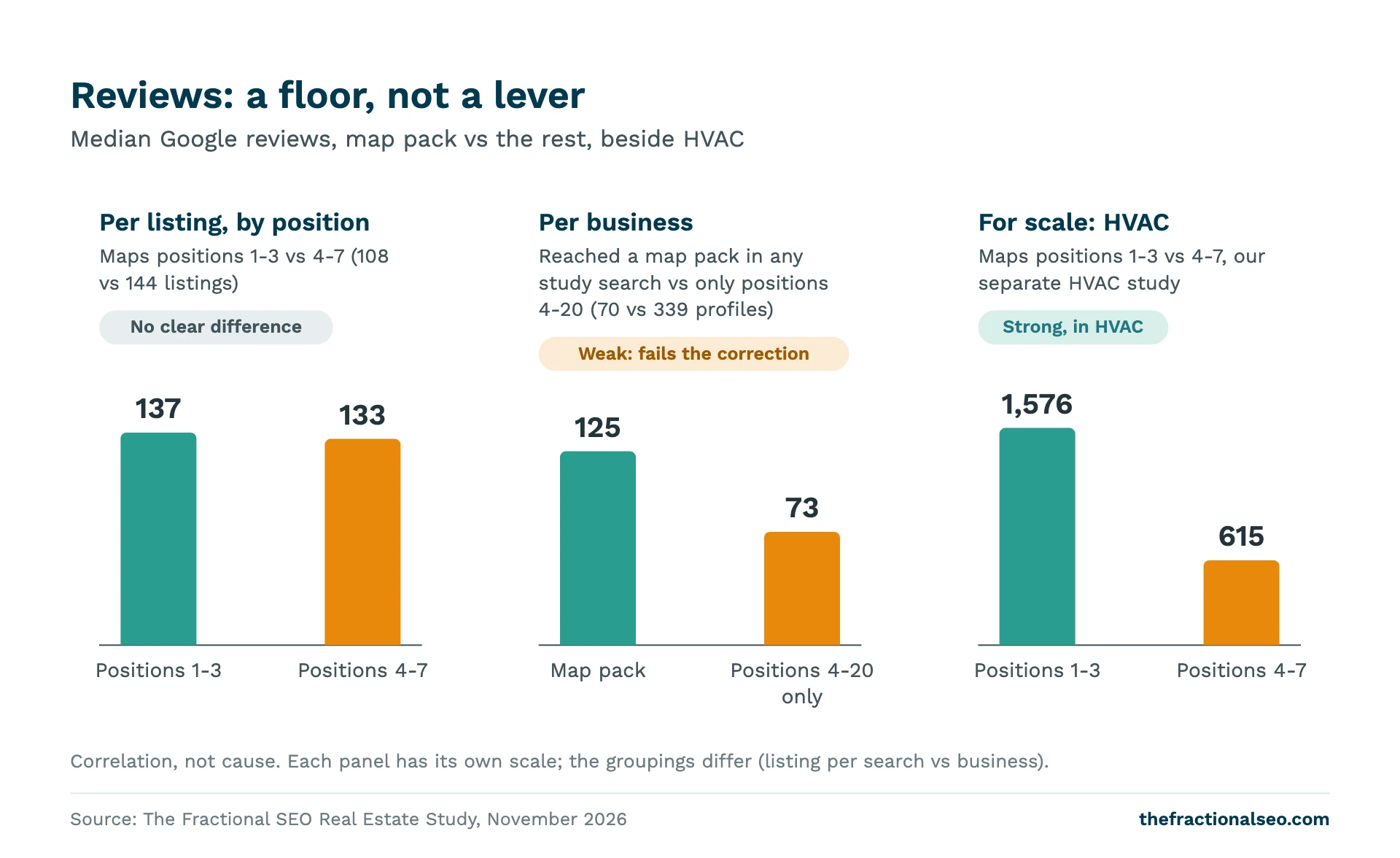
The better reading is a floor. Few agents reach the map pack on a handful of reviews: 4 of 108 map-pack listings have fewer than 10, and three-quarters have 64 or more. Agents in the pack and just below it are both well reviewed, so reviews look like a level most pack agents clear, not what puts one above another. Keep the habit going:
- Ask every client at closing, buyers and sellers both. Google’s content policy says merchants may not “selectively solicit positive reviews from customers”.
- Make it one tap. Google lets you share a direct review link or a QR code. Put it in the closing email and on the card in the gift bag.
- Never offer a gift card or a discount for a review. Google says incentives for reviews are strictly prohibited.
- Reply to reviews in plain words. Google’s advice is to reply as best practice.
For review benchmarks by metro size and search wording, see our research on Google reviews and real estate rankings.
Brokerage brands
Brokerage brands’ own domains barely touch the map pack: franchise-brand domains and company-owned chains hold 3 of 108 map-pack spots. They do better organically, with 21 of 92 agent-or-brokerage organic results (23%), 9 of them Sotheby’s International Realty pages. Most agents brand their own site and listing and name the brokerage on it: 87% of the 296 readable homepages name a brokerage.
The homepage is also where disclosures sit. 53% of those readable homepages show an Equal Housing Opportunity statement and 20% a license number. The rules behind these statements are quoted in our research on homepage disclosures. Check with your broker or the state commission for what applies to you.
Part 2: Local organic results
The organic list is where the portals sit, and where most map-pack agents don’t appear. It runs on your website and the links pointing to it.
Portals and directories own the plain agent search
The sites agents compete with most on page one are Yelp (42 results, on 24 of 36 searches), Facebook (20), Realtor.com (19, on 16 searches), Instagram (12), HAR.com (8, Houston only), Triple.com (6), Zillow (6), YouTube (6), and Realtorson.com, Homes.com, MerchantCircle and U.S. News Real Estate (5 each).
Listing portals are on page one for 24 of 36 searches, 42 results in all, and they hold #1 on 5 searches (Realtor.com 4, Zillow 1). For agent searches the portal page is usually an agent finder, not a listing. Nationally the portals are also the big searches: “realtor.com” alone has 1,000,000 searches a month, against 74,000 for “real estate agents near me”.
You won’t outrank a portal’s agent finder by wishing. Two things help. Make your profile on the portals and directories that rank for your city complete and identical to your site, since a click there can still reach you. Then put your own effort where portals are weaker: luxury, neighborhood and property-type searches. Our guide to the portals and directories in real estate search covers what each one charges, where its pages let us check, and how it works.
Neighborhood and location pages: the lean worth having
A location page is a page for a city, suburb or neighborhood, or a service-in-city page such as “homes for sale in a named suburb”. 55% of agent and brokerage websites have them; among those that do, the median is 5 such pages. On homepages, 64% of the 296 readable ones show neighborhood or community guides.
These are the closest thing to a website edge in our data, and they are still only a lean. Map-pack agents’ sites more often have location pages (72% vs 54% for agents only seen at Maps positions 4-20) and have more of them (a median of 3 vs 1). The lean fails the correction for the number of tests, and it doesn’t show in organic results (36% vs 38% for the organic top 3 vs positions 4-10, no clear difference).
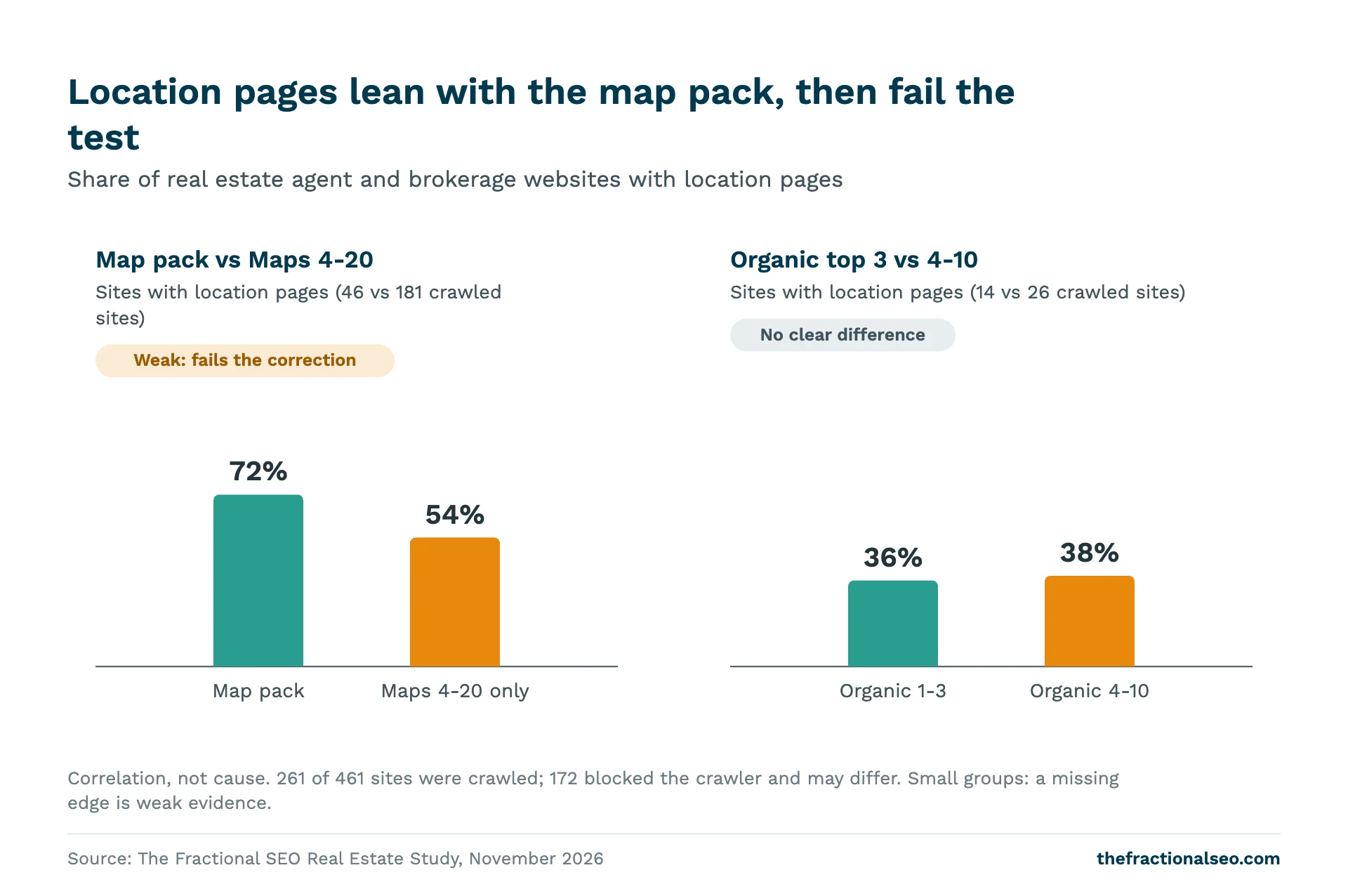
The groups are small (46 map-pack sites against 181), and these shares rest on the 261 sites we could crawl. 172 sites blocked our crawler and may differ. Our study of 261 real estate websites has the detail.
Build them properly anyway, because they answer what buyers and sellers search for: a page for each neighborhood you sell in, with what homes there are like, recent sales you handled and what you know that a portal doesn’t. Never city-swapped copies: Google’s spam policies list “Having multiple domain names or pages targeted at specific regions or cities that funnel users to one page” as doorway abuse.
Buyer, seller and listing pages
68% of the 261 agent and brokerage websites we could crawl have dedicated buyer, seller, listing or service pages, with a median of 7 among those that do. That count includes IDX listing and search URLs, so it overstates hand-written pages. Map-pack agents’ sites have more service pages (a median of 7.5 vs 2), another lean that fails the correction.
On homepages, 72% of the 296 readable ones offer an IDX or MLS home search and 54% a home valuation tool. IDX pages show the same listings as other sites in your MLS. A page for sellers in your area and one for first-time buyers, written by you, are what a portal can’t copy.
City in the title tag and LocalBusiness schema
62% of crawled agent and brokerage websites with a homepage title have their metro’s name in it (a floor, since suburbs and neighborhoods weren’t counted). 21% of the 261 crawled sites have LocalBusiness structured data or a subtype; the 172 sites that blocked our crawler may differ. Neither showed a clear difference in the map pack: city in title 70% vs 63%, LocalBusiness schema 24% vs 22%.
Do both because they’re cheap and tell Google plainly where you work. Google’s local business structured data page says to use “the most specific LocalBusiness sub-type possible”, and schema.org has a RealEstateAgent type.
Links
Links do not clearly separate rankings in real estate. Map-pack sites have a median of 124 referring domains vs 101, a lean that fails the correction, and organic top-3 sites 79 vs 141.5, no clear difference. The median site has 105; 16 have under 10. Good links are local and real: a lender, title company or inspector you work with, a neighborhood association, a local news story about the market.
Fee searches and fee pages
People search what agents cost. In our keyword set, 39 cost-related keyword groups total about 2,150 searches a month, led by “how much are realtor fees when selling a house” (390), though several of those groups are about home value rather than agent fees. Yet 5 of 296 readable homepages show a fee or commission rate, and 3 mention a buyer agreement or commission.
NAR says its settlement’s practice changes “went into effect on August 17, 2024” (NAR settlement FAQs). A plain page on how you’re paid, and what a buyer agreement covers, answers a question people already ask Google. What it must say is your broker’s call; our disclosures research quotes the rules.
Seller clicks are expensive
If you’re tempted to buy your way past the organic race, look at the bids first. The median suggested bid is $7.71 a click for “real estate agent <city>” and $8.58 for the brokerage search, up to $13.73 (“real estate brokerage austin”).
Seller searches cost far more: “sell my house” has a suggested bid of $162.26 a click (6,600 searches a month), “sell your house” $113.58, “sell my house fast” $109.86 (9,900), and “real estate agent for selling house” $57.21. Wording like “sell my house fast” suggests much of that bidding comes from home-buying investors rather than agents. That is our reading of the wording, not something we measured. Bids are planner estimates, not auction prices.
In our snapshot no text ads appeared on any of the 36 searches and Local Services Ads on 1. The searches ran before dawn in every US time zone, when ad budgets may not have been running, so this says nothing about how much agents advertise.
For most agents, organic seller pages and a strong profile are the cheaper long-run route. Paid search can still fill a gap while those build.
A 90-day local SEO plan
Here is the order we’d work in. The profile and the review habit come first because they’re quick and cost nothing but time.
Days 1-30: Business Profile and review habit
- Agree with your broker who holds the profile (you, the team or the office) and how it’s named under Google’s rules.
- Fix the listing name so it matches your real-world name, without added city or service words.
- Reply to every review you haven’t answered, then make replying a weekly habit.
- Send past clients the review link and add the QR code to your closing materials.
Days 31-60: Website pages
- Write a real page for each neighborhood or suburb where you do the most business, with sales you handled there.
- Write a seller page and a buyer page in your own words, separate from the IDX search.
- Put your main service and city in the homepage title, and add RealEstateAgent schema.
- Add a page on how you’re paid, worded with your broker.
Days 61-90: Portals, directories and a monthly routine
- Complete your profiles on the portals and directories that rank for your city, with details that match your site.
- Ask lenders, inspectors and local groups you work with for a link.
- Set a monthly routine: review replies, one neighborhood page improved, a ranking check from a phone.
For a printable task list, use the local SEO checklist for real estate agents.
How to measure local SEO
A ranking check from your office tells you little, because Google weighs distance. Track these instead, once a month:
- Map-pack position for your main searches, checked from a phone in the neighborhoods you sell.
- Business Profile actions: calls, website clicks and direction requests.
- Search Console clicks for searches that include a neighborhood, a suburb or a property type.
- Leads by source, so you can tell a portal lead from a search lead.
Real estate search is only mildly seasonal. In Google Trends “realtor” peaks in July at 1.4 times its December low, and “real estate agent” moves 1.2 times. November and December are the low months, so compare each month with the same month last year.
Questions, answered
How do I get into the Google map pack as a real estate agent?
Google names relevance, distance and popularity. In our study no single measure clearly set map-pack agents apart: review counts showed no clear difference, and reviews across profiles and links were leans that fail the correction. Most pack agents are well reviewed, so treat reviews as the floor and keep the profile accurate.
Can an agent outrank Zillow and Realtor.com?
On the plain “real estate agent <city>” search it’s hard: agents’ own sites held 15% of page one and #1 on 2 of 12 searches. On luxury searches agents held #1 on 11 of 12, so niche and neighborhood searches are where agents rank.
Should each agent on a team have their own Business Profile?
Google counts real estate agents as individual practitioners who can have their own profile, titled with only their name where several share a location. For a sole agent at a branded office, Google says it’s best to share one profile with the brokerage. Check with your broker.
Do neighborhood pages help?
They are the closest thing to a website edge we found: 72% of map-pack agents’ sites have location pages vs 54% for those at Maps positions 4-20. It’s a lean that fails the correction, so build them for buyers and sellers first.
Can I pay Google to rank higher in Maps?
No. Google says “There’s no way to request or pay for a better local ranking on Google.” Paid ads are a separate placement, not a ranking boost.
Want to know which race you’re losing?
We look at where you show up in Maps and in the organic results for your city’s agent, brokerage and neighborhood searches, and tell you what to fix first. See how fractional SEO for real estate works.
Sources
- TFS Real Estate Study, November 2026: our study of 261 real estate websites
- Google Business Profile Help, Tips to improve your local ranking on Google
- Google Business Profile Help, Guidelines for representing your business on Google
- Google Business Profile Help, Tips to get more reviews
- Maps User Generated Content Policy, Prohibited and restricted content
- Google Search Central, Spam policies for Google web search
- Google Search Central, Local business (LocalBusiness) structured data
- Schema.org, RealEstateAgent
- National Association of REALTORS®, NAR settlement FAQs