
Templates & Resource HVAC
Local SEO Checklist for HVAC Companies
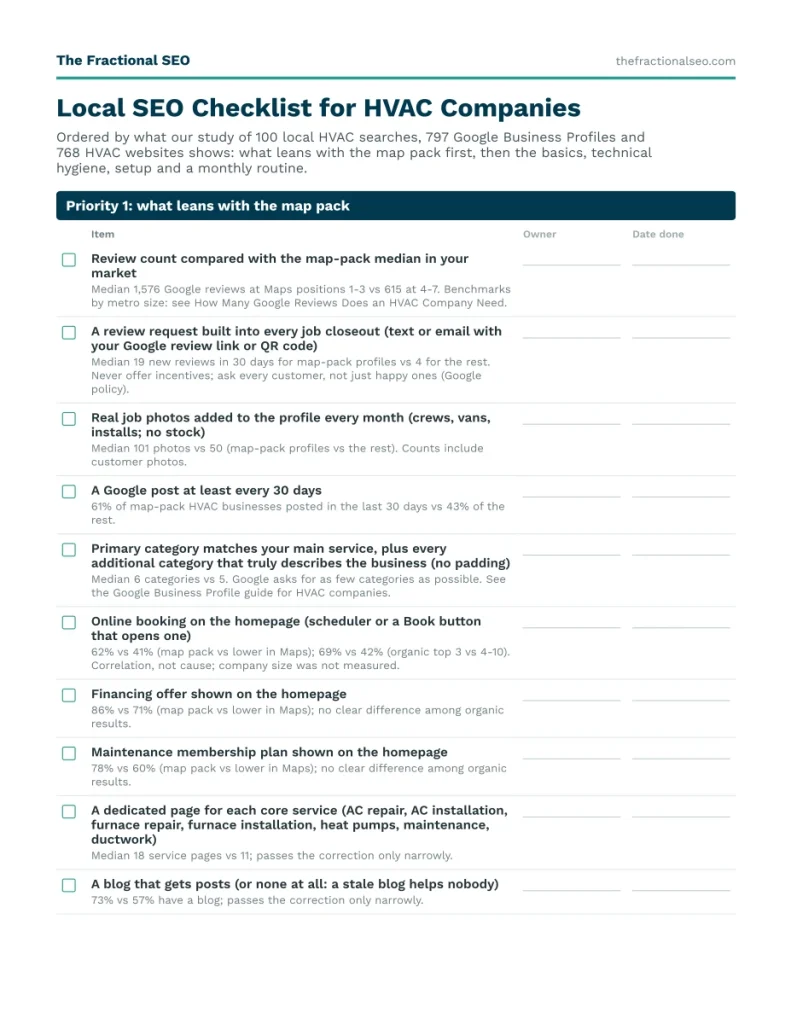
The local SEO checklists we read give every task the same weight: schema, a city in the title tag, location pages, reviews. This one is ordered by what the data shows. The items HVAC companies in the map pack tend to have more of come first. The common basics come next, then technical hygiene, setup and a monthly routine. All 31 items are free to download as a PDF or a Google Sheet.
Get the template No email required
What's inside
Priority 1: what leans with the map pack
Reviews, photos, posts, categories and online booking: the items where top-ranked HVAC companies differ most.
Priority 2: the basics
Click-to-call, schema, title tags, location pages and forms. Common, with no reliable ranking difference.
Priority 3 and setup
HTTPS, meta descriptions, H1s and titles, plus the profile setup every HVAC company needs.
Monthly tasks
Four checks to repeat each month, with columns for owner and date done.
How to use it
-
Download the PDF or copy the Sheet
Print it, or make your own copy of the Google Sheet.
-
Work top to bottom
Start with Priority 1. Give every item an owner and a date.
-
Repeat the monthly tasks
Check rankings from your service area, profile calls and new reviews each month.
We analyzed 100 local searches across 25 US metros and four HVAC search types, 853 HVAC contractor websites (768 crawled) and 797 Google Business Profiles, November 2026. We compared what top-ranked HVAC companies have with what lower-ranked ones have, and ordered the list from the answer. If you want the reasoning behind each task, read the full local SEO guide for HVAC companies.
If your Business Profile isn’t claimed yet, do items 21-24 first. The profile items in Priority 1 depend on them.
How we ordered this checklist
Every item sits in one of five groups.
- Priority 1: what leans with the map pack. Items where top-ranked HVAC companies differ strongly from lower-ranked ones, by a margin that held up after correcting for the number of tests we ran. We used two comparisons: businesses in the map pack against those lower in Google Maps (for review counts, Maps positions 1-3 against 4-7), and sites in the organic top 3 against positions 4-10.
- Priority 2: the basics. Common items where we found no reliable difference between top-ranked and lower-ranked contractors.
- Priority 3: technical hygiene. How often HVAC sites get these wrong. No ranking comparison.
- Setup and upkeep. Best practice from Google’s own guidelines, not study data.
- Monthly tasks. Best practice, with one benchmark from the study.
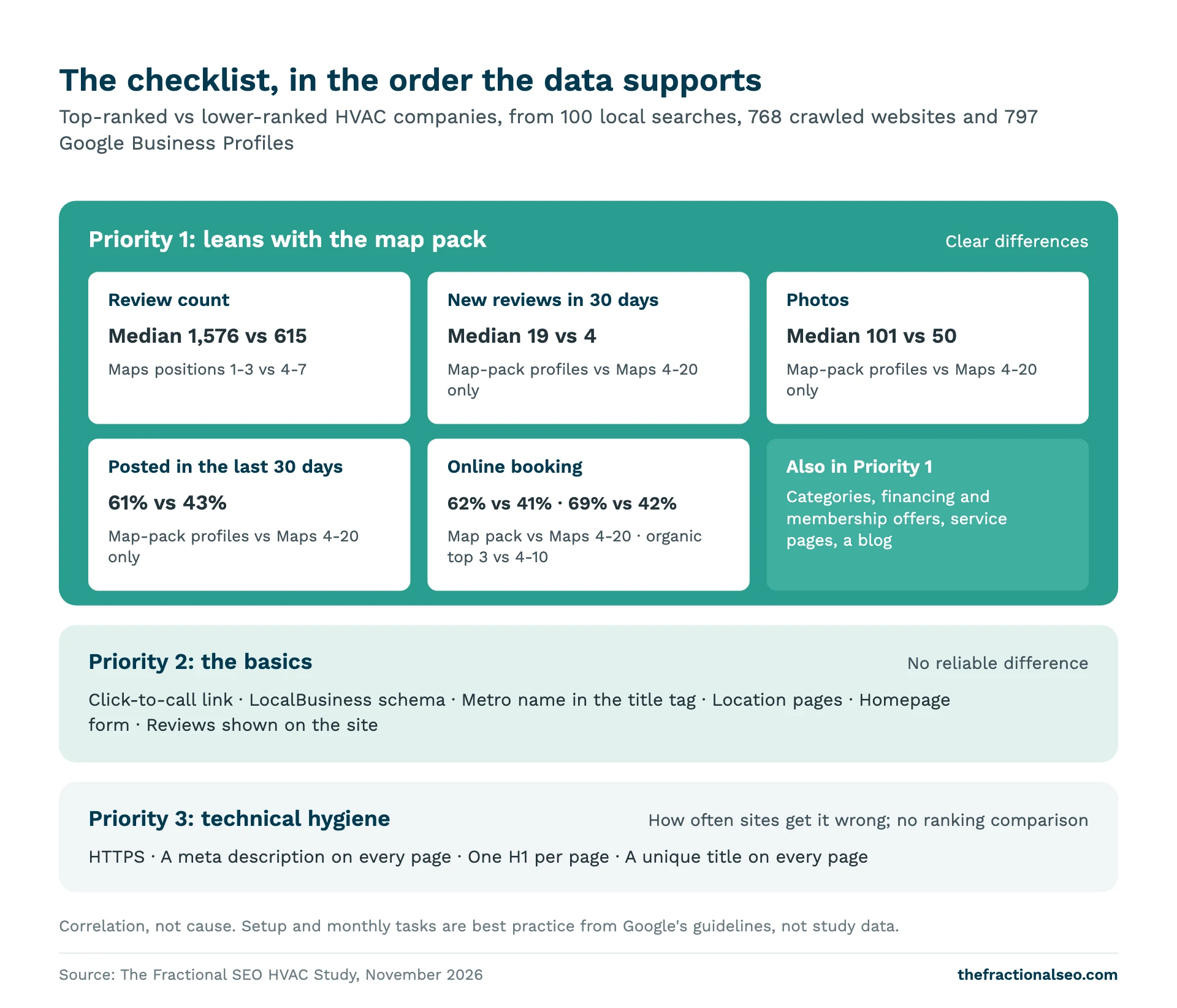
One honest note. This is a correlation study. Companies in the map pack may differ in ways we didn’t measure, such as size, age and budget. The data shows what top-ranked companies tend to have. It can’t promise that adding any one item will move you up. We still think an order based on data beats an order based on habit. The website half comes from our study of 768 HVAC websites.
Priority 1: What leans with the map pack
Reviews: count and steady flow
Review count shows one of the clearest gaps on the profile. HVAC companies in the map pack have far more Google reviews: a median of 1,576 for positions 1-3 vs 615 for positions 4-7. They also keep getting them. Profiles that reached a map pack in any study search had a median of 19 new Google reviews in the 30 days before collection, against 4 for profiles only seen at Maps positions 4-20.
- Your review count compared with the map-pack median. See how many reviews it takes in your market.
- A review request built into every job closeout: a text or email with your Google review link or QR code, sent to every customer.
Ask everyone, not only the customers you expect to be happy, and never offer a discount for a review. Google’s content policy prohibits both.
Photos, posts and categories
These use the same comparison: profiles that reached the map pack against profiles only seen at Maps positions 4-20. Map-pack profiles have about twice as many photos: median 101 vs 50. That count includes customer photos, so not all of it is the owner’s work. 61% of map-pack HVAC businesses posted on Google in the last 30 days vs 43% of the rest. Map-pack profiles also list more categories: median 6 vs 5.
Be careful with categories. Google’s guidelines say to “use as few categories as possible to describe your overall core business.” Add every category that truly describes what you do, and no padding.
- Real job photos added to the profile every month: crews, vans, installs. No stock images.
- A Google post at least every 30 days.
- A primary category that matches your main service, plus every additional category that truly applies. Step by step in our Google Business Profile guide for HVAC companies.
Online booking, financing and a membership plan
Online booking on the homepage is the only website feature in the study that differs strongly in both comparisons. 62% of map-pack businesses offer it vs 41% of those lower in Maps, and 69% of organic top-3 sites vs 42% at positions 4-10.
Map-pack companies are also more likely to advertise financing (86% vs 71%) and a maintenance membership plan (78% vs 60%) on the homepage. Among organic results there is no clear difference for either.
The caveat matters here. These are correlations, not causes. We didn’t measure company size or budget, so the study can’t tell whether these features or the kind of company that offers them goes with ranking. More in what 768 HVAC websites show about online booking.
- Online booking on the homepage: a scheduler, or a Book button that opens one.
- Your financing offer shown on the homepage.
- Your maintenance membership plan shown on the homepage.
Service pages and a blog
Map-pack HVAC companies are more likely to have a blog (73% vs 57%) and have more service pages (median 18 vs 11) than sites lower in Maps. Both pass the correction for multiple tests only narrowly, so treat them as a lean, not a result.
- A dedicated page for each core service: AC repair, AC installation, furnace repair, furnace installation, heat pumps, maintenance and ductwork.
- A blog that gets posts. If nobody will write for it, leave it out: a stale blog helps nobody.
Priority 2: The basics (no reliable difference)
In our data, these items show no reliable ranking edge. For click-to-call links, homepage forms, review widgets, LocalBusiness schema, a city in the title tag and location pages, no difference between top-ranked and lower-ranked HVAC contractors survives the correction for multiple tests. Map-pack sites have review widgets and LocalBusiness schema somewhat more often, but those gaps are weak.
| Item | HVAC sites with it | Map pack vs lower in Maps | Organic top 3 vs 4-10 |
|---|---|---|---|
| Click-to-call link | 93% | 97% vs 91% (weak) | 96% vs 96% (no clear difference) |
| LocalBusiness schema | 70% | 77% vs 66% (weak) | 77% vs 78% (no clear difference) |
| Metro name in homepage title | 73% | 80% vs 72% (no clear difference) | 75% vs 69% (no clear difference) |
| Location pages | 71% | 74% vs 68% (no clear difference) | 83% vs 78% (no clear difference) |
| Homepage form | not counted here | 49% vs 47% (no clear difference) | 49% vs 51% (no clear difference) |
| Review widget | not counted here | 43% vs 32% (weak) | 41% vs 32% (no clear difference) |
No reliable difference is not the same as no effect, and it’s not a reason to skip them. These items help a customer call, book and see where you work. Most are quick fixes for whoever runs your site. Sites with location pages have a median of 18.5 of them. Build one only for an area you truly serve, with real local content. Google’s spam policies treat city pages that funnel visitors to one page as doorway abuse. For schema, Google asks for the most specific LocalBusiness sub-type possible.
- A click-to-call phone link in the header on every page.
- LocalBusiness schema (the HVACBusiness subtype) on the homepage and location pages.
- Your metro name in the homepage title tag.
- A page for each city or area you actually serve, with jobs done there and local reviews used with permission. Never city-swapped copies.
- A contact or quote form on the homepage.
- Real customer reviews shown on the site, with permission.
Priority 3: Technical hygiene
Nearly all HVAC contractor sites use HTTPS (767 of 768). On-page basics are missing on a minority: 16% lack a meta description on a quarter or more of their pages, 10% lack an H1 on a quarter or more, and 4% duplicate titles on a quarter or more. These figures show how common each problem is; they don’t compare rankings. Google’s SEO starter guide asks for titles and descriptions unique to each page. Our technical SEO guide for HVAC websites covers the fixes.
- HTTPS on every page.
- A meta description on every page.
- One H1 on every page.
- A unique title on every page.
Setup and upkeep: best practice
These are best practice, mostly from Google’s guidelines, not from our study. On review replies, owners of map-pack businesses reply to slightly more reviews (median 93% of their newest 20 vs 85%), but the gap does not hold up once the number of comparisons is taken into account. Reply anyway: other customers can see your replies.
- Business Profile claimed and verified.
- Business name exactly as on your trucks and paperwork. Google says extra keywords or cities in the name can get the profile suspended.
- Service area set to the areas you really cover, with the street address hidden if customers don’t visit you.
- Website link and a local phone number on the profile.
- Name, address and phone the same on your site, your profile and the directories that rank for your searches. See our HVAC directories guide.
- A reply to every review, good and bad.
- Search Console and Google Analytics set up and verified.
Monthly tasks
Put these on the calendar for the same day each month. Google ranks local results partly by distance, so check from where your customers are, not from the office.
- Check your map-pack position for your top three searches from a phone inside your service area. Use rank tracking tools if you want it on a schedule.
- Check profile calls, website clicks and direction requests.
- Count new reviews this month against last month. The map-pack median was 19 in 30 days.
- Check Search Console clicks for service and city searches, and fix any page that dropped.
Download the checklist
The HVAC Local SEO Checklist. All 31 items in priority order, with columns for status, owner, date done and the benchmark from our study. Print the PDF, or copy the Google Sheet and give every item an owner and a date.
Rather hand the list to someone? HVAC SEO done for you.
Questions, answered
What should an HVAC local SEO checklist include?
Four groups. First, what leans with the map pack: review count and a steady flow of new reviews, photos, monthly posts, honest categories and online booking. Then the basics, like click-to-call and schema, which show no reliable ranking difference. Then technical hygiene, setup and a monthly routine.
What should I do first?
If your profile isn’t claimed, items 21-24. Then reviews and online booking. Map-pack companies have a median of 1,576 reviews at positions 1-3 vs 615 at 4-7, and 62% of them offer online booking vs 41% lower in Maps.
How often should I post on Google Business Profile?
At least monthly. 61% of map-pack HVAC businesses posted in the last 30 days vs 43% of the rest.
Does LocalBusiness schema or a city in my title tag help HVAC rankings?
We found no reliable difference for either. Schema shows up somewhat more often in the map pack, but the gap is weak. Both are cheap, so do them as basics.
Do I need location pages for every town I serve?
Only for towns you really serve, with real local content. 71% of HVAC sites have location pages, and top-ranked and lower-ranked sites showed no reliable difference in how often they have them.