
Templates & Resource Landscaping
Google Business Profile Checklist for Landscaping and Lawn Care Companies
Most Google Business Profile advice for landscapers is the same list: claim it, pick a category, add photos, post, get reviews. None of the guides we read show which of those things actually differ between the landscaping and lawn care companies in the map pack and the ones below it. We looked at 582 landscaping profiles to find out. This checklist puts the items that differ first, the setup basics after, and ends with a download you can work through.
Get the template No email required
What's inside
Reviews and replies
The review routine and reply rate, where map-pack companies clearly differ.
Project photos
Patios, plantings and before-and-after shots, added every month.
Setup
Claim, category choice, name, service area, hours, website and description.
Benchmarks
Each data-backed item carries its figure from our study of 582 landscaping profiles.
How to use it
-
Download the checklist
Print the PDF or copy the Google Sheet.
-
Start the review routine
A link or QR code after every job, and a reply to every review.
-
Fix setup in one sitting
Category, name, service area, hours and description take minutes once you're logged in.
We analyzed 45 local searches across 15 US metros and three landscaping search types, 577 landscaping company websites (537 crawled) and 582 Google Business Profiles, November 2026. For this checklist we compared the profiles of businesses that reached a map pack in any study search with those only seen at Maps positions 4-20, counting each business once. Five #1 listings had no profile record, so the map-pack group is 88 profiles, not 93. The website side of the same study is in our study of 537 landscaping websites.
We collected this data in mid-November 2026, after the spring and summer landscaping season, so rankings, review pace, Google posting and ad activity may look different in season.
The short version: the setup basics are near-universal and separate nobody. What differs is the review routine, replies and photos.
What map-pack landscaping profiles have more of
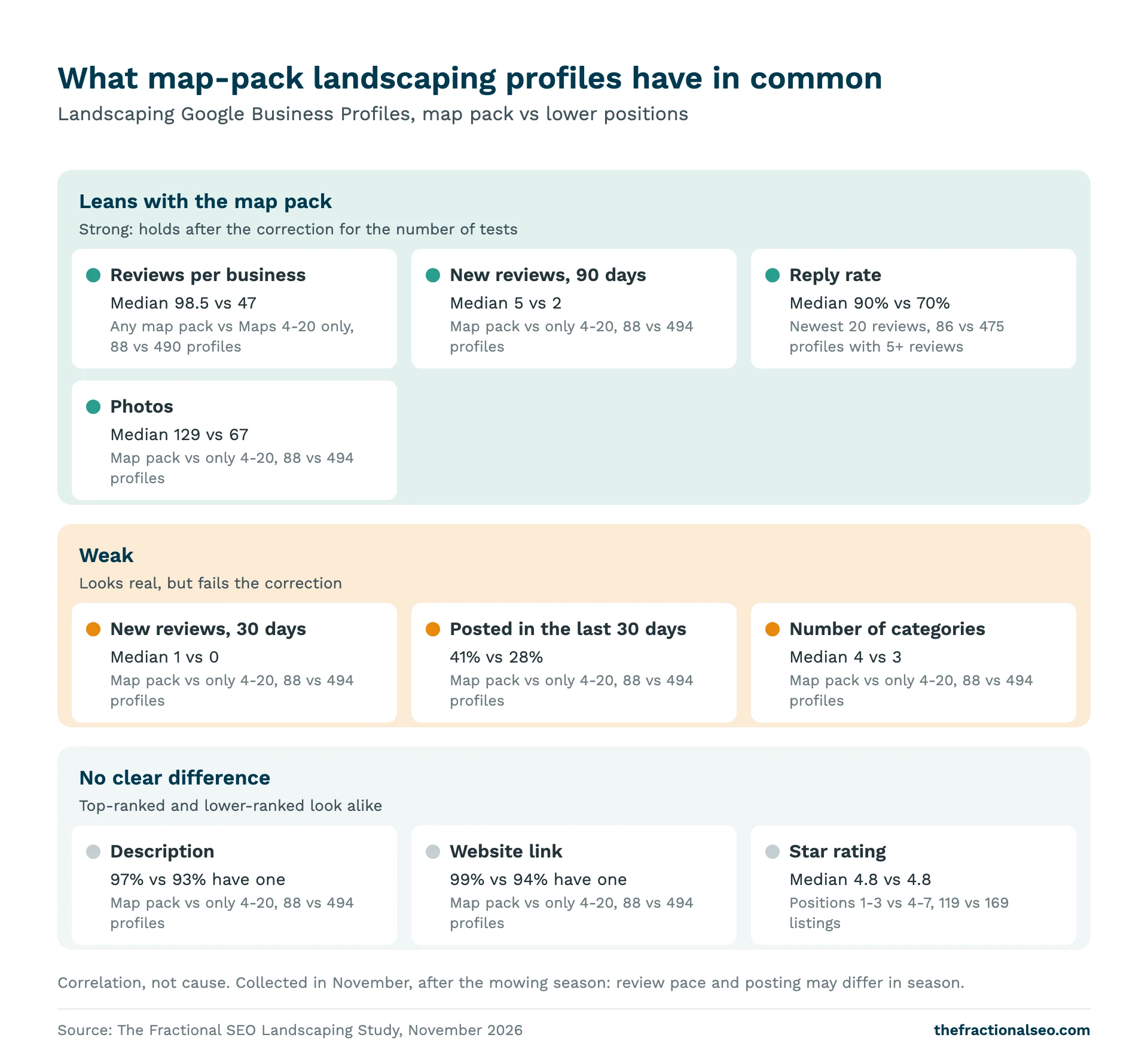
These four lean with the map pack, and all were strong results statistically:
- Reviews: businesses that reached a map pack in any study search have a median of 98.5 reviews vs 47 for those only seen at positions 4-20.
- Recent reviews: a median of 5 vs 2 new reviews in the 90 days before collection.
- Replies: a median reply rate of 90% of their newest 20 reviews vs 70% for the rest.
- Photos: about twice as many, a median of 129 vs 67.
These lean the same way but are weak, meaning the gap does not survive the correction for the number of tests we ran:
- Posting: 41% of map-pack businesses posted on Google in the 30 days before collection vs 28% of the rest.
- Categories: map-pack profiles list a median of 4 categories vs 3.
- Reviews in the last 30 days: medians of 1 vs 0. In late autumn most companies collect very few.
These showed no clear difference:
- Description and website link: 97% vs 93% and 99% vs 94%.
- Star rating: the median is 4.8 in the map pack and 4.8 at positions 4-7.
One caution. This is a correlation. Established companies tend to have more reviews and other advantages too, such as age, budget and links, and busier companies collect more customer photos. The study shows what map-pack profiles have, not what put them there. For the review side in detail, see what 582 landscaping profiles show about reviews.
Download the checklist
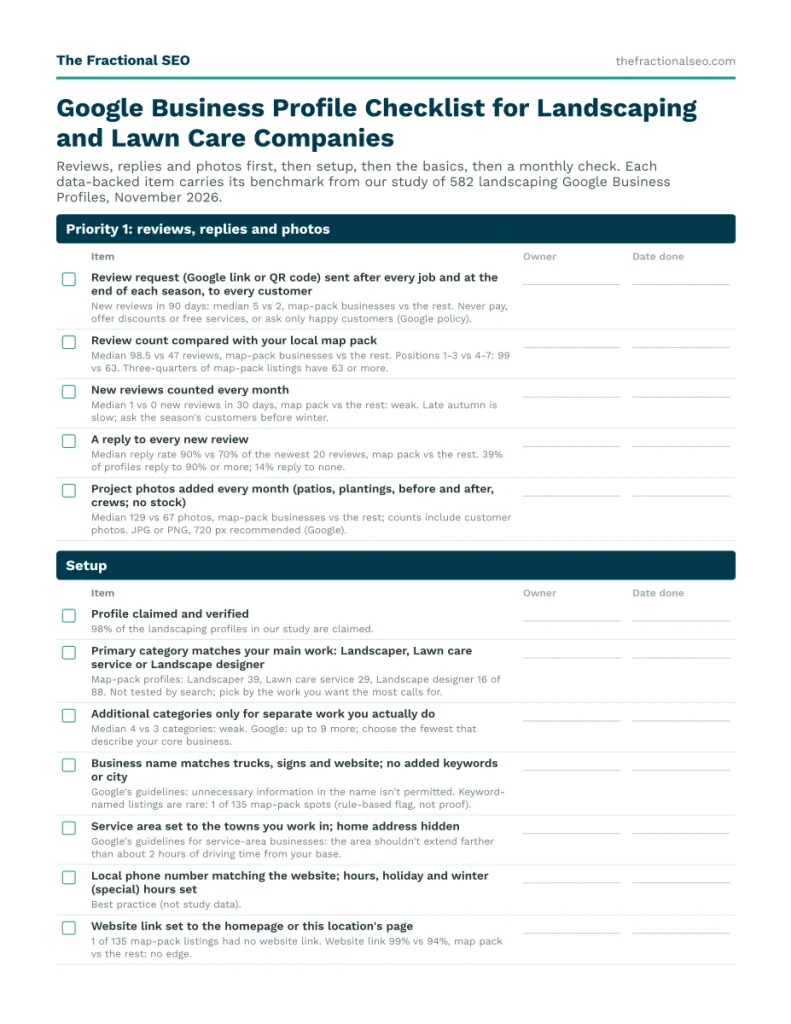
The free checklist turns this page into 18 items: reviews and replies, photos, setup, posts and a monthly check. Each data-backed item carries its figure from our study, on two printable pages. It covers the profile only. For your website, links and the rest of local SEO, use the local SEO checklist for landscaping companies.
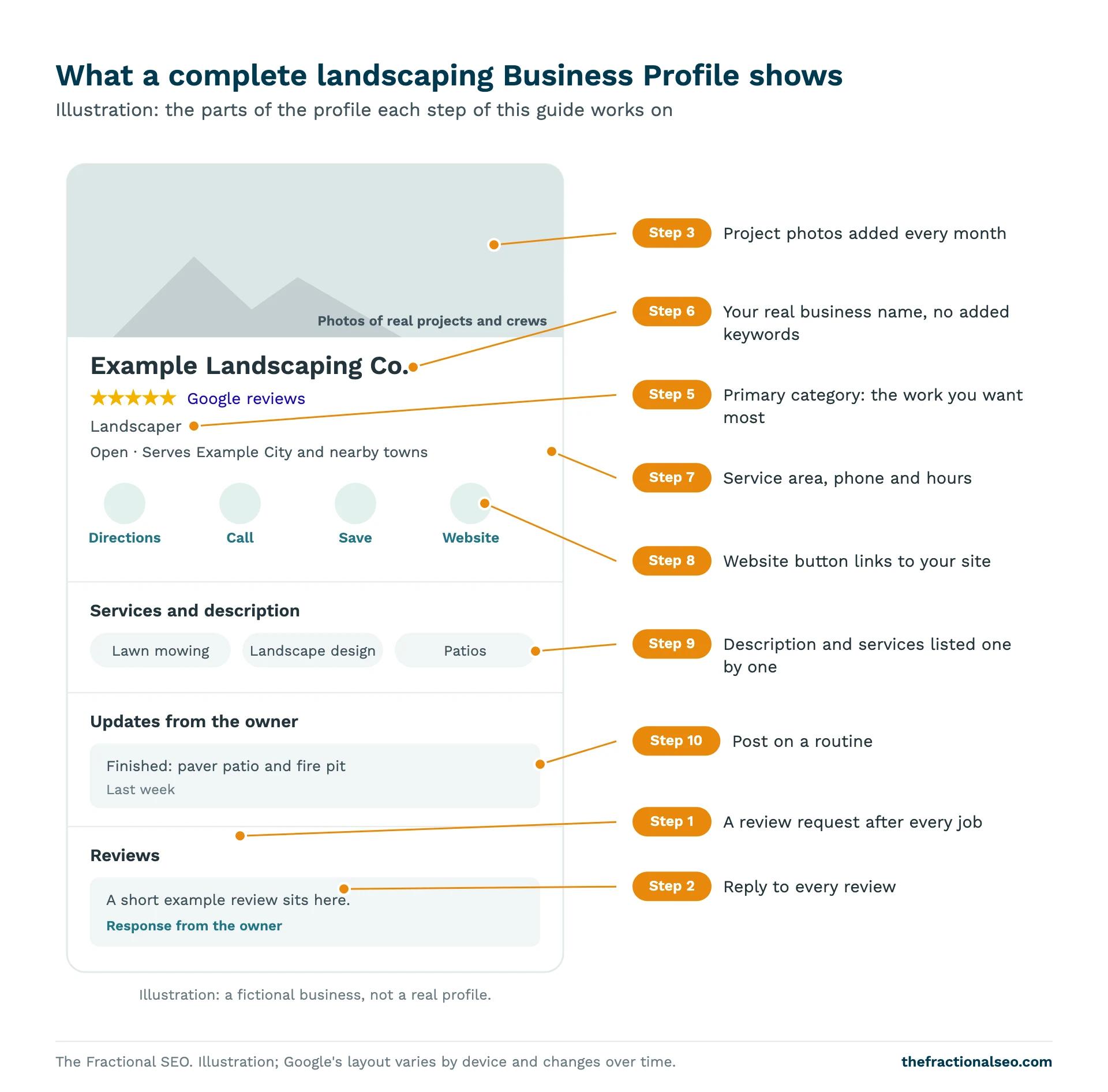
Step 1: Ask for a review after every job, all year
Reviews are the clearest gap, and the pace counts as well as the total. Businesses that reached a map pack in any study search have a median of 98.5 reviews vs 47 for those only seen at positions 4-20. They also got more new reviews in the 90 days before collection: a median of 5 vs 2. The same holds per search: a median of 99 reviews at positions 1-3 vs 63 at positions 4-7.
Few landscaping companies reach the map pack on a handful of reviews: 2 of 119 map-pack listings have fewer than 10, three-quarters have 63 or more, the median is 99 and 11 (9%) have 500 or more. Hardscaping companies reach the pack with the fewest reviews. These figures describe the sample; they are not targets. For benchmarks by metro size and search, see our landscaping reviews research. And the rating isn’t the gap: the median is 4.8 in the map pack and 4.8 at positions 4-7.
Make asking part of how every job ends:
- Get your review link or QR code from the profile. Google’s help page on reviews says you can share either.
- For a patio, planting or install, ask at the final walkthrough, then text the link the same day.
- For mowing and maintenance customers, ask after the first few visits and again when the season closes. A customer you’ve served all season has the most to say.
- Ask every customer, not only the ones you expect to be happy. Google’s content policy says businesses may not “selectively solicit positive reviews from customers,” and should not pressure anyone or ask for specific wording.
- Never pay for a review or offer a discount or a free service for one. The same policy bans incentives.
Count new reviews each month. Over 30 days the gap was weak in our data: in late autumn most companies collect very few. That makes the end of the season the time to ask.
Step 2: Reply to every review
This one stands out in landscaping. Map-pack landscaping companies reply to more of their reviews: a median reply rate of 90% of their newest 20 reviews vs 70% for the rest, a gap that survives the correction. Across all profiles, 39% reply to 90% or more and 14% reply to none. In our HVAC and painting studies, reply rate did not clearly separate the map pack, so treat it as a sign of a well-run profile rather than a switch that moves rankings.
Google’s help page says that when you reply, you show customers you value their feedback. Replies are checked against Google’s content policies, and the customer is notified. Thank good reviews briefly and name the job (“glad the new beds came out the way you pictured”). Answer a bad one calmly, once, and offer to fix it offline. Never repeat a customer’s address or details.
Step 3: Add project photos every month
Map-pack landscaping profiles have about twice as many photos: median 129 vs 67. Photo counts include customer photos, and busier companies collect more of both, so the counts mix in customers’ own photos. The study didn’t split the two.
Landscaping sells on how the finished yard looks. Add your own photos as the work happens:
- Before-and-after pairs from the same spot: a bare backyard and the finished patio, an overgrown bed and the new planting.
- Hardscape close-ups: paver patterns, wall caps, steps, edging.
- Plantings and lawns a few weeks after install, once they’ve filled in.
- Crews at work and trucks and trailers with the logo showing.
- Seasonal work you want booked: spring cleanups, mulch, fall leaf removal, snow if you plow.
Google’s photo guidelines ask for JPG or PNG files between 10 KB and 5 MB, recommend 720 px tall and 720 px wide, and say photos should represent reality, with no heavy edits or filters. Photos show on Google only after the profile is verified. Use real job photos, never stock. Get the homeowner’s permission and keep house numbers and plates out of the frame.
Step 4: Claim and verify your profile
98% of the landscaping profiles in our study are claimed, so if yours isn’t, fix that first. Search for your business on Google Maps and claim the profile if one exists, rather than making a second one. Verify it with one of the methods Google offers you. Then add a second owner or manager from your company so the profile isn’t tied to one login. If an agency runs it, make them a manager, not the owner.
Step 5: Pick your primary category
This is the one setup step that takes a real decision. Landscaping profiles split across three primary categories: in the map pack “Landscaper” (39 of 88), “Lawn care service” (29) and “Landscape designer” (16). A few use “Landscape architect” or “Paving contractor”.
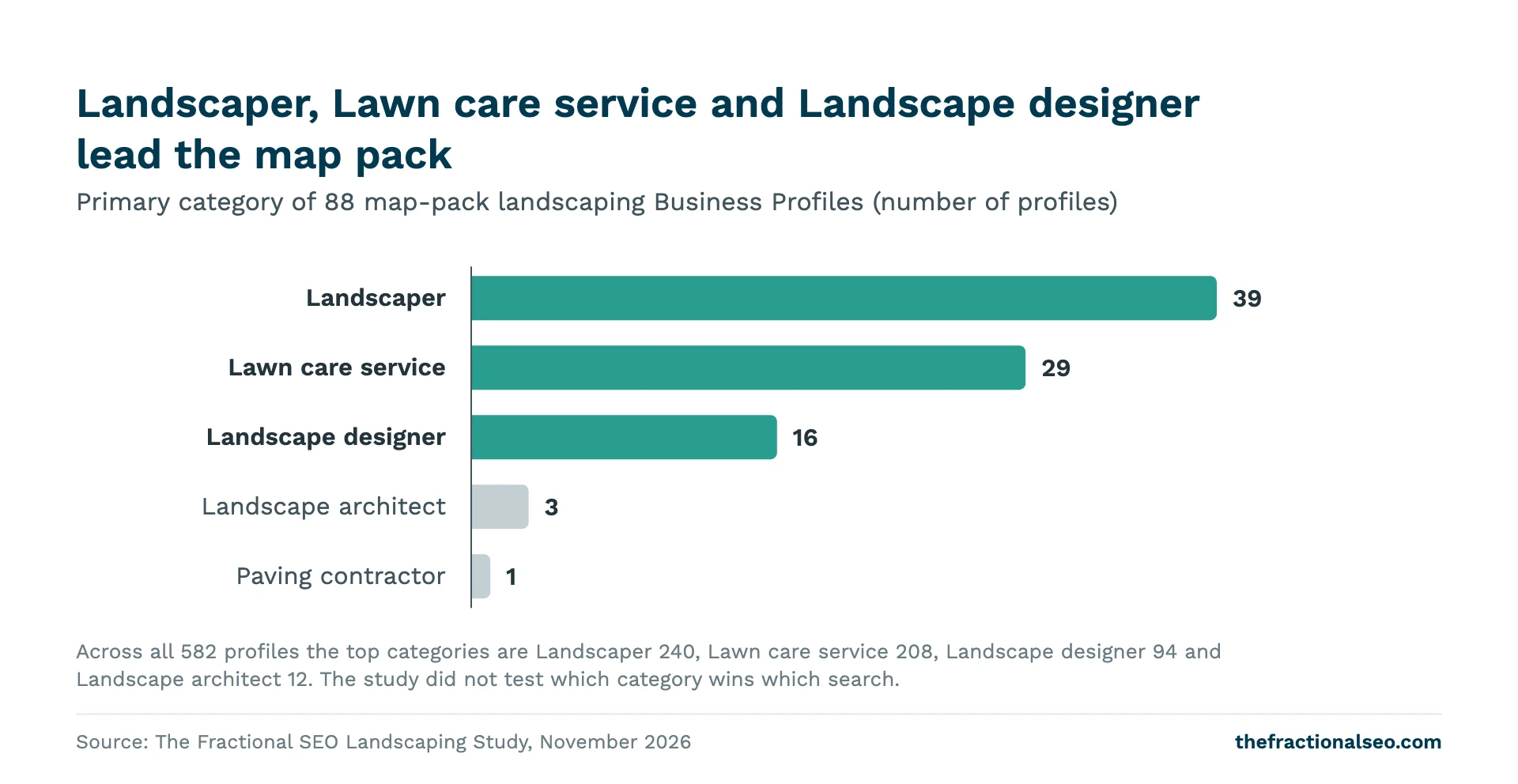
We didn’t test which category wins which search, so pick by your work. If most of your revenue is mowing, fertilizing and maintenance, “Lawn care service” describes you. If you design and build, “Landscaper” or “Landscape designer” does. If you do both, choose the primary for the work you want the most calls for and add the other as an additional category.
Google’s help page on editing your profile says all locations of a business must share a primary category, that you can select up to 9 more, and that you shouldn’t use categories solely as keywords. Its guidelines say to choose the fewest number of categories it takes to describe your overall core business. Map-pack profiles list a median of 4 categories vs 3, a weak lean. Add one only for separate work you actually do, such as irrigation or tree service.
If you mow, know who else is in the pack. LawnStarter and Lawn Love city listings hold 13 of the 45 map-pack spots on “lawn care service” searches (29%), including 7 of the 15 #1 spots. They are lead-generation marketplaces, not lawn care companies. More in our benchmark of 45 landscaping searches.
Step 6: Use your real business name
Use the name on your trucks, signs and invoices. Google’s guidelines for representing your business say the name should reflect your real-world name, and that including unnecessary information isn’t permitted and could get the profile suspended. That rules out tacking “Lawn Care & Landscaping Dallas” on the end. Keyword-named Maps listings with few reviews (a listing named only “<city> lawn care”, for example) are rare in landscaping: 13 listings, 13 Maps rows, and 1 of 135 map-pack spots. Our flag is rule-based, not proof that any listing is fake. Either way, it isn’t worth copying.
Step 7: Set your service area, phone and hours
Service area. Most landscapers go to the customer, which makes you a service-area business. Google’s guidelines allow one service-area profile, say to hide your address from customers, and say the area shouldn’t extend farther than about 2 hours of driving time from your base. List the towns you actually work in.
Phone and hours. Use a local number, the same one that’s on your website and trucks. Set the hours someone answers the phone. Google lets you set special hours for holidays and other temporary periods, which covers a winter schedule too.
Step 8: Link your website
Almost every business in the landscaping map pack shows a website: 1 of 135 map-pack listings had no website link. On the profile side it is near-universal (99% vs 94%), with no edge. It won’t set you apart, but without it a homeowner can’t get from your profile to your project gallery. Point it at your homepage, or the page for this location if you have several, and add UTM tags so your analytics shows visits from the profile.
Step 9: Write the description and services
Google’s edit page says not to exceed 750 characters and not to include URLs. Its guidelines rule out links of any type and descriptions that focus on promotions, prices or sales. A description is near-universal (97% vs 93%, no edge), so write it for the homeowner and move on: what you do, which towns you cover, and whether you handle residential, commercial or both. Then fill in the services list: mowing, cleanups, mulch, design, plantings, patios and walls, irrigation.
Step 10: Post on a routine, without expecting a ranking boost
Every guide we read tells you to post. Our data gives it a weak lean at best. 30% of landscaping profiles posted on Google in the 30 days before collection and 27% have no posts at all. Map-pack businesses post a little more often (41% vs 28% in 30 days; 50% vs 37% in 90), but the gap is weak and fails the correction. November is a quiet month for lawn and landscape posts anyway.
Post because customers see it. Google’s help page on posts lists updates, offers and events, and says posts older than 6 months are archived unless a date range is set. A monthly post with a finished job is enough. Time the spring posts: interest rises from the December low, with the biggest steps from February to April. Plan the year with seasonal SEO for landscaping and lawn care companies.
Step 11: Check performance monthly
Once a month, note calls, website clicks and direction requests from the profile’s performance view. Compare with the same month last year, not last month, since landscaping demand swings with the seasons.
What the profile can’t do on its own
Google’s local ranking page says local results are mainly based on relevance, distance and popularity, and that there’s no way to request or pay for a better local ranking. No profile setting changes how far you are from the searcher.
Two more things from the study. The map pack and the organic results are mostly different businesses: 25% of map-pack landscaping companies with a website also rank on page one organically for the same search. And map-pack landscaping businesses’ websites have more links: a median of 119 referring domains vs 98 for businesses only at Maps positions 4-20. That is a correlation too, but it means the profile is one part of the job. See the full local SEO guide for landscaping companies.
Work through the checklist, then talk to us about the rest of your local SEO: SEO for landscaping companies.
Questions, answered
What Google Business Profile category should a landscaping company use?
The one that matches your main work. In the map pack, “Landscaper” is the primary category on 39 of 88 profiles, “Lawn care service” on 29 and “Landscape designer” on 16. Add the others only for work you actually do.
Does replying to Google reviews help a landscaping company?
Map-pack companies reply more: a median of 90% of their newest 20 reviews vs 70%. That is a correlation, not proof replies move rankings, but it costs nothing and customers read them.
How many Google reviews does a landscaping company need?
There’s no set number. Three-quarters of map-pack listings have 63 or more, and only 2 of 119 have fewer than 10. Compare yourself with the map pack in your own town.
How often should a lawn care company post on Google?
Monthly is a sensible routine for customers. Posting was a weak lean in our data: 41% of map-pack businesses posted in the 30 days before collection vs 28% of the rest.
Does star rating matter?
Not in a way we could measure. The median is 4.8 in the map pack and 4.8 at positions 4-7.