
Research & Benchmark Landscaping
We Analyzed 537 Landscaping Websites: What Map-Pack Landscaping Companies Do Differently
Most lists of landscaping website mistakes are guesses. Someone who sells websites or marketing writes down what they think is wrong with yours, and there is rarely a number behind it. We wanted numbers. We analyzed 45 local searches across 15 US metros and three landscaping search types, 577 landscaping company websites (537 crawled) and 582 Google Business Profiles, November 2026. First we compared the landscaping companies Google puts in the map pack with the ones it shows lower in Maps, feature by feature. Two website measures clearly separate them: location pages, the pages for a town or for a service in a town, and the number of service pages. Both are correlations, and the map-pack companies are bigger and better reviewed too, so read them as a picture of who is at the top, not a recipe. Then we counted seven common gaps and how often each one occurs.
This study looks at landscaping websites. For the other half of the picture, who actually shows up when a homeowner searches, read who wins local landscaping searches. If you want to see how we approach this work, start with fractional SEO for landscaping companies. We collected this data in mid-November 2026, after the spring and summer landscaping season, so rankings, review pace, Google posting and ad activity may look different in season. The sample, dates and limits are in the Method card on this page.
Key findings at a glance
- Location pages separate the map pack. 65% of map-pack businesses’ sites have city or service-in-city pages vs 42% for businesses only seen at Maps positions 4-20. The gap survives our correction for the number of tests. It does not show in organic results, and map-pack companies are bigger, so location pages may mark an established company rather than cause the ranking.
- More service pages, too: a median of 11 vs 5 for map-pack sites, though simply having any service page is only a weak lean (88% vs 73%).
- Four more leans fail the correction: a blog (58% vs 39%), any service page, a maintenance plan or program (34% vs 22%) and the city in the homepage title (72% vs 60%). Worth having, not ranking factors.
- Blogs go quiet: 43% of landscaping-company sites have a blog, but only 10% published anything in the last 12 months and 5% averaged a post a month.
- Phones wait: the median largest contentful paint is 8.4 seconds, and only 12% load their main content within Google’s 2.5-second target. Speed shows no clear difference between map-pack sites and the rest.
- Under half have a homepage form: 45% of landscaping-company websites have a contact or quote form on the homepage itself.
- Prices and booking are rare: prices shown 2%, online booking or instant quote 6%.
Location pages: the website feature that separates the map pack
The comparison here is simple. On one side are landscaping businesses that reached positions 1-3 of the Google Maps list in at least one of our 45 searches. On the other are businesses we only saw at Maps positions 4-20. We crawled both groups’ websites and counted their pages.
Location pages separate map-pack landscaping companies from the rest, and the gap survives the correction: 65% of map-pack businesses’ sites have city or service-in-city pages vs 42% for businesses only seen at Maps positions 4-20 (median 3 such pages vs 0). In counts, that is 54 of 83 map-pack sites vs 172 of 405. A city page is a page for a town or area you serve. A service-in-city page is something like “lawn care in Frisco” or “paver patios in Plano”. We counted both.
We checked it two more ways. With chain sites removed, it still holds: 63% vs 42% (50 of 79 vs 167 of 398). And it runs the same way within each search wording, “landscaping company”, “lawn care service” and “hardscaping company”. Those groups are too small to pass the correction on their own, so treat the by-wording result as same direction, not proof.
Now the caution, and it matters. This is a correlation, not a cause. Map-pack businesses also have bigger sites (median 46 vs 22 indexable pages) and more reviews (103 vs 48), so location pages may mark an established company rather than cause the ranking. And the gap does not show in organic results: 63% of sites in the organic top 3 have location pages vs 54% at positions 4-10, no clear difference. In our HVAC study, location pages showed no difference at all (74% vs 68%). So this is a landscaping result, and a map-pack result.

How common are they overall? 47% of landscaping-company websites have location pages (a page for a city or area, or a service-in-city page such as “lawn care in Frisco”); among those that do, the median is 7 such pages.
What we’d do, as our view rather than study data: build a page for each town where you want work and actually do it. Put real things on it: jobs you did there, photos from those jobs, the services you offer in that town, the neighborhoods you cover. Don’t stamp out copies with the town name swapped. Google’s spam policies list “pages targeted at specific regions or cities that funnel users to one page” as doorway abuse. Our local SEO guide for landscaping companies covers how to plan the set.
More service pages, too
Map-pack landscaping companies also have more service pages (median 11 vs 5, strong), though simply having any service page is only a weak lean (88% vs 73%). With chain sites removed, the medians are 10 vs 5. The comparison is the same as above: map pack in any study search vs Maps positions 4-20.
Most sites have some. 76% of landscaping-company websites have dedicated service pages (lawn care, patios, irrigation and so on); median among those that do: 9. We counted pages about one service and left service-in-city pages out, so this is the core services menu.
The same caution applies. Bigger sites have more of every page type, so a long services menu may be another sign of an established company. In our view, the usual gap is one “Services” page that lists everything. Mowing, aeration, cleanups, irrigation repair, paver patios and retaining walls are different jobs and different searches. Each one you want to sell deserves its own page: what the job involves, where you do it, what happens after someone calls.
What else leans with the map pack, off the website
The other strong differences sit on the Google Business Profile and in links. Across all 578 landscaping profiles with a review count, businesses that reached a map pack in any study search have a median of 98.5 reviews vs 47 for those only seen at positions 4-20. Map-pack landscaping profiles have about twice as many photos: median 129 vs 67. Map-pack landscaping companies reply to more of their reviews: a median reply rate of 90% of their newest 20 reviews vs 70% for the rest. And map-pack landscaping businesses’ websites have more links: a median of 119 referring domains vs 98 for businesses only at Maps positions 4-20.
All four are strong in this data, and all four are correlations. Established companies tend to have more of everything. They do line up with Google’s own local ranking guidance, which says prominence is based on things like how many websites link to your business and how many reviews you have. We cover the profile side in what 582 Business Profiles show about reviews and our Google Business Profile checklist for landscaping and lawn care companies.
Four leans that fail the correction
When you run 59 tests, a few will look meaningful by luck. So we applied a standard correction (Holm) that raises the bar for each one. Location pages and the service-page count passed it. Nothing else on the website or homepage did.
Apart from location pages and the number of service pages, no website or homepage feature passes the correction. Four lean toward the map pack without passing: a blog (58% vs 39%), any service page (88% vs 73%), a maintenance plan or program (34% vs 22%) and the city in the homepage title (72% vs 60%). In organic results, none of the four shows a clear difference.
Read these as worth having, not as ranking factors. A maintenance plan or program shows up on 23% of landscaping homepages, and it is a good offer to lead with in any case: it turns one-off jobs into a season of visits. 64% of landscaping-company websites have their metro’s name in the homepage title tag. We didn’t count suburbs, so that is a floor. Put your service area in the title because it tells a searcher you work where they live, not because this data shows it moves you up.
Seven common gaps on landscaping websites
Most landscaping sites are small. The median landscaping-company website gets an estimated 52 organic visits a month; 63% get fewer than 100. With traffic that thin, each visitor counts, which is why the gaps below matter for leads even where they show no ranking edge.
Gap 1: A blog nobody has posted to in a year
43% of landscaping-company sites have a blog, but only 10% published anything in the last 12 months and 5% averaged a post a month. Post dates come from our crawl, which stopped at 500 URLs per site, so a very large blog may be undercounted.
Having a blog leans toward the map pack (58% vs 39%), but the lean fails the correction, and we measured having a blog, not posting to one. In our view a dead blog makes the site look abandoned. If you can’t post once a month, take it out of the menu. If you can, write what customers ask every season: when to aerate, when to start up and winterize irrigation, what a spring cleanup includes. Our seasonal SEO guide for landscaping companies lays out the calendar.
Gap 2: Slow pages on a phone
Landscaping homepages are slow on mobile: the median PageSpeed performance score is 61, 9% score 90 or more and 29% score under 50; the median largest contentful paint is 8.4 seconds, and only 12% load their main content within Google’s 2.5-second target. The median homepage weighs 3.8 MB and 35% weigh over 5 MB. These are lab tests on a simulated mid-range phone, one run per site, so single scores are noisy.
Only 64 of 577 landscaping sites (11%) get enough Chrome traffic for Google to report real-user speed data at all; of the 35 with a full assessment, 23 pass Core Web Vitals. Small sites rarely have real-user data. That is normal and not a ranking problem in itself.
Speed does not separate top-ranked landscaping sites: median mobile score 60 for map-pack businesses vs 61 for the rest, and 54 vs 59 for organic top 3 vs 4-10. No difference is not proof that speed never matters. Our view: the likely weight on most of these pages is project photos uploaded straight from a phone or camera. Resize them before upload, save them as WebP, and keep the homepage slider to a few images.
Gap 3: No way to ask for a quote on the homepage
45% of landscaping-company websites have a contact or quote form on the homepage itself. 46% of homepages mention a free estimate. 79% have a click-to-call phone link on the homepage.
None of these shows a ranking edge. The homepage form: pack 43% vs 45%, organic 53% vs 40%, no clear difference in either. Click-to-call: 78% vs 78% in the map-pack comparison. A free-estimate offer: 48% vs 45%. These are lead questions, not ranking questions. In our view, a homeowner who looks after the crew has gone home needs a way in besides the phone. Give them a short form near the top of the homepage (name, address, what they want done, a photo upload if you can) as well as the phone number.
Gap 4: No prices, no online booking
What landscaping homepages offer: free estimate 46%; maintenance plan or program 23%; financing 4%; project gallery or portfolio 65%; licensed and insured 27%; online booking or instant quote 6%; prices shown 2%. A project gallery and a free estimate are common; financing, prices and online booking or instant quotes are rare.
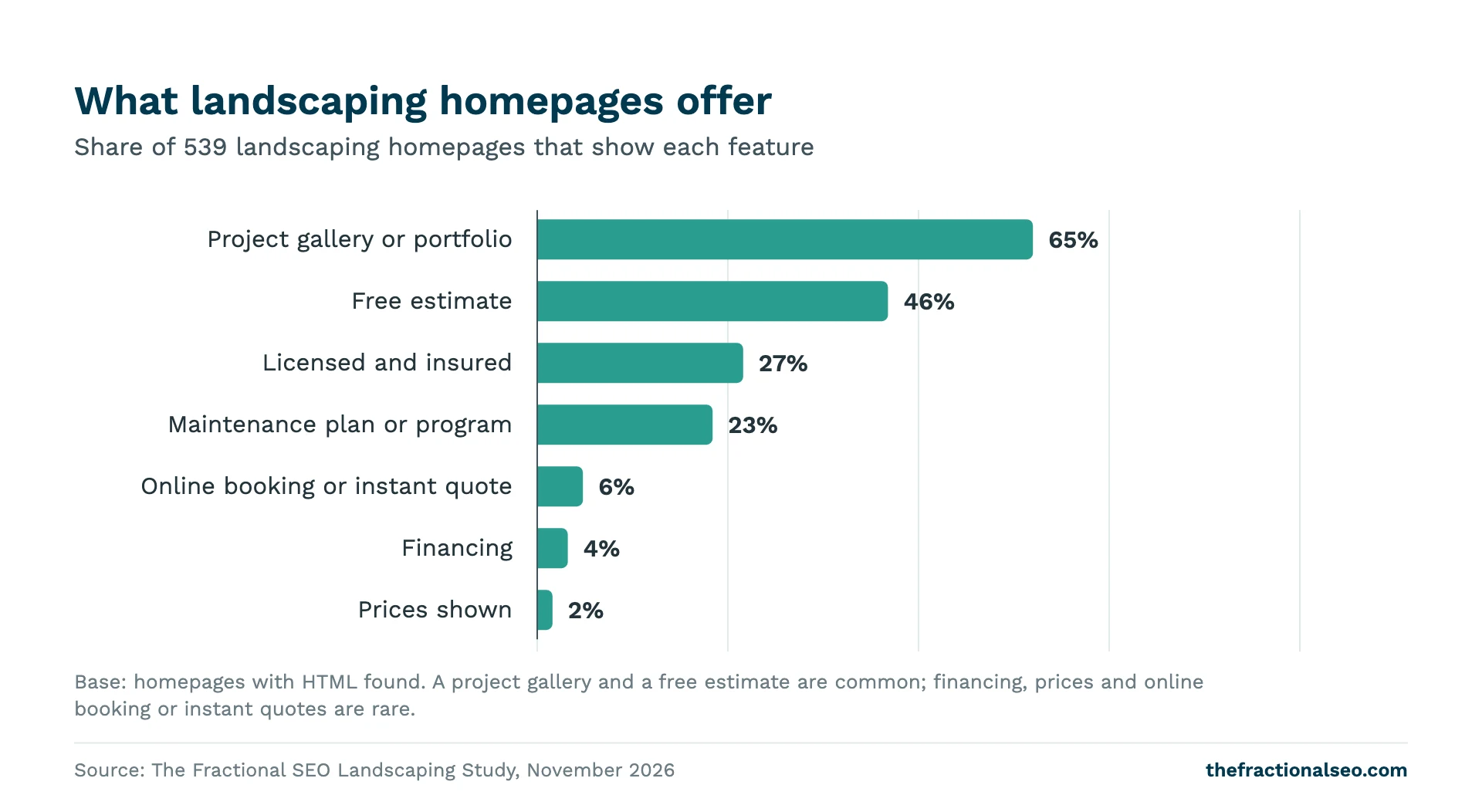
Yet people search for prices. 19 cost-related keyword groups total about 12,590 searches a month, led by “landscaping costs” (2,400), “sprinkler system cost” (1,900) and “sprinkler system repair cost” (1,600). Those are national Google Ads averages.
Does showing prices help a site rank? Not on this evidence: prices shown 4% vs 2% in the map-pack comparison and online booking or instant quote 6% vs 5%, both no clear difference. Treat prices as a way to win the lead. You don’t need a full price list. A “starting at” figure for mowing or a spring cleanup, or a page that explains what drives the cost of a patio or an irrigation system, answers the question the searcher is asking.
Gap 5: No LocalBusiness schema
48% of landscaping-company websites have LocalBusiness structured data (the LocalBusiness type or a more specific type such as HomeAndConstructionBusiness). Schema is code that tells search engines your business name, address, phone and hours in a form they can read.
It shows no clear ranking difference here: 55% vs 49% in the map-pack comparison, 47% vs 42% in organic results. Google’s LocalBusiness documentation says “Google does not guarantee that features that consume structured data will show up in search results.” It is a cheap basic to get right, not a lever. Many SEO plugins can add it; make sure the details match your Business Profile.
Gap 6: Reviews and basics left off the page
15% of landscaping-company websites show reviews through an embedded review widget. That shows no ranking difference (16% vs 16% in the map-pack comparison), but reviews near the quote form help a homeowner decide. Put a few where the decision gets made, not on a testimonials page nobody opens.
On-page basics are missing on a minority of landscaping sites: 33% lack a meta description on a quarter or more of their pages, 21% lack an H1 on a quarter or more, and 8% duplicate titles on a quarter or more. These are cheap to fix: a free crawler will list every page that is missing one.
Gap 7: No way to tell which calls came from the website
Marketing tags on landscaping homepages: Google Tag Manager 35%, GA4 37%, a Google Ads tag 14%, a Meta pixel 12%; call tracking 6% (CallRail 18 sites), HighLevel 4%, HubSpot 4%. Tags loaded only through Tag Manager don’t show in the page code we read, so the GA4, Ads and pixel shares are floors.
Call tracking is the one that matters most for a business that gets its work by phone. Without it, you can’t tell whether this spring’s calls came from the website, the Business Profile or the truck wrap. That is best practice, not study data, but it is how you find out whether any fix on this page paid off.
What landscaping websites already get right
Every crawled landscaping-company site uses HTTPS (537 of 537). 79% have a click-to-call phone link on the homepage. 65% of homepages show a project gallery or portfolio. WordPress runs 75% of landscaping sites where the platform could be identified, and Wix 12%: both let you edit pages and titles without a developer.
Every feature we compared
Here is every website feature in our two comparisons. The map-pack comparison sets businesses at positions 1-3 of the Google Maps list in any study search against those only at Maps positions 4-20. The organic comparison sets sites at positions 1-3 of the regular results against those at positions 4-10. “Strong” passed the correction, “weak” looked like a difference before it but not after, and “no clear difference” never looked like one.
| Website feature | Map pack 1-3 vs Maps 4-20 | Organic 1-3 vs 4-10 |
|---|---|---|
| Location pages | 65% vs 42% (p=2.6e-04, strong) | 63% vs 54% (p=0.43, no clear difference) |
| Service pages, count | median 11 vs 5 (p=3.0e-04, strong) | not reported |
| Blog | 58% vs 39% (p=0.0022, weak) | 61% vs 54% (p=0.56, no clear difference) |
| Any service page | 88% vs 73% (p=0.0031, weak) | 89% vs 86% (p=0.77, no clear difference) |
| Maintenance plan | 34% vs 22% (p=0.023, weak) | 37% vs 22% (p=0.12, no clear difference) |
| City in title | 72% vs 60% (p=0.046, weak) | 82% vs 70% (p=0.19, no clear difference) |
| LocalBusiness schema | 55% vs 49% (p=0.28, no clear difference) | 47% vs 42% (p=0.69, no clear difference) |
| Gallery | 71% vs 65% (p=0.31, no clear difference) | 66% vs 67% (p=1, no clear difference) |
| Free estimate | 48% vs 45% (p=0.63, no clear difference) | 50% vs 51% (p=1, no clear difference) |
| Prices shown | 4% vs 2% (p=0.44, no clear difference) | 3% vs 0% (p=0.31, no clear difference) |
| Online booking or instant quote | 6% vs 5% (p=0.79, no clear difference) | 8% vs 6% (p=0.71, no clear difference) |
| Homepage form | 43% vs 45% (p=0.81, no clear difference) | 53% vs 40% (p=0.24, no clear difference) |
| Licensed/insured | 24% vs 28% (p=0.5, no clear difference) | 26% vs 29% (p=0.83, no clear difference) |
| Click-to-call | 78% vs 78% (p=1, no clear difference) | 89% vs 81% (p=0.3, no clear difference) |
| Review widget | 16% vs 16% (p=1, no clear difference) | 5% vs 11% (p=0.5, no clear difference) |
| Financing | 4% vs 4% (p=1, no clear difference) | 3% vs 5% (p=1, no clear difference) |
| Mobile speed score | median 60 vs 61 (p=0.2, no clear difference) | median 54 vs 59 (p=0.31, no clear difference) |
Fisher exact tests (Mann-Whitney for counts and speed), Holm correction over all 59 comparison tests. Map pack: 83 vs 405 crawled sites (83 vs 407 homepages for homepage features). Organic: 38 vs 83 sites. Speed: 87 vs 417 and 38 vs 86 scored sites. The service-page count was compared in the map pack only.
Two things to keep in mind. The organic groups are small, so a missing edge there is weak evidence, and a missing edge anywhere is not proof of no effect. And as Google’s SEO Starter Guide puts it, “There are no secrets here that’ll automatically rank your site first in Google”. Every row above is a correlation. None shows what put a company where it ranks.
How to check your own site in 30 minutes
Open your website on your phone and set aside half an hour. The figures in brackets are from the study. The advice is best practice, not study data.
- Minutes 1-5, location pages. List the towns where you want work. Does each have its own page with real jobs and photos from that town? (47% of landscaping sites have any location pages.)
- Minutes 5-10, service pages. List every service you want to sell. Count how many have their own page. (Median among sites with service pages: 9.)
- Minutes 10-15, contact. Can you tap the number and fill in a short quote form without scrolling far? (Click-to-call on 79%, a homepage form on 45%.)
- Minutes 15-20, offers. Can a visitor see a starting price, your maintenance plan or program and recent project photos from the homepage? (Prices on 2% of homepages, a maintenance plan or program on 23%.)
- Minutes 20-25, blog and speed. Check the date of the newest blog post, then run the homepage through PageSpeed Insights on mobile. (10% of sites posted in the last 12 months; median LCP 8.4 seconds.)
- Minutes 25-30, titles and descriptions. Read your homepage title in the browser tab: does it name your service area? Run a free crawler and list pages with no meta description, no H1 or a duplicate title.
For a fuller pass, work through our local SEO checklist for landscaping companies.
FAQs
What are the most common SEO mistakes on landscaping websites?
Dead blogs, slow phone pages and missing offers top the list. 43% of landscaping-company sites have a blog, but only 10% published anything in the last 12 months. The median largest contentful paint on mobile is 8.4 seconds. Only 45% have a contact or quote form on the homepage, and 2% show prices.
Do location pages help a landscaping company rank?
They line up with the map pack: 65% of map-pack businesses’ sites have them vs 42% for businesses only seen at Maps positions 4-20, and that passes our correction. But map-pack companies also have bigger sites and more reviews, and the gap does not show in organic results. So location pages may mark an established company rather than cause the ranking. Build them for towns you really serve, with real local detail.
Does website speed affect landscaping company rankings?
Not in this sample. Map-pack sites score a median 60 on mobile vs 61 for the rest: no clear difference. That is not proof speed never matters, and most landscaping homepages are slow for visitors, with a median largest contentful paint of 8.4 seconds.
Do landscaping companies need a blog?
This data can’t show that a blog helps you rank. Map-pack sites are more likely to have one (58% vs 39%), but that lean fails the correction. Only 10% of landscaping sites posted anything in the last 12 months, so a blog kept up through the season is rare.
Should a landscaping company show prices on its website?
Consider it. Only 2% of homepages show prices, while 19 cost-related keyword groups total about 12,590 searches a month. Prices show no clear ranking difference, so treat them as a way to win the lead, not a ranking lever.
Want to know which of these your site is missing, and what is worth doing before spring? See how we work with landscaping companies.
More research & benchmarks
The whole Landscaping library- Google Reviews and Landscaping Rankings: What 582 Business Profiles Show Which parts of a landscaping company's Google review profile lean with the map pack, and how…
- Who Wins Local Landscaping Searches: A Benchmark of 45 Searches Who holds page one and the map pack when people search for a landscaper, a lawn…