
Guide Insurance
Insurance Agency Websites and Advertising Rules: License Numbers, Savings Claims and the Medicare Disclaimer
Your homepage advertises your agency, and insurance advertising has rules. We checked what independent agency homepages actually show. Only 22 of 306 show a producer license number, but 11 of the 30 Los Angeles agencies do. Of the 28 that say they sell Medicare plans, 7 show the CMS third-party marketing disclaimer on the homepage. And 40% make a savings or price claim. This guide sets each of those beside what the official rule text says, and is plain about what we could not read. It is not legal advice and not an audit of any agency.
We analyzed 36 local searches across 12 US metros and three insurance search types, 385 insurance agency and broker websites (337 crawled) and 390 Google Business Profiles, November 2026. The searches were collected on 19 November 2026, from one desktop search per query, so rankings and ads can differ by day, device and location, and the sites were crawled that month. That date fell inside Medicare’s fall Open Enrollment Period, which Medicare.gov gives as October 15-December 7. Everything below describes what homepage text says. It does not tell you whether any agency broke a rule, and we don’t say that any did. Rules differ by state, by product and by how you sell, so take the questions here to your state insurance department, your carriers and your compliance contact.
The short answer
- License numbers: 7% of independent-agency homepages show one. Whether yours must depends on your state. The California bulletin we read covers business cards, premium quotes and print ads, and does not mention websites.
- Medicare: federal rules name independent agents and brokers paid for Medicare marketing or enrollment as third-party marketing organizations, and say the disclaimer, for a TPMO that sells for more than one plan organization, is “Prominently displayed on TPMO websites.”
- Savings claims: common (40%) and not a violation by themselves. The rule texts we read bar untrue, deceptive or misleading statements.
- Quote forms: if a form leads to marketing calls or texts, read the federal consent definition. We did not measure consent wording.
- Carrier names: your carrier agreement sets how you may use them; New York adds a rule for ads that refer to an insurer.
- Reviews: never trade gifts or discounts for reviews.
What we checked on 336 homepages
We read the homepage text (and logo alt text, for carriers) of every agency site we could crawl, chains and carriers included. Across all 336 homepages:
- 62% say the agency is independent.
- 36% name the carriers they represent.
- 10% show a license number.
- 77% offer an online quote form or rater.
- 40% make a savings or price claim.
- 9% say they sell Medicare plans, and 2% show the CMS third-party marketing disclaimer.
To describe independent agencies on their own, the rest of this guide uses the 306 independent-agency homepages, with chains, carriers and State Farm template sites taken out. Each signal was found by a text pattern and hand-checked on a sample. A signal is what the homepage says, not what the agency does, and a license number or disclaimer on another page of the site is not counted.
| What the homepage shows | Independent-agency homepages (of 306) |
|---|---|
| Says the agency is independent | 200 (65%) |
| Names the carriers it represents | 112 (37%) |
| Online quote form or rater | 236 (77%) |
| Savings or price claim | 122 (40%) |
| Producer license number | 22 (7%) |
| Says it sells Medicare plans | 28 |
| CMS disclaimer, among those 28 | 7 (25%) |
License numbers
License numbers are rare on agency homepages: 22 of 306 independent-agency homepages (7%) show a producer license number. Los Angeles is the exception. 11 of the 30 Los Angeles agencies show one (37%), against 11 of the other 276 (4%). All 10 State Farm template sites (State Farm agents’ own domains on the carrier’s agent-site template) show one too, so a shared template can carry the number on every agent’s site.

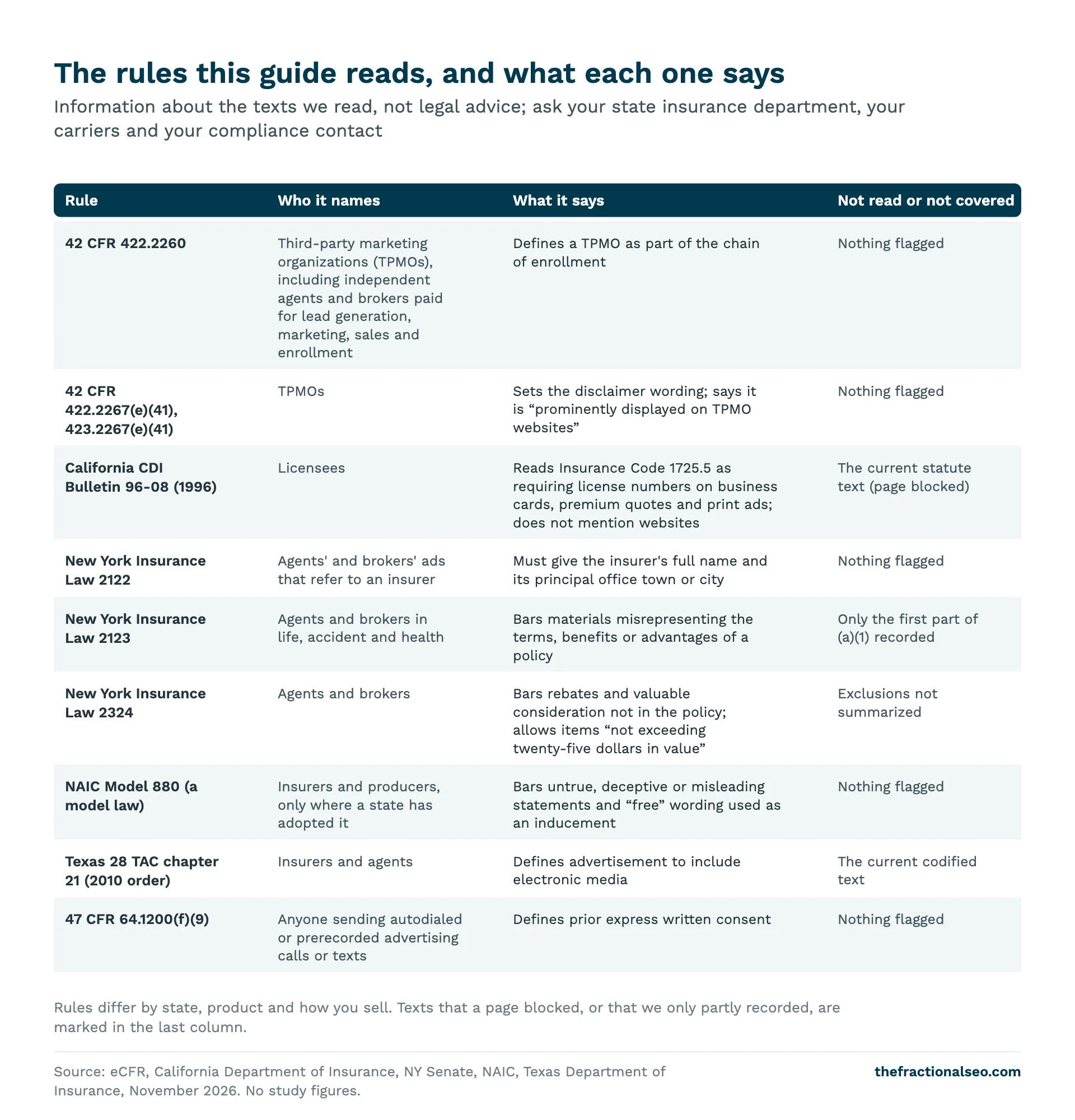
Why Los Angeles? We can only describe what we read. The California Department of Insurance’s Bulletin 96-08 says Insurance Code 1725.5 “requires licensees to include their license numbers on business cards, premium quotes and print advertisements for insurance products distributed exclusively in California.” The same bulletin says the Department reads “print advertisements” as “ads that consist of printed words on paper,” and that the number must be at least the same size as any address or phone number on the item. The bulletin is from 1996 and does not mention websites. We could not open the current statute text, so this guide does not say what California law requires on a website. California agencies should ask the Department.
Other states we read handle identification differently. New York’s Insurance Law 2122 is about the insurer, not your license: an agent’s or broker’s ads “which refer to an insurer” must give “the name in full of the insurer” and the city, town or village of its principal office. In Texas, the Department of Insurance’s 2010 adoption order for its advertising rules (28 TAC chapter 21) defines an advertisement to include “electronic media” of an insurer or agent, and treats web pages that don’t refer to a specific policy or offer a quote as institutional advertisements. That order is not the current codified text, so check the rule as it stands now.
If you are licensed in several states, the simplest page to keep current is one that lists your agency’s license numbers by state. Whether a state requires it on the homepage, in the footer or at all is a question for that state’s department.
The Medicare disclaimer (TPMO)
If you sell Medicare Advantage or Part D plans, read the federal definition first. 42 CFR 422.2260 defines a third-party marketing organization (TPMO) as “organizations and individuals, including independent agents and brokers, who are compensated to perform lead generation, marketing, sales, and enrollment related functions” as part of the chain of enrollment.
42 CFR 422.2267(e)(41) sets the disclaimer. Where a TPMO does not sell for every Medicare Advantage organization in the area, it reads:
“We do not offer every plan available in your area. Currently we represent [insert number of organizations] organizations which offer [insert number of plans] products in your area. Please contact Medicare.gov or 1-800-MEDICARE to get information on all of your options.”
A second version applies when the TPMO sells for every Medicare Advantage organization in the service area. The same section lists where the disclaimer goes: it is used by any TPMO that sells plans for more than one organization, it is verbally conveyed on sales calls before benefits are discussed, it is “Electronically conveyed” in email, online chat and other electronic communication, it is included in marketing materials, and it is “Prominently displayed on TPMO websites.” The Part D rule, 42 CFR 423.2267(e)(41), uses the same statements and the same website line.
Now the data. 28 of 306 independent-agency homepages say they sell Medicare plans, and 7 of those 28 (25%) show the disclaimer on the homepage. That group is small, because our searches used property-and-casualty and commercial wordings, so Medicare brokers only appear where Maps returned them. The disclaimer may also sit on other pages of a site, and whether a given agency needs it depends on what it sells and how.
If Medicare is part of your book, ask your plans and your compliance contact whether you are a TPMO, which version of the disclaimer applies and where they expect it on your site. Then apply that answer wherever your site mentions Medicare, and update the organization and plan counts when your appointments change.
Savings claims and the word “free”
Savings and price claims are common: 122 of 306 independent-agency homepages (40%) make one. We counted words such as “save”, “lowest” and “cheapest”. “Competitive” and “affordable” were not counted. A savings claim is not by itself a violation. The texts we read are about claims that mislead.
The NAIC’s Unfair Trade Practices Act (Model 880) is a model law. It binds an agency only where a state has adopted it, so treat it as a guide to how states tend to write these rules. Section 4A covers any statement or comparison that “Misrepresents the benefits, advantages, conditions, or terms of any policy.” Section 4B covers any “internet advertisement or posting” with a statement about the business of insurance “which is untrue, deceptive or misleading.” The model also says an insurer or producer may not offer insurance as an inducement to buy another policy “or otherwise use the words ‘free’, ‘no cost’ or words of similar import, in an advertisement.”
New York’s Insurance Law 2123 applies to agents and brokers in life, accident and health business. It bars any “illustration, circular, statement or memorandum misrepresenting the terms, benefits or advantages of any policy.”
In practice, a claim you can show is easier to keep. “We compare quotes from several carriers” describes what you do. “Save hundreds” or “the lowest rates in town” is a claim about results, and harder to support for every customer who reads it. If you use a savings line, ask your carriers and compliance contact what they need to support it.
Quote forms, calls and texts
236 of 306 independent-agency homepages (77%) offer an online quote form or rater, and 19 of those also show a license number. 72 homepages have a form that asks for a phone number, and 71 use reCAPTCHA. What we did not measure is whether those forms ask for consent to calls or texts. So this section tells you what the rule says, not how many agencies follow it.
The federal rule is 47 CFR 64.1200(f)(9). It defines prior express written consent as “an agreement, in writing, bearing the signature of the person called that clearly authorizes the seller” to deliver advertisements or telemarketing messages using an autodialer or an artificial or prerecorded voice, to the number the person gives. It also says the agreement must include a clear disclosure that the person “is not required to sign the agreement … as a condition of purchasing any property, goods, or services.”
You may have read about a 2023 “one-to-one” consent rule. The FCC’s Federal Register notice (90 FR 42137) says the Eleventh Circuit vacated that amendment, with the court’s mandate issued on April 30, 2025, and the FCC conformed its rules. The current (f)(9) text we read has no one-to-one language. If your form feeds a call or text campaign, have your compliance contact review the consent wording beside the submit button.
Naming carriers
Naming carriers is common but far from universal. 200 of 306 independent-agency homepages (65%) say the agency is independent, 112 (37%) name the carriers they represent, and 84 do both. There is search demand for carrier names: carrier-name “near me” searches total about 414,300 a month, and “state farm near me” alone is 135,000 (Google Ads via DataForSEO, November 2026).
That demand is not a license to use the names. An independent agency that appoints with a carrier may not be free to use the carrier’s name in its own marketing; its carrier agreement sets that. Check each agreement before you put a carrier name in a page title, an ad or a logo row. In New York, Insurance Law 2122 says an agent’s or broker’s ads that refer to an insurer must give the insurer’s full name and the city, town or village of its principal office, as above.
Reviews and rebating
Gifts for reviews can touch two sets of rules. New York’s Insurance Law 2324 bars agents and brokers from offering the insured any rebate from the premium, or other valuable consideration not specified in the policy, “either as an inducement to the making of insurance or after insurance has been effected.” It allows items “not exceeding twenty-five dollars in value”, but read the full section, including its exclusions, before relying on that. The NAIC model has a rebating section too.
Google is plainer. Its review help page says offering incentives “like free or discounted goods or services” in exchange for reviews is “strictly prohibited”, and its Maps content policy lists payment, discounts and free goods. So ask every client for a review, make it easy with a link, and give nothing for it. Our research on Google reviews and insurance agency rankings shows why a steady flow of new reviews is worth that effort.
Where SEO and the rules meet
None of these signals made a clear difference to who reached the map pack: license numbers, the Medicare disclaimer and savings claims all showed no clear difference between sites of Maps-found agencies in the pack and the rest. Compliance is not a ranking tactic. It is part of a site that is accurate.
Where SEO helps is in the pages themselves. A site that is easy to keep current makes the rules easier to follow:
- A licenses page listing your agency’s license numbers by state, linked from the footer.
- A carriers page you update when appointments change, within what your agreements allow.
- A Medicare page with the disclaimer your plans and compliance contact tell you to use, and the counts kept current.
- Product pages that describe coverage as the policy does, with savings lines you can support.
- Quote forms whose consent wording has been reviewed, on every page that carries them.
More on what agency sites leave out is in our study of 337 insurance agency websites. For the full plan, see our guide to local SEO for insurance agencies, and work through the local SEO checklist for insurance agencies, which keeps these rules in their own block.
Want a website that is easier to keep accurate and easier to find? Talk to us about SEO for insurance agencies.
FAQs
Do insurance agents have to put their license number on their website?
It depends on the state, and on what the page is. Only 7% of independent-agency homepages we checked show one, with Los Angeles far higher. The California bulletin we read covers business cards, premium quotes and print ads and does not mention websites. Ask your state insurance department.
Do independent agents need the Medicare disclaimer on their website?
The federal definition of a TPMO names independent agents and brokers who are paid for Medicare marketing, sales or enrollment, and the disclaimer rule says it is prominently displayed on TPMO websites. Whether that covers you depends on what you sell and how; ask your plans and compliance contact.
Can an insurance agency advertise savings?
40% of the homepages we checked do. The texts we read target untrue, deceptive or misleading statements, and the NAIC model restricts “free” and “no cost” wording used as an inducement. Use claims you can support.
Can I offer a gift card for a Google review?
No. Google prohibits incentives for reviews, and state anti-rebating laws such as New York’s limit what agents may give clients. Ask without offering anything.
Sources
- TFS Insurance study, November 2026: our study of 337 insurance agency websites
- eCFR, 42 CFR 422.2260, definitions
- eCFR, 42 CFR 422.2267, required materials and content
- eCFR, 42 CFR 423.2267, required materials and content (Part D)
- Medicare.gov, Joining a plan
- California Department of Insurance, Bulletin 96-08
- New York Insurance Law 2122, 2123 and 2324
- NAIC Unfair Trade Practices Act (Model 880)
- Texas Department of Insurance, 2010 adoption order, 28 TAC chapter 21
- eCFR, 47 CFR 64.1200
- Federal Register, 90 FR 42137
- Google Business Profile Help, Tips to get more reviews
- Google Maps User Generated Content Policy, Prohibited and restricted content