
Research & Benchmark Healthcare
Who Wins Local Healthcare Searches: Health Systems, Chains and Independent Clinics in 27 Searches
A patient types "urgent care" and the name of their city into Google. Who do they see? Often a hospital system, sometimes a clinic chain, and in the map pack, more often than you might think, an independent clinic. We analyzed 27 local searches across 9 US metros and three clinic types (urgent care, primary care and dermatology), 301 provider websites (261 crawled) and 534 Google Business Profiles, November 2026. This page is about search: who holds page one and the map pack, split by health systems, company chains, the one franchise brand and independent clinics, and how urgent care, primary care and dermatology differ. If you came for patient-behavior or market-size statistics, this isn't that report.
The healthcare local search statistics pages that rank today repeat other people’s numbers about lead sources and click rates. None we could read looked at the results page itself: who a patient actually sees when they search for a clinic in their city.
We ran these searches once, on 17 November 2026, so treat rankings as a snapshot: they move from week to week. Healthcare search is fairly steady through the year. Google Trends interest in “urgent care” peaks in January at about 1.4 times its April low, so a November snapshot is not an off-season one.
Key findings
- Providers hold most of page one, but not all. 59% of page-one organic results for local healthcare searches go to clinics’ and health systems’ own websites; the other 41% go to directories, health-information and city-guide sites, social sites and insurers.
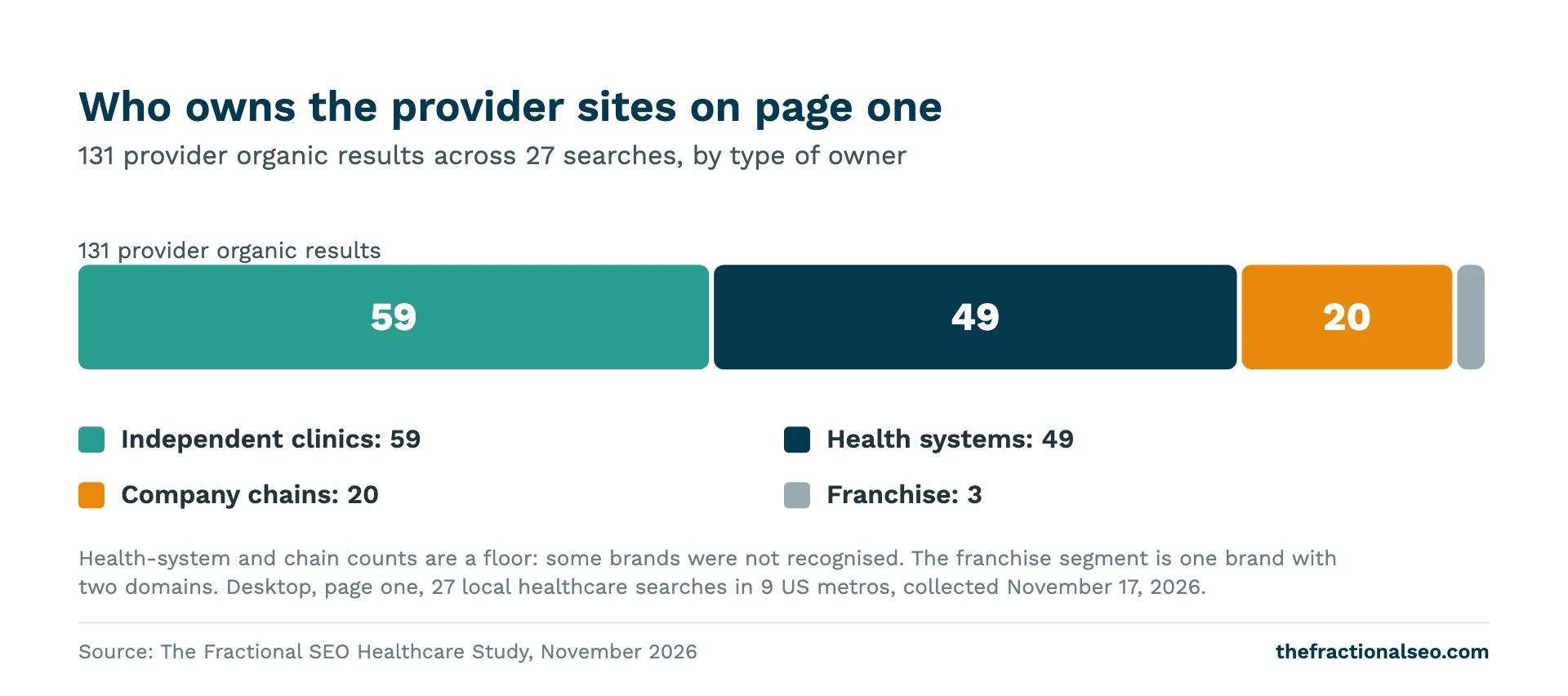
- Health systems punch far above their numbers. They are a tenth of the providers in the study (30 of 301 websites) but hold 49 of 131 provider organic results (37%) and 9 of the 27 #1 organic spots.
- Independents still hold the map pack. Independent clinics hold 50 of 81 map-pack spots (62%), and 24 of 27 on dermatology searches.
- Chains are an urgent care story. Company chains and the one franchise brand hold 9 of the 27 urgent care map-pack spots, none in primary care and 3 in dermatology.
- Two different races. 38% of map-pack listings with a website also rank on page one organically for the same search.
The website side of the same study is in the SEO gaps most clinic websites leave open.
Who holds page one
Across the 27 searches we recorded 223 organic results on page one. 131 of them were provider websites: clinics’ and health systems’ own sites. Directories took 66, city guides and media 13, social sites 9 and insurers 2. In our HVAC study, contractor sites held 53% of page one; here providers hold 59%.
The split changes by clinic type. Dermatology searches give providers the least of page one (47%), primary care the most (73%); urgent care 55%. In counts: 34 of 72 results on dermatology searches, 56 of 77 on primary care and 41 of 74 on urgent care.
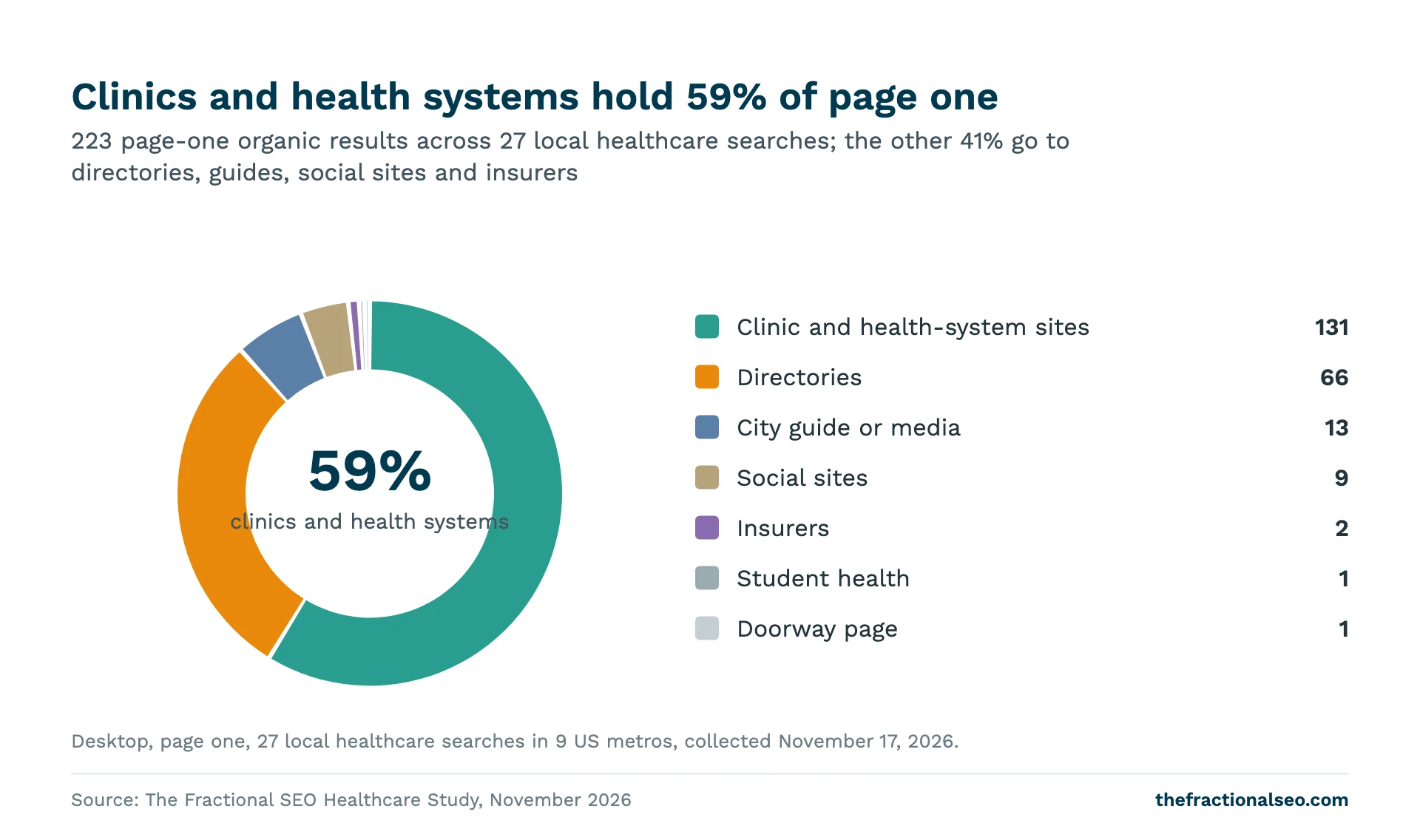
The top spot is less certain. A site that is not a provider holds the #1 organic spot in 12 of 27 local healthcare searches (44%), and 40% of all top-3 organic spots. Directories took 9 of those 12. Of the 15 #1 spots that go to a provider, 9 are health systems, 2 company chains and 4 independent clinics.
The study shows who appears, not why. But it does show where the competition sits, and it is not the same in each clinic type.
Four kinds of provider
We sorted all 301 provider websites into four groups and report them separately throughout:
- Health systems: hospital and health-system programs, including their physician groups and urgent care brands. 30 domains.
- Company chains: one clinic brand operating in more than one metro. 23 domains.
- Franchise: AFC Urgent Care, the only franchise brand in the study. 2 domains.
- Independent clinics: everyone else. 246 domains.
Where we couldn’t read a chain-check page, the site kept its first-pass label, so the chain and health-system counts are a floor. The real numbers may be a little higher.
Health systems: a tenth of providers, over a third of provider results
Health systems are a tenth of the providers in the study (30 of 301 websites) but hold 49 of 131 provider organic results (37%) and 9 of the 27 #1 organic spots. In the map pack they hold 17 of 81 spots, and 101 of the 540 Maps rows.
Their weight differs by clinic type. Primary care searches give them 26 of 56 provider organic results and 9 of 27 map-pack spots. Urgent care gives them 16 of 41 and 8 of 27. Dermatology gives them 7 of 34 and none of the 27 pack spots. In the Maps lists they fill 62 of 180 primary care rows, 34 urgent care rows and only 5 dermatology rows.
The 30 domains include Kaiser Permanente, Northwestern Medicine, Atrium Health, Novant Health, Vanderbilt University Medical Center, Cedars-Sinai, Baylor Scott & White Health and UT Southwestern Medical Center. Hospital physician-group and urgent care brands count as health systems here.
Part of what you see is how their sites are built: a health-system site covers many locations and services on one domain, so that one domain can show up in search after search. An independent clinic can’t match a hospital site’s size. It can compete where health systems are thin, which on this data means dermatology, and in the map pack, where Google weighs distance to the searcher.
Company chains and the franchise
Company-owned clinic chains and the one franchise brand are an urgent care story: 9 of the 27 urgent care map-pack spots and 75 of 180 urgent care Maps rows, against 0 primary care and 3 dermatology pack spots. Across all searches, 25 chain websites (8%) hold 12 of 81 pack spots and 23 of 131 provider organic results.
Split by type of chain:
- Company chains (23 domains) hold 10 pack spots (7 on urgent care, 3 on dermatology), 20 provider organic results and 104 Maps rows. Brands in the study include CareNow (HCA), CityMD (Summit Health), Concentra, FastMed, GoHealth Urgent Care, MinuteClinic (CVS), One Medical, Oak Street Health, Forefront Dermatology, U.S. Dermatology Partners and Schweiger Dermatology Group.
- The franchise, AFC Urgent Care (2 domains), holds 2 pack spots, both on urgent care, 3 provider organic results and 8 Maps rows.
Patients search for some of these brands by name. Nationally, “minute clinic” has 135,000 searches a month, “forefront dermatology” 110,000 and “afc urgent care” 90,500. Those are brand names as search terms, not endorsements, and a clinic only competes for its local share.
Independent clinics hold the map pack
Independent clinics still hold most map-pack spots: 50 of 81 (62%), and 24 of 27 on dermatology searches, 16 of 27 on primary care, 10 of 27 on urgent care. They also hold the #1 pack spot on all 9 dermatology searches, 7 of 9 primary care searches and 5 of 9 urgent care searches.
Organically it’s a different picture. Independents hold 59 of 131 provider results (45%) but only 4 of the 27 #1 spots.
| Map-pack spots (27 per clinic type) | Health system | Company chain | Franchise | Independent |
|---|---|---|---|---|
| Urgent care | 8 | 7 | 2 | 10 |
| Primary care | 9 | 0 | 0 | 16 |
| Dermatology | 0 | 3 | 0 | 24 |
| All 81 spots | 17 | 10 | 2 | 50 |
Two primary care pack listings had no website link, which is why that row adds up to 25.
Three clinic types, three markets
Urgent care
Providers hold 55% of page one. This is where chains and the franchise are strongest, with 9 of 27 pack spots, and health systems hold 8 more, leaving independents 10. Urgent care searches add urgent-care finder sites to the usual directories; Yelp appeared 11 times. The median “urgent care <city>” search gets 3,600 searches a month. An AI Overview appeared on 2 of 9.
Primary care
Providers hold the most of page one here, 73%, but health systems take 26 of the 56 provider results and 9 of 27 pack spots. Zocdoc shows up on primary care searches more than anywhere else (4 of its 5 results). Both pack listings with no website were on primary care searches, and so were all 5 keyword-named Maps listings with few reviews, none of which reached a pack. The median search gets 1,000 searches a month, and AI Overviews appeared on 4 of 9, the most of the three.
Dermatology
Dermatology gives providers the least of page one (47%): directories spread across Yelp, Practo, MapQuest, Healthgrades, Solv and WebMD. But the map pack belongs to independents, with 24 of 27 spots and every #1 spot. Health systems hold none. The median “dermatologist <city>” search is the biggest of the three, 5,400 a month, and AI Overviews appeared on 3 of 9.
Big metros vs small metros
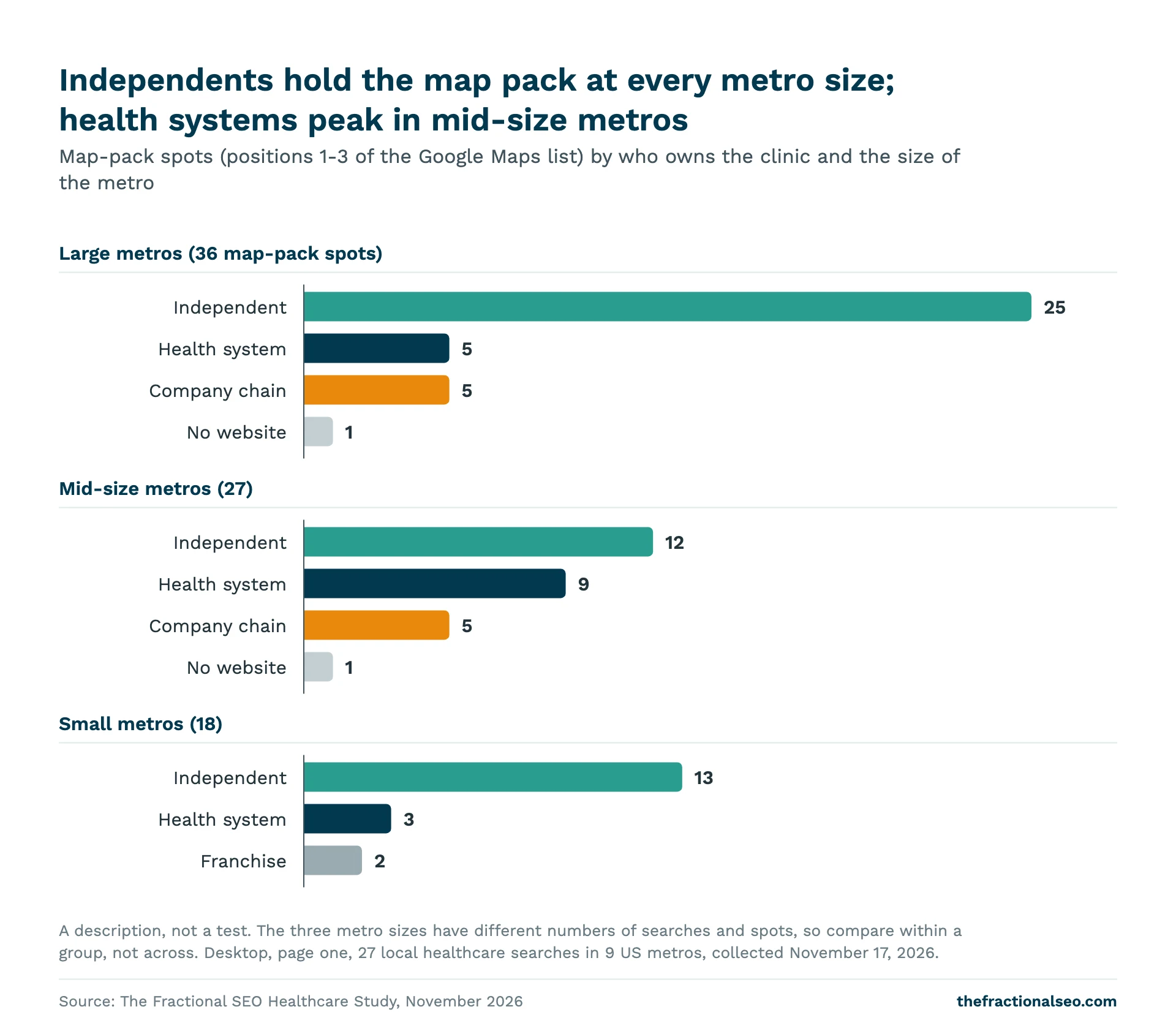
Share of page one that is provider websites, by metro size: large metros 42%; mid metros 78%; small metros 65%. In the four large metros directories and other sites take most of page one; in mid-size and small metros providers hold two-thirds or more.
The map pack shifts too. In large metros independents hold 25 of 36 spots, with health systems and chains 5 each. In mid metros independents hold 12 of 27 and health systems 9. In small metros independents hold 13 of 18, health systems 3 and the franchise 2. With only two small metros, these are descriptions, not tested differences.
The directories on page one
The sites clinics compete with most on page one: Yelp (24 results), Facebook (9), Zocdoc (5), Healthgrades (4), MapQuest (4), Practo (4) and Solv (3). The counts are appearances across 27 searches, so small numbers per site. Each clinic type has its own mix, as the section above shows.
For what each directory offers clinics, see Yelp, Zocdoc, Healthgrades and the other directories.
Map pack and organic are two different races
The map pack and the organic results are mostly different providers: 38% of map-pack listings with a website also rank on page one organically for the same search. In HVAC it was 16%. Health systems raise the overlap here, because one domain covers many locations.
Almost every provider in the map pack shows a website: 2 of 81 map-pack listings had no website link (17 of 540 across Maps positions 1-20).
Google says local results are mainly based on relevance, distance and popularity, and that prominence draws on things like links and reviews. In our data, providers that reached a map pack have far more Google reviews: a median of 794 vs 317 for those seen only at Maps positions 4-20. That’s a correlation, not a cause; the detail is in what 534 Business Profiles show about reviews, and the plan for each race is in our local SEO plan for each clinic type.
What sits above the organic results
Every search showed a map pack, and 5 of 27 showed four or more pack listings. AI Overviews appeared on 9 of 27 searches (33%): 4 of 9 primary care, 3 of 9 dermatology and 2 of 9 urgent care. AI Overviews vary by session and day, so read these as one day’s count.
Paid results were thin on the day we searched: text ads on 5 of 27 searches (3 urgent care, 2 dermatology, none on primary care) and Local Services Ads on none. Only 9% of provider domains show any paid search activity in DataForSEO’s estimate. This is one desktop collection per search, and ads rotate, so don’t read it as a permanent gap.
What patients search and what a click costs
Google’s planner figures for the study searches, median across the 9 metros: “urgent care <city>” 3,600 searches a month at $4.64; “primary care doctor <city>” 1,000 at $10.18; “dermatologist <city>” 5,400 at $9.86. Primary care and dermatology clicks cost about twice what urgent care clicks do. These are advertiser bid estimates, not what a click costs a clinic.
Estimated traffic by provider group
The typical independent clinic site gets an estimated 1,446 organic visits a month: urgent care 2,331, dermatology 1,769 and primary care 738. Across all 301 provider domains the median is 2,134.
Health-system and chain domains have estimated medians of 130,186 and 124,938. Don’t compare those with your own site: they are whole hospital or multi-location sites covering many services, not one clinic. All of these are DataForSEO’s modeled estimates, not measured visits.
What this means for independent clinics
- Dermatology: the map pack is held by independents, and health systems are nearly absent. Page one is crowded with directories, so the pack is where an independent practice is most visible.
- Primary care: expect health systems on page one and in the pack. Independents still hold 16 of 27 pack spots, so the pack is open; organic page one is harder.
- Urgent care: independents share the pack with chains, the franchise and health systems. This is the most crowded of the three.
- Everyone: treat the map pack and organic results as separate jobs, and check your own Business Profile against our Google Business Profile checklist for clinics.
For what clinic websites in the same study get right and wrong, see the SEO gaps most clinic websites leave open.
How we did this
We analyzed 27 local searches across 9 US metros and three clinic types (urgent care, primary care and dermatology), 301 provider websites (261 crawled) and 534 Google Business Profiles, November 2026.
Searches were “urgent care”, “primary care doctor” and “dermatologist”, each followed by a metro: New York, Los Angeles, Chicago and Dallas (large); Charlotte, Nashville and Austin (mid); Boise and Knoxville (small). We recorded page one on desktop through SerpAPI on 17 November 2026, plus the Google Maps list for each search: 540 Maps rows, positions 1-20. The map pack is positions 1-3 of that list, 81 spots, 27 per clinic type.
Groups: health system (30 domains), company chain (23), franchise (AFC Urgent Care, 2) and independent (246). Chain and health-system counts are a floor. Traffic is DataForSEO Labs’ modeled estimate; volumes and bids are Google Ads planner figures.
What it can’t claim: why anyone ranks, or anything about patients, appointments or revenue. It is one snapshot per search, organic page one moves day to day, and results vary by searcher location. With 9 searches per clinic type, differences are described, not tested.
Questions, answered
Why do health systems rank so well organically?
We measured who ranks, not why. A health-system domain covers many locations and services, so it appears on many searches. Google says prominence draws on links and reviews.
Can an independent clinic still reach the map pack?
Yes. Independent clinics hold 50 of 81 map-pack spots (62%), including 24 of 27 on dermatology searches.
Do chains dominate urgent care searches?
They hold a third of the urgent care map pack: company chains 7 of 27 spots and the franchise 2. Independents hold 10 and health systems 8.
Is the map pack the same as the organic results?
Mostly not. 38% of map-pack listings with a website also rank on page one organically for the same search.
How much organic traffic does a typical independent clinic site get?
An estimated 1,446 visits a month at the median, from 738 in primary care to 2,331 in urgent care. These are modeled estimates.
Want to see where your clinic sits against these benchmarks in your own city? See how we approach SEO for urgent care, primary care and dermatology clinics.
More research & benchmarks
The whole Healthcare library- We Analyzed 261 Clinic Websites: The SEO Gaps Most Clinics Leave Open Seven common gaps on clinic websites, measured across 261 urgent care, primary care and dermatology sites,…
- Google Reviews and Clinic Rankings: What 534 Business Profiles Show Which parts of a clinic's Google review profile lean with the map pack, by clinic type…