
Research & Benchmark Healthcare
We Analyzed 261 Clinic Websites: The SEO Gaps Most Clinics Leave Open
Most lists of medical SEO mistakes are written by someone selling the fix, and few have a number behind them. We wanted numbers. We analyzed 27 local searches across 9 US metros and three clinic types (urgent care, primary care and dermatology), 301 provider websites (261 crawled) and 534 Google Business Profiles, November 2026. First we counted how often each common gap shows up on clinic websites. Then we checked which website features separate the clinics Google puts at the top, in the map pack and in the regular results, from the ones below them. The plain answer: once you correct for the number of tests, no website feature does. Two lean that way and are worth having. Links separate the top organic results and reviews separate the map pack, but both sit off the website. The gaps are still real, and they are cheap to close. Here is how common each one is, by clinic type where the types differ, and what we would fix first.
This study looks at clinic websites. For the other half of the picture, who shows up when a patient searches and how health systems, company chains, the one franchise brand and independent clinics split page one, read who wins local healthcare searches. To see how we work with clinics, start with fractional SEO for healthcare clinics. We ran these searches once, on 17 November 2026, so treat rankings as a snapshot: they move from week to week. The sample, dates and limits are in the Method card on this page.
Key findings at a glance
- No website feature separates the map pack. Location pages and review widgets lean that way but fail the correction for the number of tests. The top-ranked groups are small, so read it as no clear difference, not proof of no effect.
- Links separate the top organic results: a median of 2,016 referring domains for top-3 sites vs 298 at positions 4-10, and 441 vs 117 for independent clinics alone.
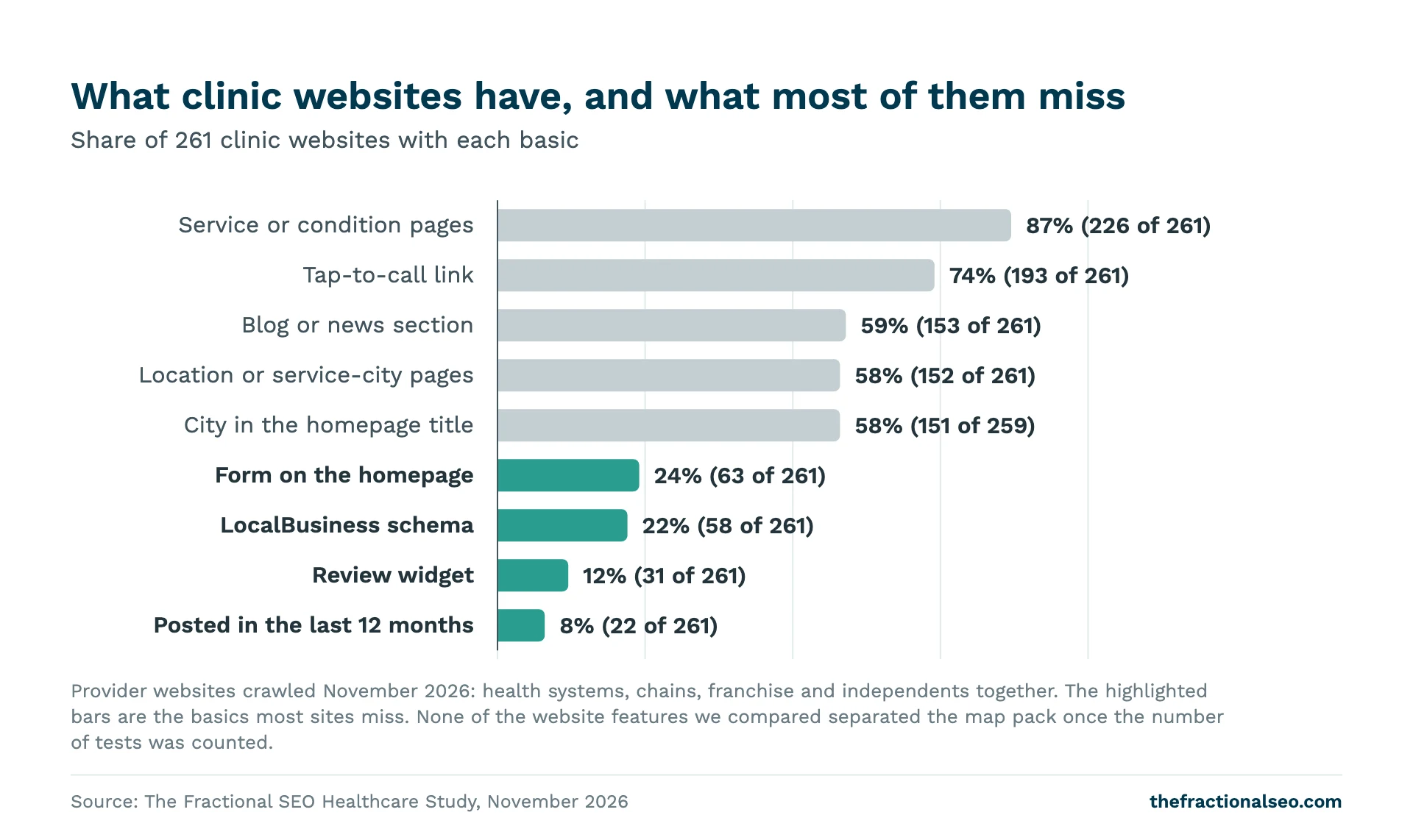
- Forms and schema are rare: 24% have a form on the homepage and 22% mark up the business with LocalBusiness-type schema.
- Blogs go quiet: 59% of provider sites have a blog or news section, but only 8% posted in the 12 months before the crawl.
- Phones wait: the median Largest Contentful Paint is 6.8 seconds, and 11% load their largest element within Google’s 2.5-second “good” threshold.
- Ad pixels split the field: none of 22 health-system homepages loads an ad pixel, against 46 of 222 independent clinics (21%).
No website feature separates the map pack
We ran two comparisons. The map-pack comparison sets providers that reached positions 1-3 of the Google Maps list in any study search against those seen only at Maps positions 4-20: 57 sites against 173. The organic comparison sets provider sites in the top 3 regular results against those at positions 4-10: 32 against 51.
Across both we tested eight website features: tap-to-call, a homepage form, a review widget, LocalBusiness-type schema, the city in the homepage title, a blog, location pages and service pages. When a study runs 59 tests, a few will look meaningful by luck, so we applied a standard correction (Holm) that raises the bar for each one. No website feature separates map-pack providers once the number of tests is corrected for.
Two come closest. Location or service-in-city pages are on 68% of map-pack providers’ sites vs 53%, and on 94% of top-3 organic sites vs 65% at positions 4-10. Review widgets are on 23% vs 10% in the map-pack comparison. Both are leans that fail the correction. With independents alone, the map-pack lean on location pages fades (61% vs 50%). Top-ranked sites are also bigger (indexable pages, median 315.5 vs 101 in organic results), and health systems’ location directories drive much of the gap.
Speed is no different. Speed does not separate map-pack providers: median score 63.5 vs 63. Top-3 organic sites are slower, not faster (LCP 9.9 s vs 6.3 s, a weak result).
Read this with care. The groups are small, so a real but modest edge can hide in them. The right reading is “no clear difference in this sample”, not “these things don’t matter”. What the data does not support is the pitch that one website fix will lift a clinic past the ones above it.
The clearer map-pack differences sit on the Google profile. Providers that reached a map pack have a median of 794 Google reviews vs 317 for those seen only at Maps positions 4-20, and they got more new reviews in the 90 days before collection: a median of 39 vs 15. Both survive the correction and hold for independent clinics alone. By clinic type, the review gap is clear on its own only in dermatology; urgent care and primary care point the same way in groups too small to pass alone. We collected each profile’s newest 40 reviews, so the map-pack median of 39 sits near that cap and the real gap is likely larger. These are correlations, and established clinics tend to have more of everything. They line up with Google’s local ranking guidance, which says prominence is also based on info like how many websites link to your business and how many reviews you have. The profile side is in what 534 Business Profiles show about reviews and our Google Business Profile checklist for clinics.
Gap 1: No way to ask for a visit on the homepage
24% of provider sites have a form on the homepage, and 74% have a tap-to-call link. A homepage form may be a contact or appointment-request form. Online booking is more common: 51% of homepages mention it. By clinic type, that is 42 of 66 urgent care homepages, 48 of 100 primary care homepages and 56 of 119 dermatology homepages.
Neither a form nor tap-to-call shows a ranking edge. A homepage form is on 21% of map-pack sites vs 26%, and 13% vs 24% in organic results. Tap-to-call is on 67% vs 75%, and 63% vs 67%. These are patient questions, not ranking levers.
Our view, not study data: the homepage should let a patient take the next step without hunting for it. For urgent care that is check-in or the walk-in hours. For primary care and dermatology it is a booking link or an appointment request near the top of the page, plus a phone number that is tappable on a phone. One rule for every clinic type: a homepage form should not ask for symptoms or other health details unless the form tool is built for health information and the vendor will sign a business associate agreement. Check with your privacy or compliance counsel before you add fields. The tools we found on clinic homepages are in patient booking, messaging and review software.
Gap 2: No LocalBusiness schema
22% of provider sites mark up the business with LocalBusiness-type schema: LocalBusiness itself or a subtype such as MedicalClinic, Physician or MedicalBusiness. It is code that states your name, address, phone and hours in a format search engines read directly.
It shows no clear difference in rankings: 25% of map-pack sites vs 23%, and 25% vs 14% in organic results. Google’s LocalBusiness documentation also says Google does not guarantee that features that consume structured data will show up in search results. Add it because it is cheap and keeps your details consistent, and use the subtype that fits the clinic. Don’t expect it to move your listing.
Gap 3: A blog or news section nobody updates
59% of provider sites have a blog or news section, but only 8% posted in the 12 months before the crawl and 4% posted at least monthly. Among independent clinics, 129 of 222 have a blog and 19 posted in the 12 months; among health systems, 13 of 22 have one and 1 posted. We read post dates from crawled pages, capped at 500 URLs per site, so a large site may hide some posts. Health-information libraries that are not dated posts do not count as posts.
Having a blog shows no clear difference: 61% of map-pack sites vs 56%, and in organic results 53% of top-3 sites vs 73% at positions 4-10. This is not evidence that blogging gets a clinic into the map pack.
What a dead blog does, in our view, is make the site look unattended. If you can’t post at least monthly, take “Blog” or “News” out of the main menu. If you do post, answer the questions your front desk hears every week: holiday hours, which insurance plans you take, what to bring to a first visit, how check-in works, how a cosmetic dermatology visit differs from a medical one. Anything about symptoms or treatment should be written or reviewed by your own clinicians.
Gap 4: Slow pages on a phone
Provider sites are slow on mobile: the median PageSpeed performance score is 63, the median Largest Contentful Paint is 6.8 seconds, and 11% load their largest element within Google’s 2.5-second “good” threshold. Health-system sites score lowest (median 47), independents highest (65). Company chains score a median of 52. Lab scores vary run to run by several points, so one score is noisy; the pattern across 293 scored provider homepages is not.
On real-user data, 66% of the provider sites Google has enough Chrome visits for pass Core Web Vitals; 62% have any field data. Only busier sites get field data, so that pass rate describes them, not the small clinic site.
Speed showed no clear difference in rankings. Core Web Vitals pass rates even lean the other way in the map-pack comparison (56% vs 75%), a lean that fails the correction. Health systems run slow, heavy sites and still rank well organically for other reasons, links among them. That is not proof that speed never matters. The reason to fix it is the patient in a parking lot with a phone, deciding whether to wait for your page or tap the next result.
Our view, not study data: the usual weight on a clinic homepage is a large hero photo or slider, a chat widget and more than one booking or review script loading before the page is usable. Size images to the width they display at, use WebP, load below-the-fold images lazily, and load third-party widgets after the main content.
Gap 5: Location and service pages that say little
58% of provider sites have location pages or service-in-city pages (median 6 among those with any), 87% have service or condition pages (median 19.5), and 58% name their city in the homepage title. These are counts of URL patterns, and condition pages count as service pages.
Location pages are the nearest thing to a website edge in this study, and still a lean that fails the correction. Among independent clinics alone, 12 of 13 top-3 organic sites have location pages vs 19 of 35 at positions 4-10, a check outside the main correction set on very small groups. Worth having; not a ranking factor on this evidence.
The gap is less about having pages than about what is on them. A location page that swaps the city name into the same paragraph tells a patient nothing. Our view of what each type needs: for urgent care, a page per clinic with hours, address, parking, check-in and what the clinic treats as your clinicians describe it; for primary care, a page per office with the insurance plans taken and whether it is accepting new patients; for dermatology, separate medical and cosmetic service pages, since patients search them differently. Our local SEO guide for urgent care, primary care and dermatology clinics covers how to plan the set.
Gap 6: Homepages that skip what patients ask first
What provider homepages tell patients: a clinician credential or board certification (65%), online booking (51%), insurance accepted or named (41%), telehealth (34%), walk-ins or same-day care (32%), accepting new patients (12%), Spanish spoken (10%), any price (8%), self-pay prices (8%) and a wait time (4%). The mix follows the clinic type: walk-ins on 67% of urgent care homepages, cosmetic services on 87% of dermatology homepages, “accepting new patients” on 18% of primary care homepages. The credential share differs too: 30% of urgent care homepages, 53% of primary care and 85% of dermatology.
Read each as “the homepage mentions it”: a menu label or a disclaimer can match. No homepage signal separates map-pack providers. So this is a patient gap, not a ranking gap.
Our view: put the answer to the first question near the top. For urgent care, that is whether a patient can walk in now and what it costs without insurance. Only 10 of 66 urgent care homepages show any price, and 8 show a wait time. For primary care, it is whether you are taking new patients and which insurance plans you accept. For dermatology, it is whether you see medical patients as well as cosmetic ones.
Gap 7: Reviews and on-page basics left off the site
12% of provider sites show a review widget. In the map-pack comparison it is one of the two leans (23% vs 10%) and fails the correction. Your reviews are still your best sales copy. If you show them on the site, show reviews only, and keep replies on Google free of anything that confirms the reviewer is a patient. The Business Profile checklist covers replies.
Every crawled provider site uses HTTPS. 31% are missing meta descriptions on a quarter or more of their pages, 16% are missing H1s on a quarter or more, and 7% have duplicate titles on a quarter or more. A crawler lists every page missing one.
58% name their city in the homepage title. It shows no clear difference: 58% of map-pack sites vs 61%, and 34% vs 51% in organic results. Put the city or neighborhood in the title anyway: it tells a patient you are near them.
Links: the clear difference in organic results
Sites in the top 3 organic results have far more links: a median of 2,016 referring domains vs 298 for sites at positions 4-10, and a higher domain rank (344 vs 203.5). Both survive the correction, and the gap holds for independent clinics alone (441 vs 117 referring domains). That independents-only check is small: 14 sites against 38.
Health systems explain part of it. They are 15 of the 35 top-3 domains, with whole hospital sites behind them: a median of 5,149 referring domains, against 159 for independent clinics. Their estimated traffic is on another scale too (a median of 130,186 organic visits a month, estimated, vs 1,446 for the typical independent clinic site), but a hospital domain is not comparable to a clinic site, so don’t measure yourself against it. Independents hold 14 of the top-3 domains, which shows the top 3 is not closed to them.
In the map pack, links matter less: map-pack providers have a median of 297 referring domains vs 166, a lean that fails the correction. For the map pack, reviews are the clearer marker.
Best practice, not study data: the links a clinic can earn are local and specific. Think local news coverage of a new location or extended hours, community health events, school and youth sports partnerships, the chamber of commerce, and the hospital or medical group pages that list affiliated practices.
Ad pixels: where independent clinics differ from health systems
18% of provider homepages load at least one advertising pixel: Google Ads (32), the Meta pixel (21), Microsoft Bing UET (5), TikTok (2) or LinkedIn Insight (2). Google Analytics 4 or Google Tag Manager is on 66%.
Advertising pixels are an independent-clinic habit. None of 22 health-system homepages loads an ad pixel, and 1 of 17 chain and franchise homepages does, against 46 of 222 independent clinics (21%). Not one health-system or chain homepage loads the Meta pixel; 21 independent homepages do. That is a large difference in small groups, checked outside the main correction set. Large organisations may also load tags through server-side or consent tools our scan cannot see, and the data does not show why any site added or removed a pixel.
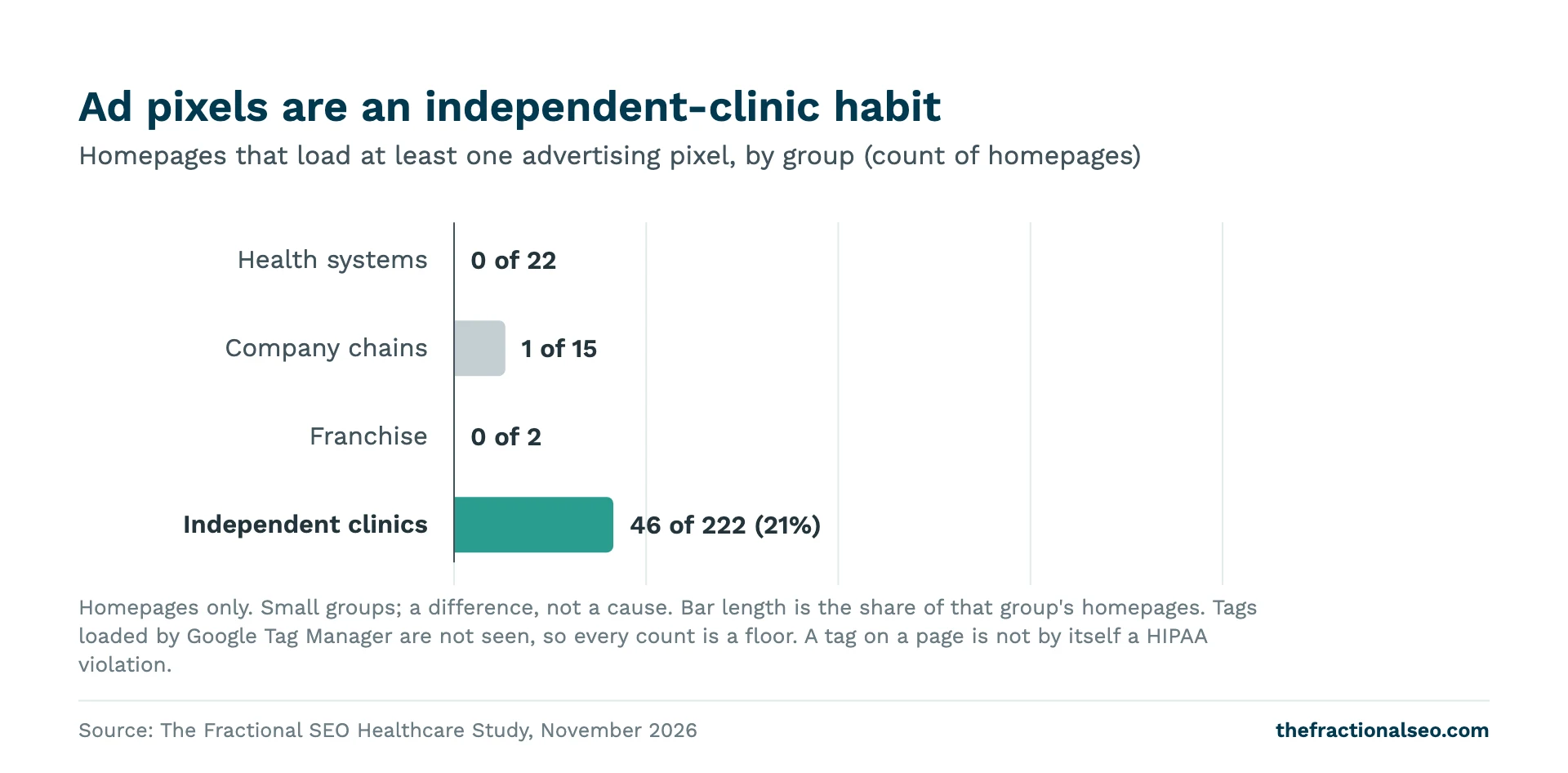
Advertising pixels do not track with rankings: 23% of map-pack providers’ homepages load one vs 18% of the rest. Pixels serve ads and measurement, not organic ranking, so removing one is not shown to cost rankings and keeping one is not shown to help them.
We scanned homepages only. A pixel on a booking, portal or condition page was not measured, and a tag loaded later by Tag Manager is not seen. A pixel on a public homepage does not by itself tell you anything about a clinic’s compliance, and nothing here says any site has done something wrong. If your site runs ad pixels, inventory every tag on every page type, starting with booking, portal, condition and contact pages, and take the list to your privacy or compliance counsel. Our guide to tracking pixels and HIPAA-safe measurement for clinics walks through it.
What clinic websites already get right
Every crawled provider site uses HTTPS (261 of 261). 87% have service or condition pages, 74% have a tap-to-call link and 65% of homepages show a clinician credential or board certification (85% in dermatology, 30% in urgent care). WordPress runs 83% of sites whose platform could be identified, so most of the gaps above are edits to the site you have, not a rebuild.
Every feature we compared
Here is every website feature, both comparisons. “Weak” means a result looked like a difference before the correction for multiple tests but not after. “No clear difference” means it never did.
| Website feature | Map pack 1-3 vs Maps 4-20 | Organic 1-3 vs 4-10 |
|---|---|---|
| Location or service-in-city pages | 68% vs 53% (p=0.047, weak) | 94% vs 65% (p=0.0031, weak) |
| Review widget | 23% vs 10% (p=0.021, weak) | 9% vs 8% (p=1, no clear difference) |
| Service or condition pages | 93% vs 84% (p=0.12, no clear difference) | 97% vs 90% (p=0.4, no clear difference) |
| Blog or news section | 61% vs 56% (p=0.54, no clear difference) | 53% vs 73% (p=0.098, no clear difference) |
| LocalBusiness-type schema | 25% vs 23% (p=0.86, no clear difference) | 25% vs 14% (p=0.24, no clear difference) |
| City in homepage title | 58% vs 61% (p=0.76, no clear difference) | 34% vs 51% (p=0.18, no clear difference) |
| Form on homepage | 21% vs 26% (p=0.49, no clear difference) | 13% vs 24% (p=0.26, no clear difference) |
| Tap-to-call link | 67% vs 75% (p=0.23, no clear difference) | 63% vs 67% (p=0.81, no clear difference) |
How to check your own site in 30 minutes
Open your homepage on your phone. The figures in brackets are from the study; the steps are best practice, not study data.
- Minutes 1-5, the next step. Can a patient book, check in or request a visit without leaving the homepage? Is the phone number tappable? (24% have a homepage form; 74% have tap-to-call.)
- Minutes 5-10, the first question. Does the top of the page answer it for your clinic type: walk-ins and self-pay cost, new patients and insurance, medical and cosmetic care?
- Minutes 10-15, speed. Run the homepage through PageSpeed Insights on mobile and note the Largest Contentful Paint. (Median 6.8 seconds.)
- Minutes 15-20, locations and services. Does each location and each service you want more of have its own page with something specific on it?
- Minutes 20-25, the blog and the basics. Check the date of the newest post, and whether the homepage title names your city. (8% posted in 12 months.)
- Minutes 25-30, tags. List the tags your homepage and booking pages load, and send the list to whoever handles privacy for the clinic.
For a fuller pass, work through our local SEO checklist for medical clinics.
FAQs
What are the most common SEO mistakes on clinic websites?
Quiet blogs, slow phones and missing basics. 59% of provider sites have a blog or news section, but only 8% posted in the 12 months before the crawl. The median homepage takes 6.8 seconds to show its largest element on a phone. 24% have a form on the homepage and 22% have LocalBusiness-type schema.
What makes top-ranked clinic websites different?
In our sample, no single website feature reliably separates them. Location pages and review widgets lean toward the map pack but fail the correction. The clearer differences are links in organic results and reviews in the map pack, both correlations.
Does site speed affect clinic rankings?
Speed showed no clear difference here: a median score of 63.5 for map-pack providers vs 63. That is not proof that speed never matters. Fix it for the patient on a phone.
Does a clinic need a blog?
Not to rank, on this evidence: a blog showed no clear difference. A blog you keep up, written or reviewed by your clinicians, can answer patients’ questions. A dead one is better out of the menu.
Is a Meta pixel on a clinic website a problem?
We can’t say for any site, and the scan only read homepages. Health-system and chain homepages almost never load an ad pixel; 21% of independent clinic homepages do. Inventory your tags and ask your privacy or compliance counsel. Our HIPAA-safe analytics guide explains the steps.
Want to know which of these gaps your clinic’s site has, and which are worth fixing first? See how we work with urgent care, primary care and dermatology clinics.
More research & benchmarks
The whole Healthcare library- Who Wins Local Healthcare Searches: Health Systems, Chains and Independent Clinics in 27 Searches Who holds page one and the map pack when patients search for urgent care, a primary…
- Google Reviews and Clinic Rankings: What 534 Business Profiles Show Which parts of a clinic's Google review profile lean with the map pack, by clinic type…