
Templates & Resource Healthcare
Local SEO Checklist for Medical Clinics
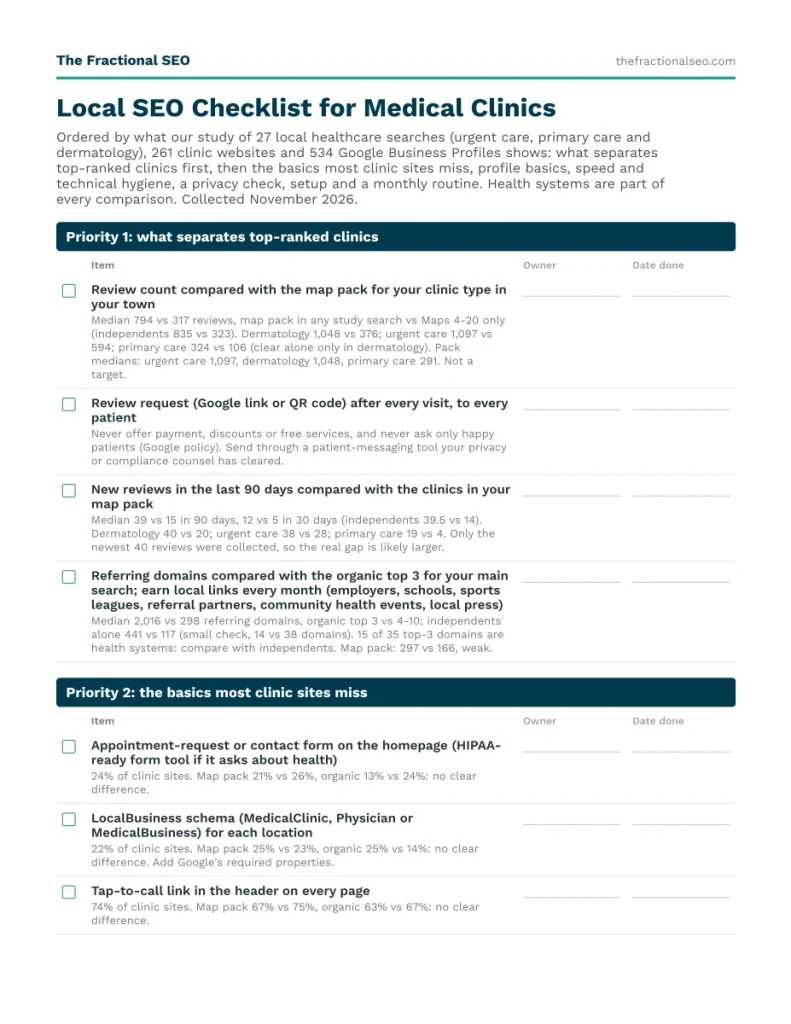
The clinic SEO checklists we read treat every task as equal. This one is ordered by clinic data: what clearly separates top-ranked urgent care, primary care and dermatology clinics comes first, and the basics with no measured edge come after it, marked as such. All 33 items are free to download as a PDF or a Google Sheet.
Get the template No email required
What's inside
Priority 1: what separates top-ranked clinics
Total reviews, recent reviews and, for the organic results, links.
The basics most clinic sites miss
Forms, schema, location and condition pages and a live blog: no measured edge, still worth having.
No clear difference
Profile basics, photos, replies, posts and speed, where top-ranked clinics look like everyone else.
A tag check and monthly tasks
Which advertising pixels your pages load, plus three checks to repeat each month.
How to use it
-
Download the PDF or copy the Sheet
Print it, or make your own copy of the Google Sheet.
-
Work top to bottom
Start with Priority 1. Give every item an owner and a date.
-
Repeat the monthly tasks
Rankings from your area, new reviews and links.
We analyzed 27 local searches across 9 US metros and three clinic types (urgent care, primary care and dermatology), 301 provider websites (261 crawled) and 534 Google Business Profiles, November 2026. We compared what top-ranked clinics have with what lower-ranked ones have, and ordered the list from the answer. We ran these searches once, on 17 November 2026, so treat rankings as a snapshot: they move from week to week. For the reasoning behind each task, read the full local SEO guide for clinics.
If your Google Business Profile isn’t claimed yet, do items 15-17 first. Everything on the profile depends on them.
How we ordered this checklist
Every item sits in one of four priority groups, followed by a privacy check, setup and a monthly routine:
- Priority 1: what separates top-ranked clinics. Four items built on the three measures where top-ranked clinics differ by a margin that held up after correcting for the number of tests, and for independents alone.
- Priority 2: the basics most clinic sites miss. No measured edge, but most clinic sites lack several, and patients use them.
- Priority 3: profile basics. Profile items with no clear difference.
- Priority 4: speed and technical hygiene. How often clinic sites get these wrong.
- A privacy check. Which advertising tags your pages load. A patient-privacy task, not a ranking one.
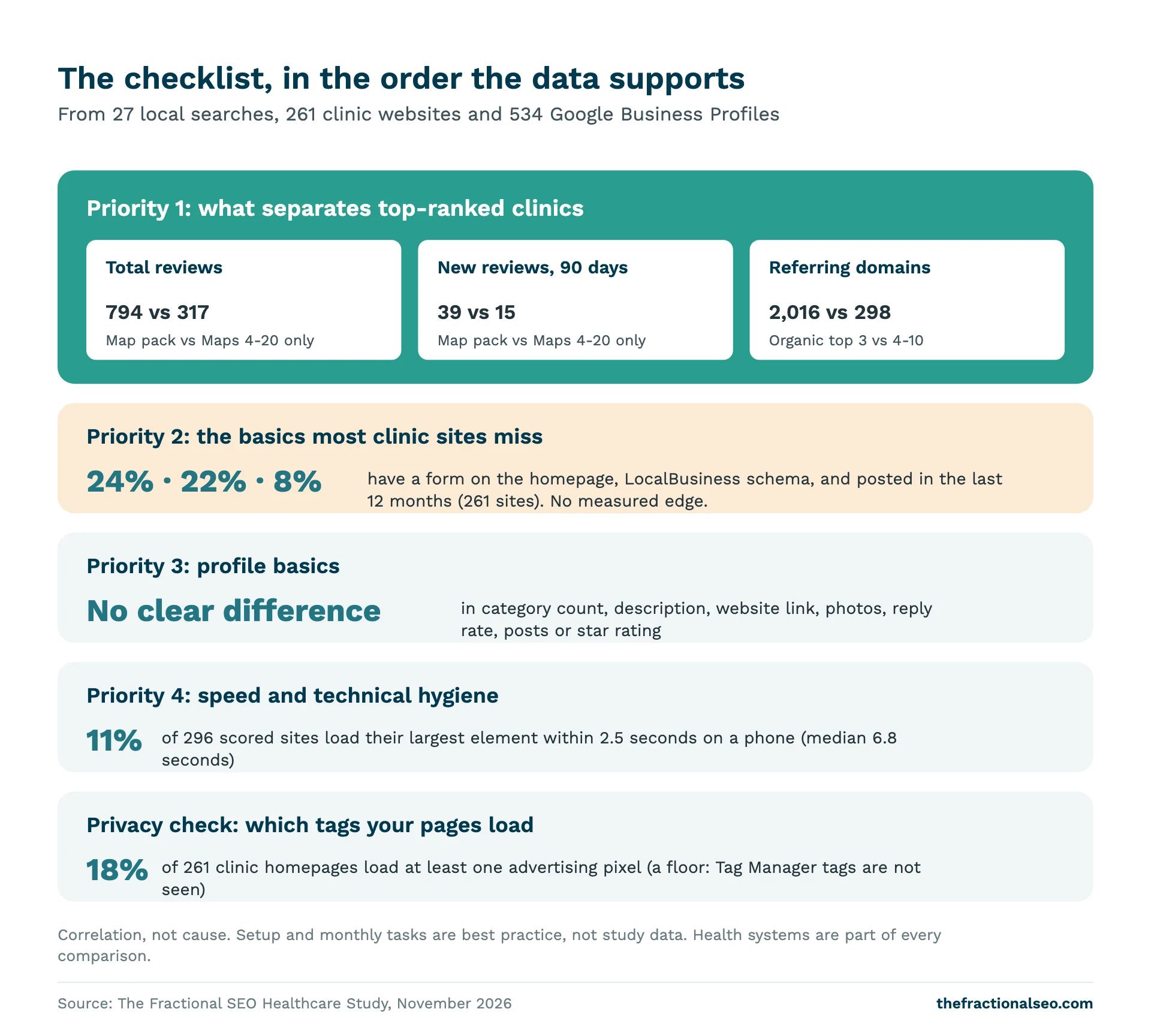
One honest note. This is a correlation study. Established clinics tend to have more reviews and other advantages too, such as age, locations and links. So the list shows what top-ranked clinics tend to have. It can’t promise that any one item will move you up, and a missing edge is not proof that an item never matters. The website half comes from our study of 261 clinic websites. Health systems are part of every search here, and they rank on whole hospital websites; where that changes a number, we say so.
Priority 1: What separates top-ranked clinics
Reviews: how many, and how recent
Providers that reached a map pack have far more Google reviews: a median of 794 vs 317 for those seen only at Maps positions 4-20. It holds for independent clinics alone (835 vs 323). By clinic type: dermatology 1,048 vs 376, urgent care 1,097 vs 594, primary care 324 vs 106. The direction is the same in all three, but the gap is clear on its own only in dermatology; the urgent care and primary care groups are too small to show it alone.
The bar differs by clinic type. The map-pack median is 1,097 reviews for urgent care, 1,048 for dermatology and 291 for primary care, and only 4 of 81 map-pack listings have fewer than 10. That describes the pack. It is not a target.
Recent reviews show the same pattern. Map-pack providers got more new reviews in the 90 days before collection: a median of 39 vs 15, and 12 vs 5 in 30 days. It holds for independents alone (39.5 vs 14 in 90 days). By clinic type the 90-day gap is clear in dermatology (40 vs 20) and smaller in urgent care (38 vs 28) and primary care (19 vs 4). We collected only the newest 40 reviews per profile, so the pack median of 39 sits near that cap and the real gap is likely larger. More in what 534 Business Profiles show about reviews.
Ask every patient, not only the happy ones. Google’s content policy bars offering payment, discounts or free services for a review, and selectively asking for positive ones. Send the request through a patient-messaging tool your privacy or compliance counsel has cleared.
- Your review count compared with the map pack for your clinic type in your town.
- A review request after every visit, to every patient, with your Google review link or QR code. Never an incentive.
- Your new reviews in the last 90 days compared with the clinics in your map pack.
Links, for the organic results
Sites in the top 3 organic results have far more links: a median of 2,016 referring domains vs 298 for sites at positions 4-10. Read that with care. Health systems, with whole hospital sites behind them, make up a large part of the top-3 group (15 of 35 domains), and they hold 49 of 131 provider organic results. The gap still holds for independent clinics alone, at 441 vs 117 referring domains, though that check is small (14 vs 38 domains). In the map pack, links matter less: 297 vs 166, a lean that fails the correction, and no clear difference for independents alone. More on health systems in who wins local healthcare searches.
Good clinic links come from real local relationships: employers, schools, sports leagues, referral partners, community health events and local press. Compare yourself with the independents in your organic top 3, not with the hospital.
- Your referring domains compared with the organic top 3 for your main search, and a plan to earn local links every month.
Priority 2: The basics most clinic sites miss
No website feature separates map-pack providers once the number of tests is corrected for. The nearest are location or service-in-city pages (68% of map-pack providers’ sites vs 53%) and review widgets (23% vs 10%), both leans that fail the correction. With independents alone the location-page lean fades (61% vs 50%). They are still basics patients use.
| Item | Clinic sites with it | Map pack vs lower in Maps | Organic top 3 vs 4-10 |
|---|---|---|---|
| Form on the homepage | 24% | 21% vs 26% (no clear difference) | 13% vs 24% (no clear difference) |
| LocalBusiness-type schema | 22% | 25% vs 23% (no clear difference) | 25% vs 14% (no clear difference) |
| Tap-to-call link | 74% | 67% vs 75% (no clear difference) | 63% vs 67% (no clear difference) |
| Review widget | 12% | 23% vs 10% (weak lean, fails the correction) | 9% vs 8% (no clear difference) |
| Location or service-in-city pages | 58% | 68% vs 53% (weak lean, fails the correction) | 94% vs 65% (lean, fails the correction) |
| Service or condition pages | 87% | 93% vs 84% (no clear difference) | 97% vs 90% (no clear difference) |
| City in the homepage title | 58% | 58% vs 61% (no clear difference) | 34% vs 51% (no clear difference) |
| Blog or news section | 59% | 61% vs 56% (no clear difference) | 53% vs 73% (no clear difference) |
- Forms. Only 24% of clinic sites have a form on the homepage. If yours asks for anything about a patient’s health, use a HIPAA-ready form tool, not a plain contact form plugin.
- Schema. 22% mark up the business with LocalBusiness-type schema, including subtypes such as MedicalClinic, Physician and MedicalBusiness. Add Google’s required properties for each location.
- Location and condition pages. 58% have location or service-in-city pages, and 87% have service or condition pages. Build one page per real clinic location, never city-swapped copies: Google’s spam policies call pages created to rank for specific, similar searches doorway abuse. Have your own clinicians write or review condition pages.
- Blogs. 59% have a blog or news section, but only 8% posted in the 12 months before the crawl.
- Your homepage, by clinic type. Walk-ins or same-day care appear on 67% of urgent care homepages, cosmetic services on 87% of dermatology homepages, and “accepting new patients” on only 18% of primary care homepages. Across all clinics, 51% mention online booking and 41% name insurance accepted.
- An appointment-request or contact form on the homepage, on a HIPAA-ready form tool if it asks about health.
- LocalBusiness schema (MedicalClinic, Physician or MedicalBusiness) for each location.
- A tap-to-call link in the header on every page.
- A page for each clinic location, with its own hours, directions and services.
- A page for each service or condition you treat, written or reviewed by your clinicians.
- Your city in the homepage title.
- A blog only if someone will post to it.
- Real reviews shown on the site, shared within your privacy rules.
- A homepage that answers what your patients look for: walk-ins and hours for urgent care, new patients and insurance for primary care, medical and cosmetic services for dermatology.
- Online booking or check-in linked from the homepage.
Priority 3: Profile basics (no clear difference)
Clinic profiles look alike on the basics. 95% of profiles are claimed (4 map-pack profiles are not), and nearly all have a description and website link. Star rating does not separate them: the median is 4.7 in the map pack and 4.7 at positions 4-7. Photos show no clear difference either (a median of 18 vs 14), nor do Google posts: 15% of map-pack profiles and 16% of the rest posted in the 30 days before collection.
The primary category is a real choice. “Urgent care center” holds 25 of 27 urgent care pack profiles and “Dermatologist” 25 of 27, while primary care splits between “Family practice physician” and “Medical clinic”. Replies show no clear difference (a median reply rate of 65% vs 55%), but they carry a privacy rule: a reply must not confirm that the reviewer is a patient or mention their care. Step by step in our Google Business Profile checklist for clinics.
- Profile claimed and verified, under your real clinic name.
- A primary category that matches your clinic type.
- Hours, website link and description filled in for each location.
- Replies that thank the reviewer without confirming they are a patient or mentioning care.
- Photos of the building, entrance, parking and waiting room.
- Google posts if you have news. Optional: no edge in our data.
Priority 4: Speed and technical hygiene
Clinic sites are slow on mobile: the median PageSpeed performance score is 63, the median Largest Contentful Paint is 6.8 seconds, and 11% load their largest element within Google’s 2.5-second “good” threshold. Health-system sites score lowest (median 47) and independents 65 (the two franchise sites, 80). Speed does not separate map-pack providers, though: median score 63.5 vs 63. On real-user data, 66% of the clinic sites Google has enough Chrome visits for pass Core Web Vitals.
Every crawled clinic site uses HTTPS. 31% are missing meta descriptions on a quarter or more of their pages, 16% are missing H1s on a quarter or more, and 7% have duplicate titles on a quarter or more. These show how common each problem is; they don’t compare rankings.
- A homepage that loads fast on a phone: compress photos, trim scripts.
- Core Web Vitals checked in Search Console.
- HTTPS on every page.
- A meta description on every page.
- One H1 on every page.
- A unique title on every page.
Check what your pages load
18% of clinic homepages load at least one advertising pixel: Google Ads (32 homepages), the Meta pixel (21), Microsoft Bing UET (5), TikTok (2) or LinkedIn Insight (2). It splits by group. None of 22 health-system homepages loads an ad pixel, and 1 of 17 chain and franchise homepages does, against 46 of 222 independent clinics (21%). Among independents, urgent care homepages load one most often (30%), then dermatology (21%) and primary care (14%). The groups are small, and the data does not show why any site added or removed a pixel. We read homepages only, not booking or portal pages.
This is where privacy rules apply. The HHS Office for Civil Rights issued a bulletin on online tracking technologies in December 2022, revised in March 2024. In 2024 a federal court in Texas vacated the part of it about tracking technologies on public pages that don’t need a login, and HHS did not appeal. That does not settle what your booking, portal or condition pages may load. This is not legal advice: check with your privacy or compliance counsel. The full picture is in what 261 clinic homepages load, and how to measure marketing safely.
- A list of every tag on your homepage, booking, portal, condition and contact pages.
- Ad pixels removed or restricted wherever patient information could be involved, decided with your privacy or compliance counsel.
Setup and monthly tasks
Keep your name, address and phone the same everywhere. The sites clinics compete with most on page one: Yelp (24 results), Facebook (9), Zocdoc (5), Healthgrades (4), MapQuest (4), Practo (4) and Solv (3). See the directories in healthcare search. Then check the same few numbers each month. Google says local results are mainly based on relevance, distance, and popularity, so check from where your patients are, not from the front desk.
- Name, address and phone the same on your site, profile and directory listings, for each location.
- Search Console set up and verified.
- Monthly: check your map-pack position for your main searches from a phone inside your area.
- Monthly: count new reviews in the last 90 days against your map pack, and answer any unreplied review.
- Monthly: list the new links you earned and check Search Console clicks for service and town searches.
Download the checklist
The Clinic Local SEO Checklist. All 33 items in priority order, with columns for status, owner, date done and the benchmark from our study. Print the PDF, or copy the Google Sheet and give every item an owner and a date. For the profile step by step, pair it with the Google Business Profile checklist.
Rather hand the list to someone? Healthcare SEO done for you.
Questions, answered
What should a clinic’s local SEO checklist include?
Start with what separates top-ranked clinics: total reviews, recent reviews and, for organic results, links. Then website basics, profile basics, speed, a tag check and a monthly routine.
What should I do first?
If your profile isn’t claimed, claim it. Then start asking every patient for a review, which costs nothing and can start this week. Links and location pages take longer.
How many reviews does a clinic need?
There’s no target, and it depends on the clinic type. The map-pack median is 1,097 for urgent care, 1,048 for dermatology and 291 for primary care. Compare yourself with the clinics in your own map pack, and keep new reviews coming every month.
Do star rating and website speed matter?
Not in a way we could measure. The median rating is 4.7 in the map pack and 4.7 at positions 4-7, and the median mobile score is 63.5 for map-pack providers vs 63 for the rest. Clinic sites are slow, though: only 11% load their largest element within 2.5 seconds.
Can a clinic website use the Meta pixel?
We can’t answer that for you, and it isn’t a ranking question: pixels serve ads and measurement. 21 independent clinic homepages in our study load it; no health-system or chain homepage does. Ask your privacy or compliance counsel, and read our guide to tracking pixels and HIPAA.