
Research & Benchmark Automotive
Who Wins Local Automotive Searches: A Benchmark of 27 Searches
A customer types "auto repair", "auto body shop" or "car dealership" and the name of their city into Google. Who do they see? In the organic results, rarely a shop or a dealer. We analyzed 27 local searches across 9 US metros and three automotive search types (auto repair, auto body shop and car dealership), 435 automotive business websites (331 crawled) and 530 Google Business Profiles, November 2026. This page is about search: who holds page one and the map pack, and how repair, body-shop and dealer searches differ. If you came for market size, shop counts or technician numbers, this isn't that report.
The auto repair industry statistics pages that rank today cover the aftermarket, jobs and wages, mostly from other people’s numbers. None we could read looked at what a customer sees when they search for a mechanic, a collision shop or a dealer in their own city. This page does.
These numbers are a single snapshot from November 2026 (searches run on 19 November), so rankings, review counts and ad activity will move over time. Repair shops, body shops and dealerships are different businesses, so we give each its own figures wherever they differ.
Key findings
- Page one mostly isn’t yours. Only 9% of page-one organic results for local automotive searches go to a repair shop’s, body shop’s or dealer’s own website: 22 of 233. Directories alone hold 79%.
- Often there is no shop at all. In 19 of the 27 searches, no repair shop, body shop or dealer website appears on page one at all.
- Two different races. Of 73 map-pack businesses with a website, 2 also appear on page one of the organic results for the same search (3%).
- The dealer pack is mostly used-car lots. 18 of 27 car dealership pack spots go to businesses whose Google category is “Used car dealer”.
- Small metros are the extreme. 1 provider result in 52 on the Boise and Knoxville searches (6 searches, so a pattern, not a tested result).
The website side of the same study is in the gaps repair, body shop and dealer websites leave open.
Who holds page one
Across the 27 searches we recorded 233 organic results on page one. Only 9% of page-one organic results for local automotive searches go to a repair shop’s, body shop’s or dealer’s own website: 22 of 233. Directories alone hold 79% (183). In our HVAC study, contractor sites held 53%.
The rest of page one: 18 social results, 6 lead-generation sites, 3 other non-provider pages such as city guides and forums, and 1 manufacturer page.

The top of the page is the same story. A directory, social page or other non-provider site holds the #1 organic spot in 24 of 27 searches, and 90% of all top-3 organic spots (73 of 81). Providers held the #1 spot on 1 auto repair search, 0 auto body searches and 2 car dealership searches.
In 19 of the 27 searches, no repair shop, body shop or dealer website appears on page one at all. The provider results that do appear cluster in a few searches: the New York auto repair search had 6, the Los Angeles auto body search 5 and the Austin car dealership search 5.
The study shows who appears, not why. Our reading: someone choosing a mechanic often wants to compare several at once, and a directory page does that in one click.
Yelp and the directories behind it
Yelp is on page one of 26 of the 27 searches and holds 97 of the 183 directory results (yelp.com and m.yelp.com counted together). After it: Facebook 18 results, Yahoo Local 9, MapQuest 6, BBB 5, then RepairPal, Yellowpages, CarWise and Cars.com with 3 each. Carfax and Superpages had 2 each.
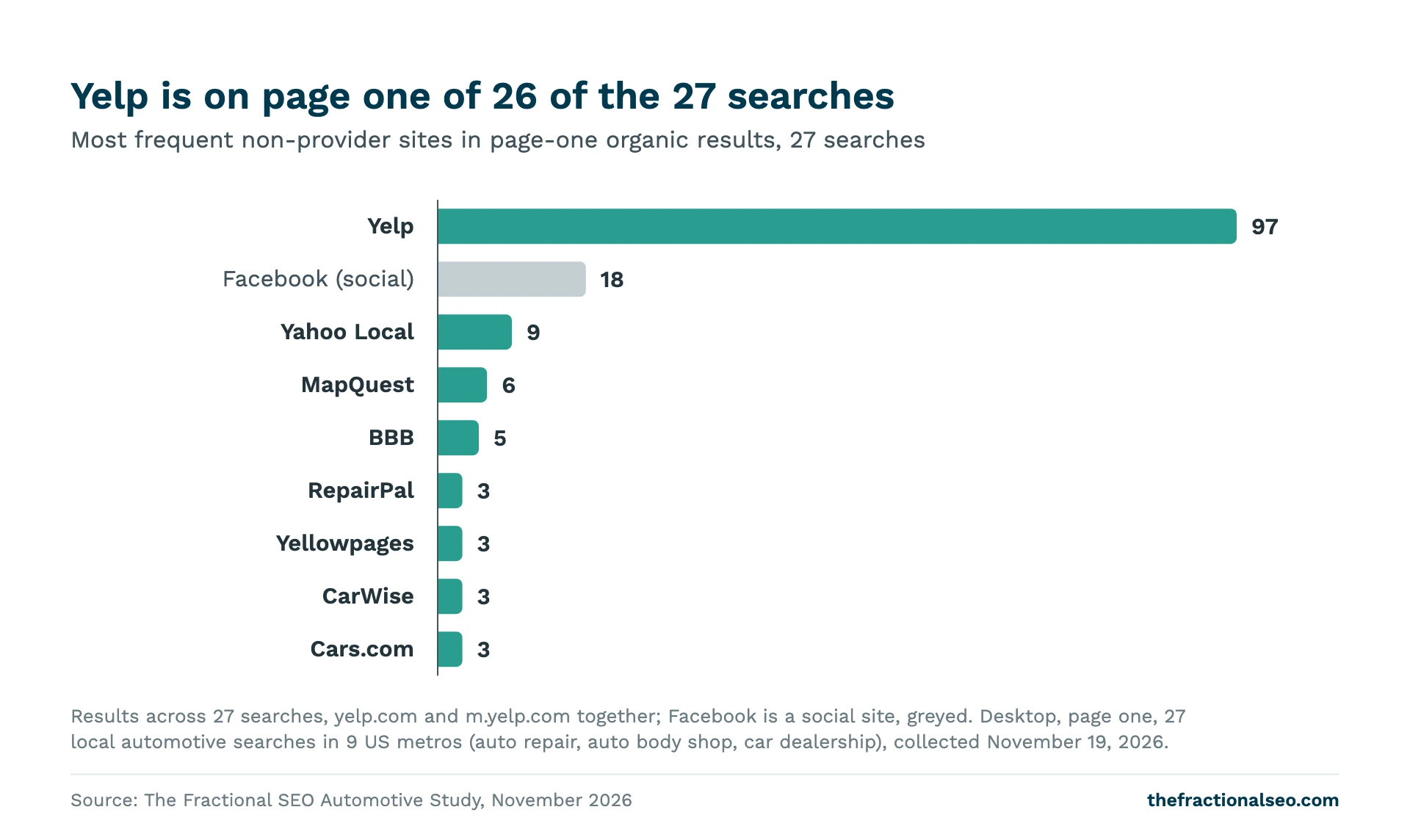
Yelp leads in every business type: 42 results on auto repair searches, 30 on auto body and 25 on car dealership searches. Behind it, each business type has its own second tier: RepairPal and Carfax for auto repair; BBB, Yahoo Local and CarWise for auto body; Yahoo Local and Cars.com for car dealerships. These are small counts from a few searches each, so we name them rather than rank them.
Many small “best of” and near-me listing sites appear once or twice each. Lead-generation sites are rare on page one: 6 results across the 27 searches.
What this means in practice: when a customer scrolls past the map pack, the page they see is mostly Yelp and directories, so your Yelp and directory profiles are part of how you show up in search. Our guide to Yelp, RepairPal, Cars.com and the other directories covers each one.
Three business types, three results pages
The provider share of page one is low in every segment: auto repair 9%, auto body 9%, car dealership 11%.
| Search (plus the metro) | Provider share of page one | Provider results | Median monthly searches per metro | AI Overview shown |
|---|---|---|---|---|
| auto repair | 9% | 7 of 81 | 1,300 | 0 of 9 |
| auto body shop | 9% | 7 of 79 | 390 | 2 of 9 |
| car dealership | 11% | 8 of 73 | 3,600 | 4 of 9 |
Demand is not the same either. “car dealership <city>” has the most local search volume of the three wordings (median 3,600 a month across the 9 metros), then “auto repair <city>” (1,300) and “auto body shop <city>” (390). The single biggest was car dealership dallas at 8,100. These are exact searches with a city name; “near me” and other phrasings add more.
Body-shop searches cost the most per click: a median of $6.81 in Google Ads planner figures, against $5.55 for auto repair and $5.23 for car dealership searches. The top was $10.47 for auto body shop charlotte.
So the provider share of page one is about the same in all three, while the number of people searching differs a lot. With 9 searches per business type, we describe these gaps rather than test them.
Big metros vs small metros
By metro size, providers held 12% of page one in the four large metros (12 of 104 results), 12% in the three mid-size metros (9 of 77) and 2% in the two small metros: 1 provider result in 52 on the Boise and Knoxville searches.
That rests on 6 small-metro searches, so read it as a pattern to watch, not a tested result.
Map pack and organic are two different races
The map pack and the organic results are almost entirely different businesses: of 73 map-pack businesses with a website, 2 also appear on page one of the organic results for the same search (3%). In our HVAC study it was about a third. The main reason is the one above: directories fill the organic results.
Google’s help page on local ranking says local results are mainly based on relevance, distance and popularity, and that prominence draws on how many websites link to a business and how many reviews it has. In our data, total reviews and profile photos are the two profile measures with a clear gap between businesses that reached a map pack and the rest (for body shops alone the photo gap is not clear). That is a correlation, not proof of cause. The numbers by business type are in what 530 Google Business Profiles show about reviews.
A website is not required for a map-pack spot. 8 of 81 map-pack spots (10%) go to businesses with no website on their Google listing: 4 auto repair, 4 auto body, 0 car dealership. Across all Maps results, 38 of 178 auto repair listings have no website, against 23 of 179 body shops and 2 of 180 dealers.
For a repair or body shop, the map pack is where you can win, and organic page one is mostly someone else’s. Our guide to local SEO for auto repair and body shops works through both.
The dealer map pack is mostly used-car lots
The “car dealership” map pack is mostly used-car lots: 18 of 27 pack spots go to businesses whose Google category is “Used car dealer”, and 8 of the 9 #1 spots. Businesses with a brand category (such as “Honda dealer”) hold 3, and “Car dealer” 5. One spot went to an auto broker.
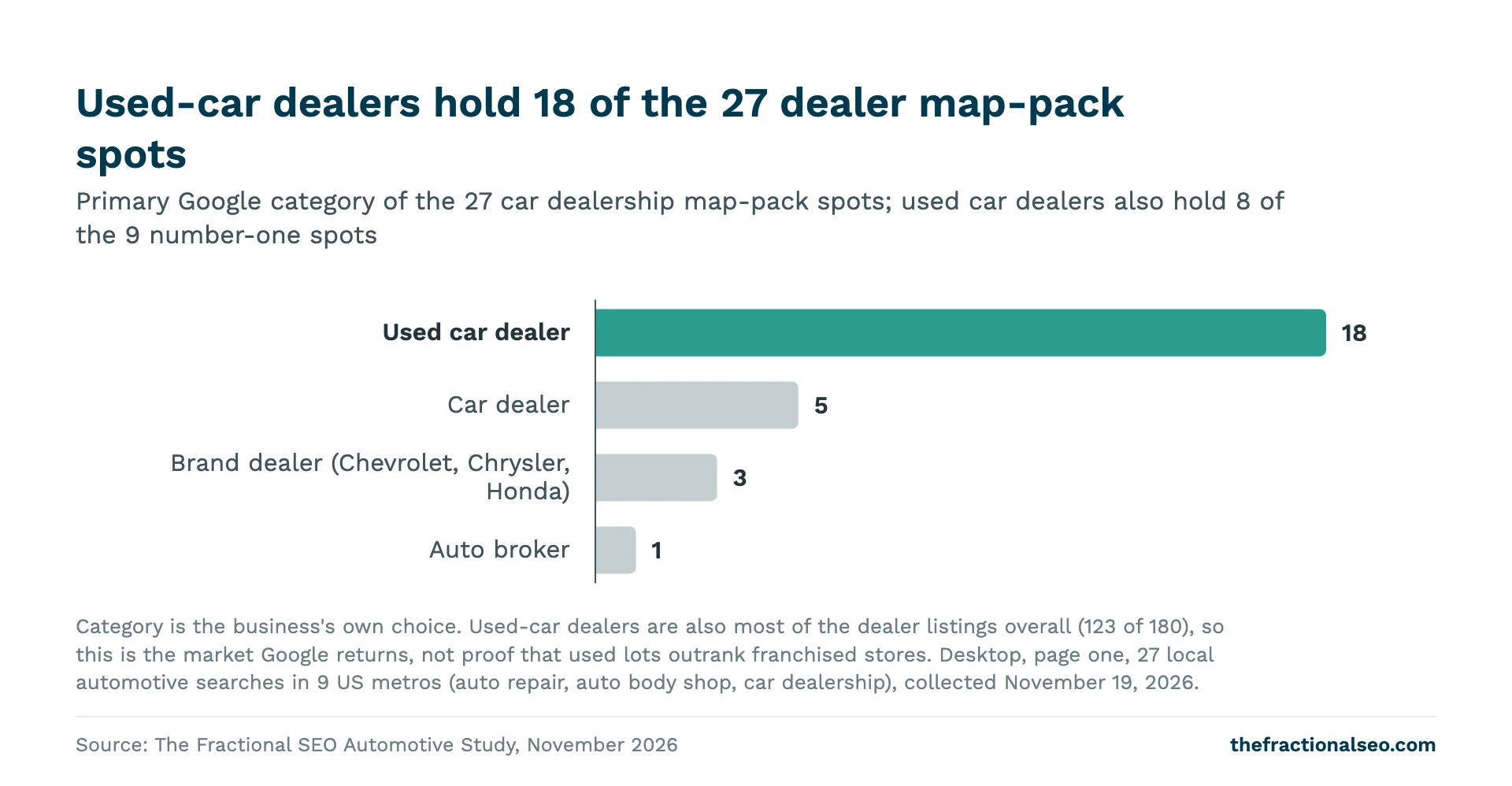
Read this carefully. The category is what each business chose on Google, not a check of whether it sells new cars. Used-car dealers are also most of the dealer listings overall (123 of 180), so this is the market Google returns for “car dealership”, not proof that used lots outrank franchised stores. Brand-category dealers were 22 of the 180 listings.
If you run a franchised store, the businesses you meet in the pack for the generic search are mostly listed as used-car dealers. Our guide to local SEO for car dealerships covers the dealer side in detail.
Chains and franchises
Chains hold few map-pack spots: 4 of 81 at most. We report three groups separately, as brands with counts.
- Franchises confirmed on their own sites (CARSTAR, Christian Brothers Automotive, Fix Auto USA, Maaco, Midas, Precision Tune Auto Care) hold 2 pack spots: Christian Brothers Automotive 1 and Fix Auto USA 1. CARSTAR has one organic result.
- Company chains (AutoNation USA, Caliber Collision, Crash Champions, DriveTime, Gerber Collision & Glass) hold none, although Caliber Collision and Crash Champions appear 11 and 10 times in the Maps results. AutoNation USA has one organic result.
- Marks we could not verify (AutoSavvy, CarMax, Carvana, EchoPark, Hendrick Automotive): their sites were unreadable at our chain check. EchoPark holds 2 pack spots.
These counts are a floor. Six sites were unreadable at the chain check and the businesses added to the study later were not chain-checked.
We also looked for keyword-named listings with few reviews. 1 Maps listing matched the suspect-listing rule (name only city and service words, under 20 reviews, no company suffix); it sat outside the map pack.
What sits above the organic results
Every search showed a map pack (27 of 27). AI Overviews appeared on 6 of 27, most on car dealership searches (4 of 9), against 2 of 9 auto body searches and none of the 9 auto repair searches.
Ads need a caveat. In this run we saw text ads on 2 searches (both car dealership) and Local Services Ads on 1 (auto body). The searches ran at 04:20-04:25 UTC, late evening to night across US time zones, which may explain the low count. Don’t read it as automotive searches carrying few ads. Google’s Local Services Ads page lists auto repair shops and auto body shops among eligible automotive services, with tire shops, towing and car wash and detailing; it lists no car dealer category.
Estimated traffic by business type
Website traffic depends on the business type. The median website gets an estimated 929 organic visits a month for a car dealership, 309 for an auto repair shop and 207 for a body shop. These are DataForSEO modeled estimates, not analytics, and chains with national sites push up the top end.
Our reading, not something we measured: given how little of page one goes to provider sites, much of that estimated traffic probably comes from searches beyond the city queries in this study. What sites do with it is in the gaps repair, body shop and dealer websites leave open.
What this means for repair shops, body shops and dealers
The study describes who appears, not what makes anyone rank. Here’s how we read it.
- The map pack is the local race you can win. Organic page one is mostly Yelp and directories, and only 2 of 73 pack businesses with a website were also on it.
- Your Yelp and directory profiles are part of your search presence. Yelp was on page one of 26 of 27 searches.
- Compare yourself with your own business type. Search volume and traffic differ several times over between repair shops, body shops and dealers.
- Dealers: know who is in your pack. For the generic search, it is mostly businesses listed as used-car dealers.
- Look at your own website too. Our flagship study covers the gaps repair, body shop and dealer websites leave open.
How we did this
We analyzed 27 local searches across 9 US metros and three automotive search types (auto repair, auto body shop and car dealership), 435 automotive business websites (331 crawled) and 530 Google Business Profiles, November 2026.
Searches were “auto repair”, “auto body shop” and “car dealership”, each followed by a metro: New York, Los Angeles, Chicago and Dallas (large); Charlotte, Nashville and Austin (mid); Boise and Knoxville (small). We recorded page one on desktop through SerpAPI on 19 November 2026 (04:20-04:25 UTC), plus the Google Maps list for each search: 540 Maps rows, positions 1-20. The map pack is positions 1-3 of that list, 81 spots (27 per business type).
Samples: 233 organic results; 183 directory results; 81 map-pack spots (73 pack businesses with a website for the overlap); 27 dealer pack spots and 180 dealer listings with a profile for categories; 435 business domains for chains and traffic. Traffic is DataForSEO Labs’ modeled estimate; volumes and per-click figures are Google Ads planner figures.
What it can’t claim: why anyone ranks, or anything about leads. It is one desktop snapshot per search, run late evening to night US time, organic page one moves day to day, and results vary by searcher location. That’s why we report shares and medians, never one business’s position. Business types and metro sizes are compared by description, not tested, and chain counts are a floor.
Questions, answered
Why do directories outrank auto repair shop websites?
We measured who ranks, not why. Directories held 183 of 233 page-one results, and Yelp alone 97. Google says prominence draws on links and reviews, and a directory page lists many shops at once.
Is the map pack the same as the organic results?
Almost never. Of 73 map-pack businesses with a website, 2 also appeared on organic page one for the same search.
Do used-car lots outrank franchised dealers?
The data can’t say that. Used-car dealers held 18 of 27 dealer pack spots, but they are also 123 of the 180 dealer listings, and the category is each business’s own choice.
Do chains dominate local automotive search?
No. Chains held 4 of 81 map-pack spots at most, and company chains none. Our chain counts are a floor.
How much organic traffic does a repair shop, body shop or dealer website get?
At the median, an estimated 929 visits a month for dealers, 309 for repair shops and 207 for body shops. These are modeled estimates.
Want to see where your shop or dealership sits against these benchmarks in your own city? See how we approach SEO for automotive businesses.
More research & benchmarks
The whole Automotive library- We Analyzed 331 Automotive Websites: The Gaps Repair, Body Shop and Dealer Sites Leave Open Seven common gaps on auto repair, body shop and dealer websites, measured across 331 sites, and…
- Google Reviews and Automotive Rankings: What 530 Business Profiles Show Which parts of a Google Business Profile separate map-pack auto repair shops, body shops and dealerships…