
Research & Benchmark Automotive
Google Reviews and Automotive Rankings: What 530 Business Profiles Show
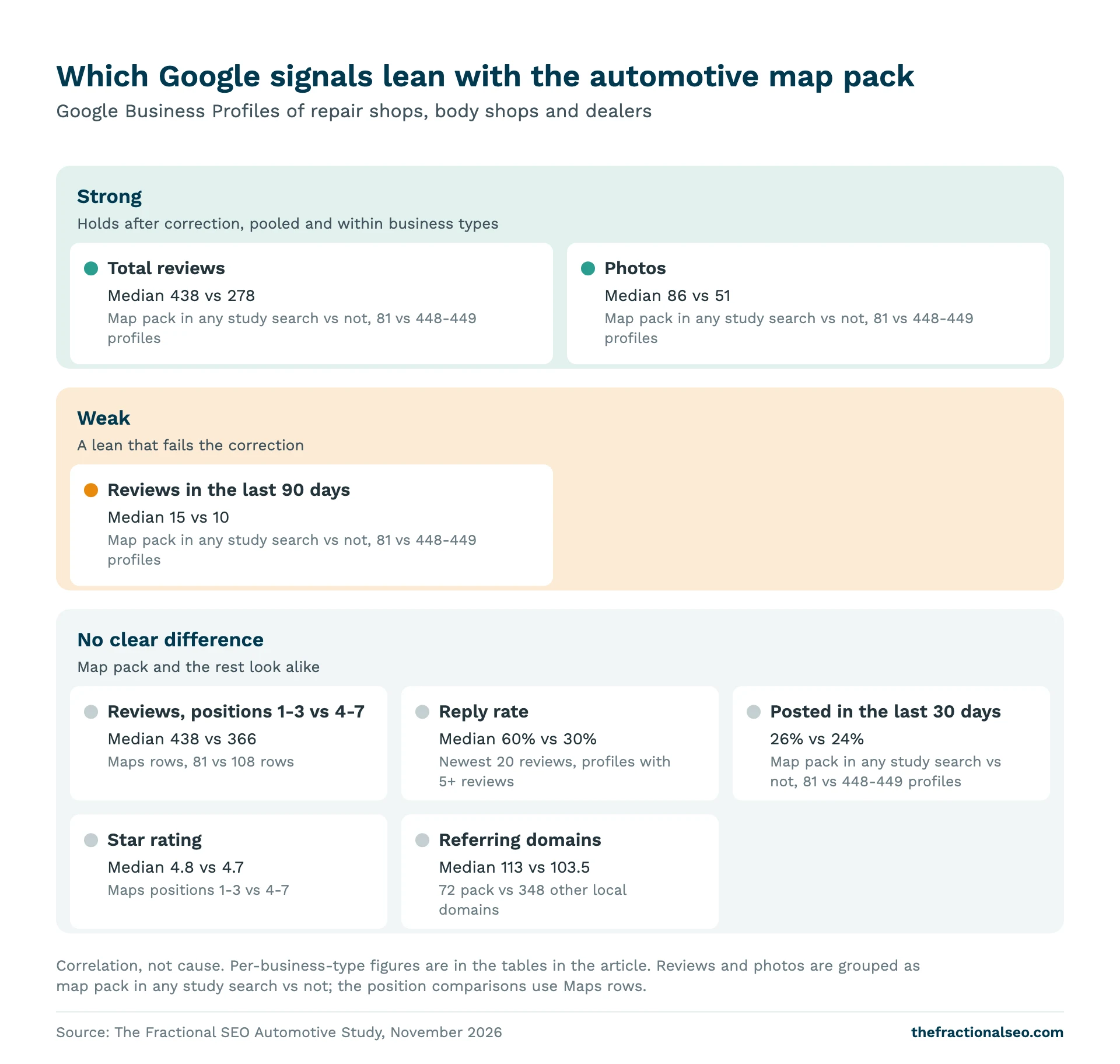
The auto shop marketing guides we read say Google reviews drive Maps rankings. None of them measures it. We checked 530 Google Business Profiles of auto repair shops, body shops and car dealerships. Two things clearly separate the businesses that reach the map pack from the rest, when each profile is compared within its own business type: total reviews and profile photos. Recent reviews lean the same way but not reliably. Reply rate, Google posts and star rating show no clear difference.
We analyzed 27 local searches across 9 US metros and three automotive search types (auto repair, auto body shop and car dealership), 435 automotive business websites (331 crawled) and 530 Google Business Profiles, November 2026. For this article we looked at the review side of those profiles: how many reviews each business has, how many came in recently, the star rating, owner replies, photos and Google posts.
These numbers are a single snapshot from November 2026 (searches run on 19 November), so rankings, review counts and ad activity will move over time.
Repair shops, body shops and dealerships are different businesses, and their review counts differ a lot. So every comparison here is also given for each business type, and we never give one review number for “automotive” as a whole.
Key findings
- Total reviews (strong): businesses that reached a map pack have a median of 438 reviews vs 278 for the rest. The gap holds when each profile is ranked within its own business type, and points the same way in all three types, though each type alone is too small to pass the correction.
- Photos (strong within business types): a median of 86 photos for businesses that reached a map pack vs 51 for the rest. Dealers show the biggest gap; for body shops it is not clear.
- Neighbours on the list: positions 1-3 vs 4-7 show no clear difference in review counts.
- Replies: no clear difference. The median reply rate is 60% for map-pack businesses vs 30% for the rest, but the gap doesn’t hold up.
- Star rating: no clear difference, a median of 4.8 at positions 1-3 vs 4.7 at positions 4-7.
The website findings from the same study are in our study of 331 automotive websites.
Do Google reviews help SEO? Map-pack businesses have more
Businesses that reach a map pack have more Google reviews than those that don’t: median 438 vs 278 pooled. That compares 81 profiles that reached a map pack in at least one study search with 448 that didn’t. In this study, the map pack means the top three businesses in the Google Maps list for a search.
A pooled number can mislead when one group has far more reviews, as dealers do. Here it doesn’t: the pack and the rest have the same mix of business types, so the pooled gap is not a dealer effect.
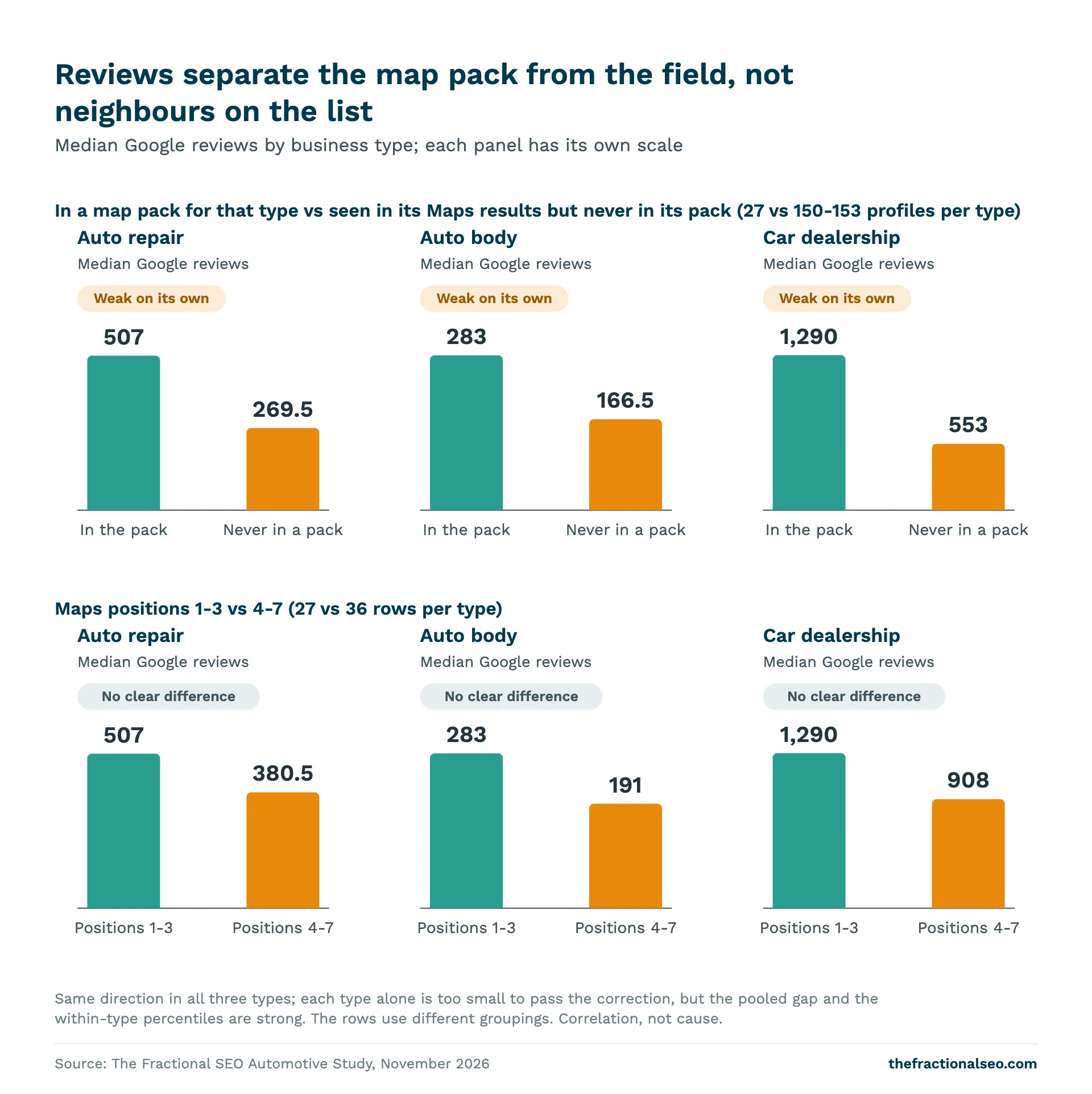
We also checked it the stricter way. We ranked each profile against others of its own business type, then compared. The gap holds inside each business type: the typical map-pack profile sits at the 68th percentile of its own type vs the 47th for the rest. That result is strong. It also points the same way in all three types:
| Business type | Map pack | Never in that type’s pack | Positions 4-7 |
|---|---|---|---|
| Auto repair | 507 | 269.5 | 380.5 |
| Auto body | 283 | 166.5 | 191 |
| Car dealership | 1,290 | 553 | 908 |
Each type alone is too small to pass the correction for the number of tests we ran, so read the three rows together, not one by one.
Google says something similar in general terms. Its help page on local ranking says prominence is based partly on how many reviews a business has, and that more reviews and positive ratings can help a business’s local ranking. It gives no numbers. So the plain answer to “do Google reviews help SEO?” is that review count shows a clear gap between map-pack businesses and the rest in our data. It doesn’t prove reviews are what put those businesses there.
Neighbours on the list: no clear difference
The last column in that table tells a different story. On the Maps list itself, positions 1-3 vs 4-7 show no clear difference in review counts within any segment, and pooled the medians are 438 vs 366, also no clear difference. That compares 81 map-pack rows with 108 rows at positions 4-7, each row one listing in one search.
So the review gap is between businesses that reach a pack and the wider field, not between neighbours on the list. Positions 4-7 are already near the top of a 20-row list, with 27 vs 36 rows per business type. We didn’t measure what sets the order among neighbours. Google’s ranking page names distance from the searcher alongside prominence, and no review count changes where your shop is.
Why 278 in one comparison and 366 in the other? Different groupings. The first counts every business that never made a pack; the second counts only the listings just below the top three.
Photos: the other clear gap
Map-pack businesses have more photos on their Google profile: median 86 vs 51 pooled, and the gap holds within segments, when each profile is ranked against its own business type. That within-type result is the strong one. By business type:
| Business type | Map pack | Rest | On its own |
|---|---|---|---|
| Car dealership | 310 | 138 | nearly passes the correction |
| Auto repair | 44 | 27 | weak |
| Auto body | 62 | 49 | no clear difference |
For body shops the photo gap is not clear. Photo counts include customer photos, and busier businesses collect more reviews and more photos at the same time. That is why we say photos lean with the pack, not that they put anyone in it.
Links are a useful contrast. Links show no clear difference between map-pack businesses and the rest (median referring domains 113 vs 103.5); within segments only auto repair leans (140 vs 105), and it fails the correction. On the profile, reviews and photos are the two things that stand out.
Photo ideas for each business type are in our Google Business Profile checklist for auto repair shops, body shops and car dealers.
Recent reviews lean, but not reliably
Recent reviews lean the same way but not reliably: map-pack businesses got a median 15 reviews in the 90 days before collection vs 10 for the rest, a lean that fails the correction, pooled and in each segment (dealers 39 vs 18, repair 16 vs 9, body 12 vs 8).
One limit matters here. We collected each profile’s newest 40 reviews, and 94 profiles had 40 reviews inside 90 days, so high-volume profiles are undercounted, mostly dealers. The real recent-review gap for dealers may be larger or smaller than this. What we can say is that total reviews separate the pack clearly and recent reviews only lean.
Replying to reviews: no clear difference here
Replying to reviews shows no clear difference between map-pack businesses and the rest (median reply rate on the newest 20 reviews 60% vs 30%), pooled or in any segment. By business type the medians are 60% vs 30% for repair shops, 60% vs 50% for body shops and 60% vs 25% for dealers. That counts 528 profiles with 5 or more reviews.
Those gaps look big, but reply rates vary so much from one business to the next that they don’t hold up. Habits vary: 134 of 528 profiles (25%) replied to none of their newest reviews and 165 (31%) to 90% or more.
Reply anyway, for the customers. Google’s help page on managing reviews says replying shows customers you value their feedback, and its ranking page says helpful replies can help a business stand out. Drivers choosing a shop may read your replies before deciding who gets the car. Keep it calm on bad reviews, and keep customers’ names, vehicles and invoice details out of public replies. It is good practice, not a measured ranking edge.
Star rating made no clear difference
Star ratings barely differ: median 4.8 for positions 1-3 vs 4.7 for 4-7, no clear difference. That compares 189 Maps rows. Dealers rate slightly lower overall (median 4.6) than repair (4.7) and body shops (4.8).
In our view the rating still matters to the person choosing a shop. Don’t chase a perfect 5.0, and never try to keep unhappy customers from posting.
Google posts: no clear difference
Google posts show no clear difference: 26% of map-pack businesses posted in the 30 days before their profile was collected vs 24% of the rest. 177 of 530 profiles (33%) had no post at all; dealers post most (51 of 180 in 30 days, vs 38 of 178 repair and 41 of 179 body).
Profile basics such as a description, extra categories and a website link also show no edge. They are still worth doing. The GBP checklist linked above covers posting, categories and the other basics.
How many Google reviews do auto shops and dealers need?
Google doesn’t publish a minimum, and no review count guarantees a spot. Here is what map-pack businesses actually have. How many reviews map-pack businesses have depends on the business type: median 1,290 for car dealerships, 507 for auto repair shops and 283 for body shops. Across every Maps listing the medians are 613.5, 276 and 178.
| Business type | Median reviews in the map pack | Pack profiles | Median across all Maps listings | All listings |
|---|---|---|---|---|
| Car dealership | 1,290 | 27 | 613.5 | 180 |
| Auto repair | 507 | 27 | 276 | 178 |
| Auto body | 283 | 27 | 178 | 179 |
These are descriptive levels, not targets. A dealer median tells a body shop nothing, which is why there is no single number for automotive businesses here. And a median is the middle: half the pack has fewer.
Suspect listings play no part in these numbers. 1 Maps listing matched our suspect-listing rule (a name made only of city and service words, under 20 reviews, no company suffix), and it sat outside the map pack. The rule is a flag, not proof.
Dealers will find the rest of their picture in local SEO for car dealerships. Repair and collision shops: see our local SEO guide for auto repair and body shops.
How to set your own target
Your real benchmark is your own market. Here’s the method we’d use. It’s our advice, not study data.
- Search your own wording in Google Maps with your city: auto repair, auto body shop or car dealership. Search from inside the area you want to win, because results change with where the searcher is.
- Note the review counts of positions 1-3. The middle one of the three is your local map-pack median for that search.
- Compare your count with it. If it sits far above yours, plan for a long climb and a steady pace of asks, not a one-off push.
- Ask every customer. Google’s help page says you can share a review request link or QR code. Text it when the car is picked up, or print it on the repair order or delivery paperwork.
Never pay for reviews or offer anything for them. Google’s content policy bans incentives “such as payment, discounts, free goods and/or services”. That includes a free oil change or money off the next service. The same policy bars businesses from selectively asking only happy customers, so ask everyone. The local SEO checklist for auto repair shops, body shops and dealerships puts reviews and photos in order with the rest.
Want to see how your profile compares with the map pack for your own business type and city? Talk to us about SEO for auto repair shops, body shops and dealerships.
How we did this
We analyzed 27 local searches across 9 US metros and three automotive search types (auto repair, auto body shop and car dealership), 435 automotive business websites (331 crawled) and 530 Google Business Profiles, November 2026.
Searches were “auto repair”, “auto body shop” and “car dealership”, each followed by the metro, run on 19 November 2026. Map pack means positions 1-3 of the Google Maps list for each search, 27 spots per business type. Profile comparisons count each business once: those that reached a map pack vs the rest, pooled and within each business type. Review count by position and star rating compare positions 1-3 with 4-7. Recent reviews come from each profile’s newest 40, replies from the newest 20.
What it can’t claim: cause. Busier, longer-established businesses may have more reviews and photos. Each business type has only 27 pack profiles. One snapshot, no “near me” searches.
Questions, answered
Do Google reviews help an auto repair shop rank?
Review count shows a clear gap between map-pack businesses and the rest. Repair shops in the pack have a median of 507 reviews vs 269.5 for repair shops that never made it. Repair shops alone are too few for that gap to pass the correction; the clear result comes from comparing each profile within its own business type across all three. It’s a correlation, not proof.
How many Google reviews does an auto shop or dealership need?
There’s no fixed number, and it depends on the business. Map-pack medians were 507 for repair shops, 283 for body shops and 1,290 for dealers. Check your own market.
Does replying to reviews help ranking?
We found no clear difference: a median reply rate of 60% for map-pack businesses vs 30% for the rest, a gap that doesn’t hold up. Reply anyway, because customers read replies.
Does star rating affect map-pack rankings?
We found no clear difference. The median is 4.8 at positions 1-3 and 4.7 at positions 4-7.
Do recent reviews matter more than total reviews?
Not in our data. Total reviews separate the pack clearly. Reviews in the last 90 days lean the same way (15 vs 10) but fail the correction.
More research & benchmarks
The whole Automotive library- We Analyzed 331 Automotive Websites: The Gaps Repair, Body Shop and Dealer Sites Leave Open Seven common gaps on auto repair, body shop and dealer websites, measured across 331 sites, and…
- Who Wins Local Automotive Searches: A Benchmark of 27 Searches Who holds page one and the map pack when people search for a mechanic, a body…