
Templates & Resource Automotive
Google Business Profile Checklist for Auto Repair Shops, Body Shops and Car Dealers
Most Google Business Profile advice for auto shops is the same list: claim it, pick a category, add photos, post, get reviews. Dealers get their own version of that list. None of the guides we read show which of those things actually differ between the businesses in the map pack and the ones below it, or whether the answer changes for a repair shop, a body shop and a dealership. We looked at 530 automotive profiles to find out. This checklist puts the two items that differ first, the setup basics after, and ends with a download you can work through.
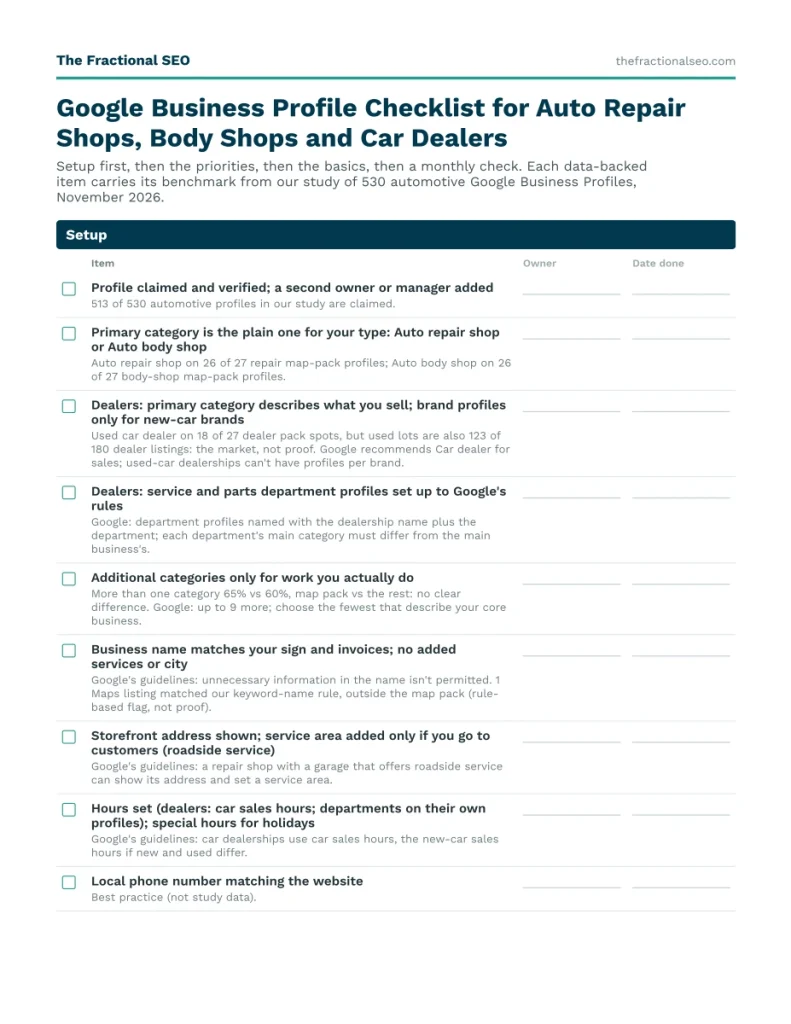
Get the template No email required
What's inside
Reviews
A review request after every job or sale, and your count against your own type's map pack.
Photos
Bays, before-and-after repairs, the lot and real inventory, added every month.
Setup
Claim, category for your type, dealer departments, name, hours, website and description.
Benchmarks
Each data-backed item carries its figure from our study of 530 automotive profiles, per business type.
How to use it
-
Download the checklist
Print the PDF or copy the Google Sheet.
-
Start the review and photo routine
A link or QR code after every job or sale, and new photos each month.
-
Fix setup in one sitting
Category, name, hours, website and description take minutes once you're logged in.
We analyzed 27 local searches across 9 US metros and three automotive search types (auto repair, auto body shop and car dealership), 435 automotive business websites (331 crawled) and 530 Google Business Profiles, November 2026. For this checklist we compared the profiles of businesses that reached a map pack (the top 3 of the Google Maps list) in any study search with those that did not, and then did the same inside each business type. The website side of the same study is in our study of 331 automotive websites.
These numbers are a single snapshot from November 2026 (searches run on 19 November), so rankings, review counts and ad activity will move over time.
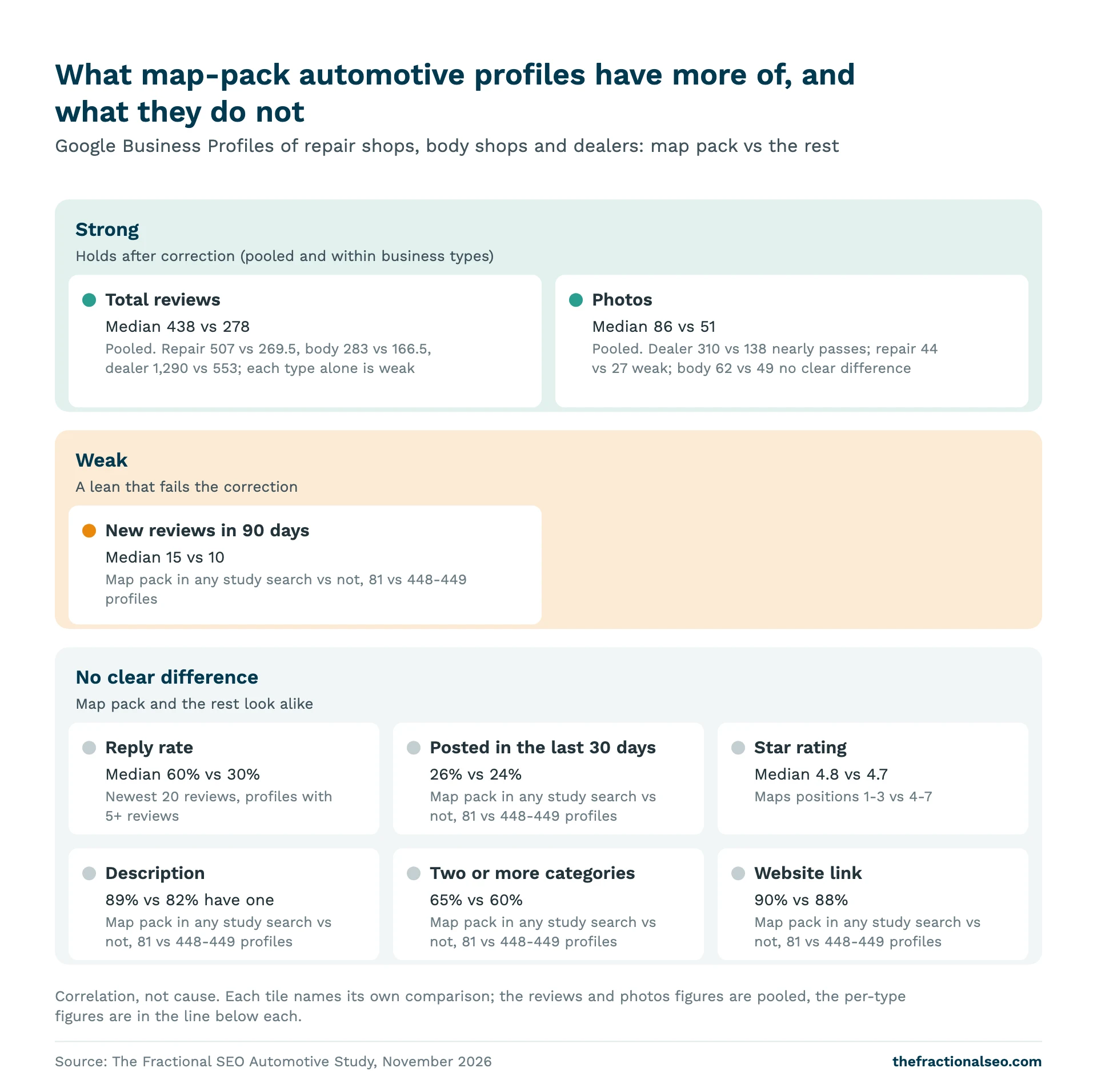
The short version: reviews and photos are the two profile figures that separate the map pack, and the gaps hold when each profile is ranked against its own type of business. The setup basics are near universal and separate nobody. Replies and posts are worth doing for customers, but our data shows no ranking edge for either.
What map-pack automotive profiles have more of
Two figures show a clear gap with the map pack, and both were strong results statistically, pooled across all three business types and when each profile is ranked against its own type:
- Reviews: businesses that reach a map pack have a median of 438 Google reviews vs 278 for those that don’t. The gap points the same way for repair shops, body shops and dealers, though each type alone is too small to pass the correction for the number of tests we ran.
- Photos: a median of 86 vs 51. Here the types differ: dealers 310 vs 138 (nearly passes on its own), repair shops 44 vs 27 (weak), and for body shops (62 vs 49) the gap is not clear.
The levels are very different by business type, so compare yourself with your own kind of business, never one automotive number. In the table, “rest” means profiles seen in that type’s Maps results (positions 1-20) but never in its map pack.
| Business type | Reviews: map pack vs rest (median) | Photos: map pack vs rest (median) | Reviews: all Maps listings (median) |
|---|---|---|---|
| Auto repair shops | 507 vs 269.5 | 44 vs 27 (weak) | 276 |
| Auto body shops | 283 vs 166.5 | 62 vs 49 (no clear difference) | 178 |
| Car dealerships | 1,290 vs 553 | 310 vs 138 (nearly passes) | 613.5 |
Recent reviews lean the same way but not reliably: map-pack businesses got a median 15 reviews in the 90 days before collection vs 10 for the rest, a lean that fails the correction.
These showed no clear difference between map-pack businesses and the rest:
- Replies: a median reply rate of 60% vs 30% on the newest 20 reviews, but no clear difference, pooled or in any business type.
- Posts: 26% of map-pack businesses posted in the 30 days before collection vs 24% of the rest.
- Star rating: a median of 4.8 at positions 1-3 vs 4.7 at positions 4-7.
- Basics: a description (89% vs 82%), more than one category (65% vs 60%) and a website link (90% vs 88%).
One caution. This is a correlation: reviews and photos may mark established, busy businesses rather than cause the ranking. The study shows what map-pack profiles have, not what put them there. For the review side in detail, see what 530 automotive profiles show about reviews.
Download the checklist
The free checklist turns this page into 21 items: reviews, photos, setup for your type of business, replies, posts and a monthly check. Each data-backed item carries its figure from our study, on two printable pages or a Google Sheet you can copy. It covers the profile only. For your website, Yelp and the rest of local SEO, use the local SEO checklist for auto repair shops, body shops and dealerships.
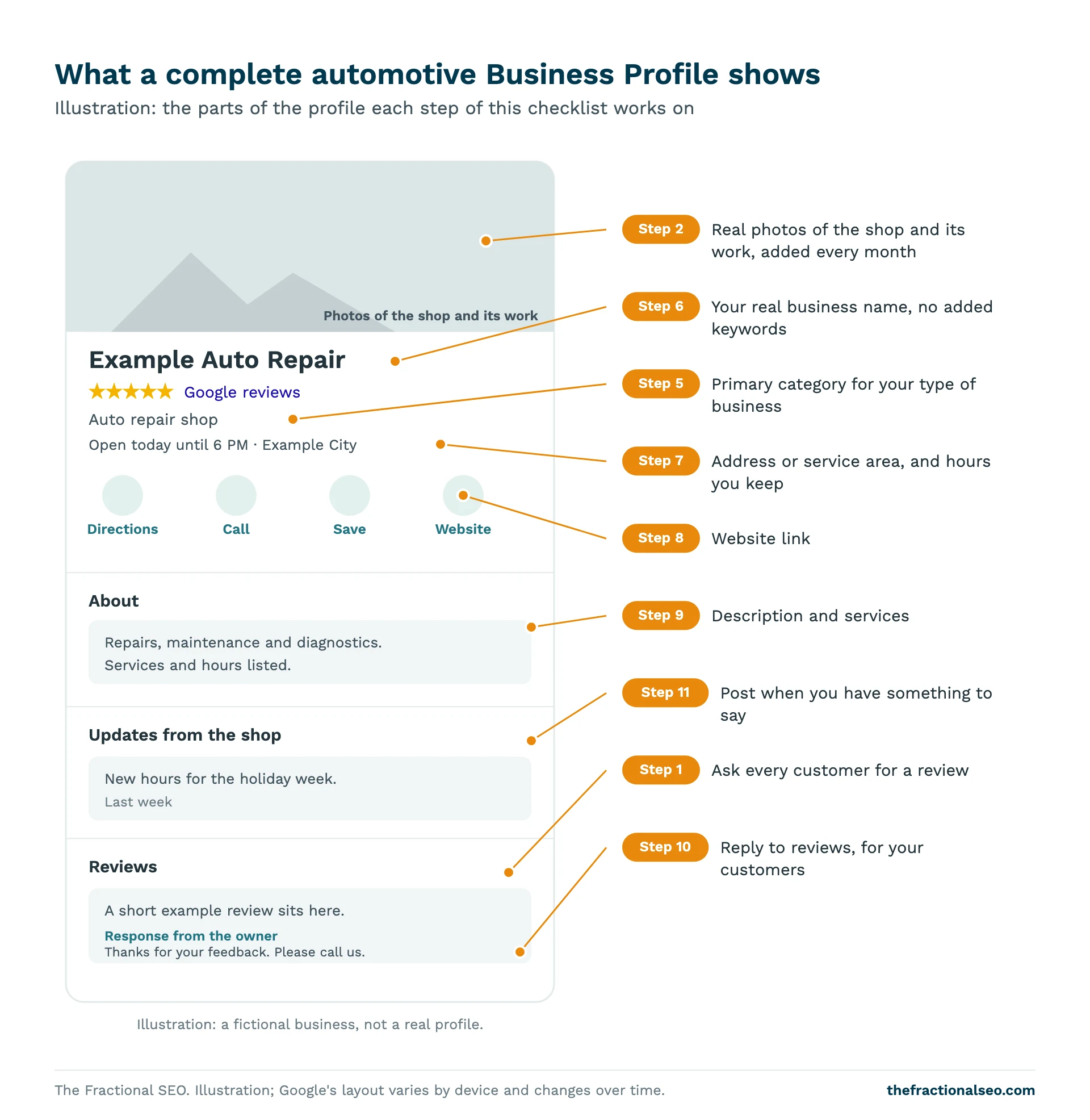
Step 1: Ask every customer for a review
Reviews are the clearest gap. Businesses that reach a map pack have a median of 438 reviews vs 278 for those that don’t, and the gap holds when each profile is compared only with its own type. By type, map-pack repair shops have a median of 507 vs 269.5, body shops 283 vs 166.5 and dealerships 1,290 vs 553. These figures describe the sample; they are not targets. Google’s own local ranking page says more reviews and positive ratings can help a business’s local ranking.
One more thing the data shows: the review gap is between businesses that reach a pack and the wider field, not between neighbours on the list. Compare yourself with the map pack for your own type of business in your own town.
Make asking part of how every job or sale ends:
- Get your review link or QR code from the profile. Google’s help page on reviews says you can share either.
- Repair shops: ask at pickup, when the customer has the keys back, and text the link the same day.
- Body shops: ask at delivery, once the customer has seen the finished repair, including on insurance jobs.
- Dealers: ask at delivery and again after the first service visit. Ask service customers too.
- Ask every customer, not only the ones you expect to be happy. Google’s content policy says businesses may not “selectively solicit positive reviews from customers,” should not pressure anyone to review while on the premises, and should not ask for specific content. That includes asking customers to name a salesperson or technician.
- Never pay for a review or offer a discount, a free oil change or any other service for one. The same policy bans incentives, and reviews from employees count as a conflict of interest.
Step 2: Add real photos every month
Map-pack profiles have more photos: a median of 86 vs 51, and the gap holds when each profile is ranked against its own type. It is clearest for dealers (310 vs 138, nearly passing on its own), weak for repair shops (44 vs 27) and not clear for body shops (62 vs 49). Photo counts include customer photos.
Add your own photos as the work happens, and match them to your business:
- Repair shops: the bays and lifts, diagnostic equipment, technicians at work (with their OK), the front counter and waiting area, and the shop front and sign so customers can find the entrance.
- Body shops: before-and-after repairs shot from the same angle, the paint booth and frame equipment, the finished car at delivery, and the drop-off entrance.
- Dealers: the lot, the showroom and the service drive, real vehicles on your lot rather than maker images, and delivery photos with the customer’s permission.
Google’s photo guidelines ask for JPG or PNG files between 10 KB and 5 MB, recommend 720 px tall and 720 px wide, and say the image should represent reality, with no heavy edits or filters. Photos show on Google only after the profile is verified. Keep plates and customers’ faces out of the frame unless you have permission.
Step 3: Count new reviews every month
Recent reviews lean with the map pack but not reliably: a median 15 reviews in the 90 days before collection vs 10, a lean that fails the correction, pooled and in each type (dealers 39 vs 18, repair 16 vs 9, body 12 vs 8). We read only the newest 40 reviews per profile, so busy dealers are undercounted. Count your new reviews each month anyway. A falling count tells you the asking has stopped.
Step 4: Claim and verify your profile
513 of the 530 automotive profiles in our study are claimed, so if yours isn’t, fix that first. Search for your business on Google Maps and claim the profile if one exists, rather than making a second one. Verify it with one of the methods Google offers you. Add a second owner or manager from your business so the profile isn’t tied to one login. If an agency runs it, make them a manager, not the owner.
Step 5: Pick the primary category for your type of business
Map-pack profiles use the plain category: “Auto repair shop” on 26 of 27 auto repair pack profiles and “Auto body shop” on 26 of 27 body-shop pack profiles. If you fix cars, “Auto repair shop” describes you. If you do collision work, “Auto body shop” does. A body shop that also does mechanical work can add “Auto repair shop” as an additional category.
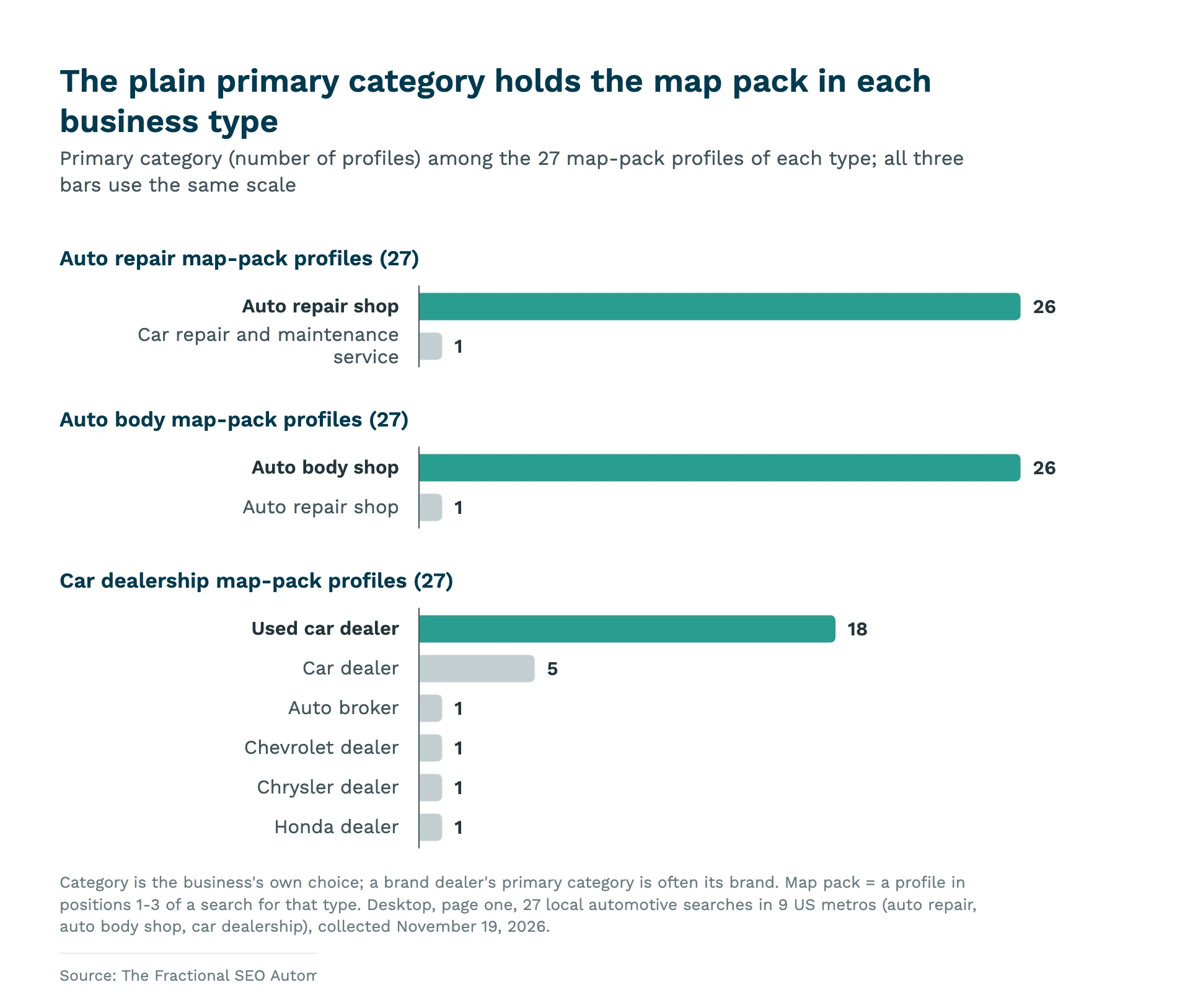
Dealers are different. The “car dealership” map pack is mostly used-car lots: 18 of 27 pack spots go to businesses whose Google category is “Used car dealer”, brand categories (such as “Honda dealer”) hold 3 and “Car dealer” 5. Used-car dealers are also most of the dealer listings overall (123 of 180), so this is the market Google returns, not proof that used lots outrank franchised stores. Pick the category that describes what you sell. Google’s page for car dealerships recommends “Car dealer” for sales, says new-car dealerships can have a profile for each brand of new cars sold and used-car dealerships can’t, and allows separate profiles for departments such as service and parts, named with the dealership name plus the department. Its guidelines say each department’s main category must differ from the main business’s. More in local SEO for car dealerships.
Google’s help page on editing your profile says all locations of a business must share a primary category, that you can select up to 9 more, and that you shouldn’t use categories solely as keywords. Its guidelines say to choose the fewest categories it takes to describe your core business. Using more than one category showed no clear difference (65% vs 60%). Add one only for work you actually do, such as tires or alignment.
Step 6: Use your real business name
Use the name on your sign and invoices. Google’s guidelines say the name should reflect your real-world name, and that including unnecessary information isn’t permitted and could get the profile suspended. That rules out adding “Brakes, Tires and Oil Change” or your city to the end. In our data, 1 Maps listing matched our keyword-name rule and it sat outside the map pack. The flag is rule-based, not proof. Either way, it isn’t worth copying.
Step 7: Set your address, service area and hours
Address. Customers come to you, so show the address. Google’s guidelines say an auto repair shop with a garage that also offers roadside service can show its storefront address and set a service area. Don’t add a service area unless you actually go to customers.
Hours. Set the hours someone answers the phone and the doors are open. Google’s guidelines say car dealerships should use car sales hours, and the new-car sales hours if new and used differ; a service department’s hours go on its own profile. Set special hours for holidays and other temporary closures.
Step 8: Link your website
A website is not required for a map-pack spot: 8 of 81 map-pack spots went to businesses with no website on their Google listing, 4 auto repair and 4 auto body. Across all Maps results, 38 of 178 auto repair listings had no website, against 23 of 179 body shops and 2 of 180 dealers. On the profile side a website link showed no clear difference (90% vs 88%). Link one anyway: it is where a customer checks your services, warranty and booking before calling. Point it at your homepage, or the page for this location if you have several, and add UTM tags so your analytics shows visits from the profile.
Step 9: Write the description and services
Google’s edit page says not to exceed 750 characters and not to include URLs. Its guidelines rule out links of any type and descriptions that focus on promotions, prices or sales. A description showed no clear difference (89% vs 82%), so write it for the customer and move on: what you work on, which makes or kinds of repair, and where you are. Then fill in the services list. Google’s guidelines say a car repair shop’s service menu should list the complete set of services you offer.
Step 10: Reply to reviews, for your customers
Most guides we read say to reply, and it is good practice. But replying showed no clear difference between map-pack businesses and the rest, pooled or in any business type. Habits vary: 25% of profiles replied to none of their newest reviews and 31% to 90% or more. So reply because customers read it, not to move rankings.
Google’s help page says that when you reply, you show customers you value their feedback, and the reviewer is notified. Thank good reviews briefly and mention the job (“glad the brakes feel right again”). Answer a bad one calmly, once, and offer to sort it out by phone. Never repeat a customer’s name, plate or details.
Step 11: Post when you have something to say
Posts showed no clear difference: 26% of map-pack businesses posted in the 30 days before collection vs 24% of the rest, and 33% of profiles had no post at all. Dealers post most. Google’s help page on posts lists updates, offers and events, and says posts older than 6 months are archived unless a date range is set. A new service, a holiday schedule or a finished job is enough. If a dealer post shows a vehicle price or a financing offer, check your state’s rules first.
Step 12: Check performance monthly
Once a month, note calls, website clicks and direction requests from the profile’s performance view, and compare with the same month last year.
What the profile can’t do on its own
Google’s local ranking page says local results are mainly based on relevance, distance and popularity, and that there’s no way to request or pay for a better local ranking. No profile setting changes how far you are from the searcher.
In automotive search the profile is most of what a business controls on page one, because the organic results below the map mostly belong to directories. Only 9% of page-one organic results in our searches went to a repair shop’s, body shop’s or dealer’s own website: 22 of 233. Yelp was on page one of 26 of the 27 searches, and of 73 map-pack businesses with a website, 2 also appeared on page one of the organic results for the same search. So your Yelp and directory profiles are part of the job too: see the directories that hold page one, the local SEO guide for repair and body shops and, for dealers, local SEO for car dealerships.
Work through the checklist, then talk to us about the rest of your local SEO: SEO for automotive businesses.
Questions, answered
What Google Business Profile category should an auto repair shop use?
“Auto repair shop”. It is the primary category on 26 of 27 auto repair map-pack profiles. Body shops show the same pattern with “Auto body shop”. Add others only for work you actually do.
How many Google reviews does a shop or dealer need?
There’s no set number, and it depends on the business. Map-pack medians are 1,290 for car dealerships, 507 for auto repair shops and 283 for body shops. Compare yourself with the map pack in your own town.
Does replying to Google reviews help rankings?
Not in a way we could measure. The reply rate showed no clear difference between map-pack businesses and the rest. Reply anyway: customers read replies before they call.
How often should we post on Google?
When you have something worth saying. Posting showed no clear difference (26% vs 24% in 30 days). Dealers post the most.
Does star rating matter?
Ratings barely differ: a median of 4.8 at positions 1-3 vs 4.7 at 4-7, no clear difference. Dealers rate slightly lower overall (4.6) than repair shops (4.7) and body shops (4.8).