
Research & Benchmark Automotive
We Analyzed 331 Automotive Websites: The Gaps Repair, Body Shop and Dealer Sites Leave Open
The lists of auto shop website mistakes that rank today are opinion, mostly from people who sell websites or marketing, and none of the ones we read measured a single automotive site. We wanted numbers. We analyzed 27 local searches across 9 US metros and three automotive search types (auto repair, auto body shop and car dealership), 435 automotive business websites (331 crawled) and 530 Google Business Profiles, November 2026. We counted how often each common gap shows up on repair, body shop and dealer sites, and we checked which website features line up with the map pack. The plain answer: no website feature clearly separates the businesses Google puts in the map pack from the rest. We could not even run the comparison for the regular results, because directories fill them. The gaps are still real, and they differ by business type. Here is how common each one is, and what we would fix first for the customers who click through to your site.
These numbers are a single snapshot from November 2026 (searches run on 19 November), so rankings, review counts and ad activity will move over time. This study is about websites. For who actually shows up when a driver searches, read who wins local automotive searches. To see how we approach this work, start with how we work with automotive businesses. The sample, dates and limits are in the Method card on this page.
Key findings at a glance
- No website feature clearly separates the map pack. No homepage or crawl feature clearly separates map-pack businesses from the rest, pooled or within a business type. The groups are small, so read that as no clear difference, not proof of no effect.
- No organic comparison is possible. Only 9% of page-one organic results went to a repair shop’s, body shop’s or dealer’s own website: 22 of 233. Directories hold 79%.
- Three businesses, three kinds of website. Dealer homepages show financing (89%) and inventory (77%). Repair homepages show warranties (55%) and coupons (46%). Body-shop homepages show insurance-claim help (52%).
- Blogs are mostly dormant: 34% of crawled sites have a blog section, but 11 of 331 published a post in the 12 months before the crawl.
- Dealer homepages are slowest on a phone: median score 56 and 7.4 seconds to show the main content.
- Schema is uncommon: LocalBusiness schema is on 35% of repair sites, 27% of body-shop sites and 8% of dealer sites.
- The clear gaps are on the Google profile: map-pack businesses have more reviews and more profile photos.
What the data does not show: a website feature that separates the map pack
We compared businesses that reached the map pack (positions 1-3 of the Google Maps list) in at least one study search with businesses seen in the Maps results that never did. That is 55 map-pack homepages against 268 others, and 15-19 map-pack sites per business type when we ran each type on its own.
We tested online booking, coupons, warranties, ASE or OEM certification, financing, inventory, trade-in tools, prices, Spanish, same-day service, loaners, schema, blogs, forms and the city in the title. Every one showed no clear difference, pooled or within a business type. When you run this many tests, a few look meaningful by luck, so we used a standard correction (Holm) that raises the bar for each one. Nothing passed it.
Two features came closest, and both fail the correction. A price disclaimer on dealer homepages showed up on 3 of 17 map-pack dealer sites against 0 of 82 others. Location pages were on 53% of map-pack businesses’ sites against 37% of the rest, a lean that is mostly dealers. Speed showed no clear difference either (median mobile score 60 vs 62), and neither did links (median referring domains 113 vs 103.5).
We could not check the regular results at all. Organic results 1-3 vs 4-10 are too few to compare: 6 vs 11 crawled provider sites, because directories fill the organic results. So there is no organic comparison in this study.
Be careful with what that means. The groups are small, and a real but modest edge can hide in groups this size. The right reading is “no clear difference in this sample”, not “websites don’t matter”. What the data does not support is the sales pitch that one website fix will lift you past the shops above you.
The clear gaps sit on the Google profile. Businesses that reach a map pack have more Google reviews: median 438 vs 278 pooled, and the gap holds when each profile is ranked against its own business type. It points the same way in all three: auto repair 507 vs 269.5, auto body 283 vs 166.5, car dealership 1290 vs 553, though each type alone is too small to pass the correction. Map-pack businesses also have more profile photos, and that gap holds within business types too: car dealership 310 vs 138 (the clearest, though still short of the correction on its own), auto repair 44 vs 27 (weak). For body shops the photo gap is not clear (62 vs 49). Both are correlations, not causes. The review gap lines up with Google’s own local ranking help page, which says prominence is based on things like how many websites link to your business and how many reviews you have. We cover the profile in what 530 Business Profiles show about reviews and our Google Business Profile checklist.
So why fix the website at all? Because that is where a profile click lands. 90% of map-pack profiles and 88% of the rest link a website. A driver who taps through from your profile is deciding whether to call you. The gaps below are about that person, not about Google.
Three businesses, three kinds of website
Automotive websites tell three different stories, so we report their content by business type. Dealer homepages show financing (89%), vehicle inventory (77%), trade-in tools (68%) and prices (52%). Repair homepages show warranties (55%), coupons (46%), online booking (41%) and ASE certification (32%). Body-shop homepages show insurance-claim help (52%), warranties (48%) and OEM certification (30%). These are signals found on the homepage; a site may say the same thing on another page.
| On the homepage | Auto repair (121) | Auto body (118) | Car dealer (101) |
|---|---|---|---|
| Warranty | 55% | 48% | 39% |
| ASE certification | 32% | 4% | 2% |
| OEM certification | 10% | 30% | 2% |
| Insurance-claim help | 4% | 52% | 0% |
| Coupons | 46% | 10% | 33% |
| Online booking | 41% | 9% | 15% |
| Same-day service | 26% | 9% | 0% |
| Loaner or shuttle | 23% | 20% | 1% |
| Financing | 31% | 12% | 89% |
| Vehicle inventory | 1% | 3% | 77% |
| Trade-in tool | 0% | 2% | 68% |
| Prices shown | 7% | 2% | 52% |
| Spanish | 5% | 7% | 15% |
| Form on the homepage | 23% | 33% | 56% |
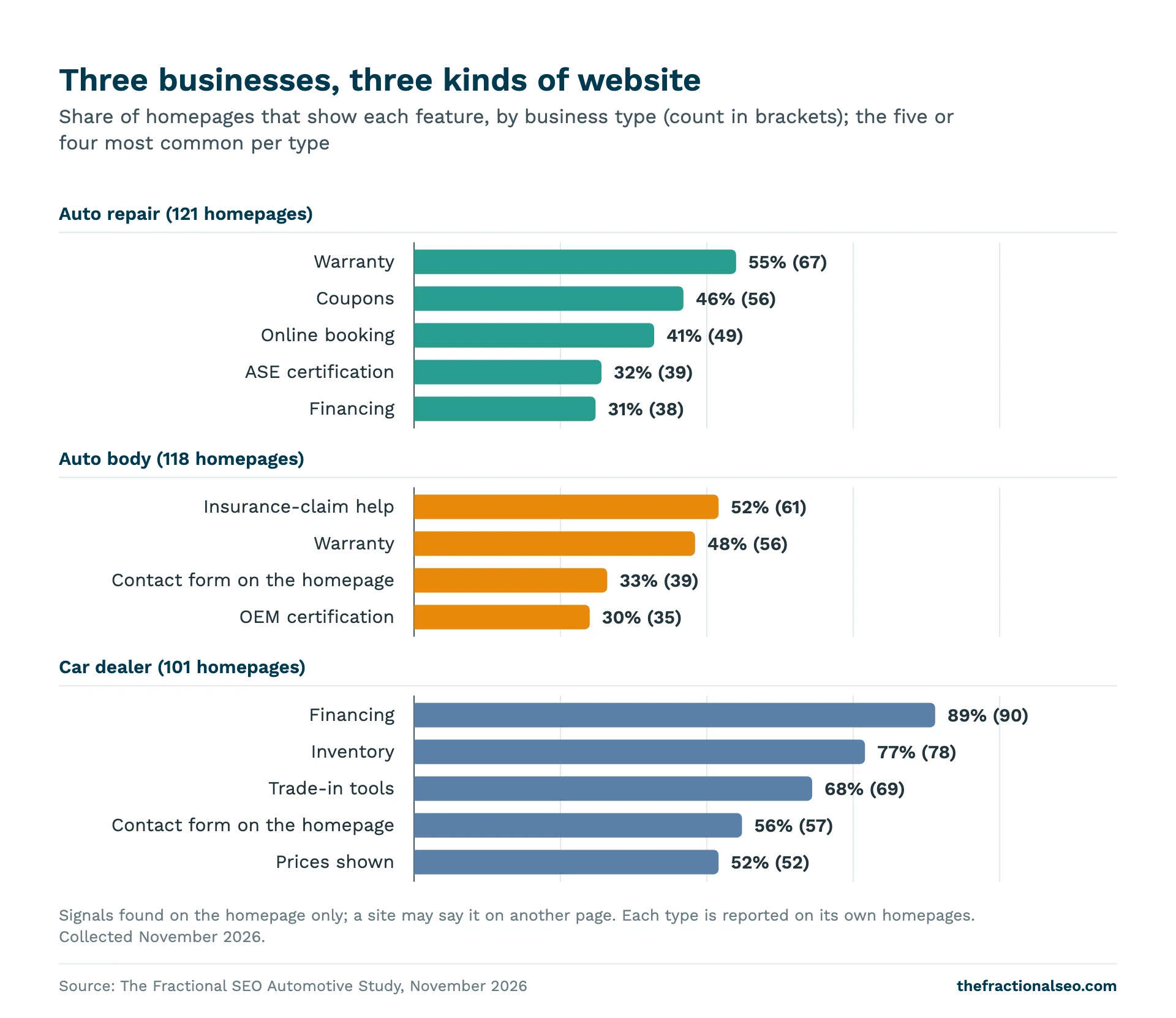
Prices are rare outside dealerships: 7% of repair homepages and 2% of body-shop homepages show a price, against 52% of dealer homepages, where the prices are vehicle prices. A fee, tax or title disclaimer near a price appears on 4 of 101 dealer homepages. That count describes what homepages show. It is not a compliance finding: disclaimers can sit on vehicle pages our homepage read did not cover. Rules for advertised vehicle prices vary by state, so check your state’s rules with someone who knows them. We give no advice on price, fee or financing wording here.
Dealers get their own guide: local SEO for car dealerships. The rest of this page gives each gap by business type, because a pooled number would mostly describe whichever type happens to be largest.
Gap 1: A blog nobody has posted to in a year
Blogs are mostly dormant: 34% of crawled sites have a blog section, but 11 of 331 (3.3%) published a post in the 12 months before the crawl and 5 posted monthly. By business type, 43.8% of repair sites have a blog section (4 posted in 12 months), 29.4% of body-shop sites (5 posted) and 30.6% of dealer sites (2 posted). Our crawl stopped at 500 URLs on 20 sites, so a very large blog could be undercounted.
Having a blog showed no clear difference between map-pack businesses and the rest. So this is not evidence that blogging gets a shop into the map pack.
What a dead blog does, in our view, is make the site look abandoned. A driver who clicks “Blog” and finds a post from years ago learns nobody is minding the site. If you can’t post at least once a month, take the blog out of the main menu. If you do post, answer the questions your service writers hear every day: what a check-engine light usually means, how a claim works with the insurer, what a trade-in appraisal looks at. Those pages help the customer who is already on your site.
Gap 2: Slow homepages on a phone
Automotive homepages are slow on mobile: median Lighthouse performance score 62, median largest contentful paint 6.9 seconds, and 67 of 412 (16%) load the main content within Google’s 2.5-second line. Dealer homepages are slowest (median score 56, 7.4 s). Repair homepages have a median score of 65 and body-shop homepages 65.5. The median homepage weighs 3.1 MB, and 112 of 412 are over 5 MB. These are lab tests on a simulated phone, one run per homepage, so any single score is noisy; the medians across 412 homepages are steadier.
Google has real-user (Core Web Vitals) data for 126 of 435 sites; of the 109 it assessed, 42 pass (39%).
Speed showed no clear difference between map-pack sites and the rest. Google’s Core Web Vitals page asks site owners to strive to have the main content load within the first 2.5 seconds, and says good Core Web Vitals line up with what its core ranking systems seek to reward. In our sample, speed did not clearly separate the map pack. The reason to fix it is the driver on the shoulder with a phone, deciding whether to wait for your page or tap the next one.
Our view, not study data: dealer pages are heavy because they load inventory photos, sliders and chat widgets before the visitor sees anything. Repair and body-shop pages often carry big hero images and video. Size photos to the space they fill, load the gallery and inventory below the fold lazily, and drop widgets nobody uses. Then run the homepage through PageSpeed Insights on mobile again.
Gap 3: Few ways to ask for work on the homepage
78% of crawled sites have a tap-to-call phone link and 36% have a form on the homepage. Forms differ by business type: dealers 56%, body shops 33%, repair 23%. Online booking is on 41% of repair homepages, 9% of body-shop homepages and 15% of dealer homepages.
Neither forms nor booking showed a clear difference between map-pack businesses and the rest. This is a lead question, not a ranking one. Our view: a form takes requests when nobody can answer the phone, so give each type the form its customer needs. A repair shop needs an appointment request that asks for the vehicle and the problem. A body shop needs an estimate request with a photo upload and a field for the insurance company. A dealer needs test-drive and trade-in requests that reach a person quickly. Keep the phone number tappable on every page.
Gap 4: No LocalBusiness schema
24% of crawled sites carry LocalBusiness (or a subtype) schema: 35% of repair sites, 27% of body-shop sites, 8% of dealer sites. Schema is code that states your business name, address, phone and hours in a format search engines read directly. The automotive subtypes are AutoRepair, AutoBodyShop and AutoDealer.
It showed no clear difference between map-pack businesses and the rest. And Google’s LocalBusiness documentation says Google does not guarantee that features that consume structured data will show up in search results. Add it because it is cheap and keeps your details consistent. Many WordPress SEO plugins can output it. This data gives no reason to expect it to move your listing.
Gap 5: Thin location and service pages
40% of crawled sites have at least one location or service-in-city page, and 59% have service pages. By business type: repair sites 46.3% with location pages and 64.5% with service pages; body-shop sites 33.6% and 58.0%; dealer sites 40.8% and 53.1%. Among sites with any location pages, the median is 6.
Location pages lean toward the map pack but not reliably: 53% of pack businesses’ sites vs 37% of the rest, a lean that fails the correction. The lean is mostly dealers (73% vs 36%, still failing the correction on 15 pack sites); repair and body shops show no clear difference. So this data does not show location pages as a ranking factor.
In our view, the gap is less about having pages and more about what is on them. A page that swaps the city name into the same paragraph tells a driver nothing. A repair page for brakes, diagnostics or transmission work that says what you check, how long it takes and what the warranty covers is worth reading. So is a collision page that explains how you work with insurers and which makes you are certified for. Our guide to local SEO for auto repair and body shops covers how to plan the set.
Gap 6: Basics left off the page
31% of sites lack a meta description on a quarter or more of their pages, 25% lack an H1 on a quarter or more, and 11% repeat titles on a quarter or more. These are cheap to fix: a crawler lists every page that is missing one.
70% of titled homepages name the business’s metro in the title. The city in the title showed no clear difference in the map-pack comparison. Put your service area in the title anyway, because it tells a driver you are near them.
Prices are another gap. 7% of repair homepages and 2% of body-shop homepages show a price. Prices showed no clear difference either. Our view: repair and collision jobs vary too much for a price list, but a page that explains what drives the cost of a common job, such as brakes or a bumper repair, answers the first question without locking you into numbers. Repair estimate rules vary by state, so check your state’s rules before you publish any figure.
Gap 7: Websites that get little search traffic
The median website gets an estimated 929 organic visits a month for car dealerships, 309 for auto repair and 207 for auto body. 93 of 435 sites (21%) get under 100. These are DataForSEO estimates, not analytics, and chains with national sites inflate the top end.
The reason is on the results page. Only 9% of page-one organic results for local automotive searches go to a repair shop’s, body shop’s or dealer’s own website: 22 of 233. Directories alone hold 79% (183). In 19 of the 27 searches, no repair shop, body shop or dealer website appears on page one at all. And of 73 map-pack businesses with a website, 2 also appear on page one of the organic results for the same search.
So the honest plan is not “rank your website on page one”. The map pack is where a shop or dealer can win, and the organic page is mostly Yelp and other directories. Your profiles on those sites are part of your search presence. See the directories in local automotive search for which ones show up and what they charge, and our benchmark of 27 searches for the full picture.
What automotive websites already get right
Every crawled site uses HTTPS (331 of 331). Tap-to-call links are common in every type: 76.9% of repair sites, 71.4% of body-shop sites and 85.7% of dealer sites. Repair homepages put warranties (55%) up front, body shops explain insurance claims (52%), and dealers show financing (89%) and inventory (77%). WordPress leads the identified platforms (103 of 145), and 48 of 121 repair sites run on it. Dealer sites run on dealer platforms: the crawl could identify a common CMS on 26 of 98 of them. On either, in our view, most of the gaps above are edits to the site you have, not a rebuild. For the platforms themselves, see shop management and dealer website software.
The gaps by business type
Here is every gap in one place. Use the column for your business, not the average.
| Gap | Auto repair | Auto body | Car dealer |
|---|---|---|---|
| Blog section | 43.8% | 29.4% | 30.6% |
| Sites that posted in the last 12 months | 4 | 5 | 2 |
| LocalBusiness schema | 34.7% of 121 | 26.9% of 119 | 8.2% of 98 |
| Form on the homepage | 28 of 121 | 39 of 118 | 57 of 101 |
| Tap-to-call link | 76.9% | 71.4% | 85.7% |
| Location pages | 46.3% | 33.6% | 40.8% |
| Service pages | 64.5% | 58.0% | 53.1% |
| Median mobile score | 65 | 65.5 | 56 |
| Median largest contentful paint | 6,485 ms | 6,692.5 ms | 7,446 ms |
| Homepages within 2.5 s | 22 of 131 | 21 of 128 | 27 of 162 |
| Estimated organic visits a month (median) | 309 | 207 | 929 |
How to check your own site in 30 minutes
Open your homepage on your phone. The figures in brackets are from the study; the advice is good practice, not study data, and none of it is a ranking promise.
- Minutes 1-5, the ask. Can a customer request an appointment, an estimate or a test drive without leaving the homepage? Is the phone number tappable? (Homepage forms: repair 23%, body shops 33%, dealers 56%.)
- Minutes 5-10, the reason to pick you. Is your warranty, insurance-claim help or financing visible without scrolling far, whichever your customer needs?
- Minutes 10-15, speed. Run the homepage through PageSpeed Insights on mobile. Note the largest contentful paint and the page weight. (Median largest contentful paint: repair 6,485 ms, body shops 6,692.5 ms, dealers 7,446 ms.)
- Minutes 15-20, services and areas. List the jobs you want more of and the towns you want customers from. Count how many have their own page with real content.
- Minutes 20-25, the blog. Check the date of the newest post. Over a year old? Commit to a schedule or take the blog out of the menu. (11 of 331 posted in 12 months.)
- Minutes 25-30, basics. Does the homepage title name your area? Does the site carry LocalBusiness schema of the right subtype? Do your name, address and phone match your Google profile?
For the full list, work through our local SEO checklist for automotive businesses.
FAQs
What are the most common website mistakes for auto repair shops?
Dead blogs and slow pages on phones. 43.8% of repair sites have a blog section, and 4 of them posted in the last 12 months. The median repair homepage scores 65 on mobile. Only 23% have a form on the homepage, and 35% carry LocalBusiness schema.
What makes map-pack automotive businesses different?
Not their websites, in this sample: no website feature clearly separates them from the rest. The clear gaps are on the Google profile. Map-pack businesses have more reviews, and the gap points the same way in all three business types, though each type alone is too small to pass our correction. They also have more profile photos; for body shops that gap is not clear. Those are correlations, not causes.
Does website speed affect auto shop rankings?
Speed showed no clear difference here: a median mobile score of 60 for map-pack sites vs 62 for the rest. Google’s own page says good Core Web Vitals line up with what its core ranking systems seek to reward. In our sample, speed did not clearly separate the map pack. Fix it for the customer on a phone.
Do body shops and dealers need different websites?
They already have them. Body-shop homepages lead with insurance-claim help (52%) and OEM certification (30%). Dealer homepages lead with financing (89%), inventory (77%) and trade-in tools (68%). Build for the questions your own customers ask.
Why does my shop’s website get so little search traffic?
Directories take most of page one: 79% of organic results in our searches. The median repair site gets an estimated 309 organic visits a month and the median body-shop site 207. On these searches, the map pack and directory listings fill most of what a searcher sees first, so your Google profile and directory profiles matter as much as the site.
Want to know which of these gaps your site has, and whether fixing any of them is worth it next to your Google profile? See how we work with automotive businesses.
More research & benchmarks
The whole Automotive library- Who Wins Local Automotive Searches: A Benchmark of 27 Searches Who holds page one and the map pack when people search for a mechanic, a body…
- Google Reviews and Automotive Rankings: What 530 Business Profiles Show Which parts of a Google Business Profile separate map-pack auto repair shops, body shops and dealerships…