
Research & Benchmark Chiropractors
HIPAA and Tracking Pixels: What 472 Chiropractic Homepages Load
We read the raw homepage code of 472 chiropractic practice websites to see which tracking tags they load. 26% load at least one advertising pixel, and 69% load some Google, advertising or session-recording tag. A pixel on a homepage is not by itself a HIPAA violation. The risk is greatest on booking, intake and condition pages and forms, and with any vendor that receives patient information without a business associate agreement. Here is what we found, what the rules say as of November 2026, what a federal court removed from the HHS guidance in June 2024, and what to check on your own site.
We analyzed 36 local searches across 12 US metros and three chiropractic search types, 511 chiropractic practice websites (473 crawled) and 521 Google Business Profiles, November 2026. We collected this data in mid-November 2026, when chiropractic searches are near their low point of the year, so review pace and ad activity may look different in summer. The tag data comes from the same homepages we used for the gaps 473 chiropractic websites leave open. The samples, dates and limits are in the Method card on this page.
Key findings
- About a quarter load an ad pixel. 26% of homepages load a Google Ads tag, a Meta pixel or another ad pixel in their raw HTML (Google Ads 18%, Meta 14%). 6% load a session-recording tool.
- Tools sold for HIPAA use are almost absent. Freshpaint on 0 homepages, Piwik PRO on 1.
- Pixels sit a little closer to patient information. 31% of homepages that offer online booking load one, vs 22% of the rest. None of these gaps survives a correction for the number of tests.
- No ranking edge. 34% of map-pack practices’ homepages load an ad pixel vs 24% of the rest: no clear difference.
- Every share is a floor. Tags fired through Google Tag Manager are invisible in raw HTML.
What we measured, and what raw HTML can’t show
For each homepage we read the HTML the server sends and looked for the code signatures of known tags: the Meta pixel, the Google Ads tag, GA4, Tag Manager, TikTok, LinkedIn and Bing ad tags, session-recording tools, call tracking and the analytics tools sold for healthcare use.
That method has a blind spot. Google Tag Manager is on 43% of chiropractic homepages, and anything it loads later does not appear in the raw HTML. 87 homepages load Tag Manager and nothing else we detect. 148 show no tag at all. So every share below is a floor: the real numbers are likely higher, and we can’t say by how much.
We also measured only what loads, not what it sends. A tag on the homepage tells us nothing about what it records on the booking page, which form fields it can read, or whether the practice has set it to strip personal details. The tag counts were not hand-checked.
What 472 chiropractic homepages load
Here is what showed up in the raw homepage HTML, from most to least common.
| Tag found in raw homepage HTML | Homepages | Share of 472 |
|---|---|---|
| Any Google, advertising or session-recording tag | 324 | 69% |
| Google Tag Manager | 202 | 43% |
| GA4 (Google Analytics) | 187 | 40% |
| Any advertising pixel | 122 | 26% |
| Google Ads tag | 84 | 18% |
| Meta pixel | 64 | 14% |
| Session recording (Hotjar 12, Microsoft Clarity 15) | 26 | 6% |
| Call tracking | 28 | 6% |
| TikTok, LinkedIn or Bing ad tag | 5 | – |
| Piwik PRO | 1 | – |
| Freshpaint | 0 | – |

An advertising pixel reports visits and actions back to an ad platform so the practice can measure ads and build audiences. A session-recording tool records how visitors move, click and scroll through a page so someone can replay the visit later. 16 homepages load both an ad pixel and a session-recording tool.
The tools sold for HIPAA use barely register: Freshpaint on 0 homepages and Piwik PRO on 1. That does not mean no practice has a careful setup. A server-side setup or a tool loaded through Tag Manager would not show here. It does mean the common pattern is the standard Google and Meta tags.
Pixels sit a little closer to patient information
The places where a pixel matters most are the ones nearest patient information: booking, insurance and conditions. So we split the homepages by what they mention. Online booking shows on 44% of homepages, insurance is named on 29% and conditions are named on 74%.
| Homepage mentions | Mentions it: loads an ad pixel | Does not mention it: loads an ad pixel | Fisher p |
|---|---|---|---|
| Online booking | 31% (63 of 206) | 22% (59 of 266) | 0.044 |
| Insurance accepted or named | 32% (44 of 139) | 23% (78 of 333) | 0.066 |
| Conditions named | 29% (102 of 351) | 17% (20 of 121) | 0.0078 |
| Auto accident or personal injury | 60 of 223 | 62 of 249 | – |

Pixels are more common on the homepages that offer booking, name insurance or name conditions. But none of these gaps survives a correction for the number of tests we ran across the study, so treat them as a pattern worth noticing, not a firm result. Auto-accident and personal-injury homepages show almost no gap.
63 homepages (13%) both offer online booking and load an advertising pixel; 37 of them load a Meta pixel. That is not proof of a problem. The booking page is often a separate page run by a scheduling company, and the homepage pixel may never fire there. It is the group where we would check first.
Naming insurance on the homepage suggests, but does not prove, that a practice bills insurance. That matters because billing insurance electronically is what usually brings a practice under HIPAA, as the next sections explain.
No ranking edge from pixels
Ad pixels do not line up with the map pack. Comparing practices that reached a map pack in any study search with those only seen at Maps positions 4-20, 34% vs 24% load an ad pixel (27 of 80 vs 79 of 327) and 16% vs 12% load a Meta pixel. Neither is a clear difference.
Session recording is the only tag where the gap reaches the usual bar before any correction: 11% vs 4%. It would not survive any correction. None of the 6 chain homepages loads an ad pixel in its raw HTML, likely because they load tags through Tag Manager. Correlation is not cause either way, and nothing here suggests that removing a pixel costs rankings or that adding one earns them.
Where the booking data goes: scheduler platforms
A booking platform or practice-software link shows on 27% of chiropractic homepages: Jane on 67 (14%), ChiroTouch 22, Zocdoc 20, Calendly 11, SKED 5, Acuity 4, ChiroFusion and ChiroHD 2 each. ChiroMatrix (now iMatrix), a website and marketing provider, shows on 13. Only tools that leave a trace on the homepage are detected, so this is not a usage share.
For most practices the booking form, the intake form and the reminders run on the scheduler’s pages, not on the practice’s own website. That moves the question. Whether your own pixel can fire inside the booking flow, whether the scheduler adds tracking of its own, and whether the vendor signs a business associate agreement are questions for the vendor. Our chiropractic software comparison records what each vendor’s own pages say about a BAA.
Does HIPAA apply to your practice?
Not every practice is under HIPAA. The federal definition of a covered entity includes a health care provider who transmits any health information in electronic form in connection with a HIPAA transaction, and the first transaction on the list is health care claims. In plain terms, a chiropractor who bills insurance electronically is a covered entity. A cash-only practice may not be.
You can’t tell which practices bill insurance from the homepage. Insurance is named on 29% of homepages and a cash price or membership plan on 17%, but those are mentions, not billing records. Your own billing setup is what counts.
If you are a covered entity, any vendor that creates, receives, maintains or transmits protected health information on your behalf is generally a business associate under the same definitions. That can include the scheduler, the reminder service, the call-tracking company and, if patient information reaches it, an ad or analytics platform.
What the HHS bulletin says, and what the court removed
On December 1, 2022, the HHS Office for Civil Rights issued a bulletin on tracking technologies used by HIPAA covered entities and business associates. It revised the bulletin on March 18, 2024. The HHS page itself refused our reads, so the wording below comes from court documents and law-firm copies, attributed each time.
The original bulletin, as quoted in the hospitals’ court brief, said that tracking technologies on a regulated entity’s user-authenticated webpages “generally have access to PHI”. Those are pages behind a login, such as a patient portal. It also said that an unauthenticated page that addresses specific symptoms or health conditions, or that lets people schedule appointments without logging in, “may have access to PHI in certain circumstances.” The court opinion notes that the revised bulletin said it does “not have the force and effect of law”.
In American Hospital Association v. Becerra (N.D. Tex.), decided June 20, 2024, the court took aim at one part of the guidance, which it called the “Proscribed Combination”: an online technology connecting a person’s IP address with a visit to an unauthenticated public page about specific health conditions or healthcare providers. The court declared that part unlawful, as “promulgated in clear excess of HHS’s authority under HIPAA”, and vacated it.
The court was explicit that the vacatur should not be read as limiting “the legal operability of other guidance” in the bulletin. HHS withdrew its appeal on August 29, 2024, according to the American Hospital Association, which was a party to the case, and a law-firm account agrees.
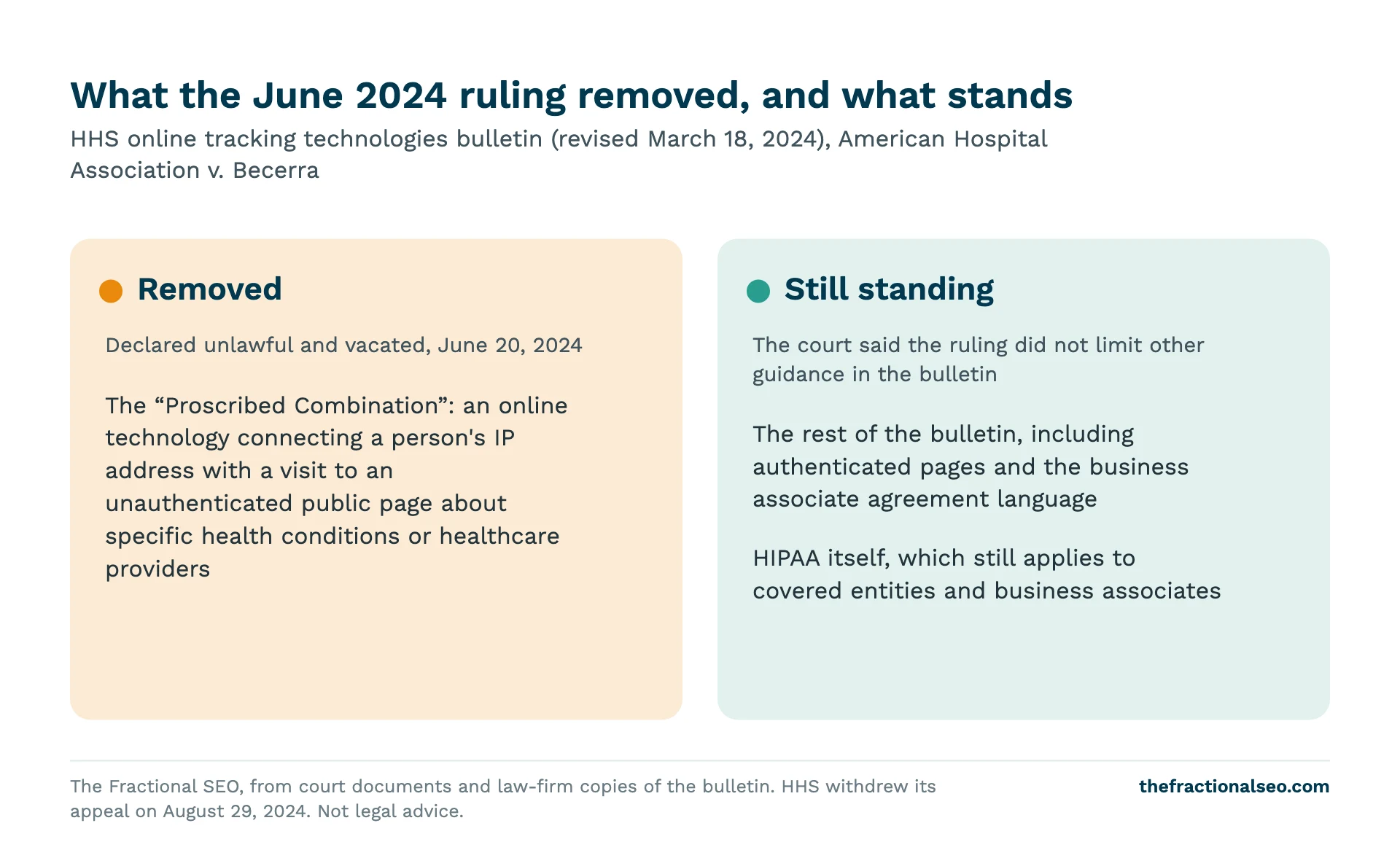
What that means for a practice website: the part of the guidance saying that an IP address plus a visit to a public conditions page triggers HIPAA obligations is the part the court removed. A booking or intake form is different. It collects a name, contact details and often a reason for the visit, and the ruling did not address what a pixel does with that. The rest of the bulletin still stands, and HIPAA itself still applies.
Business associate agreements
The bulletin’s own words on vendors, as reproduced by the law firm Proskauer: “Regulated entities must ensure that all tracking technology vendors have signed a BAA and that there is an applicable permission prior to a disclosure of PHI.” On vendors that offer to strip or de-identify data, it adds that any disclosure of PHI to the vendor without individuals’ authorizations “requires the vendor to have a signed BAA in place”.
For a covered entity, the practical test is simple to state. If a tag could send patient information to a vendor, that vendor needs a BAA with you, or the tag has to come off those pages. We did not read Google’s or Meta’s terms on BAAs and make no claim about them. Ask the vendor in writing.
If HIPAA doesn’t cover you: the FTC and state health-data laws
A cash-only practice outside HIPAA is not outside every rule. The FTC has gone after online health services that shared health data with ad platforms. In 2023 it proposed an order against BetterHelp, an online counseling service, over allegations that it gave consumers’ health information to advertising platforms including Facebook; the proposed order prohibits sharing that information with third parties for advertising. GoodRx, according to a law-firm summary of the proposed order, will pay a $1.5 million civil penalty. Neither is a clinic, and we found no FTC case against a chiropractic practice in what we read.
The FTC’s Health Breach Notification Rule is narrower than it sounds. It covers vendors of personal health records and related entities that are not covered by HIPAA, and its definition of a vendor leaves out HIPAA covered entities and business associates acting as such. A personal health record there means an electronic record that can draw information from multiple sources and is managed by or primarily for the individual, such as a patient app. The amendments took effect July 29, 2024.
State laws reach further, and they differ:
- Washington, My Health My Data Act (RCW 19.373). Beginning March 31, 2024, a regulated entity may not collect consumer health data without the consumer’s consent for a specified purpose, unless it is needed to provide a service the consumer asked for. Small businesses had until June 30, 2024. Sharing needs separate consent. The Act bans geofences around providers of in-person health care used to track people or send them ads, and a violation is treated as an unfair or deceptive act under the state’s Consumer Protection Act. It exempts information that is PHI under HIPAA, so it is aimed at health data HIPAA does not cover.
- Nevada, SB 370. Effective March 31, 2024. It requires affirmative, voluntary consent to collect or share consumer health data, with an exception for providing a requested service, and bars geofences within 1,750 feet of in-person health care providers for certain purposes.
- Connecticut, Public Act 23-56. In effect from July 1, 2023. Its 1,750-foot geofence ban covers mental health and reproductive or sexual health facilities, not health care in general, and it requires consent to sell consumer health data.
Those are three states, not a national rule. If you practice elsewhere, ask what your state requires.
What Google and Meta allow
The ad platforms set limits of their own. Google’s personalized advertising policy lists Health among its sensitive interest categories, and advertisers promoting products and services in those categories “are unable to use advertiser-curated audiences”. Customer match, your data segments (once called remarketing) and audience expansion are listed as not supported. In practice, a patient email list is not an ad audience.
Meta began removing detailed targeting options on topics people may perceive as sensitive, including options referencing health causes, organizations or public figures, on January 19, 2022. Its business tools terms did not load for us, so we say nothing about them here.
Review replies are a disclosure risk too
Tracking is not the only way patient information leaks online. Replies to reviews are public. Chiropractors reply often: a median reply rate of 62% of the newest 20 reviews in the map pack vs 70% for the rest, which is no clear difference. 36% of profiles reply to 90% or more of their recent reviews and 18% reply to none.
The Office for Civil Rights has settled cases over replies. According to a law-firm summary of the HHS announcement, OCR announced on October 2, 2019 that Elite Dental Associates in Dallas had agreed to pay $10,000. The practice had replied to a Yelp review with the patient’s last name and details of her treatment plan and insurance. Manasa Health Center, a New Jersey psychiatry provider, paid $30,000 in 2023 after replies on Google Reviews that mentioned patients’ diagnoses, per trade-press reports.
The rule for a reply: never confirm that the reviewer is a patient, and never mention their care. Thank them, invite them to call the office, and stop there. Our Google Business Profile checklist covers replies and review requests, and what 521 Business Profiles show about reviews has the review data.
What to do
This is not legal advice. Before you change how your practice handles patient data, talk to a healthcare privacy attorney. These are the questions we would bring to that conversation, in the order we would check them:
- List every tag. Open your Tag Manager account, or ask whoever runs it, and write down each tag and the pages it fires on. The homepage code is not enough: our scan missed anything loaded through Tag Manager.
- Keep ad pixels off patient pages. Booking, intake and insurance-verification pages, the patient portal and every form are where the remaining guidance applies. The court removed the HHS guidance on visits to public symptom and condition pages, but those pages still say the most about a visitor’s health, so we would keep ad tags off them too. Set ad tags to fire only on pages that carry no patient information, or remove them.
- Turn session recording off on any page with a form. A recording of someone typing into an intake form can capture patient information.
- Ask your scheduler vendor three things. Can our pixel fire inside your booking flow? Do you add tracking of your own? Will you sign a BAA?
- Measure ads another way. If you need conversion data, look at server-side setups or analytics vendors that will sign a BAA, and send only what you need.
- Get consent where state law requires it. Washington and Nevada require consent to collect consumer health data unless it is needed for a service the consumer asked for.
- Don’t build ad audiences from patients. Google’s health category bars advertiser-curated audiences, and a patient list is patient information.
- Keep review replies generic. No names, no conditions, no visit details.
- Write down who owns this. If an agency or website vendor runs your tags, get the tag list from them in writing and review it each year.
For the rest of the site, our local SEO checklist puts the tracking check in order with everything else.
Get help with chiropractic SEO
We are an SEO firm, not a law firm, and we don’t review compliance. What we do is local SEO for practices, and that work starts with knowing what your site loads and where. See how we work with practices on chiropractic SEO.
More research & benchmarks
The whole Chiropractors library- We Analyzed 473 Chiropractic Websites: The Gaps They Leave Open Eight common gaps on chiropractic websites, measured across 473 sites, and the plain result that no…
- Who Wins Local Chiropractic Searches: A Benchmark of 36 Searches Who holds page one and the map pack when patients search for a chiropractor, a sports…
- Google Reviews and Chiropractic Rankings: What 521 Business Profiles Show Which parts of a chiropractor's Google review profile lean with the map pack, which show no…