
Research & Benchmark Chiropractors
We Analyzed 473 Chiropractic Websites: The Gaps They Leave Open
The lists of chiropractic website mistakes we read were mostly written by companies that sell marketing services or software, and none measured how common any mistake is. We wanted numbers. We analyzed 36 local searches across 12 US metros and three chiropractic search types, 511 chiropractic practice websites (473 crawled) and 521 Google Business Profiles, November 2026. We compared the practices Google puts in the map pack with the ones it shows lower in Maps, feature by feature, and the plain result comes first: no website or homepage feature separates map-pack chiropractors from the rest once the number of tests is allowed for. Two features lean toward the map pack without passing that bar, named below as leans, not ranking factors. The gaps are still real for the patient reading your site. Here is how common each one is, and what we would fix first.
This study looks at chiropractic websites. For the other half of the picture, who actually shows up when a patient searches, read who wins local chiropractic searches. If you want to see how we approach this work, start with fractional SEO for chiropractors. We collected this data in mid-November 2026, when chiropractic searches are near their low point of the year, so review pace and ad activity may look different in summer. The sample, dates and limits are in the Method card on this page.
Key findings at a glance
- No feature separates the map pack. No website or homepage feature separates map-pack chiropractors from the rest once the number of tests is allowed for. The groups are small, so read that as no clear difference, not proof of no effect.
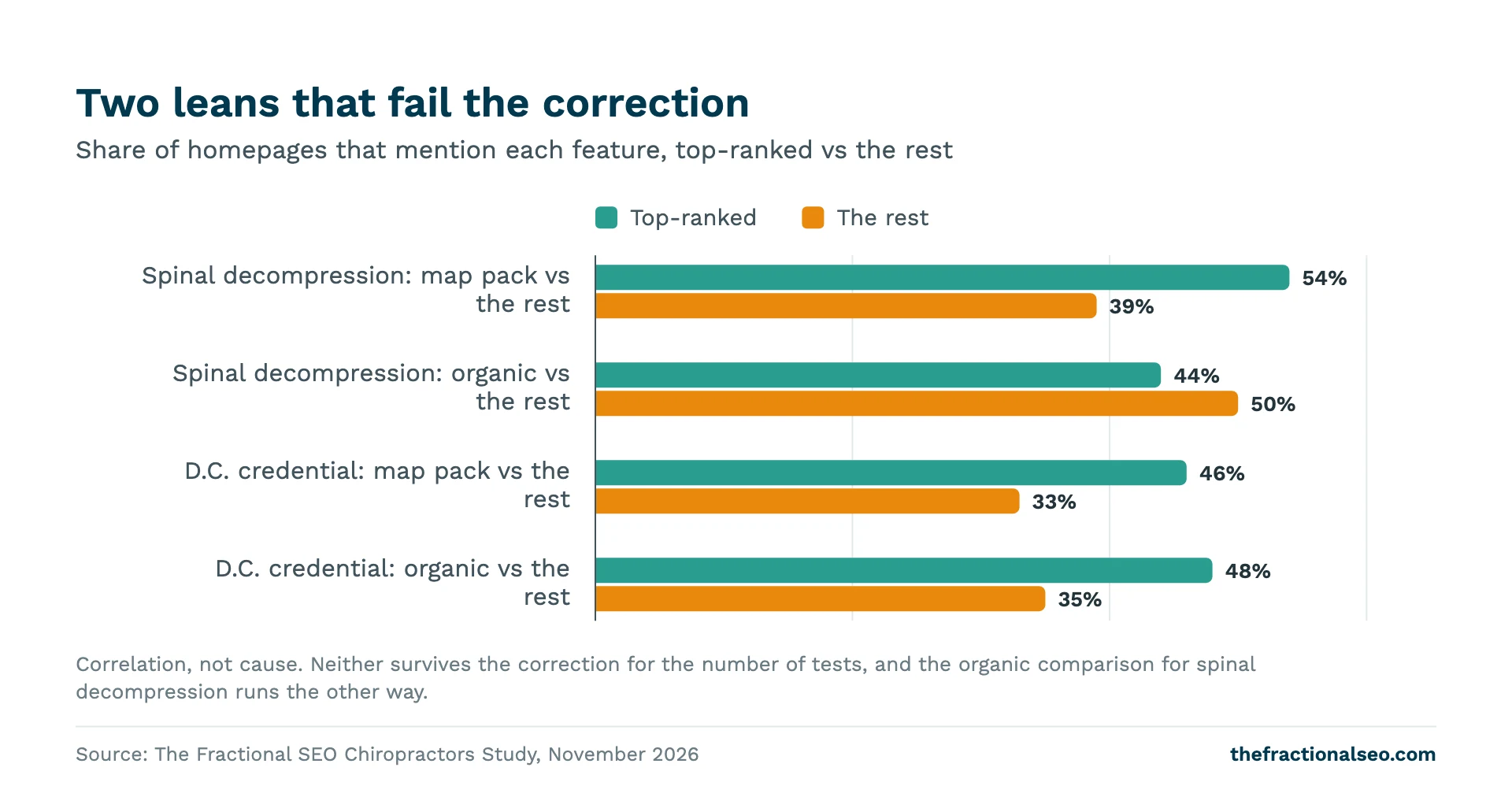
- Two leans that fail the correction: the homepage mentioning spinal decompression (54% vs 39%) and showing the chiropractor’s D.C. credential (46% vs 33%).
- Blogs go quiet: 62% of chiropractic-practice sites have a blog, but only 12% published anything in the last 12 months and 4% averaged a post a month.
- Phones wait: the median largest contentful paint is 6.8 seconds, and only 9% load their main content within Google’s 2.5-second target.
- Few homepage forms: 35% of chiropractic-practice websites have a contact or appointment-request form on the homepage itself.
- Basics left blank: 30% lack a meta description on a quarter or more of their pages.
- Ad pixels: 26% of chiropractic homepages load at least one advertising pixel in their raw HTML.
No website feature separates the map pack
We ran two comparisons. The map-pack comparison sets practices at positions 1-3 of the Google Maps list for a study search against those only seen at Maps positions 4-20. The organic comparison sets practice sites at positions 1-3 of the regular results against those at positions 4-10. A practice counts as top-ranked if it reached the top 3 in at least one study search.
Across both comparisons we tested 19 website and homepage features, from click-to-call and a homepage form to online booking, insurance, prices, location pages and a blog. When you run 67 tests, a few will look meaningful by luck, so we applied a standard correction (Holm) that raises the bar for each one. None of the 19 passed it. Location pages, which separated the Landscaping map pack, show no clear difference here (49% vs 43%).
Speed was no help either. Speed does not separate top-ranked chiropractic sites: map-pack practices’ homepages score a median 57.5 vs 64 for the rest (a lean toward the slower sites that fails the correction), and 65 vs 59 for organic top 3 vs 4-10.
Be careful with what that means. The groups are small: 81 map-pack sites against 327 lower in Maps, and 61 organic top-3 sites against 101 at positions 4-10. A modest edge can hide in groups that size, so read it as “no clear difference in this sample”, not “these things don’t matter”. What the data does not support is the pitch that one website fix will lift you past the practices above you.
What does line up with the map pack sits mostly off the website. Practices that reached a map pack in any study search have a median of 260 reviews vs 158 for those only seen at Maps positions 4-20, and that gap survives the correction. Map-pack chiropractors’ websites also have stronger link profiles: a higher DataForSEO Domain Rank (144 vs 114 on a 0-1000 scale, strong) and more referring domains (122 vs 101, just short of passing the correction). Both are correlations: map-pack practices also tend to have slightly bigger sites (58 vs 45 indexable pages), and a study like this can’t pull those apart. They match Google’s own local ranking guidance, which says prominence is also based on info like how many websites link to your business and how many reviews you have. We cover the profile side in what 521 Business Profiles show about reviews and our Google Business Profile checklist for chiropractors.
One more number puts the website in proportion. The median chiropractic-practice website gets an estimated 78 organic visits a month; 53% get an estimated fewer than 100 (HVAC median: 214; Landscaping: 52). These are DataForSEO estimates. In our view, for most practices the website’s job is to turn a patient who found you in Maps into a booked first visit, so the gaps below are worth fixing even when they don’t move rankings.
Two leans that fail the correction
Two homepage features lean toward the map pack without passing: the homepage mentioning spinal decompression (54% vs 39%) and showing the chiropractor’s D.C. credential (46% vs 33%). Both looked like differences before the correction for multiple tests and not after.
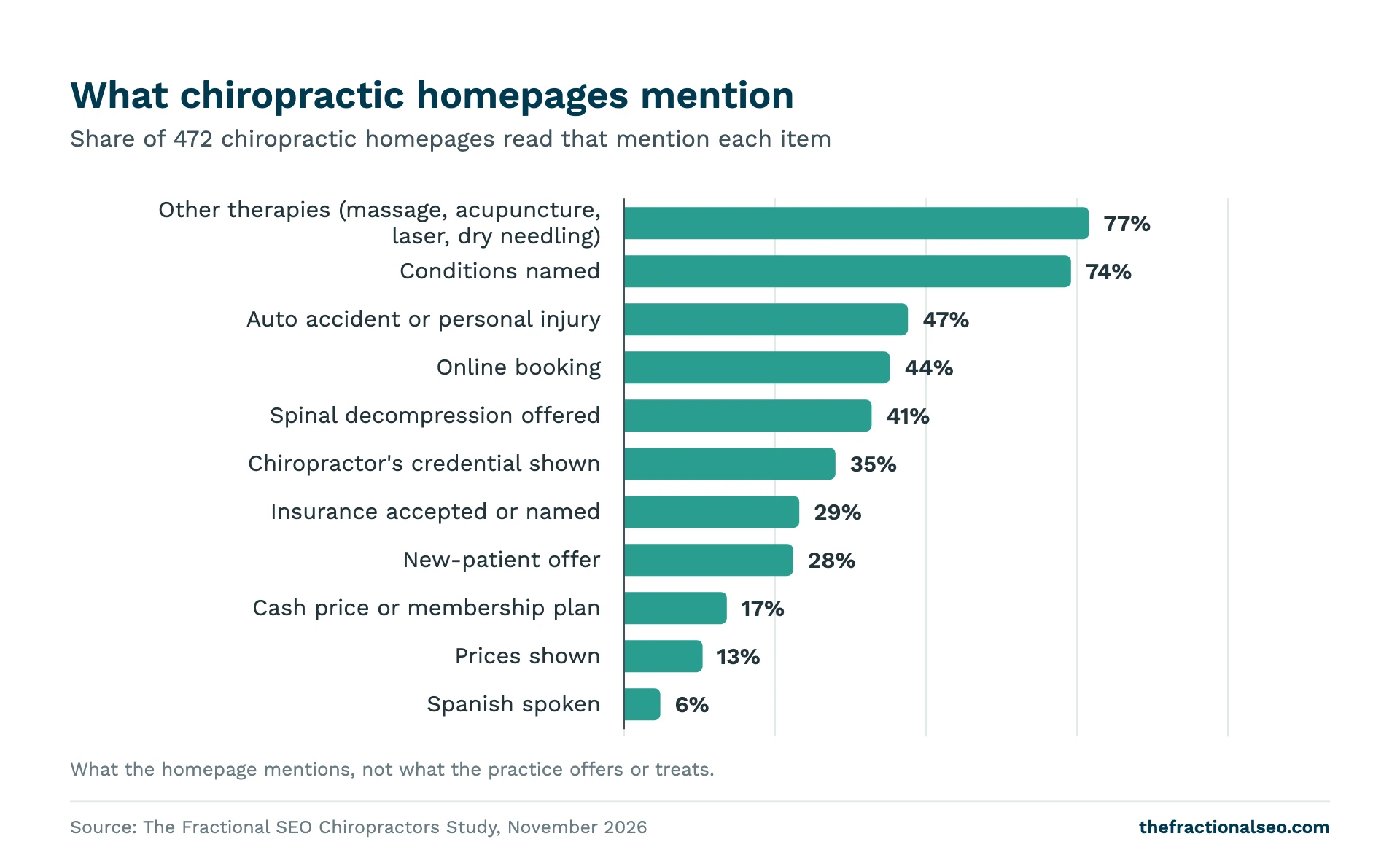
Read the decompression lean with care. One of our three search types was “spinal decompression”, so practices that mention it on the homepage had more chances to show up in those searches. The lean partly reflects the study’s own searches. In organic results it runs the other way: 44% vs 50%. Across all 472 homepages read, 41% mention spinal decompression.
The credential lean holds the same direction in organic results (48% vs 35%), but it does not pass there either. Across all homepages, 35% show the chiropractor’s credential, counted only where the homepage says D.C. or “doctor of chiropractic”.
Neither is a ranking factor on this evidence. Both are still worth having, for the patient rather than for Google. Someone choosing a chiropractor for the first time wants to know who will treat them and what their training is, so put the doctor’s name with D.C. and a short bio near the top of the homepage. If you offer decompression, say so plainly and link to a page that explains what a visit involves.
Gap 1: A blog nobody has posted to in a year
62% of chiropractic-practice sites have a blog, but only 12% published anything in the last 12 months and 4% averaged a post a month. Two cautions on that number. Post dates come from our crawl, which stopped at 500 URLs per site, so a very large blog may be undercounted. And many chiropractic sites carry vendor-supplied article libraries, which count as a blog here.
Having a blog shows no clear difference in rankings: map pack 68% vs 61%, organic 61% vs 63%. So this is not evidence that blogging gets a practice into the map pack.
What a stale blog does, in our view, is make the site look unattended. A patient who clicks “Blog” and finds a three-year-old post, or articles that could be on any chiropractor’s site, learns little about you. If you can’t post at least once a month, take “Blog” out of the main menu. If you do post, answer the questions your front desk hears every week: what happens at a first visit, which insurance plans you take, how long a visit takes, and where to park. Write about what you do and how, not about results you can’t promise.
Gap 2: Slow pages on a phone
Chiropractic homepages are slow on mobile: the median PageSpeed performance score is 63, 10% score 90 or more and 22% score under 50; the median largest contentful paint is 6.8 seconds, and only 9% load their main content within Google’s 2.5-second target. The median homepage weighs 2.7 MB and 23% weigh over 5 MB. These are lab tests on a simulated mid-range phone, one run per homepage, so any single score is noisy. The pattern across 497 homepages is not.
Only 69 of 511 chiropractic sites (14%) get enough Chrome traffic for Google to report real-user speed data at all; of the 39 with a full assessment, 24 pass Core Web Vitals. Small sites rarely have real-user data. That is normal, and not a ranking problem in itself.
As above, speed showed no clear difference between top-ranked chiropractic sites and the rest, and the map-pack lean was toward slower homepages. No difference is not proof that speed never matters. It means speed is not what separates chiropractors in this sample. The reason to fix it is the patient with a sore back in a parking lot, deciding whether to wait for your page or tap the next result.
Our view, not study data: the usual weight is a video or slider, a stack of chat, review and booking widgets, and full-size stock photos. Keep one hero image at the size it displays, load widgets after the page, and remove any you no longer use.
Gap 3: No way to ask for an appointment on the homepage
35% of chiropractic-practice websites have a contact or appointment-request form on the homepage itself. 84% have a click-to-call phone link on the homepage, so most practices make calling easy. Online booking is mentioned on 44% of homepages, counted only where there is a booking platform or an explicit book-online control.
Where does the Book button go? A booking platform or practice-software link shows on 27% of chiropractic homepages: Jane on 67 (14%), ChiroTouch 22, Zocdoc 20, Calendly 11, SKED 5, Acuity 4, ChiroFusion and ChiroHD 2 each. Only tools that leave a trace on the homepage are detected, so this is not a usage share. We compare the options in chiropractic EHR and scheduling software compared.
None of these shows a ranking edge. Homepage form: pack 35% vs 34%, organic 34% vs 34%. Click-to-call: pack 85% vs 84%. Online booking: pack 45% vs 46%. These are new-patient questions, not ranking levers. Our view: some people will look for a chiropractor after the front desk closes. Give them a short form on the homepage: name, phone or email, preferred time. Don’t ask for symptoms on a public form; that belongs in your intake system, and it is where the privacy question in Gap 8 starts.
Gap 4: No LocalBusiness schema
41% of chiropractic-practice websites have LocalBusiness (or a subtype such as MedicalBusiness or MedicalClinic) structured data. It is code that states your practice name, address, phone and hours in a format search engines read directly.
It shows no clear difference in rankings, and it leans the other way: pack 31% vs 42%, organic 31% vs 43%. Google’s LocalBusiness documentation also says Google does not guarantee that features that consume structured data will show up in search results. Add it because it is cheap and keeps your details consistent (an SEO plugin or your developer can add it), and don’t expect it to move your listing.
Gap 5: Few location pages, and condition pages written as promises
46% of chiropractic-practice websites have location pages (a page for a city or area, or a service-in-city page such as “chiropractor in Frisco”); among those that do, the median is 5.5 such pages. 81% have dedicated service or condition pages; median among those that do: 13.
Neither shows a ranking edge. Location pages: pack 49% vs 43%, organic 56% vs 56%. Service or condition pages: pack 81% vs 79%. So the gap is less about having the pages and more about what is on them.
A location page that swaps the town name into the same paragraph tells a patient nothing; one with drive time, parking and hours is worth reading. Condition pages need more care. Say what the condition is, what a first visit for it involves, what you will check and when you would refer someone elsewhere. Don’t promise results or a number of visits, and if a page says what a treatment does, cite where that comes from. Our guide to local SEO for chiropractors covers how to plan the set.
Gap 6: Reviews and basics left off the page
17% of chiropractic-practice websites show reviews through an embedded review widget. It shows no clear difference in rankings (pack 17% vs 15%), but it is the easiest way to show a new patient what others say. If you add one, pull reviews from your Google profile rather than retyping them.
On-page basics are missing on a sizeable minority of chiropractic sites: 30% lack a meta description on a quarter or more of their pages, 19% lack an H1 on a quarter or more, and 7% duplicate titles on a quarter or more. These are cheap to fix: a crawler lists every page that is missing one.
72% of chiropractic-practice websites have their metro’s name in the homepage title tag. We didn’t count suburbs or neighborhoods, so read it as roughly seven in ten, and a floor. A city in the title shows no clear difference: pack 79% vs 72%, organic 80% vs 70%. Put your town in the title because it tells a searcher you are near them.
Gap 7: No prices, no word on insurance
Insurance is named on under a third of homepages and prices on one in eight. In full: insurance accepted or named 29%, prices shown 13%, a cash price or membership plan 17%, and a new-patient offer 28%.
None of these shows a ranking difference: insurance named pack 33% vs 28%, prices 15% vs 13%, cash or membership plan 14% vs 19%, new-patient offer 31% vs 28%, all no clear difference.
In our view, a new patient’s first two questions are “do you take my insurance?” and “what will it cost?” A homepage that answers neither sends them to the phone or the next practice. Name the plans you are in network with, say whether you offer a self-pay rate or membership, and state what a first visit costs if you can. If you run a new-patient offer, check it against your state’s advertising rules before it goes on the site. In Florida, for example, any advertisement for a free, discounted or reduced-fee examination must carry a set statement in capital letters (Florida Statutes 456.062).
Gap 8: Ad pixels, and little call tracking
26% of chiropractic homepages load at least one advertising pixel in their raw HTML (Google Ads tag 18%, Meta pixel 14%, TikTok, LinkedIn or Bing on 5), 6% load a session-recording tool (Hotjar 12, Microsoft Clarity 15), and 69% load some Google, advertising or session-recording tag. Analytics tools sold for HIPAA use are almost absent: Freshpaint on 0 homepages, Piwik PRO on 1.
That is what the homepage loads, not what data a tag sends. Google Tag Manager is on 43% of homepages, and tags fired through it are invisible in the raw page; 87 homepages load Tag Manager and nothing else we detect. So every share here is a floor.
A homepage pixel is not by itself a violation; the risk is on booking, intake and condition pages, and in the forms on them. Under HIPAA, a health care provider is a covered entity if it transmits health information electronically in connection with a covered transaction, such as an insurance claim (45 CFR 160.103), so a cash-only practice may not be one. If your practice bills insurance and runs ad pixels, find out which pages they fire on and talk to a healthcare privacy attorney. We measured where pixels sit on chiropractic homepages, and what the rules say, in what 472 chiropractic homepages load.
The other half of measurement is rarer: call tracking is on 6% of homepages. Without a tracking number on the website it is hard to tell whether a new-patient call came from the site, the Google profile or a referral.
What chiropractic websites already get right
Nearly every crawled chiropractic site uses HTTPS (471 of 473). 84% have a click-to-call link on the homepage. 81% have service or condition pages. Other therapies (massage, acupuncture, laser, dry needling) are mentioned on 77% of homepages, and conditions are named on 74%.
WordPress runs 83% of chiropractic sites where the platform could be identified; next are Wix 11%, GoDaddy 2%. Another 179 sites could not be identified, many of them on chiropractic website vendors’ own platforms. ChiroMatrix (now iMatrix), a website and marketing provider, shows on 13 homepages. Most of the gaps above are edits to the existing site, not a rebuild.
Every feature we compared
Here is every row, sorted by the map-pack result. “Weak” means a result looked like a difference before the correction for multiple tests but not after. “No clear difference” means it never looked like one.
| Website feature | Map pack 1-3 vs Maps 4-20 | Organic 1-3 vs 4-10 |
|---|---|---|
| Spinal decompression mentioned | 54% vs 39% (p=0.016, weak) | 44% vs 50% (p=0.52, no clear difference) |
| D.C. credential shown | 46% vs 33% (p=0.037, weak) | 48% vs 35% (p=0.14, no clear difference) |
| LocalBusiness schema | 31% vs 42% (p=0.076, no clear difference) | 31% vs 43% (p=0.18, no clear difference) |
| Auto accident / personal injury | 58% vs 47% (p=0.1, no clear difference) | 51% vs 49% (p=0.87, no clear difference) |
| City in title | 79% vs 72% (p=0.26, no clear difference) | 80% vs 70% (p=0.2, no clear difference) |
| Blog | 68% vs 61% (p=0.31, no clear difference) | 61% vs 63% (p=0.74, no clear difference) |
| Cash or membership plan | 14% vs 19% (p=0.33, no clear difference) | 11% vs 22% (p=0.14, no clear difference) |
| Location pages | 49% vs 43% (p=0.38, no clear difference) | 56% vs 56% (p=1, no clear difference) |
| Other therapies | 81% vs 77% (p=0.46, no clear difference) | 72% vs 80% (p=0.25, no clear difference) |
| Spanish spoken | 9% vs 6% (p=0.46, no clear difference) | 10% vs 5% (p=0.33, no clear difference) |
| Insurance named | 33% vs 28% (p=0.49, no clear difference) | 38% vs 37% (p=1, no clear difference) |
| New-patient offer | 31% vs 28% (p=0.58, no clear difference) | 21% vs 32% (p=0.2, no clear difference) |
| Prices shown | 15% vs 13% (p=0.59, no clear difference) | 8% vs 20% (p=0.071, no clear difference) |
| Service or condition pages | 81% vs 79% (p=0.65, no clear difference) | 89% vs 87% (p=1, no clear difference) |
| Conditions named | 76% vs 73% (p=0.67, no clear difference) | 77% vs 84% (p=0.3, no clear difference) |
| Review widget | 17% vs 15% (p=0.73, no clear difference) | 16% vs 20% (p=0.68, no clear difference) |
| Homepage form | 35% vs 34% (p=0.9, no clear difference) | 34% vs 34% (p=1, no clear difference) |
| Online booking | 45% vs 46% (p=0.9, no clear difference) | 38% vs 39% (p=1, no clear difference) |
| Click-to-call | 85% vs 84% (p=1, no clear difference) | 85% vs 87% (p=0.81, no clear difference) |
How to check your own site in 30 minutes
Open your homepage on your phone. The figures in brackets are from the study; the advice is best practice, not study data.
- Minutes 1-5, the first visit. Can a new patient ask for an appointment without leaving the homepage? Is the phone number tappable? (35% have a homepage form; 84% have click-to-call.)
- Minutes 5-10, who and what it costs. Can a visitor see the doctor’s name and D.C., the insurance plans you take and a self-pay option without scrolling far? (Credential on 35% of homepages, insurance on 29%.)
- Minutes 10-15, speed. Run your homepage through PageSpeed Insights on mobile. Note the largest contentful paint and the page weight. (Median 6.8 seconds; median weight 2.7 MB.)
- Minutes 15-20, conditions and towns. Do any condition pages promise results? How many of the towns you draw patients from have a page with directions and hours?
- Minutes 20-25, the blog. Check the date of the newest post you wrote yourself. Over a year old? Commit to a schedule or take the blog out of the menu. (12% posted in the last 12 months.)
- Minutes 25-30, tags. Ask whoever manages the site which pixels load on booking and intake pages. Is there a call tracking number? (Ad pixels on 26% of homepages; call tracking on 6%.)
For a fuller pass, work through our local SEO checklist for chiropractors.
FAQs
What are the most common SEO mistakes on chiropractic websites?
Stale blogs and slow phones top the list. 62% of chiropractic-practice sites have a blog, but only 12% published anything in the last 12 months. In a mobile lab test, the median homepage takes 6.8 seconds to show its main content. Only 35% have a contact or appointment-request form on the homepage.
What do map-pack chiropractic websites do differently?
In our sample, no website feature separates them once the number of tests is allowed for. Mentioning spinal decompression and showing the D.C. credential lean toward the map pack without passing. The clearer map-pack differences were off the site: more reviews and a higher Domain Rank, both correlations.
Does website speed affect chiropractic rankings?
Speed showed no clear difference here, and map-pack homepages leaned slower: a median score of 57.5 vs 64. That is not proof that speed never matters. Fix it for the patient on a phone.
Do chiropractors need a blog?
Not to rank, on this evidence: having a blog showed no clear difference. A stale one is better taken out of the menu.
Is a Meta or Google Ads pixel on a chiropractic website a HIPAA problem?
A homepage pixel is not by itself a violation; the risk is on booking, intake and condition pages. 26% of chiropractic homepages load at least one advertising pixel. Our study of what 472 chiropractic homepages load covers where they sit and what the rules say.
Want to know which of these gaps your site has, and which are worth fixing first? See how we work with chiropractors.
More research & benchmarks
The whole Chiropractors library- HIPAA and Tracking Pixels: What 472 Chiropractic Homepages Load What 472 chiropractic homepages load in tracking tags, and what HIPAA, the June 2024 court ruling,…
- Who Wins Local Chiropractic Searches: A Benchmark of 36 Searches Who holds page one and the map pack when patients search for a chiropractor, a sports…
- Google Reviews and Chiropractic Rankings: What 521 Business Profiles Show Which parts of a chiropractor's Google review profile lean with the map pack, which show no…