
Research & Benchmark Chiropractors
Who Wins Local Chiropractic Searches: A Benchmark of 36 Searches
A patient types "chiropractor" and the name of their city into Google. Who do they see? Mostly chiropractors, a bigger share than in our HVAC or landscaping studies. But the plain search, the one with the volume, is the one directories crowd the most. We analyzed 36 local searches across 12 US metros and three chiropractic search types, 511 chiropractic practice websites (473 crawled) and 521 Google Business Profiles, November 2026. This page is about search: who holds page one and the map pack, and how plain and specialty searches differ. If you came for market size, revenue or workforce figures, this isn't that report.
The chiropractic industry statistics pages that rank today cover market size, employment and patient numbers, mostly from other people’s research. None we could read looked at what a patient actually sees when they search for a chiropractor in their city. This page does.
We collected this data in mid-November 2026, when chiropractic searches are near their low point of the year, so review pace and ad activity may look different in summer. The swing is small: “chiropractor” interest peaks in July at about 1.24 times its December low, so November and December are the quietest months.
Key findings
- Practices hold most of page one. 65% of page-one organic results for local chiropractic searches go to chiropractic practices’ own websites, against 53% for contractors in our HVAC study and 37% in Landscaping.
- The top spot usually goes to a practice too. A site that is not a chiropractic practice holds the #1 organic spot in 9 of 36 local chiropractic searches (25%), and 37% of all top-3 organic spots.
- The plain search is the crowded one. Practices hold 51% of page one on “chiropractor” searches, 70% on “sports chiropractor” and 72% on “spinal decompression”.
- Map pack and organic are mostly different practices. 34% of map-pack chiropractors with a website also rank on page one organically for the same search.
- Chains hold one pack spot in ten. Six chain websites, 1% of the sample, hold 11 of 108 map-pack spots. The Joint Chiropractic holds 7 of them.
The website side of the same study is in the gaps chiropractic websites leave open.
Who holds page one
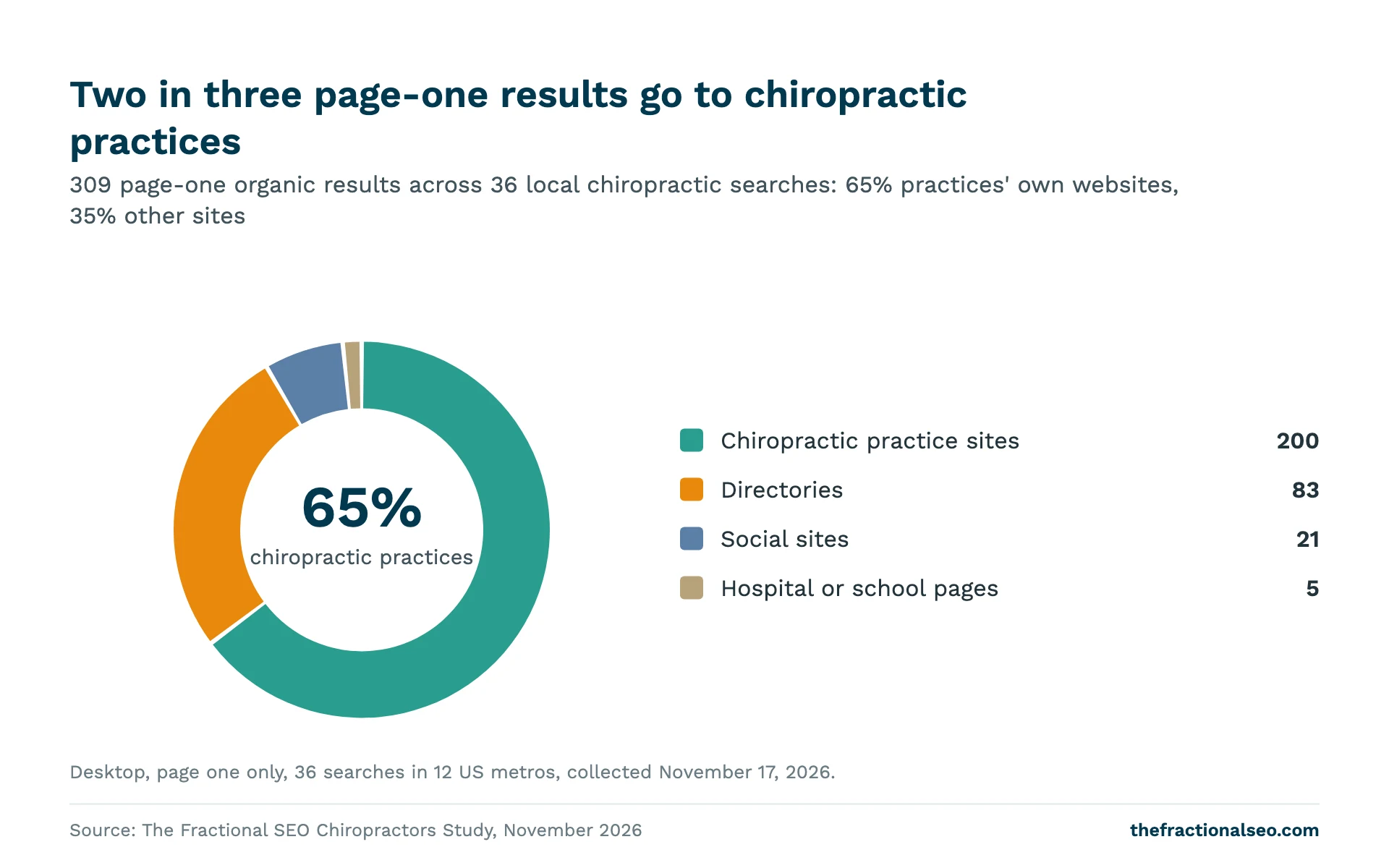
Across the 36 searches we recorded 309 organic results on page one. 65% of them went to chiropractic practices’ own websites; the other 35% went to directories, social sites and hospital or school pages. That is a bigger share than in our HVAC and landscaping studies: contractors held 53% in HVAC and landscaping companies 37%.
In counts, 200 of the 309 results were practice sites. Directories took 83, social sites 21, and hospital or school pages 5.
The top of the page follows the same pattern. A site that is not a chiropractic practice holds the #1 organic spot in 9 of 36 searches (25%), and 40 of the 108 top-3 spots (37%). Facebook held 2 of those #1 spots, and Zocdoc, Healthgrades, Yelp and MapQuest 1 each; the rest went to three smaller listing or content sites. In HVAC, non-contractors held 35% of #1 spots.
The study shows who appears, not why. Our reading: for most chiropractic searches, the organic page is yours to compete for. The exception is the plain “chiropractor” search, which we come to below.
Which sites chiropractors compete with
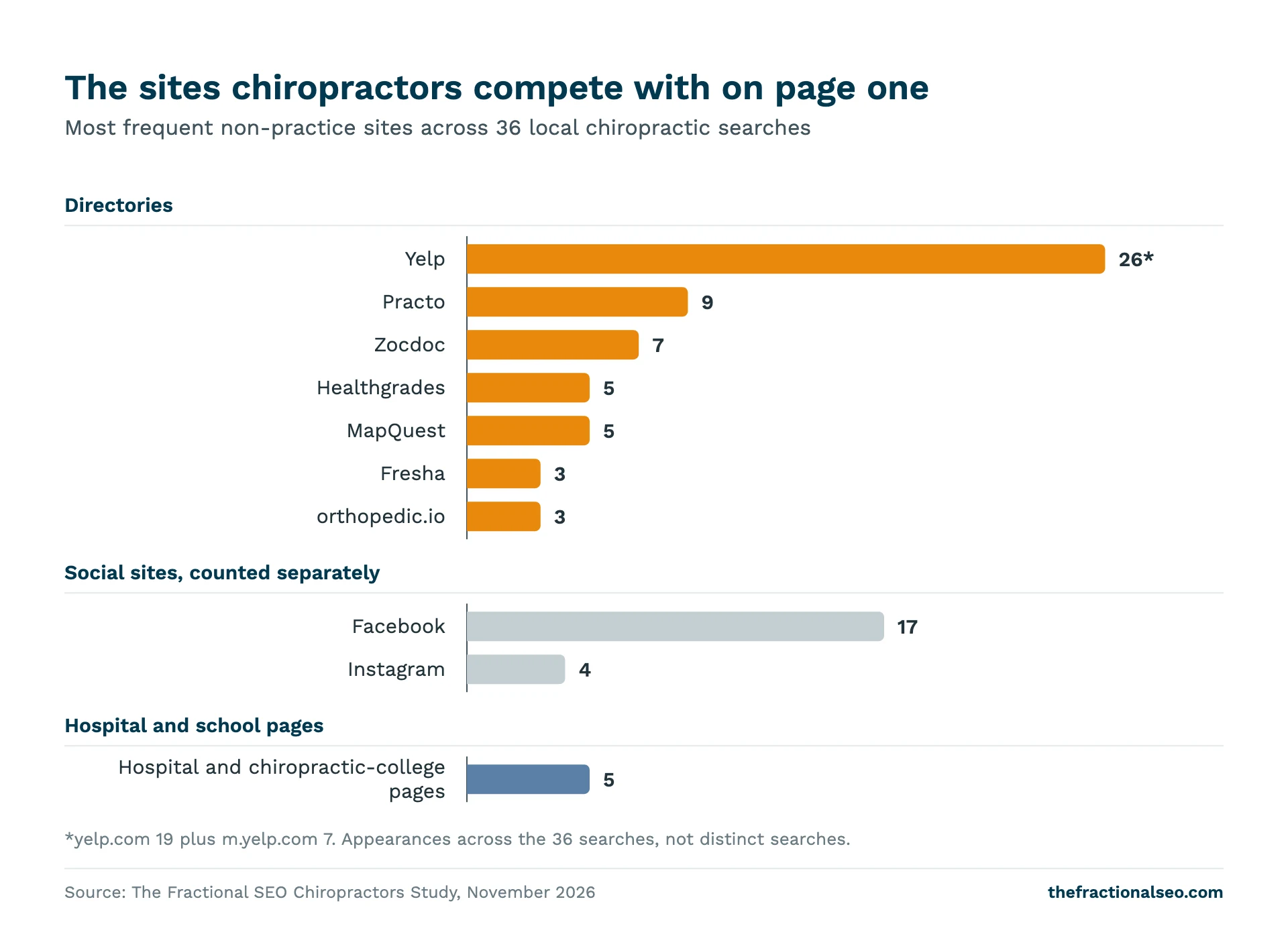
The sites chiropractors compete with most on page one: Yelp (26 results, on 25 of 36 searches), Facebook (17, on 13 searches), Practo (9, 7 of them on sports chiropractor searches), Zocdoc (7, all on “chiropractor” searches), Healthgrades (5) and MapQuest (5). Instagram had 4, and the booking marketplace Fresha and the provider directory orthopedic.io 3 each.
Several of these are health directories rather than general ones, and they work differently. Practo is an India-based clinic directory with US listings. Zocdoc books appointments and, by its own description, charges practices a fee per new-patient booking that varies by specialty and location. Yelp and Healthgrades both offer a free profile a practice can claim (all as of November 2026).
Hospital and chiropractic-college pages took 5 results: four health-system pages and one chiropractic college. They are few. Our reading: they are hard to move, so count them as fixed.
For which listings are worth your time, see Yelp, Zocdoc, Healthgrades and Practo: directories in chiropractic search.
Plain and specialty searches are different markets
Share of page-one results that are chiropractic-practice sites, by search: “chiropractor” 51%; “sports chiropractor” 70%; “spinal decompression” 72%. Directories crowd the plain search most; practices hold about seven in ten results on the specialty searches.
| Search (plus the metro) | Practice share of page one | Median reviews for a map-pack spot | Metros with Google volume data |
|---|---|---|---|
| chiropractor | 51% (50/99) | 461 | 12 of 12 |
| sports chiropractor | 70% (74/105) | 149 | 6 of 12 |
| spinal decompression | 72% (76/105) | 251 | 1 of 12 |
The competitors change with the wording. On “chiropractor” searches Yelp appeared 9 times, Zocdoc 7 and Healthgrades 4. On spinal decompression searches it was mostly Yelp (11) and Facebook (6). On sports chiropractor searches Practo led with 7, ahead of Yelp and Facebook at 6 each.
The volume sits almost entirely on the plain search. “Chiropractor <city>” gets a median of 3,250 searches a month per metro, and all 12 metros have data. Google reports volume for “sports chiropractor <city>” in only 6 of 12 metros (median 30) and for “spinal decompression <city>” in 1 (70). Those searches exist, since they returned full results pages, but Google gives little or no metro-level number for them.
Reviews follow the same line. Map-pack listings on sports chiropractor searches have about a third of the reviews of those on plain “chiropractor” searches: a median of 149 against 461. These medians describe who held the spots, not a number you need. Our study of what 521 Google Business Profiles show about reviews covers what does and doesn’t separate the pack.
Big metros vs small metros
By metro size, practices held 61% of page one in the five large metros (77/126), 68% in mid-size metros (69/102) and 67% in the three small metros (54/81). The median map-pack listing had 262 reviews in large metros, 284 in mid and 308 in small ones, so small metros do not need fewer reviews here.
With only three small metros, read this as a pattern to watch, not a tested result.
Map pack and organic are two different races
The map pack and the organic results are mostly different practices: 34% of map-pack chiropractors with a website also rank on page one organically for the same search. That’s 36 of 106 listings. In our HVAC study it was 16% and in Landscaping 25%, so chiropractic overlaps more, but most pack practices still don’t appear in the organic list.
That fits how Google describes local results. Its help page on local ranking says they are mainly based on relevance, distance and popularity, and that prominence draws on how many websites link to a business and how many reviews it has. Our reading: the map pack leans on the profile and where the searcher is, the organic list more on the website, so a practice can be strong in one and missing from the other.
Almost every chiropractor in the map pack shows a website: 2 of 108 map-pack listings had no website link (16 of 696 across Maps positions 1-20).
Treat the two as separate jobs. Our guide to local SEO for chiropractors covers both, and the Google Business Profile checklist for chiropractors covers the profile side.
Franchises and company chains
Chains are a small share of chiropractic websites but hold one map-pack spot in ten: 3 franchise brands and 3 company-owned chains are 6 of 511 practice websites, and hold 11 of 108 map-pack spots (10%). In HVAC, franchises held 8% of map-pack spots.
Franchises first. The Joint Chiropractic holds 7 map-pack spots and appears in the Maps results of 11 of the 12 metros (44 Maps rows). HealthSource Chiropractic had 3 Maps rows and no pack spot, and 100% Chiropractic 1 row and no pack spot (its franchise status is a first-pass mark we have not verified). Franchise sites had 4 organic results. People search The Joint by name: “joint chiropractors” gets 49,500 searches a month nationally (a 12-month average), largely for that brand.
Company-owned chains are separate. Dynamic Sports Medicine and Genesis Back & Neck hold 2 map-pack spots each, all in Texas metros. KIRO Chiropractic runs studios in New York only and held no pack spot. Company chains had 6 organic results: Dynamic Sports Medicine 4, Genesis Back & Neck 1 and KIRO 1. Altogether, chains have 10 of 200 practice organic results (5%).
One thing we looked for and found little of: keyword-named Maps listings with few reviews (a listing named only “<city> chiropractic”, for example) are rare: 8 listings, 8 Maps rows, and 1 of 108 map-pack spots.
What sits above the organic results
A map pack appeared on all 36 searches, with four listings on 2 of them. An AI Overview appeared on 15 (42%): 6 of 12 sports chiropractor searches, 5 of 12 spinal decompression and 4 of 12 “chiropractor” searches. So in this snapshot the specialty searches, where practices hold the most of page one, showed an AI summary slightly more often. With 12 searches per wording, that is a description, not a tested difference.
Paid results were almost absent: text ads appeared on 2 of 36 searches and Google Local Services Ads on none. Read that with care. Ads rotate by time, device and user, and we took one snapshot per search, so this is a floor for November, not a measure of how many chiropractors advertise. We did not check whether Local Services Ads are offered for chiropractors in each metro, only that none appeared. Website data needs the same care: only 3 of 511 chiropractic websites show any estimated Google Ads search traffic in DataForSEO, while a Google Ads tag is visible on 18% of homepages. Our HVAC searches, also run in November, showed Local Services Ads on 45% and text ads on 35%.
What a click costs
Clicks on local chiropractic searches are expensive: the median suggested bid for “chiropractor <city>” is $11.50. The highest in the study were $23.31 (“spinal decompression dallas”), $19.26 (“chiropractor chicago”) and $15.79 (“chiropractor new york”). These are Google Ads planner bids collected in November; auction prices move by month.
Traffic and links
The median chiropractic-practice website gets an estimated 78 organic visits a month; 53% get an estimated fewer than 100. The HVAC study’s estimated median was 214 and Landscaping’s 52.
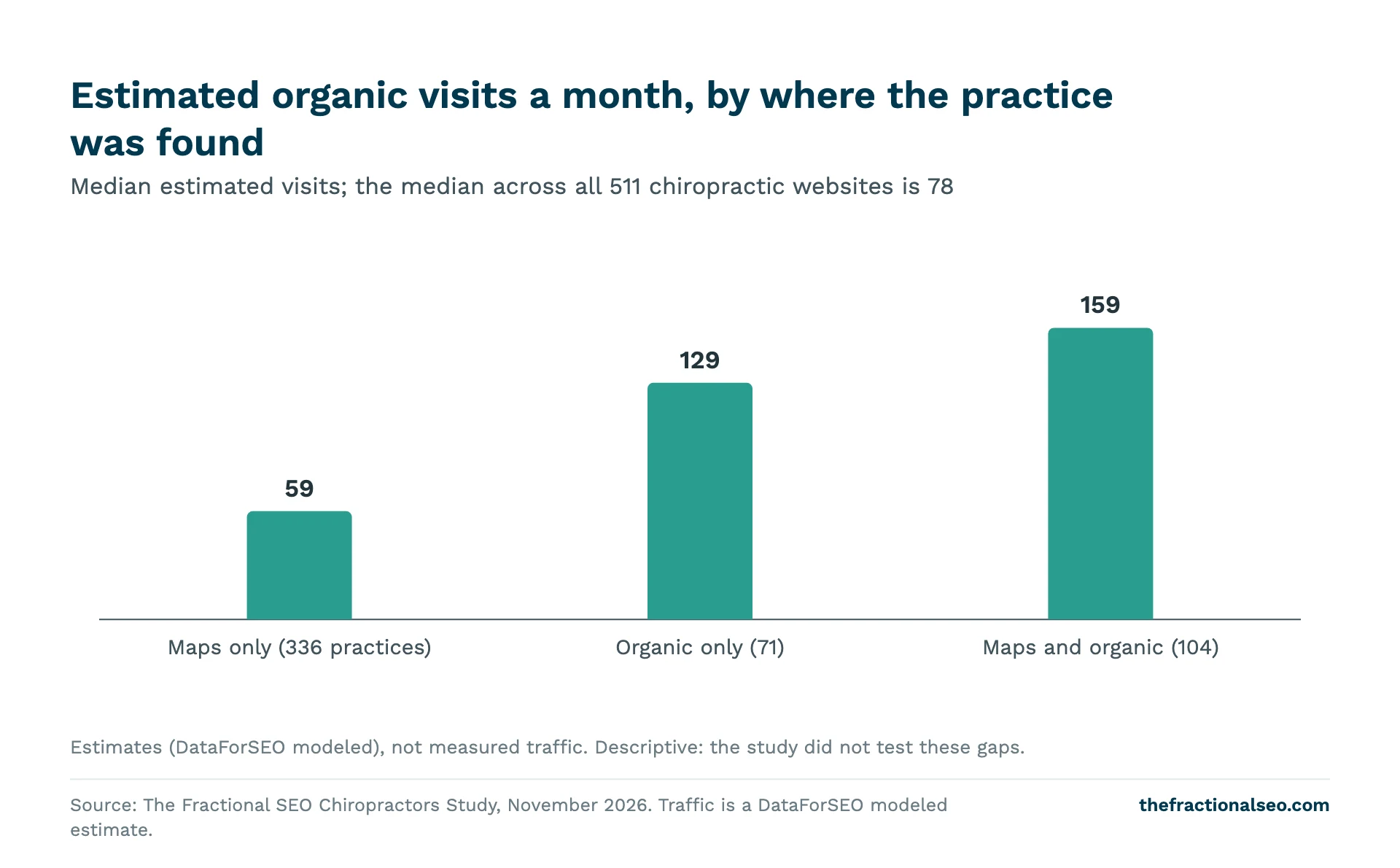
Chiropractors found only in Maps have little estimated organic traffic (median 59 visits a month); those that rank only organically get an estimated 129 and those found in both about 159. Those groups are 336, 71 and 104 websites.
Links split by result type. Map-pack chiropractors’ websites have stronger link profiles: a higher DataForSEO Domain Rank (144 vs 114 on a 0-1000 scale, a strong result) and more referring domains (122 vs 101, just short of passing our correction for the number of tests). That compares map-pack practices with those seen only at Maps positions 4-20. In organic results links do not separate them: sites in the organic top 3 have a median of 123 referring domains vs 112 at positions 4-10, no clear difference.
Traffic figures are modeled estimates, not measured visits. The study didn’t measure new patients.
What this means for chiropractic practices
The study describes who appears, not what makes anyone rank. Here’s how we read it.
- The plain search is where the fight is. It carries the volume, directories and other non-practice sites take about half of page one, and pack listings there have the most reviews.
- Specialty searches are easier to show up in, but small. Practices hold about seven in ten results, yet Google reports little local volume for them.
- The map pack and organic results are separate jobs. Only 34% of map-pack practices with a website were also on organic page one for the same search.
- Links go with the map pack. Domain Rank is the one website-side measure in the study that clearly separates pack practices from the rest, as a correlation.
- Look at your own website too. Our flagship study covers the gaps chiropractic websites leave open.
How we did this
We analyzed 36 local searches across 12 US metros and three chiropractic search types, 511 chiropractic practice websites (473 crawled) and 521 Google Business Profiles, November 2026.
Searches were “chiropractor”, “sports chiropractor” and “spinal decompression”, each followed by a metro: New York, Los Angeles, Chicago, Dallas and Houston (large); Charlotte, Nashville, Austin and Columbus (mid); Boise, Knoxville and Des Moines (small). We recorded page one on desktop through SerpAPI on 17 November 2026, plus the Google Maps list for each search: 696 Maps rows, positions 1-20. The map pack is positions 1-3 of that list, 108 spots. 121 lower-ranked profiles were added on 25-26 November 2026.
Samples: 309 organic results; 108 map-pack spots (106 listings with a website for the overlap); 511 practice domains. Chains were hand-checked; four sites could not be read, so chain counts are a floor. Traffic is DataForSEO Labs’ modeled estimate; volumes and bids are Google Ads planner figures.
What it can’t claim: why anyone ranks, or anything about new patients or revenue. It is one snapshot per search, organic page one moves day to day, and results vary by searcher location. That’s why we report shares and medians, never one practice’s position. With 12 searches per wording, differences between wordings are described, not tested.
Questions, answered
Why do directories outrank chiropractic practice websites?
Mostly they don’t: practices held 65% of page one. Directories took 83 of 309 results, led by Yelp, and crowd the plain “chiropractor” search most. We measured who ranks, not why; Google says prominence draws on links and reviews.
How many reviews does a chiropractor need to reach the map pack?
There is no set number. The median pack listing had 461 reviews on “chiropractor” searches, 251 on spinal decompression and 149 on sports chiropractor. Those describe who held the spots.
Is the map pack the same as the organic results?
Mostly not. Only 34% of map-pack chiropractors with a website also rank on page one organically for the same search.
How much organic traffic does a typical chiropractic website get?
An estimated 78 organic visits a month at the median, and 53% get an estimated fewer than 100. These are modeled estimates.
Do franchises like The Joint dominate local chiropractic search?
No, but they matter. Six chain websites hold 11 of 108 map-pack spots (10%), and The Joint Chiropractic holds 7 of them. Chains have 5% of practice organic results.
Want to know where your practice sits against these benchmarks in your own market? See how we approach SEO for chiropractors.
More research & benchmarks
The whole Chiropractors library- HIPAA and Tracking Pixels: What 472 Chiropractic Homepages Load What 472 chiropractic homepages load in tracking tags, and what HIPAA, the June 2024 court ruling,…
- We Analyzed 473 Chiropractic Websites: The Gaps They Leave Open Eight common gaps on chiropractic websites, measured across 473 sites, and the plain result that no…
- Google Reviews and Chiropractic Rankings: What 521 Business Profiles Show Which parts of a chiropractor's Google review profile lean with the map pack, which show no…