
Research & Benchmark Plumbing
Google Reviews and Plumbing Rankings: What 1,029 Business Profiles Show
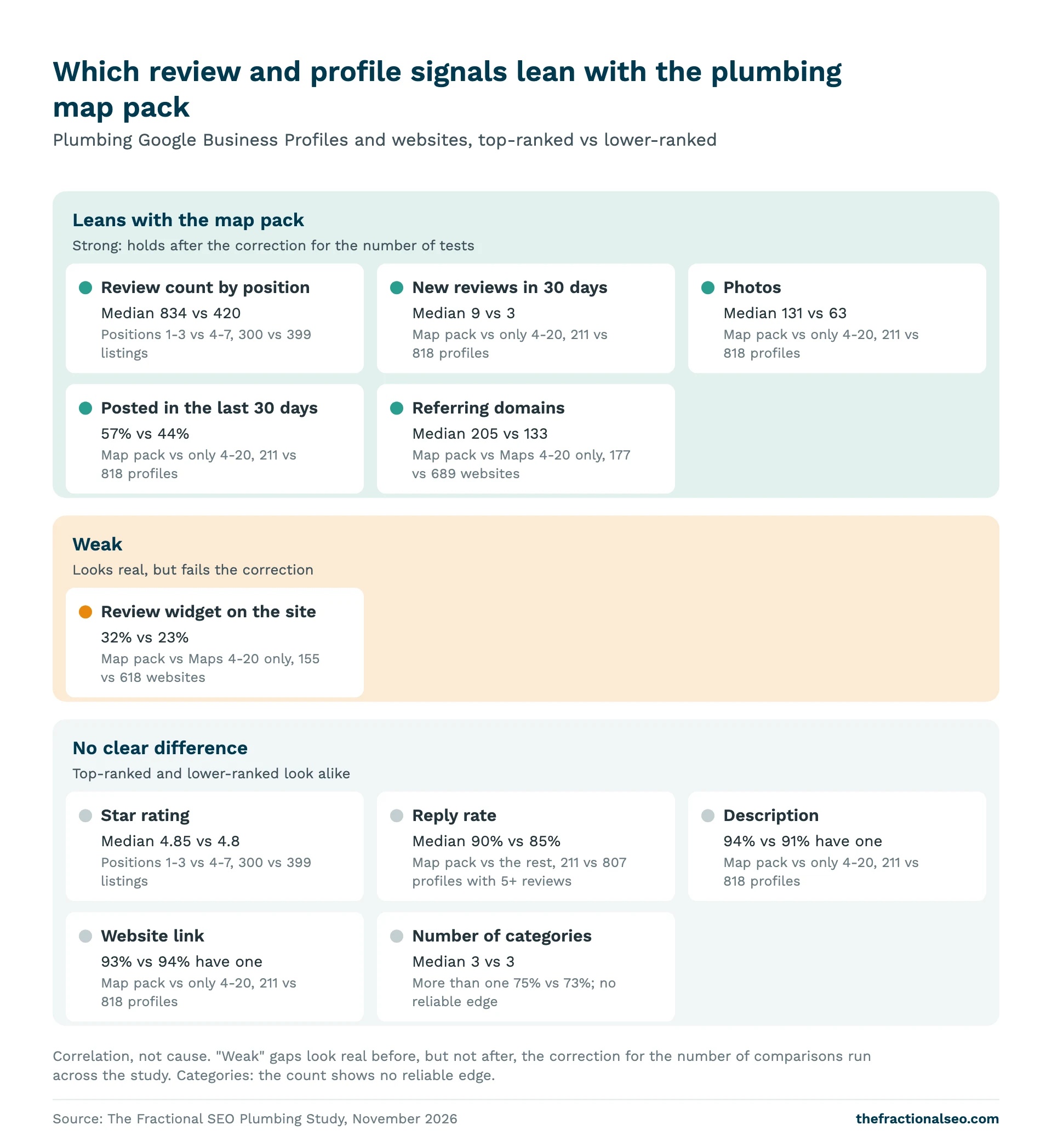
The plumbing marketing guides we read all say to get more Google reviews. Few say which part of a review profile actually goes with the map pack. We checked 1,029 plumbing Google Business Profiles. Review count and the number of new reviews in the last 30 days lean strongly with the map pack. Star rating and owner replies show no clear difference.
We analyzed 100 local searches across 25 US metros and four plumbing search types, 1,048 plumbing company websites (927 crawled) and 1,029 Google Business Profiles, November 2026. For this article we looked at the review side of those profiles: how many reviews each plumber has, how many came in recently, the star rating, how often the owner replies, and the photos and posts that sit next to the reviews on the profile.
We collected this data in mid-November 2026. Plumbing demand runs all year, but frozen-pipe and water-heater searches rise in winter, so review pace, Google posting and ad activity may look different in other months.
The short version: count and new reviews lean with the map pack, and so do photos and recent posts. Rating and replies don’t. And map-pack plumbers also have more links and other advantages, which is why none of this proves that reviews put them there.
Key findings
- Review count: plumbers in the map pack have about twice the Google reviews of those just below: a median of 834 at positions 1-3 vs 420 at positions 4-7.
- New reviews: map-pack plumbers got a median of 9 new Google reviews in the 30 days before collection vs 3 for businesses only seen at positions 4-20.
- Star rating: no clear difference. The median is 4.85 in the map pack and 4.8 at positions 4-7.
- Owner replies: no clear difference. Map-pack owners reply to a median of 90% of their newest 20 reviews vs 85% for the rest.
- Links: map-pack plumbers’ websites have a median of 205 referring domains vs 133 for businesses only at Maps positions 4-20.
The website findings from the same study are in our study of 927 plumbing websites.
Do Google reviews help SEO? Review count leans with the map pack
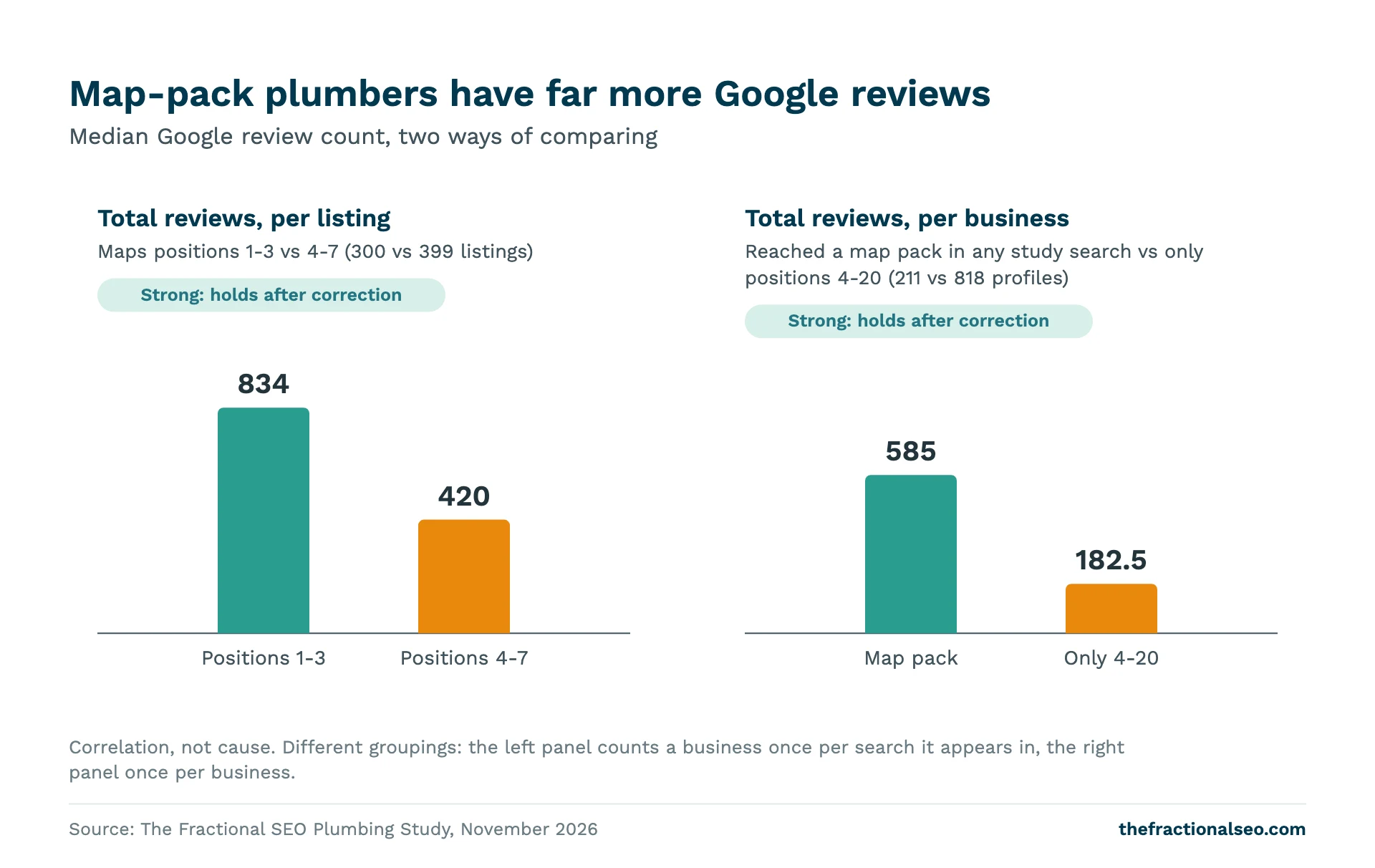
Plumbers in the map pack have about twice the Google reviews of those just below: a median of 834 at positions 1-3 vs 420 at positions 4-7. That compares 300 map-pack rows with 399 rows just below the pack, across all 100 searches. It was a strong result statistically. (In our HVAC study the same comparison was 1,576 vs 615, so plumbing’s bar sits lower, with the same pattern.)
In this study, the map pack means the top three businesses in the Google Maps list for each search. Positions 4-7 are the next listings in that list.
Some Maps listings are named only with keywords and have few reviews. We flagged them by rule, which is not proof a listing is fake. Without flagged suspect listings, the medians are 837 vs 430, so the gap doesn’t come from those listings.
That first comparison counts a plumber once for every search it shows up in. A company that appears for “plumber”, “emergency plumber” and “drain cleaning” in its city counts three times. So we also counted each business once. Across all 1,029 plumbing profiles, businesses that reached a map pack in any study search have a median of 585 reviews vs 182.5 for those only seen at positions 4-20. That’s 211 businesses against 818.
The two medians differ because the groups differ, not because one is wrong. Both point the same way, and both were strong results.
Google says something similar in general terms. Its help page on local ranking says prominence is based partly on how many reviews a business has, and that more reviews and positive ratings can help a business’s local ranking. It gives no numbers.
For benchmarks by market size and by search wording, see how many Google reviews a plumber needs.
New reviews: map-pack plumbers keep collecting them
Total count builds over years. The flow of new reviews shows what a company is doing now. Map-pack plumbers keep getting reviews: a median of 9 new Google reviews in the 30 days before collection vs 3 for the rest. That compares the 211 businesses that reached a map pack in any study search with the 818 only seen at positions 4-20, each counted once. It was a strong result.
Why 30 days and not 90? We collected each profile’s newest 40 reviews. 289 profiles had all 40 inside 90 days, so a 90-day count can’t see past 40 for the busiest plumbers. The 90-day medians were 34 vs 11, in the same direction, but because of that limit the 30-day figure is the one to quote.
Read this one carefully. A plumber in the map pack may get more calls, run more jobs and have more customers to ask. The study didn’t measure that, but if it’s true, some of that flow is a result of ranking, not only a possible cause of it. The study can’t separate the two.
The study didn’t record how plumbers ask for reviews. Our read: 9 in a month looks more like asking after every job than an occasional push.

Photos and posts lean the same way
Two other parts of the profile follow the same pattern. Map-pack plumbing profiles have about twice as many photos: median 131 vs 63. And recent Google posts are more common in the map pack: 57% of map-pack plumbers posted in the 30 days before collection vs 44% of the rest. Both compare the same 211 map-pack businesses with 818 only seen at positions 4-20, and both were strong results.
The same caution applies. Photo counts include customer photos, and busier companies collect more of both. Companies with staff for marketing do more of everything. These signals travel together, so the study can’t say which one matters on its own.
Star rating made no clear difference
Star rating does not separate them: the median is 4.85 in the map pack and 4.8 at positions 4-7. Same 300 vs 399 Maps rows as the review count comparison. The gap was not statistically meaningful.
The reason is simple. Ratings cluster near 5.0, so there is little room to differ. The plumbers near the top of Maps mostly have strong ratings already.
In our view, a good rating still matters to the homeowner with water on the floor deciding who to call. In this data, though, it is not something that sets map-pack plumbers apart.
Our advice: don’t chase a perfect 5.0. A few honest four-star reviews among many five-star ones can look more believable. And never try to keep unhappy customers from posting.
Replying to reviews: no clear difference
Replying to reviews does not separate them: map-pack owners reply to a median of 90% of their newest 20 reviews vs 85% for the rest. That compares 211 businesses that reached a map pack with 807 only seen at positions 4-20, all with 5 or more reviews. The gap was not statistically meaningful. In our HVAC study the same comparison showed a weak lean (93% vs 85%); for plumbers there is not even that.
One possible reason, which we didn’t test: replying is already common. Across the study, half reply to 90% or more of their newest reviews and 16% reply to none. When a habit is that widespread, there is little room for it to separate the top from the rest.
Reply anyway. Google’s help page on managing reviews says replying shows customers you value their feedback. A short, specific thank-you and a calm answer to a bad review can be read by the next homeowner deciding who to call. Keep customers’ addresses and personal details out of your replies.
Profile basics and categories show no edge
A business description and a website link on the profile are near-universal and show no edge: description 94% vs 91%, website 93% vs 94% (map pack vs the rest). That’s the same 211 businesses against 818. Categories are the same story. Unlike HVAC, listing more categories shows no reliable edge: the median plumbing profile lists 3 categories in and out of the map pack.
Fill these in, because customers see them. Pick the categories that match the work you do, including heating or cooling if you do it. But they’re setup tasks you do once, not what separates map-pack profiles. The plumbing Google Business Profile guide and checklist covers every setup step.
Reviews travel with size, links and age
This is the caveat that matters most. Map-pack plumbers’ websites have more links: a median of 205 referring domains vs 133 for businesses only at Maps positions 4-20, and a higher Domain Rank (187 vs 148). That compares 177 websites with 689, and both gaps were strong.
So the map-pack plumbers, which have more reviews, also tend to have more websites linking to them and stronger domains. Established companies tend to have more reviews and other advantages too: more years in business, bigger budgets, more links. A study like this can’t pull those apart.
That’s why this article says review count leans with the map pack, not that it puts plumbers there. Google’s own description fits the same picture. Its local ranking page says local results are mainly based on relevance, distance and popularity, and that prominence is based on info like how many websites link to your business and how many reviews you have. Distance, how close you are to the person searching, is something reviews can’t change. And Google says there’s no way to request or pay for a better local ranking.
The practical point: reviews are one thing to work on, alongside your website and links. If your review count is close to the plumbers above you and you still don’t show, look at the rest. A good place to start is how plumbing companies build links.
Reviews on your website
25% of plumbing websites show reviews through an embedded review widget, out of 927 crawled sites.
Comparing top-ranked and lower-ranked plumbers, the widget doesn’t hold up as a difference. In the map pack comparison (map pack 1-3 vs Maps 4-20, 155 vs 618 sites) it is 32% vs 23%, a weak lean that fails the correction for the number of tests. In organic results (positions 1-3 vs 4-10, 92 vs 179 sites) it is 30% vs 21%, no clear difference.
In our view, a widget is for homeowners, not rankings. Real Google reviews next to your phone number can help someone who lands on the site decide to call. For ideas, see plumbing websites that show reviews well.
What to do with this
None of these steps will rank you on their own. They’re our advice for building a steady review habit.
- Ask every customer when the job is done. Google’s help page says you can share a review request link or QR code. Text the link before the tech leaves the driveway, or print the code on the invoice. Ask everyone, not only the customers you expect to be happy.
- Keep the flow steady. A few reviews every week is easier to keep up than one push a year, and it keeps your newest reviews recent.
- Add photos from real jobs and post on the profile now and then. Both lean with the map pack, with the same caveat as reviews.
- Reply to every review, briefly and in your own words, for the customers reading them.
- Never pay or offer anything for reviews. Google’s content policy says businesses may not “Offer incentives – such as payment, discounts, free goods and/or services – in exchange for posting any review or revision or removal of a negative review.”
- Then check the rest with the local SEO checklist for plumbers.
Want to know where your profile stands against your own market’s map pack? Talk to us about SEO for plumbing companies.
How we did this
We analyzed 100 local searches across 25 US metros and four plumbing search types, 1,048 plumbing company websites (927 crawled) and 1,029 Google Business Profiles, November 2026.
Searches were “plumber”, “emergency plumber”, “drain cleaning” and “water heater repair”, each followed by the metro. Map pack means positions 1-3 of the Google Maps list for each search. Review count and rating compare 300 map-pack rows with 399 at positions 4-7, counting a business once per search. The other profile comparisons count each business once: those that reached a map pack in any study search vs those only at positions 4-20. New reviews come from each profile’s newest 40, replies from the newest 20.
What it can’t claim: cause. Established companies tend to have more reviews and other advantages. One snapshot, 25 metros, four search wordings, no “near me” searches.
Questions, answered
Do Google reviews help a plumber rank?
Review count and new reviews lean with the map pack. Map-pack rows have a median of 834 reviews vs 420 at positions 4-7, and map-pack businesses got a median of 9 new reviews in 30 days vs 3 for the rest. That’s a correlation, not proof. Google’s local ranking help page does say review count is part of prominence.
Does star rating affect map-pack rankings?
Not in our data. The median is 4.85 in the map pack and 4.8 at positions 4-7, because ratings cluster near 5.0. A good rating still matters to the homeowner reading it.
Does replying to reviews help ranking?
We can’t show that it does. Map-pack owners reply to a median of 90% of their newest 20 reviews vs 85% for the rest, and the gap is not statistically meaningful. Half of plumbers already reply to 90% or more. Reply anyway, for the customers.
Are recent reviews more important than total reviews?
Both lean with the map pack in our data: total count (834 vs 420, positions 1-3 vs 4-7) and new reviews in 30 days (9 vs 3, map pack vs the rest). The study can’t say which one matters more, and the two go together.
How many reviews do I need?
It depends on your market and the search. Our benchmarks for plumbing map-pack review counts break it down by market size and search wording.
More research & benchmarks
The whole Plumbing library- Online Booking and the Plumbing Map Pack: What 920 Plumbing Websites Show Top-ranked plumbers offer online booking more often, but much of that is ServiceTitan's software, and on…
- How Many Google Reviews Does a Plumber Need to Make the Map Pack? Review counts from 300 plumbing map-pack listings, by search wording and market size, and how to…
- We Analyzed 927 Plumbing Websites: What Top-Ranked Plumbers Do Differently Seven website gaps measured across 927 plumbing websites, which ones lean with rankings, and how much…