
Templates & Resource Plumbing
Local SEO Checklist for Plumbers
None of the plumber SEO checklists we read orders its tasks by plumbing data: schema, a city in the title, location pages, links and reviews sit side by side. This one is ordered by what the data shows. The things plumbers in the map pack clearly have more of come first. Website basics come last, marked honestly as showing no measured edge. All 34 items are free to download as a PDF or a Google Sheet.
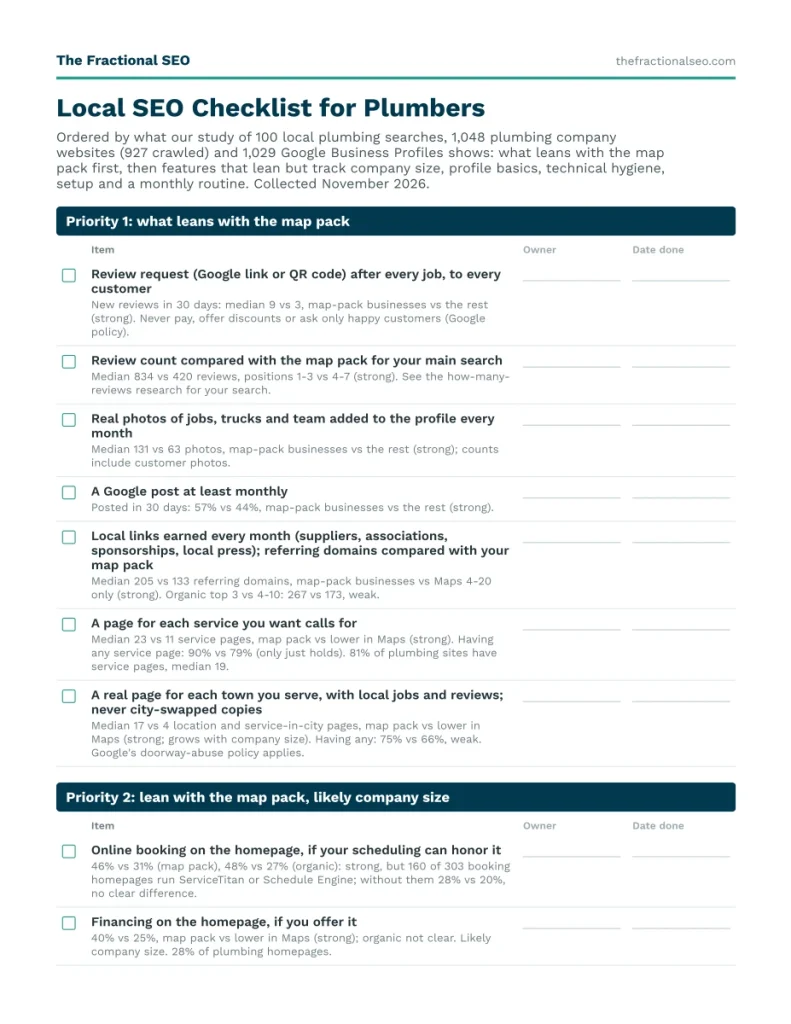
Get the template No email required
What's inside
Priority 1: what leans with the map pack
New reviews, photos, posts, links, and service and location pages.
Leans, likely company size
Online booking, financing, 24/7 and a blog: worth having, not ranking tactics.
No measured edge
Profile basics and website features where top-ranked plumbers look like everyone else.
Hygiene and monthly tasks
Technical basics plus five checks to repeat each month.
How to use it
-
Download the PDF or copy the Sheet
Print it, or make your own copy of the Google Sheet.
-
Work top to bottom
Start with Priority 1. Give every item an owner and a date.
-
Repeat the monthly tasks
Rankings from your service area, profile calls, new reviews and new links.
We analyzed 100 local searches across 25 US metros and four plumbing search types, 1,048 plumbing company websites (927 crawled) and 1,029 Google Business Profiles, November 2026. We collected this data in mid-November 2026. Plumbing demand runs all year, but frozen-pipe and water-heater searches rise in winter, so review pace, Google posting and ad activity may look different in other months. We compared what top-ranked plumbers have with what lower-ranked ones have, and ordered the list from the answer. For the reasoning behind each task, read the full local SEO guide for plumbers.
If your Google Business Profile isn’t claimed yet, do item 12 first. Everything on the profile depends on it.
How we ordered this checklist
Every item sits in one of four priority groups, plus setup and a monthly routine:
- Priority 1: what leans with the map pack. Items where plumbers that reached a map pack in any study search differ strongly from those only seen at Maps positions 4-20, by a margin that held up after correcting for the number of tests.
- Priority 2: leans, likely company size. Homepage items that also lean with the pack but most likely reflect a bigger company or its software. Worth having for customers; not ranking tactics.
- Priority 3: basics with no measured edge. Profile and website items that top-ranked plumbers have about as often as everyone else.
- Priority 4: technical hygiene. How often plumbing sites get these wrong. No ranking comparison, apart from a page-speed check with no clear difference.
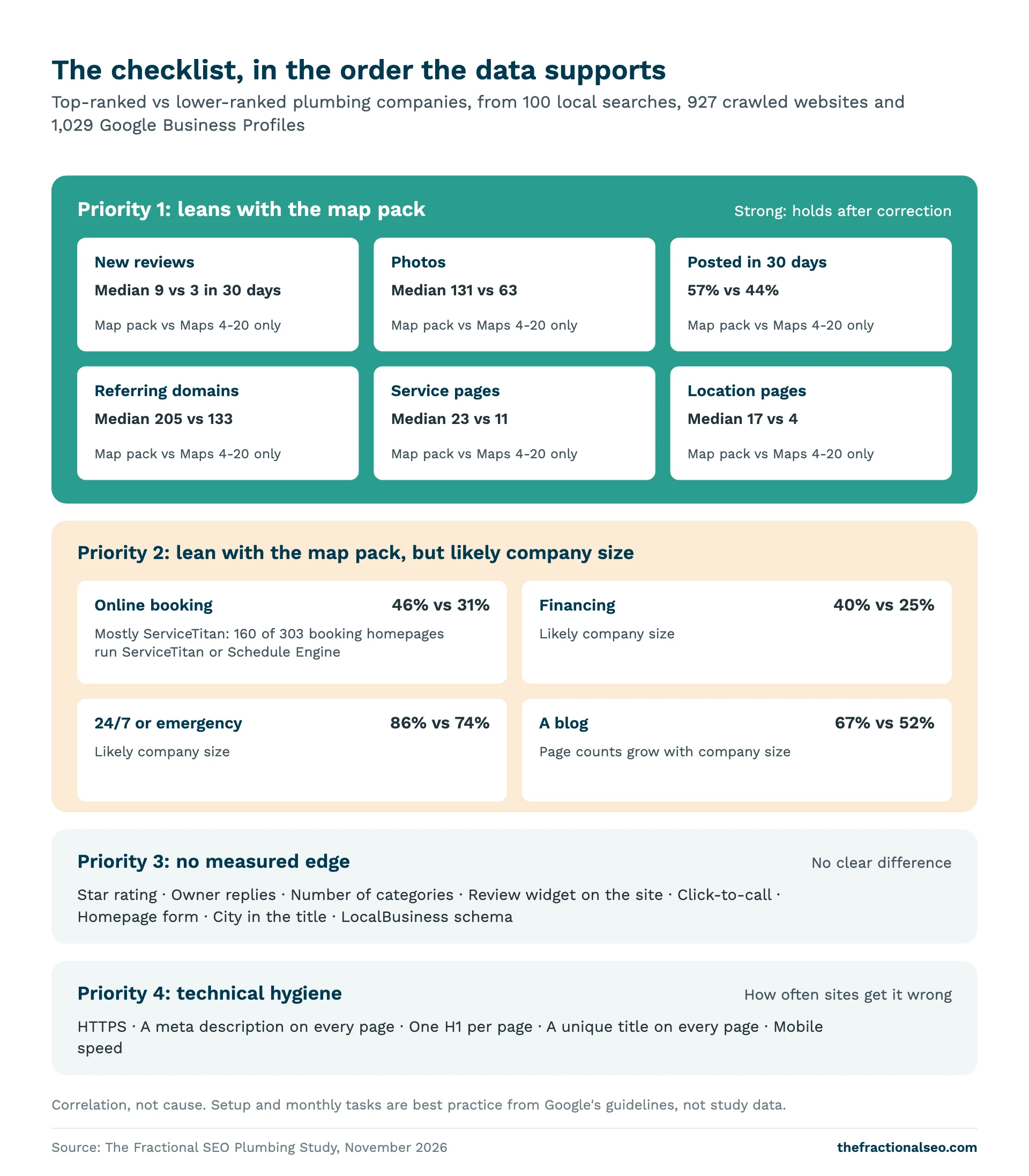
One honest note. This is a correlation study. Bigger, older companies tend to have more reviews, more pages and more of everything else, and the study can’t separate that from ranking. The data shows what top-ranked plumbers tend to have; it can’t promise that any one item will move you up, and a missing edge is not proof an item never matters. The website half comes from our study of 927 plumbing websites.
Priority 1: What leans with the map pack
Reviews, photos and posts
Map-pack plumbers keep getting reviews: a median of 9 new Google reviews in the 30 days before collection vs 3 for the rest. Their totals are higher too: a median of 834 at positions 1-3 vs 420 at positions 4-7. Map-pack plumbing profiles have about twice as many photos, median 131 vs 63, counting customer photos. And 57% of map-pack plumbers posted on Google in the 30 days before collection vs 44% of the rest. All four are strong in our data, and all are things you can start this week.
- A review request after every job, to every customer, with your Google review link or QR code. Google’s content policy bans incentives and asking only happy customers.
- Your review count compared with the map pack for your main search in your town.
- Real photos of jobs, trucks and team added to your profile every month. Step by step in our Google Business Profile guide for plumbers.
- A Google post at least once a month.
Links to your website
Map-pack plumbers’ websites have more links: a median of 205 referring domains vs 133 for businesses only at Maps positions 4-20, and a higher Domain Rank (187 vs 148). In organic results the gap is about the same proportion but the evidence is weaker: 267 vs 173 for the organic top 3 vs positions 4-10, a difference that fails the correction. Links usually take longest of anything here, so start early and think local: supplier and dealer listings, trade associations, sponsorships, local news. Our guide on building backlinks for a plumbing business has the detail.
- Local links earned every month, and your referring domains compared with the plumbers in your map pack.
Service and location pages
Map-pack plumbers have bigger sites: more service pages (median 23 vs 11) and more location pages (median 17 vs 4, counting service-in-city pages). For scale, 81% of plumbing websites have dedicated service pages, with a median of 19 among those that do, and 67% have location pages, with a median of 18. Both count gaps are strong, but page counts grow with company size and age, and simply having any service page (90% vs 79%) only just holds after the correction, so read this as “bigger plumbers have bigger sites”. Build pages because each one answers a customer, not to reach a number.
- A page for each service you want calls for: drain cleaning, water heater repair and replacement, leak detection, sewer lines, repipes.
- A real page for each town you serve, with local jobs and reviews. Never city-swapped copies: Google’s spam policies say “Doorway abuse is when sites or pages are created to rank for specific, similar search queries.”
Priority 2: Leans, likely company size
Online booking. Top-ranked plumbers are more likely to offer online booking on the homepage: 46% of map-pack businesses vs 31% of those lower in Maps, and 48% of organic top-3 sites vs 27% at positions 4-10. But much of that lean is ServiceTitan: 160 of the 303 homepages with online booking run ServiceTitan or its Schedule Engine, and among sites with neither, booking shows no clear difference (28% vs 20%). The study can’t separate booking from company size or software spend. Details in online booking and the plumbing map pack and field service software for plumbing companies.
Financing and 24/7. Map-pack plumbers are more likely to advertise financing (40% vs 25%) and 24/7 or emergency service (86% vs 74%) on the homepage. In organic results neither is clear, and the 24/7 lean only just survives the correction. Both are signs of a larger company. 24/7 is already the norm (75% of plumbing homepages); financing is not (28%). Emergency work has its own guide.
Blog. Map-pack plumbers more often have one (67% vs 52%). But while 55% of plumbing sites have a blog, only 17% published anything in the last 12 months. A dead blog helps nobody.
- Online booking on the homepage, if your scheduling can actually honor the slots.
- Financing on the homepage, if you offer it, in plain terms.
- 24/7 or emergency service on the homepage, only if someone really answers at night.
- A blog only if someone will post to it.
Priority 3: Basics with no measured edge
Profile basics. 96% of plumbing profiles are claimed, and “Plumber” is the primary category on 190 of 211 map-pack profiles. Unlike HVAC, listing more categories shows no reliable edge: the median is 3 in and out of the map pack. Replies don’t separate them either (median 90% vs 85% of the newest 20 reviews), and nor does star rating (4.85 vs 4.8). Do these because they’re quick and customers see them. The profile guide covers each one.
- Profile claimed and verified under your real business name. Google’s guidelines say “Including unnecessary information in your business name isn’t permitted”.
- Primary category Plumber; additional categories only for work you do.
- Description, website link and services list filled in.
- A reply to every review, short and specific.
- Star rating watched, not chased.
Website features. None of these reliably separates top-ranked and lower-ranked plumbing sites in either comparison; some lean, but none survives the correction:
| Item | Plumbing sites with it | Map pack vs lower in Maps | Organic top 3 vs 4-10 |
|---|---|---|---|
| Click-to-call link | 90% | 98% vs 91% (weak) | 90% vs 83% (no clear difference) |
| Homepage contact or quote form | 45% | 56% vs 44% (weak) | 39% vs 42% (no clear difference) |
| Review widget | 25% | 32% vs 23% (weak) | 30% vs 21% (no clear difference) |
| LocalBusiness schema | 69% | 76% vs 68% (no clear difference) | 76% vs 72% (no clear difference) |
| Metro name in homepage title | 70% | 76% vs 71% (no clear difference) | 64% vs 65% (no clear difference) |
| Upfront or flat-rate pricing | 49% | 55% vs 49% (no clear difference) | 57% vs 44% (no clear difference) |
| Membership plan | 22% | 27% vs 20% (no clear difference) | 32% vs 24% (no clear difference) |
No measured edge is not a reason to skip them. Most help a homeowner call, book or trust you, and most are quick. For schema, use the Plumber type and include Google’s required properties.
- A click-to-call phone link in the header on every page.
- A contact or quote form on the homepage.
- Real customer reviews shown on the site, with permission.
- LocalBusiness schema (Plumber) on the homepage.
- Your metro name in the homepage title.
- Upfront or flat-rate pricing explained, if that’s how you price.
- Your membership plan on the homepage, if you sell one.
Priority 4: Technical hygiene
Every crawled plumbing site uses HTTPS (927 of 927). On-page basics are missing on a minority of plumbing sites: 17% lack a meta description on a quarter or more of their pages, 13% lack an H1 on a quarter or more, and 4% duplicate titles that widely. Page speed shows no clear difference between top-ranked plumbers and the rest in our test of 1,000 plumbing homepages. Fix speed for customers on phones, not for rankings. More in technical SEO for plumbing websites.
- HTTPS on every page.
- A meta description on every page.
- One H1 and a unique title on every page.
- A homepage that loads fast on a phone.
Setup and monthly tasks
Keep your name, address and phone the same everywhere. On local plumbing searches, Yelp appeared 130 times on page one, thumbtack.com 36, mapquest.com 28, bbb.org 19 and angi.com 18, so those listings are worth getting right; see our plumbing directories guide. Then check the same few numbers each month. Google ranks local results partly by distance, so check from where your customers are, not from the shop.
- Name, address and phone the same on your site, profile and directory listings.
- Search Console and Google Analytics set up and verified.
- Monthly: check your map-pack position for your top searches from a phone inside your service area.
- Monthly: check profile calls, website clicks and direction requests.
- Monthly: count new reviews against last month.
- Monthly: list the new links you earned.
- Monthly: check Search Console clicks for service and town searches, and fix any page that dropped.
Download the checklist
The Plumbing Local SEO Checklist. All 34 items in priority order, with columns for status, owner, date done and the benchmark from our study. Print the PDF, or copy the Google Sheet and give every item an owner and a date. For the profile step by step, pair it with the Google Business Profile guide and checklist.
Rather hand the list to someone? Plumbing SEO done for you.
Questions, answered
What should a plumber’s local SEO checklist include?
Start with what leans with the map pack: new reviews, photos, posts, links, and a real page for each service and town. Then booking, financing, 24/7 and a blog if they fit your company, the profile and website basics, technical hygiene and a monthly routine.
What should I do first?
If your profile isn’t claimed, claim it. Then review requests and photos, which you can start this week, and a plan for local links, which takes longer.
Does online booking help plumbing rankings?
Booking leans with both the map pack and the organic top 3, but 160 of the 303 booking homepages run ServiceTitan or Schedule Engine, and without them the gap is not clear. Offer it for customers, not as a ranking move.
Do schema or a city in the title help plumbing rankings?
Not in a way we could measure. Neither showed a clear difference between top-ranked and lower-ranked plumbing sites. They’re cheap, so do them as basics.
How many location pages should a plumber have?
There’s no target. Map-pack plumbers had a median of 17 location and service-in-city pages vs 4 for those lower in Maps, which likely reflects bigger companies covering more towns as much as anything. Build one for each town you really serve.