
Guide Plumbing
The Ultimate Guide to Local SEO for Plumbers
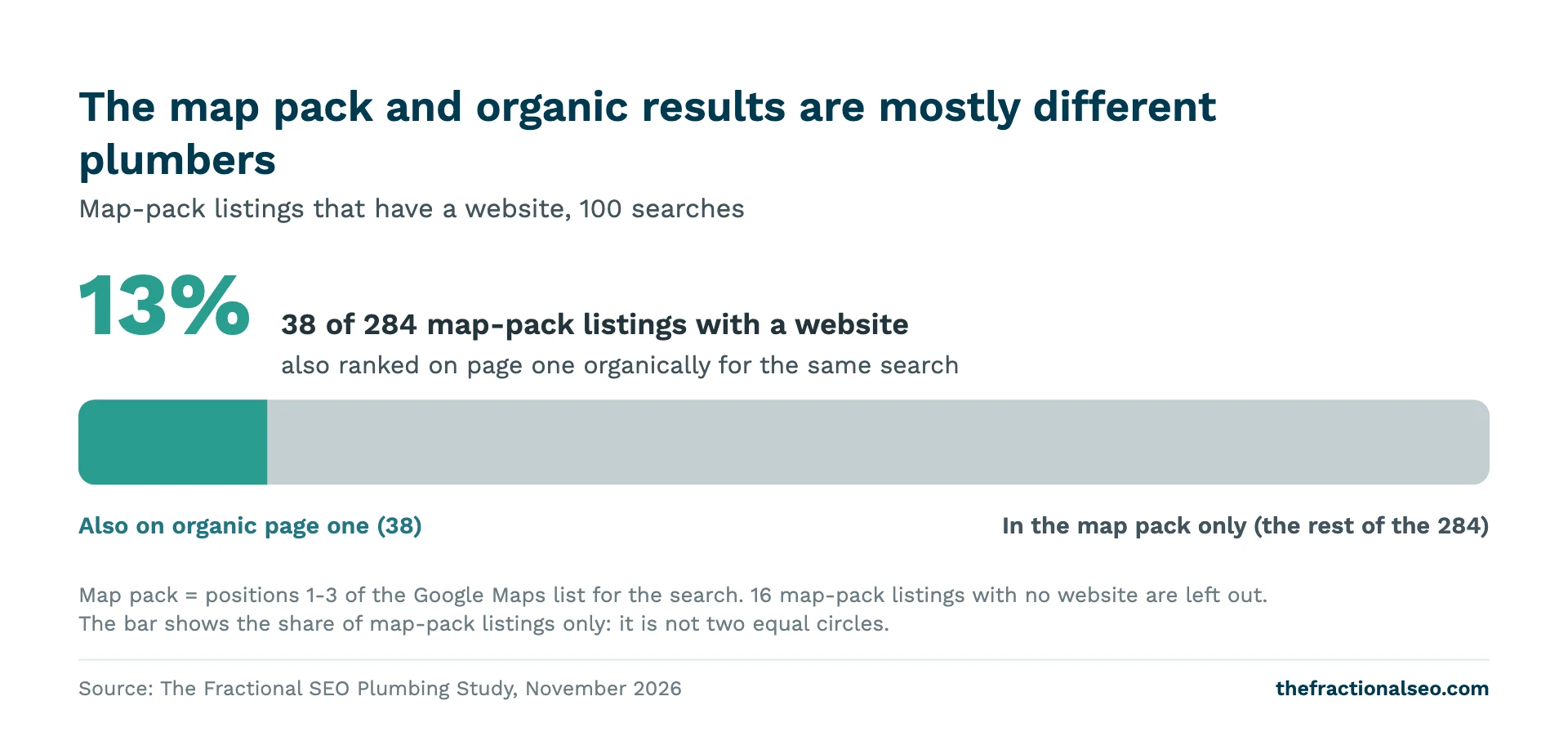
Local SEO for plumbers is two jobs, not one. The first is the map pack: the Google Maps listings near the top of a search like "plumber" plus your city. The second is the organic results below it. Different companies tend to win each. In our study, only 13% of map-pack plumbers with a website also ranked on page one organically for the same search. This guide takes each job in turn and ends with a 90-day plan.
The short answer
- Two jobs: the map pack and the organic results are mostly different businesses. Plan for each one separately.
- Map pack: map-pack plumbers have about twice the Google reviews of those just below, keep getting new ones, have more photos and are more likely to have posted recently.
- Website: map-pack plumbers have bigger sites, with more service pages and more location pages, and more links. Those are signs of bigger, older companies, not switches that rank you.
- Basics with no measured edge: a city in the title tag and LocalBusiness schema are common but show no clear difference.
- Competition: directories take a big share of page one, and one franchise brand, Roto-Rooter, shows up in both lists.
We analyzed 100 local searches across 25 US metros and four plumbing search types, 1,048 plumbing company websites (927 crawled) and 1,029 Google Business Profiles, November 2026. We collected this data in mid-November 2026. Plumbing demand runs all year, but frozen-pipe and water-heater searches rise in winter, so review pace, Google posting and ad activity may look different in other months. Where we compare higher- and lower-ranked plumbers, the results show what tends to go together, not what causes a ranking. The website half is in our study of 927 plumbing websites.
This guide covers Google Maps and the local side of your website. If you’re new to SEO and want the website basics first, start with the beginner’s guide to SEO for plumbers. Emergency and 24/7 searches behave differently enough to get their own guide: emergency plumbing SEO.
What a local plumbing results page looks like
Search “plumber” with a city name and Google shows two blocks. The map pack sits near the top: a map and a short list of businesses with ratings and a call button. In this guide, “map pack” means positions 1-3 of the Google Maps list for the search. Below it are the organic results, the web pages Google ranks with its normal search algorithm.
It’s easy to treat the two as one thing. Our data says they aren’t. Of the map-pack plumbers that had a website, only 13% also ranked on page one organically for the same search (38 of 284 listings). The plumbers you see in the map pack are mostly not the plumbers you see in the blue links below it.
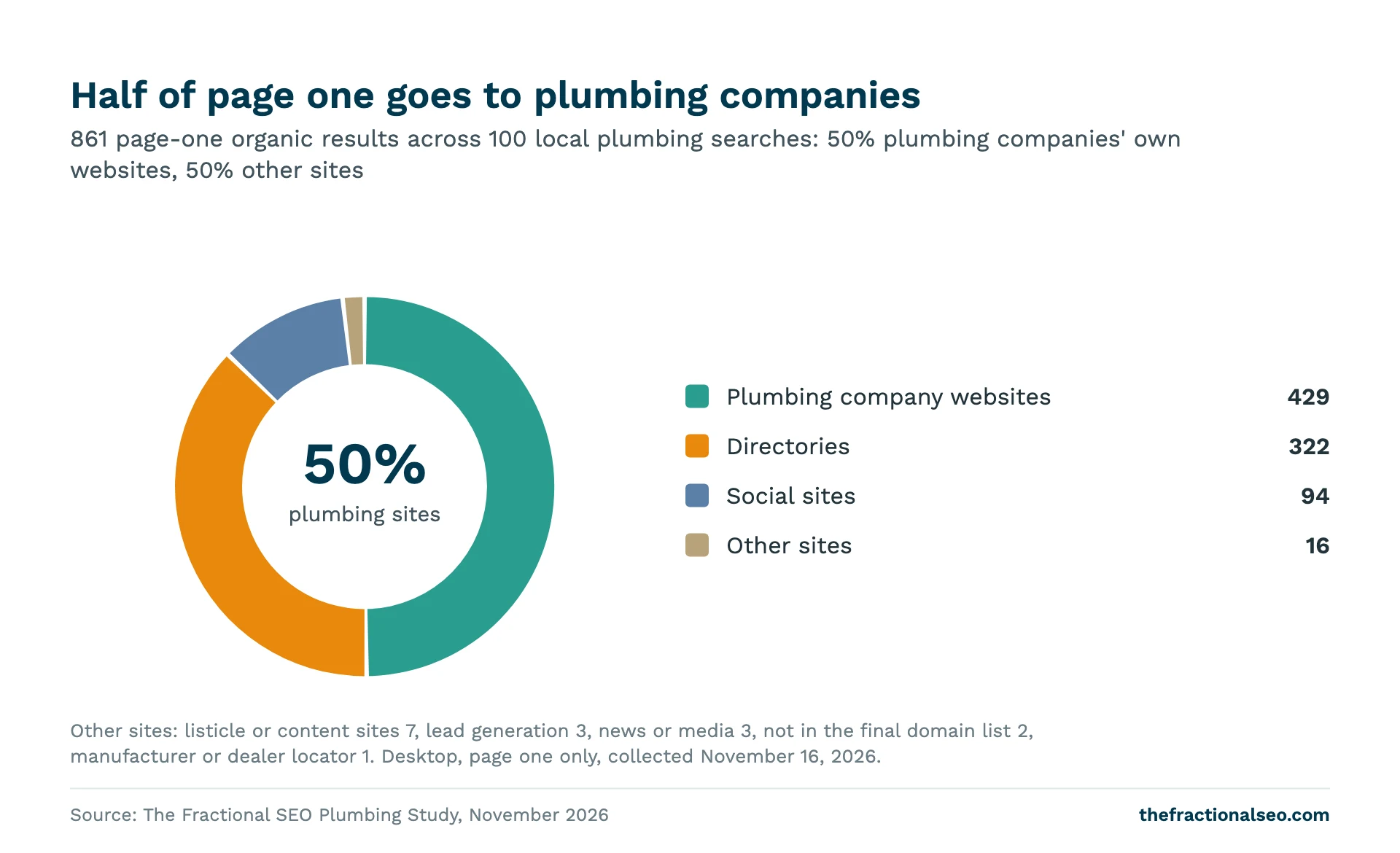
The organic half is also shared with sites that aren’t plumbers. Half of page one goes to plumbers: 50% of page-one organic results for local plumbing searches are plumbing companies’ own websites. The other 50% are directories, social sites and a few content and lead-generation sites. A site that is not a plumbing company holds the #1 organic spot in 41 of 100 local plumbing searches, and 51% of all top-3 organic spots.
| Type of page-one organic result | Results (of 861) |
|---|---|
| Plumbing company websites | 429 |
| Directories | 322 |
| Social sites | 94 |
| Other (content, lead-generation, news and other sites) | 16 |
One thing you won’t compete with much is equipment makers. Unlike HVAC, they are almost absent from page one: one manufacturer dealer-locator page appeared once in 100 searches, and no retailer ranked.
The share changes with the search. The broadest search, “plumber <city>”, leaves plumbers the smallest share of page one:
| Search wording | Plumbing-company share of page one |
|---|---|
| plumber <city> | 40% |
| emergency plumber <city> | 56% |
| drain cleaning <city> | 50% |
| water heater repair <city> | 52% |
Why does the organic job matter if you’re already in Maps? Plumbers found only in Maps have much less estimated organic traffic (median 87 visits a month) than those found only in organic results (159) or in both (528). These are modeled estimates, not measured visits. More on who wins what is in our benchmark of 100 local plumbing searches.
How Google ranks local results
Google’s help page on local ranking gives its own answer. Local results are mainly based on relevance, distance and how well-known a business is. (The page says “popularity” in its summary and “Prominence” in its heading.) Relevance is how well your profile matches the search. Distance is how far you are from the searcher. Under its “Prominence” sub-heading, the page says popularity is “based on info like how many websites link to your business and how many reviews you have.”
Distance is outside your control. A homeowner across town sees a different map pack from the one you see at the shop. The same page is blunt about shortcuts: “There’s no way to request or pay for a better local ranking on Google.” What you can work on is relevance and popularity, and they’re built in different places for the two blocks.
Part 1: The map pack
The map pack runs on your Google Business Profile, the free listing Google keeps for your company, and on what customers say about you there. In our data, a map-pack spot leans with a large and steady flow of reviews, more photos and recent posts.
Set up the Business Profile properly
Claim and verify the profile first. Then get the basics right.
Business name. Use your real name, as it appears on your trucks and invoices. Google’s guidelines say “Including unnecessary information in your business name isn’t permitted, and could result in the suspension of your Business Profile.” Our study flagged Maps listings with keyword names and few reviews, such as a listing named only “<city> plumbing”. They are few: 18 listings, 28 Maps rows and 2 of 300 map-pack spots. The flag is rule-based, not proof any listing is fake, and the pattern isn’t worth copying.
Address and service area. Google’s guidelines use a plumber as their example: if you run the business from your home address, clear the address from the profile and set the area you serve instead.
Category. “Plumber” is the primary category on 190 of 211 map-pack profiles; the next are HVAC contractor (11) and Drainage service (4). Unless most of your work is something narrower, Plumber is the default. Our Google Business Profile guide for plumbers covers additional categories, photos and the rest of the setup.
Website link and phone. Nearly every plumber in the map pack shows a website: only 16 of 300 map-pack listings (5.3%) had no website link. Fill in the field, and use a local number you control, the same one that’s on your site.
Reviews: how many, and how often
Reviews show the clearest map-pack difference in our data. Plumbers in the map pack have about twice the Google reviews of those just below: a median of 834 at positions 1-3 vs 420 at positions 4-7. The gap is strong statistically.
It’s not only the total. Map-pack plumbers keep getting reviews: a median of 9 new Google reviews in the 30 days before collection vs 3 for the rest. That compares businesses that reached a map pack in any study search with those seen only at Maps positions 4-20, each counted once.

Both are correlations, not causes. Established companies tend to have more reviews and other advantages too: age, budget and links. What the data does say is that a big, steady review flow goes with the map pack. Build it as a habit:
- Ask after every job, not only the ones that went well. Google’s content policy says businesses may not “selectively solicit positive reviews from customers”.
- Make it one tap. Google lets you ask customers “to visit a Google link or scan a QR code”. Put the link in the invoice text and the QR code on the tech’s leave-behind.
- Never offer a discount, gift or prize draw for a review. Google says incentives for reviews are strictly prohibited.
- Reply to reviews in plain words. A calm, specific reply to a bad review is there for the next homeowner who checks you out.
- Make one person responsible for checking that requests actually go out, including on after-hours calls.
For benchmarks by search and metro size, see how many Google reviews a plumber needs to make the map pack.
Photos and posts
Map-pack plumbing profiles have about twice as many photos: median 131 vs 63. Those counts include customer photos, and busier companies collect more of both, so the gap also tracks how busy a company is. Add your own as you go: trucks, the team, finished installs. Real photos only, never stock.
Recent Google posts are more common in the map pack too: 57% of map-pack plumbers posted in the 30 days before collection vs 44% of the rest. Strong statistically, and still a correlation, not proof that posting moves a listing up. Posting is cheap, so treat a post a month as the floor. Plumbing gives you plain topics: frozen-pipe tips before a cold snap, a water heater job finished this week, holiday hours, a drain-cleaning offer.
Franchises and chains in both lists
Plumbing has a competitor you can’t ignore: franchise brands. Franchise brands are under 1% of plumbing websites but hold 9% of map-pack spots and 17% of plumbing-company organic results. Seven franchise sites hold 27 of 300 pack spots in 13 of 25 metros and 75 of 429 organic results, most of them Roto-Rooter (14 pack spots, 42 organic results).
| Franchise brand | Map-pack spots (of 300) | Organic results (of 429 plumbing-company results) |
|---|---|---|
| Roto-Rooter | 14 | 42 |
| Mr. Rooter Plumbing | 6 | 14 |
| Zoom Drain | 3 | 11 |
| Benjamin Franklin Plumbing | 3 | 5 |
| 1-Tom-Plumber | 1 | – |
| Service Experts | – | 3 |
Company-owned chains, one brand running locations in several metros, are a separate group: 9 sites hold 8 pack spots and 8 organic results. Michael & Son Services holds 5 of those pack spots; Elite Rooter, Swift Brothers and Hiller hold 1 each.
Read those numbers the other way, too: most of the map pack still goes to other companies. What you control is the local work: reviews from your own town, photos of your own crews and pages about the neighborhoods you work in.
Part 2: Local organic results
The organic list is where directories crowd in, and where most map-pack plumbers don’t appear for the same search. It runs on your website and the links pointing to it.
Service pages
81% of plumbing websites have dedicated service pages (drain cleaning, water heater repair and so on), with a median of 19 among those that do. Map-pack plumbers have more: a median of 23 service pages vs 11 for businesses only at Maps positions 4-20. Having any service page also leans with the pack (90% vs 79%), but in organic results the split is 90% vs 83%, no clear difference.
The count gap is strong. The yes-or-no lean (90% vs 79%) only just holds after correcting for the number of tests, and page counts grow with company size and age. So read it as “bigger plumbers have bigger sites”, not “add pages to rank”. A page for each service you want calls for is still the plainest way to tell a homeowner, and Google, what you do. The beginner’s guide covers how to write them.
Location pages
Location pages are pages for a city or area you serve, or service-in-city pages such as “drain cleaning in Mesa”. They’re common: 67% of plumbing websites have them, and among those that do, the median is 18 such pages.
Here plumbing differs from HVAC. Our HVAC study tested only whether a site had any location page and found no reliable difference; it never counted them. In plumbing we counted, and the count leans with the map pack: map-pack plumbers have a median of 17 location and service-in-city pages vs 4 for businesses only at Maps positions 4-20, a strong difference. Simply having one is only a weak lean: 75% vs 66% in the map-pack comparison, a gap that fails the correction, and 80% vs 70% in organic results, no clear difference.

Be precise about what that means. The count is a correlation. Companies with more trucks tend to cover more towns, have been around longer and have paid for bigger websites, and that can show up as more pages. The study can’t separate the pages from the company behind them. It doesn’t show that adding pages moves you up, and it doesn’t show that it never does.
What it does show is that map-pack plumbers usually have many separate location pages, not one page with a list of towns in the footer. A homeowner in a suburb also wants to know you cover their street before they call, and a page with jobs you’ve done nearby answers that faster than a town list.
So build them where they help a customer, and build them properly:
- Only for towns you actually serve, with techs who actually go there.
- Real local content: jobs done in that town, the housing stock and pipe problems you see there (older galvanized lines, slab leaks, septic), reviews from customers there with their permission.
- Service-in-city pages only for the services you sell in that town, linked to the main service page and back.
- Never city-swapped copies of one template.
Google’s spam policies describe that last pattern: “Doorway abuse is when sites or pages are created to rank for specific, similar search queries.” Fifty near-identical “plumber in <town>” pages can fit it. Ten real ones are a better use of the same effort.
City in the title tag and LocalBusiness schema
Two more items show up on most local SEO checklists. A city in the homepage title tag is common: 70% of plumbing websites have their metro’s name there. That figure is a floor, because suburbs weren’t counted. LocalBusiness structured data, or a subtype such as Plumber, is on 69% of plumbing sites.
Neither shows a reliable difference. City in title: 76% vs 71% for map pack vs Maps 4-20, and 64% vs 65% for organic 1-3 vs 4-10, no clear difference either way. LocalBusiness schema: 76% vs 68% and 76% vs 72%, no clear difference. Do both because they’re cheap and they tell Google plainly where you work. Google’s local business structured data page lists the required properties and says “You must include the required properties for your content to be eligible for display as a rich result.”
Links
Map-pack plumbers’ websites have more links: a median of 205 referring domains vs 133 for businesses only at Maps positions 4-20, and a higher Domain Rank (187 vs 148). That’s strong statistically, it’s a correlation, and it fits what Google’s ranking page says about popularity and links. Good local links for a plumber are ordinary: supplier and manufacturer dealer listings, the local trade association, a chamber of commerce, a team you sponsor, a local news story about a job. Our guide on how to build backlinks for a plumbing business has the detail.
Directories
Directories are a big part of page one. The ones plumbers compete with most are Yelp (130 appearances, counting its mobile site), thumbtack.com (36), mapquest.com (28), bbb.org (19), angi.com (18), bestplumbers.com (15), serviceagent.ai (9) and homeadvisor.com (8). Those count appearances across 100 searches, not distinct searches. Two of them, bestplumbers.com and serviceagent.ai, are plumbing-only lead directories.
When a directory ranks above you for “plumber” in your city, your listing on that directory is another way for a homeowner to find you. Search your main services with your city name, note every directory on page one, and claim those listings first. Keep your name, address and phone identical on each one and on your Business Profile. Our guide to why directories outrank plumbers and how to use them covers each one.
Plumbing and HVAC under one roof
Many plumbers are also heating and cooling companies: 231 of 1,029 plumbing profiles (22%) list an HVAC, heating or air-conditioning category, and 88 (9%) use one as the primary category. Among profiles that reached a map pack, 15 of 211 do. If that’s you, you’re in the group that searches “plumbing hvac seo” (480 searches a month, a DataForSEO Labs modeled estimate, November 2026): two trades competing for one profile and one website.
Three practical rules. Pick the primary category for the trade most of your calls come from, and add the other as an additional category; a category is what you chose on Google, not proof of the work. Give each trade its own service pages rather than one combined page. And keep your plumbing location pages about plumbing: a drain-cleaning page for a town shouldn’t be an AC page with the word swapped.
Know your local demand
Before you build pages, know what people in one metro actually type. These are typical monthly searches for one exact wording per service, as medians across the 25 metros in our study:
| Search wording | Typical monthly searches |
|---|---|
| plumber <city> | 2,900 |
| emergency plumber <city> | 260 |
| drain cleaning <city> | 210 |
| water heater repair <city> | 170 |
“Plumber <city>” is about ten times any other wording. It’s also the search where plumbers hold the smallest share of page one (40%), so it’s where directories and other sites take the most room. Your homepage and Business Profile carry that search; your service pages carry the rest. Total demand is higher than the table, because people also search “near me” and many variants.
Some services also swing through the year (burst pipes in winter, for example), even though “plumber” itself barely moves. Plan pages around them with seasonal SEO for plumbers. Emergency searches are smaller and behave differently; see emergency plumbing SEO.
A 90-day local SEO plan
Start with the map pack: the profile and the review habit cost nothing but time. The website follows, then directories and links.
Days 1-30: Business Profile and review habit
- Verify the profile, fix the business name, set the service area and choose the primary category.
- Add the website link and a local phone number that matches the site.
- Add a review request to every job closeout: a text with the direct link, and a QR code on the leave-behind.
- Publish the first post and upload real photos of your techs, trucks and jobs.
Days 31-60: Service and location pages
- List the services you want calls for and check each has its own page.
- List the towns you serve, in order of how much work comes from each.
- Write a real page for the first few towns, with local jobs and reviews.
- Put the service and city in the title tags of key pages and add LocalBusiness schema.
Days 61-90: Directories, links and a monthly routine
- Claim and clean up the directories that rank for your main searches; fix any name, address or phone mismatch.
- Ask suppliers, associations and teams you sponsor for a link.
- Set a monthly routine: a post or two, review replies, a ranking check, one new or improved page.
For a printable task list, use the local SEO checklist for plumbers.
How to measure local SEO
A ranking check from your office tells you little, because Google weighs distance. Measure these instead:
- Map-pack position for your top searches, checked from a phone inside your service area, in more than one part of town.
- Business Profile actions: calls, website clicks and direction requests.
- Search Console clicks for searches that include your city or a service.
- New reviews per month. If that number drops, fix the ask before anything else.
Look monthly and judge quarterly: local rankings move week to week, and the trend in calls and booked jobs tells you whether the plan is working.
Questions, answered
How do I get my plumbing company into the Google map pack?
Google says local results are mainly based on relevance, distance and popularity. In our study, map-pack plumbers had about twice the reviews (a median of 834 vs 420 at positions 4-7), kept getting new ones, were more likely to have posted recently and had more links to their websites. Those are correlations, not causes, and distance is outside your control.
Is local SEO different from regular SEO for a plumber?
Yes. The map pack and the organic results are mostly different businesses: only 13% of map-pack plumbers with a website also ranked on page one organically for the same search. Treat Maps and your website as two jobs with two plans.
Do plumbers need location pages?
Most have them (67% of plumbing sites), and map-pack plumbers have more of them, a median of 17 vs 4. That’s a sign of bigger companies as much as anything. Build them for towns you really serve, with real local content, never city-swapped copies.
Can I beat Roto-Rooter in my city?
Roto-Rooter held 14 of 300 map-pack spots in our searches, more than any other brand, but most spots went to other companies. Compete on the local work: reviews from your town, real photos and pages about the towns you work in.
Can I pay Google to rank higher in Maps?
No. Google says “There’s no way to request or pay for a better local ranking on Google.” Local Services Ads are a separate paid placement above the results; our guide to plumbing lead generation covers how they fit with SEO.
Want to know which half of local search you’re losing?
We look at where your company shows up in Maps and in the organic results for your city’s plumbing searches, and tell you what to fix first. See how fractional SEO for plumbers works.
Sources
- TFS Plumbing Study, November 2026: our study of 927 plumbing websites
- Google Business Profile Help, Tips to improve your local ranking on Google
- Google Business Profile Help, Guidelines for representing your business on Google
- Google Business Profile Help, Tips to get more reviews
- Maps User Generated Content Policy, Prohibited and restricted content
- Google Search Central, Spam policies for Google web search
- Google Search Central, Local business (LocalBusiness) structured data
More guides
The whole Plumbing library- SEO for Plumbers: A Beginner’s Guide What plumbing customers search for, which pages to build first and what 927 plumbing websites show,…
- How to Generate Plumbing Leads with SEO Where plumbing leads come from on Google, what the clicks cost by wording, and how to…
- How to Build Backlinks for a Plumbing Business How many links ranking plumbers actually have, where good plumbing links come from, and what Google…