
Guide Plumbing
Seasonal SEO for Plumbers: Plan by Service, Not by Season
Most marketing calendars assume a busy season and a slow season. In search, plumbing barely has one. Google Trends interest in "plumber" varies by only 1.24 times between its May low and its August peak. What moves is single services. In Google Ads data, searches for a plumber for burst pipes peaked in winter, sump pump repair in spring and water heater replacement in autumn. So this guide plans by service: when each page, profile update and offer should be ready, and what stays ready all year.
We analyzed 100 local searches across 25 US metros and four plumbing search types, 1,048 plumbing company websites (927 crawled) and 1,029 Google Business Profiles, November 2026. For this guide we also used Google Trends (US, weekly, averaged by month over 2022 to 2025) and Google Ads monthly search volumes for the US over the latest 12 months, with windows ending between August and October 2026. We collected this data in mid-November 2026. Plumbing demand runs all year, but frozen-pipe and water-heater searches rise in winter, so review pace, Google posting and ad activity may look different in other months. Everything below is about when people search, not when jobs are booked or paid. The timing comes from the data; the page and profile suggestions are standard practice, not study findings. Your own call log will show how closely the two match in your market.
The short answer
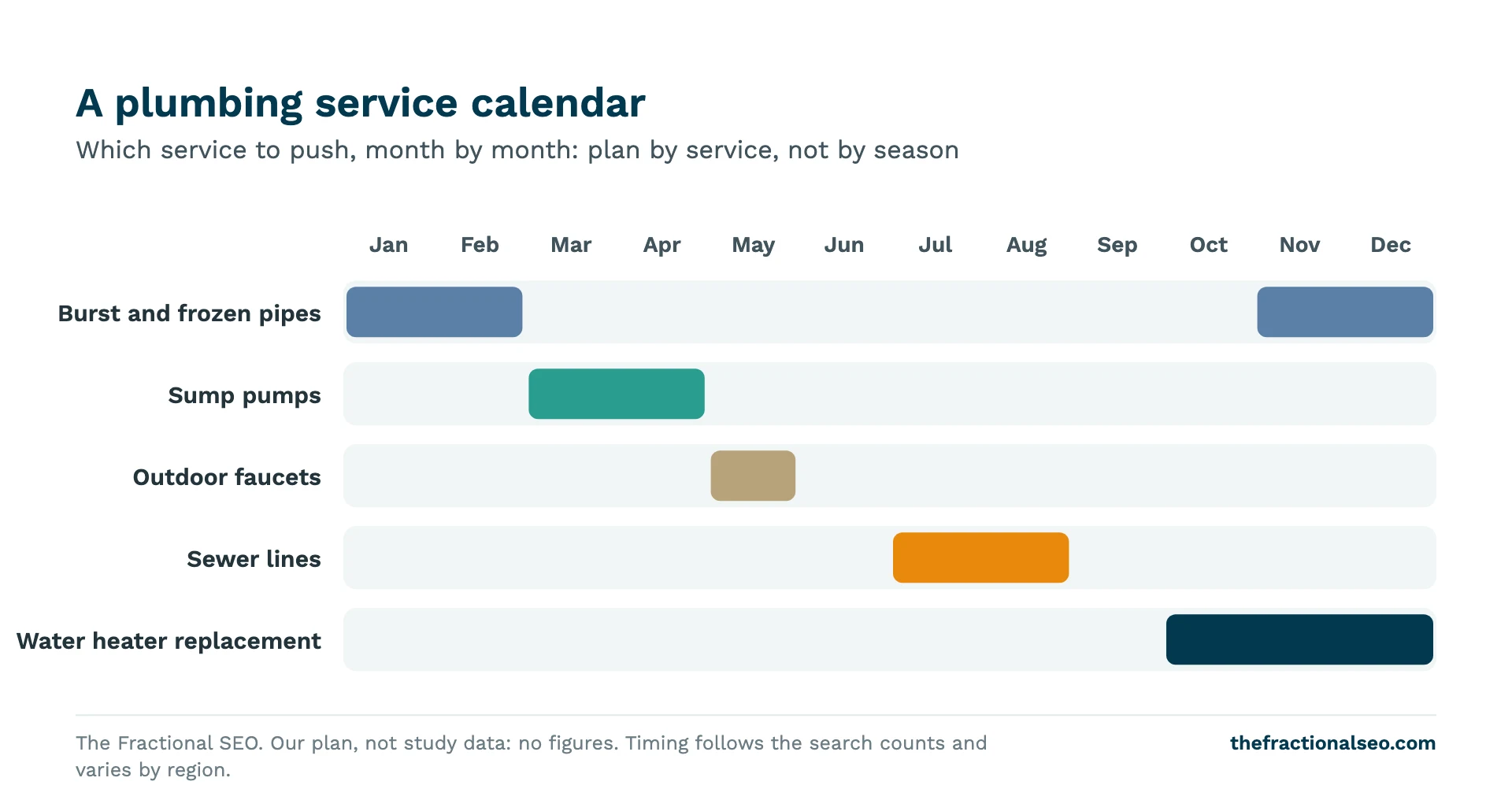
- All year: keep your core plumber, drain, water heater and emergency pages ready. Interest in “plumber” itself barely moves.
- By December: a burst and frozen pipe page, with what to do before you arrive.
- By February: sump pump and outdoor faucet pages, and a dated offer on your Business Profile.
- By June: sewer line pages, and a plan for the calls you can’t take.
- By September: water heater replacement pages with honest price ranges.
Plumbing demand is flat. Single services aren’t.
Google Trends shows how interest in a search changes over time. It doesn’t count searches. Google explains that each data point is normalized to the time and place of the query and then scaled on a range of 0 to 100. We pulled five plumbing terms on one shared scale, weekly, and averaged each calendar month over 2022 to 2025. We use Trends for the shape of the year only.
Here is what it shows. Overall plumbing demand is close to flat through the year: interest in “plumber” varies by only 1.24 times between its May low and August peak. “Drain cleaning”, “water heater repair” and “emergency plumber” each peak in August at about twice their own low, a far bigger swing than “plumber”, but still mild. For comparison, AC repair swings 4.5 times in the same kind of data.
That’s why an HVAC-style plan, with a big push before the peak and a quiet stretch after it, doesn’t fit a plumbing company. Pipes leak and drains clog in every month, and interest in “plumber” in May, its lowest month, is not far below August, its highest.
The movement is underneath, in single services. Burst-pipe searches climb in winter, sump pump searches in spring and water heater replacement searches in autumn, as the next section shows. You don’t need a season plan. You need each service page ready before its own climb.
Two cautions. These are national curves, and our data has no regional split, so a plumber in Minneapolis and one in Phoenix will see different timing for frozen pipes. And a Trends index shows shape only. It says nothing about whether plumbing searches are rising or falling from one year to the next.
What the search counts show
Trends gives the shape. Google Ads volumes give rounded counts. Single services swing hard even though interest in “plumber” barely moves: in Google Ads monthly volumes, “plumber for burst pipes” peaked in winter (60,500 in January 2026 against 1,300 in September 2026), “sump pump repair” peaked in spring (49,500 in March 2026 against 12,100 in September 2026) and “water heater replacement” in autumn (74,000 in October 2025 against 33,100 in February 2026).
| Search | Monthly average | Highest month | Lowest month |
|---|---|---|---|
| plumber for burst pipes | 12,100 | January 2026: 60,500 | September 2026: 1,300 |
| sump pump repair | 27,100 | March 2026: 49,500 | September 2026: 12,100 |
| water heater replacement | 49,500 | October 2025: 74,000 | February 2026: 33,100 |
| sewer line repair | 18,100 | July 2026: 49,500 | January 2026: 9,900 |
| emergency plumbing services | 14,800 | September 2025: 33,100 | June 2026: 5,400 |
| plumbing services | 60,500 | December 2025: 110,000 | June 2026: 27,100 |
| plumber emergencies (Google groups several emergency wordings) | 90,500 | July 2026: 201,000 | November 2025: 49,500 |
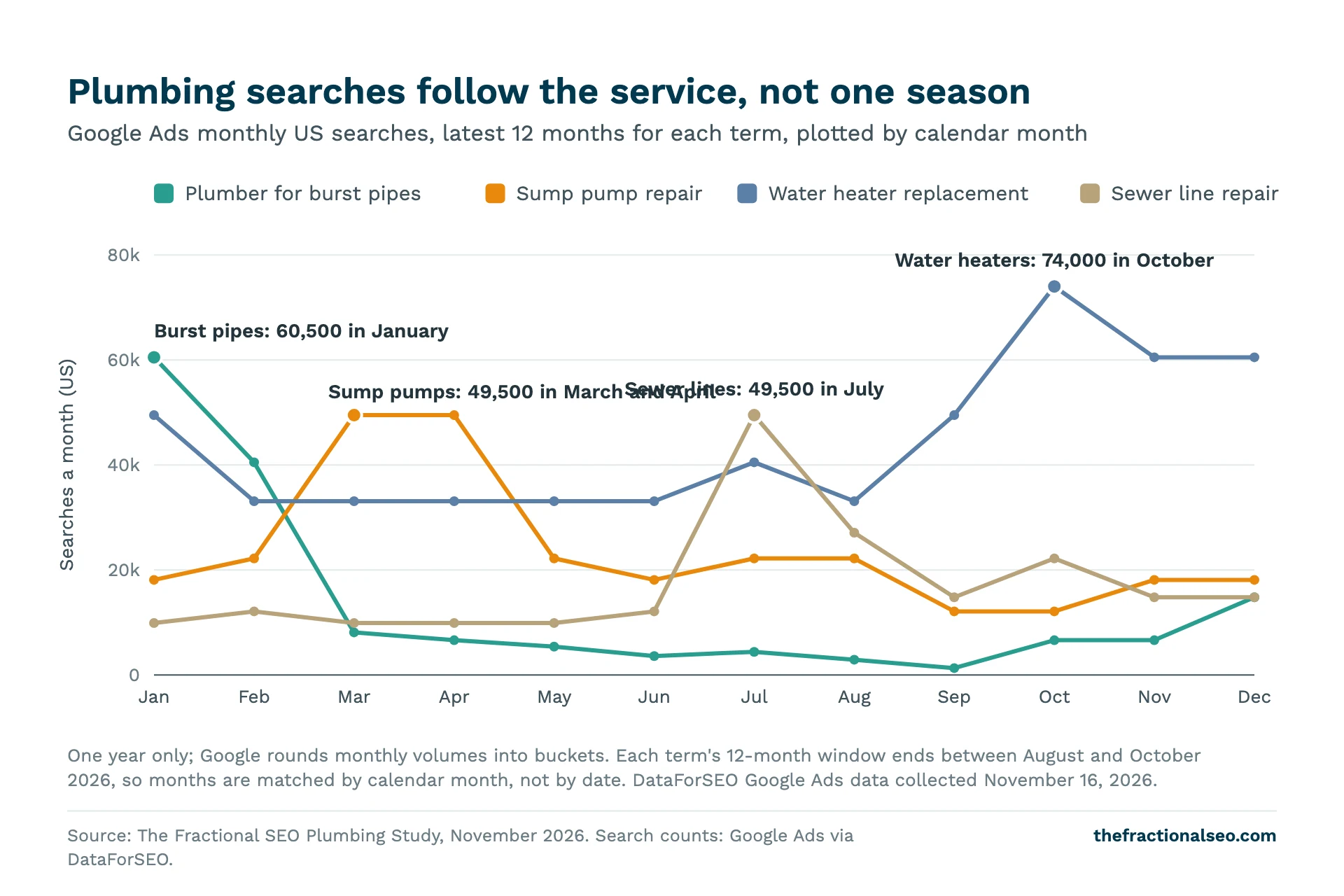
Read the table with its limits in mind. This is one year only, and Google Ads rounds volumes into buckets: water heater replacement sits at its 33,100 low for six months, so the monthly line is a staircase, not a curve. Broad wordings swing in this data too. “Plumbing services” moved 4.1 times between its high and low month, which is why the flat-overall point rests on Trends, not on these counts. And the January 2026 burst-pipe peak may reflect that winter’s cold, not a typical year. Use the table for timing. Don’t read it as a forecast.
Start with the services people search most
Before you time anything, make sure the big pages exist. In the national keyword set, the biggest plumbing service searches were “plumbing services” at 60,500 a month and “water heater replacement” at 49,500, with “french drain installation”, “change water heater” and two tankless installation wordings at 40,500 each. Two larger groups sit under odd wordings Google uses to group variants: emergency plumber searches at 90,500 and water heater repair at 74,000. Water heater work dominates the national list.
People also search for prices, and almost all of it is for water heaters: 57 cost or price keyword groups total 179,510 searches a month, led by “water heater replacement cost” at 40,500. Against that, only 21% of plumbing homepages in our study show a dollar price for a service.
So the order of work is simple. A complete page for each core service comes first, because those pages earn visits in every month. Seasonal timing is the second layer. Our SEO for plumbers guide covers the core pages, and our flagship study shows what top-ranked plumbing websites do differently.
Burst and frozen pipes: ready by December
This is the biggest swing in the data. Searches for “plumber for burst pipes” sat at 6,600 in October and November 2025, rose to 14,800 in December, hit 60,500 in January 2026 and were still at 40,500 in February before falling back. A plainer wording, “burst water pipe”, followed the same path: 2,900 in January 2026 and 2,400 in February, against 480 in June (DataForSEO keyword data, modeled from Google Ads, collected 16 November 2026).
Remember the caveat: one winter, and possibly a cold one. Plan for a spike, but don’t budget for the same size every year. What to have live by December:
- A burst and frozen pipe page that tells people what to do right now: where the main shut-off usually is, how to open faucets, what not to do with a torch or a space heater. Then how to reach you.
- If someone really answers at night, say so plainly and put the number at the top. If not, say when you open. Our emergency plumbing SEO guide covers emergency pages in detail.
- Holiday hours on your Business Profile. Google’s special hours cover holidays and other exceptional circumstances, for adjusted hours or closures of up to 6 days in a row.
- A short prevention page (insulating pipes, outdoor hose bibs, leaving a tap dripping) that you can share with past customers before the first hard freeze.
If you work in a warm metro, this section may matter much less. Check your own Search Console data from last winter before you spend time on it.
Sump pumps and outdoor faucets: ready by February
Sump pump repair is spring work. Searches ran at 18,100 a month from November 2025 to January 2026, rose to 22,200 in February, reached 49,500 in March and April 2026, then fell back to 12,100 by September. The smaller wording “sump pump services” shows the same timing: 2,400 in March 2026 against 480 in December 2025. Outdoor faucets come a little later: “leaking outdoor faucets” reached 12,100 in May 2026, against 3,600 in December 2025 (DataForSEO keyword data, modeled from Google Ads, collected 16 November 2026).
- Publish or refresh a sump pump page in February: repair vs replacement, battery backups, what a visit covers, and how to book.
- Post a dated offer on your Business Profile for sump pump checks. Google says an offer requires a title, dates and time, and posts older than 6 months are archived unless a date range is set.
- Add outdoor faucet and hose bib repair to your services list and to an existing page, if you do the work.
Our Google Business Profile guide for plumbers covers posts, services and photos in full.
Sewer lines and the summer emergency rush: ready by June
Sewer line repair was steady at around 9,900 to 14,800 a month for most of the year, then jumped to 49,500 in July 2026 and was still 27,100 in August. If you do camera inspections, sewer repair or trenchless work, have those pages complete before summer.
Emergency searches are harder to read. The grouped emergency plumber wording peaked in July 2026 at 201,000. But “emergency plumbing services” peaked in September 2025 at 33,100 and was lowest in June 2026 at 5,400. The two wordings don’t agree, so we don’t plan emergency work by month. Trends gives the steadier picture: “emergency plumber” peaks in August at about twice its own low. Treat emergency as an all-year service that runs a little hotter in late summer. Our emergency plumbing guide covers the rest.
Summer is also when “drain cleaning” and “water heater repair” reach their Trends peaks in August. Don’t plan big site changes for that month. A broken booking form in your busiest week costs more than it would in May. Decide what happens to the call you can’t take: a callback within the hour, a booking slot for tomorrow, or an honest note about wait times.
Water heaters: ready by September
Of the four seasonal services here, water heater replacement has the most searches, and it peaks in autumn. Searches reached 74,000 in October 2025 and stayed at 60,500 in November and December, then sat at 33,100 from February to June 2026. Tankless installation leans toward winter: “tankless water heater installation” reached 60,500 in January and February 2026, against 9,900 in September 2026 (DataForSEO keyword data, modeled from Google Ads, collected 16 November 2026).
Price questions come with it. “Water heater replacement cost” alone gets 40,500 searches a month, “tankless water heater cost” 27,100 and “tankless water heater price installed” 27,100. What to have live by September:
- A water heater replacement page that explains what affects the price: tank or tankless, gas or electric, size, venting and permits. A range, if you’re willing to publish one, beats “call for a quote”.
- Separate repair and replacement pages, so each one matches what people type.
- A tankless page that covers sizing and installation, ready before the winter climb.
- Photos of your own recent installs on the page and on your Business Profile.
A service calendar for the year
Here is the plan in one table. The timing comes from the search data above. The actions are our plan, not study data.
| Have it ready by | Service | What to do |
|---|---|---|
| All year | Plumber, drain cleaning, water heater repair, emergency | Complete pages, current hours, a review request after every job |
| December | Burst and frozen pipes | What-to-do-now page, holiday hours, prevention page to share |
| February | Sump pumps, then outdoor faucets | Sump pump page, dated Business Profile offer, services list |
| June | Sewer lines; summer emergency calls | Sewer and camera pages, overflow plan, no big site changes in August |
| September | Water heater replacement, then tankless | Price-factor page, repair vs replacement pages, install photos |
What to do all year
Seasonal timing only pays off on top of the basics. Keep these going every month:
- Keep your Business Profile current: hours, services, photos and posts.
- Ask for a Google review after every job, in every month.
- Use the slower weeks for the work that never fits a busy one: site fixes, new pages and building links.
- Track calls, bookings and forms by source, so you can see which service pages paid off. See how to generate plumbing leads with SEO.
For the full list, use the local SEO checklist for plumbers.
FAQs
What is the busiest time of year for plumbers?
In search, there isn’t much of one. Interest in “plumber” peaks in August and is lowest in May, only 1.24 times apart. Single services have clear peaks: burst pipes in winter, sump pumps in spring, sewer lines in summer and water heater replacement in autumn. That’s search interest, not jobs or revenue.
When should plumbers promote water heater replacement?
Have the page and any offer live by September. Searches peaked in October 2025 at 74,000 and were lowest from February 2026 at 33,100. Price searches are large too, led by “water heater replacement cost”.
Do burst pipe searches spike every winter?
We have one year of data. Searches peaked at 60,500 in January 2026, and that may reflect a cold winter rather than a typical one. Have the page ready every December, but don’t count on the same size of spike.
Is there a slow season for plumbing?
Not much of one in search. “Plumber” is lowest in May, but the August peak is only 1.24 times that low. Your own slow weeks depend on your climate and your service mix, so check your call log.
Build your own service calendar
Want a service calendar built on your own market’s searches? Start with how we approach plumbing SEO.
More guides
The whole Plumbing library- SEO for Plumbers: A Beginner’s Guide What plumbing customers search for, which pages to build first and what 927 plumbing websites show,…
- How to Generate Plumbing Leads with SEO Where plumbing leads come from on Google, what the clicks cost by wording, and how to…
- How to Build Backlinks for a Plumbing Business How many links ranking plumbers actually have, where good plumbing links come from, and what Google…