
Guide Plumbing
Emergency Plumbing SEO: What 100 Local Searches Show About 24/7 Plumbers
In our study, emergency plumbing searches looked different from plain "plumber" searches in three ways we measured: what Google puts at the top, what the clicks cost, and which plumbers show up. This guide walks through those differences and what to build if you really answer the phone after hours.
About the data: We analyzed 100 local searches across 25 US metros and four plumbing search types, 1,048 plumbing company websites (927 crawled) and 1,029 Google Business Profiles, November 2026. Only 25 of those 100 searches were emergency searches: “emergency plumber” plus the city, one in each metro. The other 75 (“plumber”, “drain cleaning” and “water heater repair”) are the comparison. We collected this data in mid-November 2026. Plumbing demand runs all year, but frozen-pipe and water-heater searches rise in winter, so review pace, Google posting and ad activity may look different in other months.
One more limit up front. The study measured search pages, click prices and what ranking plumbers have. It didn’t measure calls, jobs or revenue, so nothing here says an emergency page will bring you calls. Where we compare top-ranked and lower-ranked plumbers, the results show what tends to go together, not what causes a ranking.
The short answer
- Emergency clicks cost about 1.95 times as much. In 23 of 24 metros, “emergency plumber <city>” cost more per click than “plumber <city>” in Google’s planner estimates.
- AI Overviews crowd emergency searches most: on 76% of emergency searches vs 24% of “plumber” searches.
- Plumbers get their biggest share of page one on emergency searches: 56% of results, against 40% for “plumber”.
- The review bar is lower than for “plumber”: a median of 603 reviews in the emergency map pack vs 1,444.
- Say 24/7 only if someone answers. Map-pack plumbers are more likely to say it, but that lean only just holds up and probably reflects company size.
What an emergency plumbing search looks like
Start with the whole study. Google Local Services Ads appeared above the results on 50% of local plumbing searches, text ads on 19% (at the top on 7%), and an AI Overview on 46%. Every search showed a map pack.
Split by wording, emergency searches stand out for one thing: AI Overviews. They showed on 19 of 25 emergency searches (76%), against 6 of 25 “plumber” searches (24%). Emergency searches get an AI Overview three times as often as “plumber” searches. Local Services Ads showed on 13 of 25 emergency searches (52%), a little less often than on “plumber” searches (64%). Text ads showed on 4 of the 25.
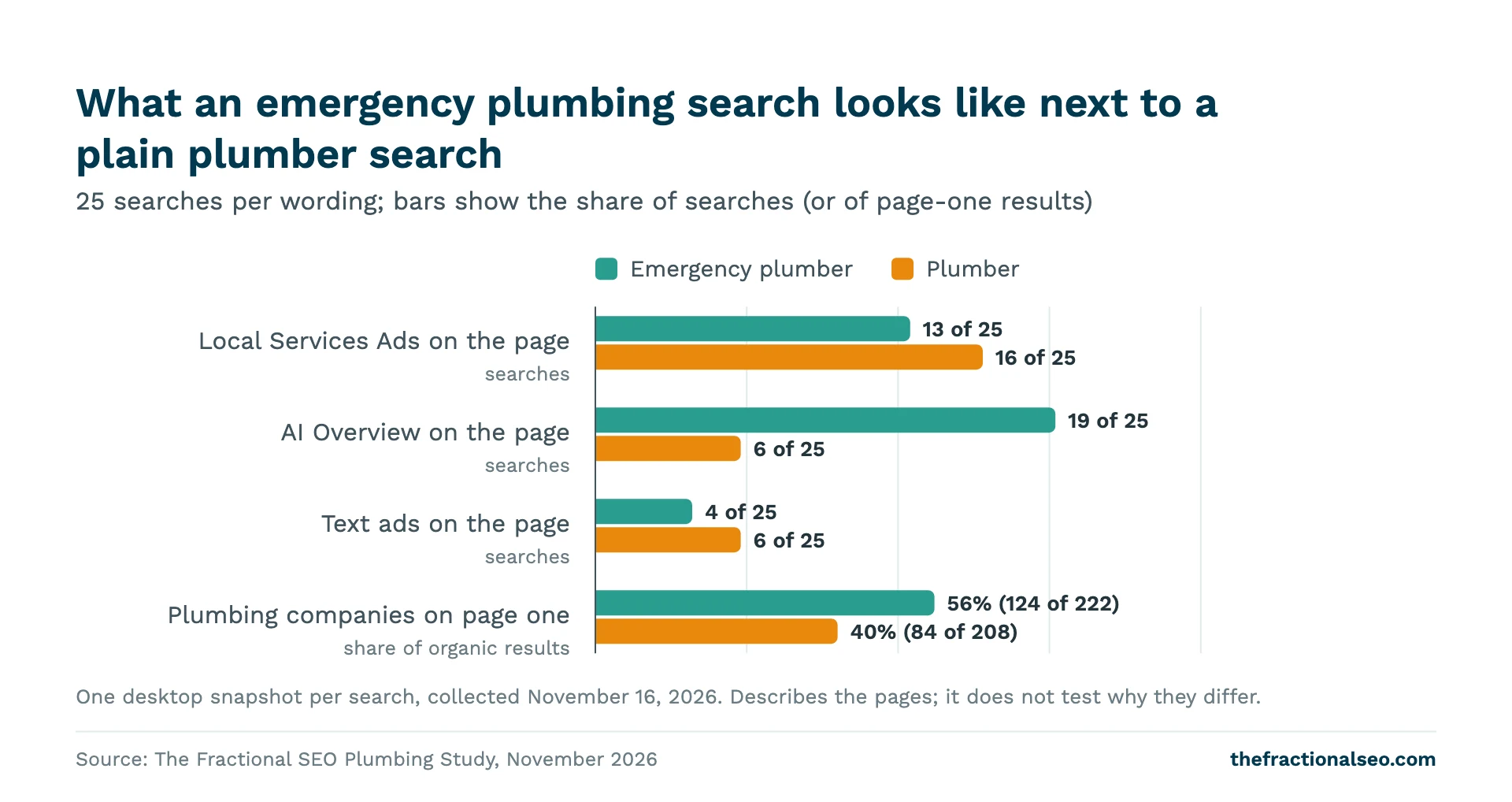
Below all that, the organic results are friendlier to plumbers on emergency searches than anywhere else in the study. Share of page-one results that are plumbing-company sites, by search: “plumber” 40%; “emergency plumber” 56%; “drain cleaning” 50%; “water heater repair” 52%. On emergency searches, 124 of 222 page-one results were plumbing companies’ own sites. On the broadest search, “plumber <city>”, directories and other sites took more of the page.
Two cautions. Each wording had 25 searches, so these are descriptions of what we saw, not tested differences. And this was one desktop snapshot per search. Ads rotate by the hour and mobile results may differ. The full picture by wording and market size is in our benchmark of 100 plumbing searches.
What emergency clicks cost
Google’s planner puts a price on every search it can, and emergency searches are near the top. In 23 of 24 metros, “emergency plumber <city>” costs more per click than “plumber <city>”: a median of $83.27 vs $38.45, about 1.95 times as much, for about a tenth of the searches. One metro had no emergency figure, so the comparison uses the 24 that had both.
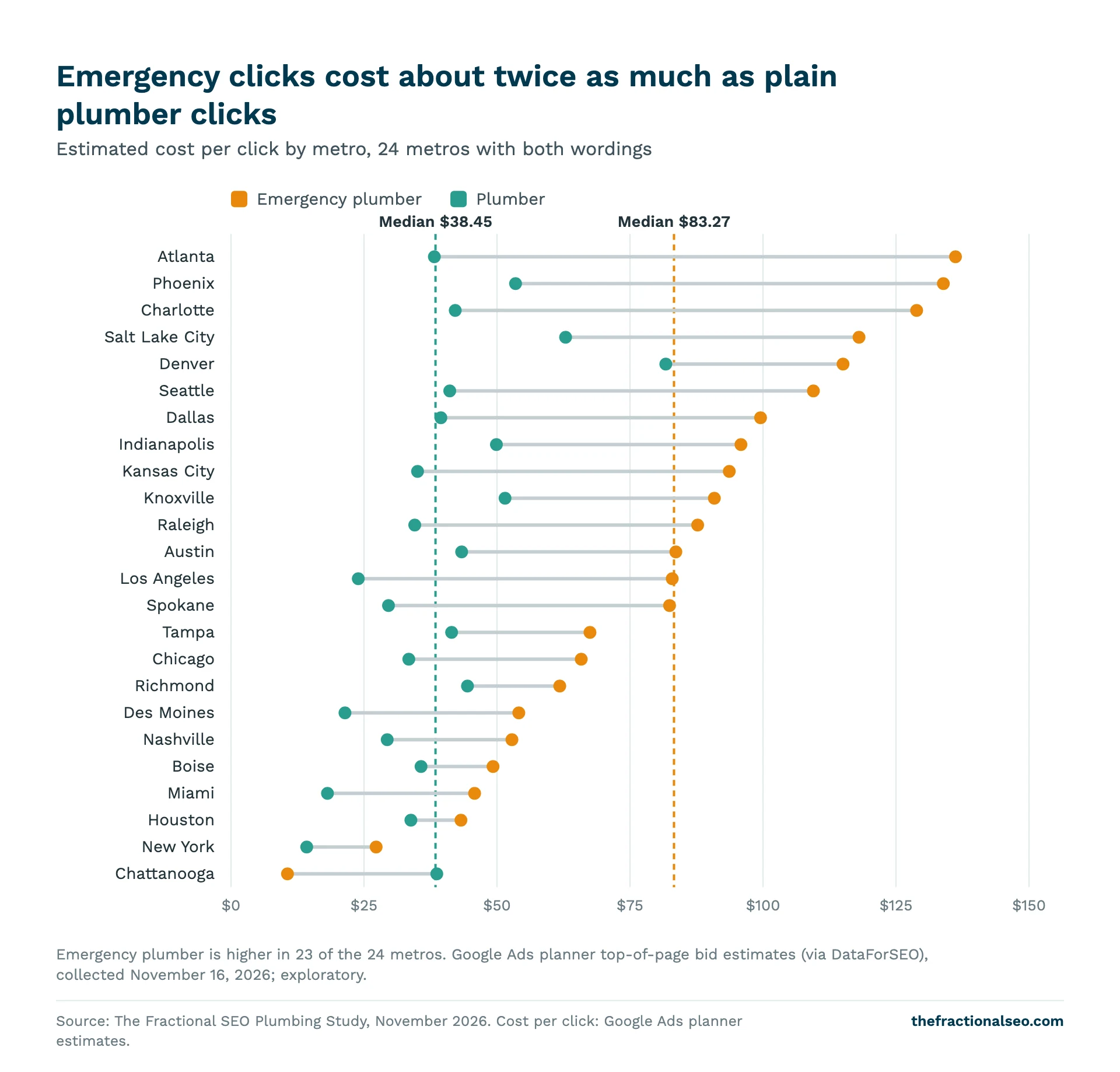
The priciest emergency searches in the study metros were “emergency plumber atlanta” at $136.18, “emergency plumber phoenix” at $133.9 and “emergency plumber charlotte” at $128.89. Nationally, emergency wordings are priced high too. Emergency searches are among the priciest plumbing clicks: 36 emergency and 24-hour keyword groups (54,560 searches a month in all) have a median cost per click of $69.01, against $13.22 for plumbing service searches overall.
Read those numbers carefully. They are Google Ads planner estimates of the top-of-page bid, not what any plumber actually paid, and the metro comparison is exploratory: we didn’t correct it for the number of tests we ran. It is consistent, though. In all but one metro, the emergency click was priced higher.
What it means for SEO is narrow. A visit from the map pack or an organic result doesn’t carry a price per click. It costs time, and work on the profile and site, instead. We have no data on cost per lead or on how many emergency visits turn into calls, so we won’t tell you organic emergency traffic is cheaper per job. How emergency fits into the rest of your lead plan is in how to generate plumbing leads with SEO.
How much emergency search there is
Emergency searches are smaller than plain “plumber” searches in any one city. The typical metro had 2,900 monthly searches for “plumber <city>” and 260 for “emergency plumber <city>”. Those are exact wordings only; “near me” and other variants aren’t included.
Nationally the emergency wordings add up. The biggest plumbing service group in our keyword data sits under Google’s odd wording “plumber emergencies”, 90,500 searches a month: Google reports a group of close variants under that one wording. “Emergency plumbing services” had 14,800 searches a month and “emergency plumber service” 12,100.
Timing matters too. In Google Trends, “emergency plumber” peaks in August at about twice its own low in February. Single services swing hard: in Google Ads monthly volumes, “plumber for burst pipes” peaked in winter (60,500 in January 2026 against 1,300 in September 2026). That is one year of data, and the January 2026 peak may reflect that winter’s cold. Trends shows the shape of the year, not whether searches are growing. To plan pages around the services that swing, see seasonal SEO for plumbers: plan by service, not by season.
The emergency map pack
Every emergency search we ran showed a map pack, and it has its own review bar. Median reviews in the map pack by search: “drain cleaning” 391; “emergency plumber” 603; “plumber” 1,444; “water heater repair” 1,698. For emergency searches, plumbers just below the pack (Maps positions 4-7) had a median of 463. Each wording had 75 map-pack listings, so treat these as a description, not a target to hit.
Across all four wordings, map-pack plumbers also keep getting reviews: a median of 9 new Google reviews in the 30 days before collection vs 3 for the rest. That is a correlation. Busier companies get more reviews and have other advantages. For the full benchmarks, see how many Google reviews a plumber needs to make the map pack.
On the profile itself, emergency comes down to hours and honesty:
- Hours: Google’s profile guidelines ask you to “Provide your regular customer-facing hours of operation.” If you really answer around the clock, set the profile to open 24 hours. If you don’t, don’t.
- Holidays and extra hours: Google lets you set special hours for holidays and “more hours” for different features you offer.
- Name: your real business name, with no “24/7” or “emergency” added. Google’s guidelines say the name should reflect your real-world name.
- Categories: in our data, listing more categories showed no reliable edge. Google’s guidelines ask for the fewest categories that describe your core business.
Distance matters too, and you can’t change it. Google’s local ranking page says distance is how far a business is from the person searching, and that “There’s no way to request or pay for a better local ranking on Google.” The field-by-field setup is in our Google Business Profile guide for plumbers.
24/7 on your website: common, and only a lean
Most plumbing websites already say they handle emergencies. In our read of 920 homepages, 24/7 or emergency service showed on 75%. 24/7 service is the norm. It isn’t a way to stand out.
Map-pack plumbers are more likely to advertise financing (40% vs 25%) and 24/7 or emergency service (86% vs 74%) on the homepage. That compares sites in the map pack with sites found lower in Maps (positions 4-20). The 24/7 gap passes our correction for the number of tests we ran, but only just. In organic results it reverses slightly: 73% of top-3 sites vs 78% at positions 4-10.
So treat it as a lean, not proof. Around-the-clock crews are a sign of a larger company, and larger companies tend to have more reviews, pages and links too. The study can’t separate a 24/7 promise from the size of the company making it. What the top-ranked sites do differently, feature by feature, is in what top-ranked plumbing websites do differently.
The practical rule follows from that. Say 24/7 if a person picks up at 2 a.m. Don’t say it to look bigger. A promise that rings through to voicemail can cost you the job and the review.
Build an emergency page you can stand behind
If you do answer after hours, give emergency work its own page. This is best practice, not study data:
- The phone number first, at the top and as a tap-to-call link. 90% of plumbing websites have a click-to-call phone link on the homepage; make sure the emergency page has one too.
- Say exactly what you cover: which hours, which towns, and which jobs (burst pipes, sewer backups, no hot water, gas smells and when to call the utility instead).
- Say what happens when they call: who answers, roughly how long until someone arrives, and how after-hours pricing works. If there’s a trip or after-hours fee, say so.
- Show proof from real jobs: photos from emergency calls and reviews that mention them, with the customer’s permission.
- Link it from the homepage, the header and each related service page.
Two cautions. First, don’t copy the page for every suburb with only the town name changed. Google’s spam policies describe doorway abuse as pages “created to rank for specific, similar search queries”. Location pages done properly are in our local SEO guide for plumbers.
Second, AI Overviews. They showed on most emergency searches we checked, and Google’s page on AI features says “There are no additional requirements to appear in AI Overviews or AI Mode”: a page needs to be indexed and eligible to show with a snippet. We didn’t measure which sites AI Overviews linked to or whether they took clicks, so the advice is the same as for any page: answer the emergency question plainly.
If you run Local Services Ads for emergency work, answer them. Google’s help page says customers can call, message or book through the ad, and that if you regularly fail to answer calls or respond to messages, your ad ranking may be affected.
Answer the phone, then measure it
An emergency page is only as good as the person who picks up. Before you promote after-hours work, decide how night and weekend calls get answered. This part is best practice, not study data:
- An on-call rotation with a clear rule for which calls go out tonight and which get booked for the morning.
- An answering service that knows your service area, your after-hours fee and what counts as an emergency for you.
- A text back to every missed call within minutes, so the homeowner knows someone saw it.
Then count what comes in. Tag calls and form fills from the emergency page separately, note which ones turned into jobs, and check the after-hours share once a month. If the page brings calls you can’t staff, take 24/7 off the profile and the page until you can. That is a business decision our study can’t make for you, but your own call log can.
What this study can’t tell you
- Whether an emergency page brings calls or jobs. We measured search pages, not phones.
- Whether saying 24/7 helps a plumber rank. The map-pack lean only just passes our correction and is probably tied to company size.
- What you would pay for emergency ads. Planner estimates are a guide to the auction, not a quote.
- How emergency results look on a phone at night. Each search was one desktop snapshot in mid-November.
Questions, answered
How do I rank for “emergency plumber” searches?
There’s no switch for it. In our data the emergency map pack had a median of 603 reviews, lower than “plumber” searches, and plumbers held 56% of emergency page one. Keep accurate hours on your profile, keep reviews coming, and build one honest emergency page.
Is Google Ads or SEO better for emergency plumbing calls?
They do different jobs. Ads are fast and priced per click: a median of $83.27 for “emergency plumber <city>” in planner estimates. Organic and Maps visits aren’t priced per click but take time to earn. We have no data on cost per lead for either.
Should I list my plumbing business as open 24 hours?
Only if someone answers. Google asks for your regular customer-facing hours. Map-pack plumbers are a little more likely to advertise 24/7 on their homepage, but that lean only just holds up and likely reflects company size.
Do AI Overviews hurt emergency plumbers?
We can’t say. They showed on 76% of emergency searches vs 24% of “plumber” searches, but we didn’t measure clicks. Google says no special setup is needed to appear in them, beyond being indexed and eligible for a snippet.
Want to know whether emergency searches are worth chasing in your market?
We look at what the emergency results page looks like where you work, what the clicks cost and what your profile and site are missing. Talk to us about plumbing SEO.
Sources
- The Fractional SEO plumbing study, November 2026: what top-ranked plumbing websites do differently
- Google Local Services Ads Help, Getting started with Local Services Ads
- Google Business Profile Help, Guidelines for representing your business on Google
- Google Business Profile Help, Edit your Business Profile
- Google Business Profile Help, Tips to improve your local ranking on Google
- Google Search Central, AI Features and Your Website
- Google Search Central, Spam policies for Google web search
More guides
The whole Plumbing library- SEO for Plumbers: A Beginner’s Guide What plumbing customers search for, which pages to build first and what 927 plumbing websites show,…
- How to Generate Plumbing Leads with SEO Where plumbing leads come from on Google, what the clicks cost by wording, and how to…
- How to Build Backlinks for a Plumbing Business How many links ranking plumbers actually have, where good plumbing links come from, and what Google…