
Collection Rehab / Addiction Treatment
Best Software for Addiction Treatment Centers
Most pages that rank for addiction treatment software are published by an EHR vendor or a company that sells next to one. This one puts 15 EHRs, admissions CRMs, benefits verification and billing tools side by side, with every price checked on the vendor's own site on November 26, 2026, and each vendor's own words on 42 CFR Part 2 and business associate agreements.
How we judged them
Every product was checked on the vendor's own website in November 2026, and had to meet these tests.
Built for or sold to addiction treatment
An addiction, substance use or behavioral health page of its own on the vendor's site. One exception: CollaborateMD, a general billing product BestNotes names as its billing partner.
Runs part of the center
EHR, admissions CRM, benefits verification or billing, as stated by the vendor.
Price or pricing model stated
A published price as of November 2026, or a stated model marked quote only. Where a page shows two figures without saying which is which, we say so.
Part 2 and BAA wording quoted
What the vendor's own pages say about 42 CFR Part 2 and a business associate agreement, as written. HIPAA compliant is not a BAA, and not stated is not the same as doesn't have.
Grouped by what it does
All-in-one suites; EHRs; admissions, verification and billing tools.
Reviewed by hand, 20261126. Nobody pays for a place on this list.
This page covers the software that runs an addiction treatment center behind the front door: the electronic health record (EHR) for levels of care, assessments and medication, the admissions CRM that tracks calls, referrals and open beds, verification of benefits (VOB), and billing. Some products do all four. Others do one job and connect to the rest.
We don’t sell or resell software. There are no affiliate links on this page, and The Fractional SEO takes no affiliate commissions or referral fees from any vendor listed. No vendor paid to be here or to be placed higher.
The short answer
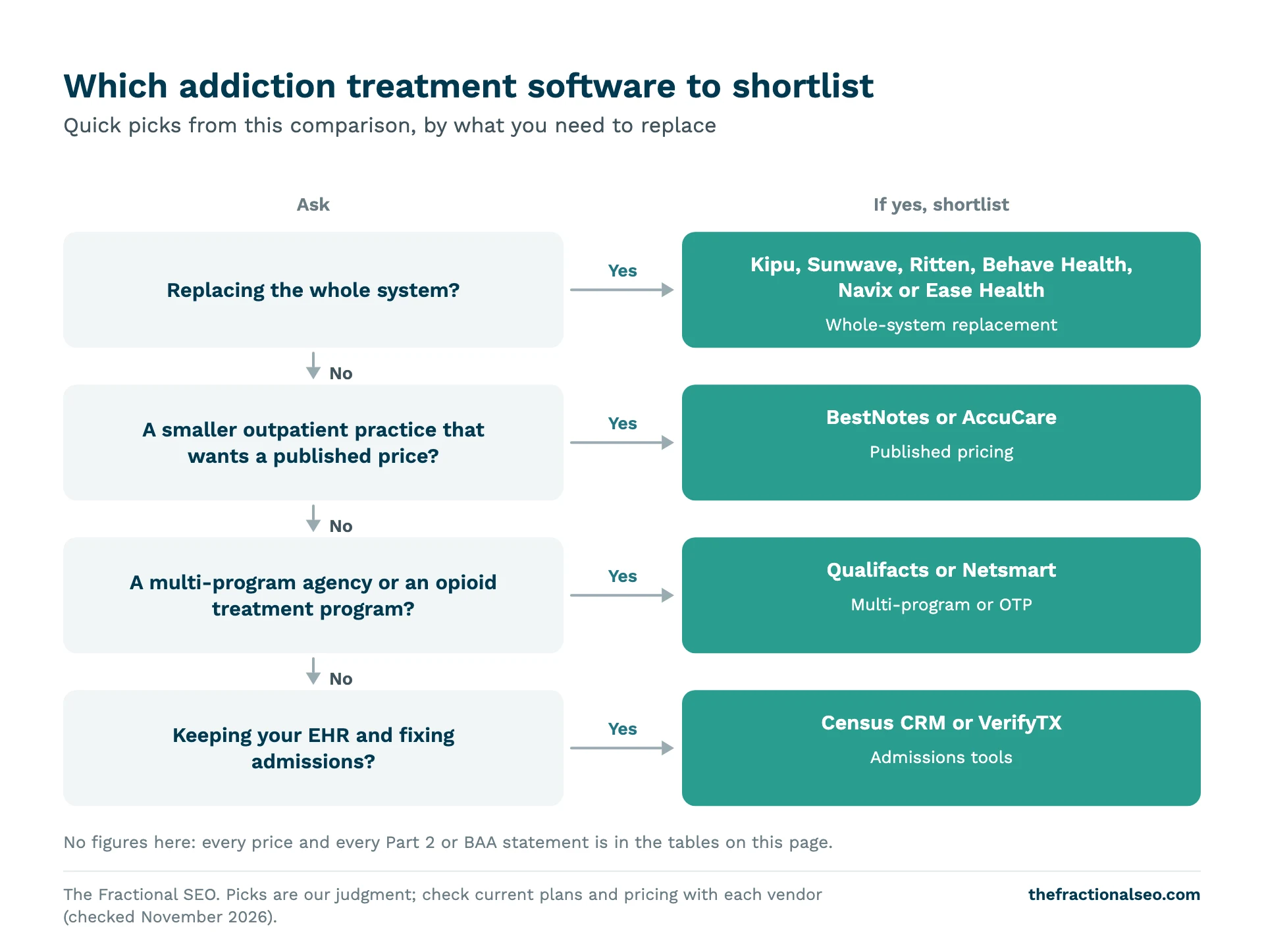
- You want admissions, the chart and billing in one system: Kipu, Sunwave, Ritten, Behave Health, Navix Health or Ease Health. Navix publishes a starting price for facilities; Behave Health offers a 7-day trial.
- You run a smaller outpatient program and want a published price: BestNotes or AccuCare.
- You run several programs or an opioid treatment program inside a larger agency: Qualifacts or Netsmart, both quote only.
- You’re keeping your EHR and want to fix admissions: Census CRM for the pipeline and calls, VerifyTX for benefits checks.
Prices are as of November 2026, from each vendor’s own site. Ten of the 15 don’t publish a price at all.
Quick picks
The table puts the 15 side by side. Free trials are listed only where the vendor says there is one. “Quote only” means the vendor’s pages show no figure. Prices are USD.
| Software | What it covers | Pricing model | Lowest published price | Free trial |
|---|---|---|---|---|
| Kipu Health | Suite: EMR, CRM, RCM | Consultation | Quote only | Not stated |
| Sunwave Health (with Lightning Step) | Suite: EMR, CRM, RCM | Demo | Quote only | Not stated |
| Ritten | Suite: EMR, CRM, RCM | By programs, levels of care, users, billing | Quote only | Not stated |
| Behave Health | Suite: EHR, CRM, RCM | Four plans, quote | Quote only | 7 days |
| Navix Health | Suite: EMR, CRM, RCM | Facilities by average daily census; per seat for professionals | $650 a month (facility Startup tier) | Only for the standalone AI tools |
| Ease Health | Suite: EHR, CRM, RCM | Demo | Quote only | Not stated |
| BestNotes | EHR, CRM and billing as add-ons | Per user per month, month to month | $59 per user/month plus $100 setup | Not stated |
| Alleva | EMR and billing | Set in an order | Quote only | Not stated |
| AccuCare | EHR and billing | Monthly after a trial | $89 a month (unit not stated) | 14 days, card required |
| AZZLY | EHR, practice management, RCM | Get Pricing | Quote only | Not stated |
| Qualifacts | EHR and billing | Demo | Quote only | Not stated |
| Netsmart | Enterprise EHR and RCM | Demo | Quote only | Not stated |
| Census CRM | Admissions CRM | Per seat, quoted on the demo | Quote only | Demo and pilot program |
| VerifyTX | Benefits verification | By verifications per month | $299 or $249 a month (two figures shown), plus $250 setup | None (month to month instead) |
| CollaborateMD | Medical billing | Per provider per month | Around $299 per provider/month | Not stated |
How we compared
Every product was checked on the vendor’s own website in November 2026 and had to pass five tests. It is built for or sold to addiction treatment, with a page of its own for it; the one exception is CollaborateMD, a general billing product that BestNotes names as its billing partner. It runs part of the center: the EHR, admissions, benefits verification or billing. It has a published price or at least a stated pricing model. Its Part 2 and business associate agreement wording is quoted as written. And we grouped the products by what they do. We read each vendor’s home, product, pricing, security and terms pages, and re-read every published price on November 26, 2026.
Some limits. “Not stated” is not “doesn’t have”: a vendor’s public pages may not list everything. There are no ratings or scores here, and we left out the results vendors claim for their customers, such as census growth, denial rates and time saved. Where a page shows two prices without saying which is which, we say so. This is a check of what each vendor says, not a hands-on test, and nothing here is a view on any product’s clinical fit for your program.
ZenCharts appears on several lists for this search. Its site didn’t load on any of our tries on the review date, so we couldn’t confirm a price or a feature on its own pages, and it’s left out rather than described from other people’s lists.
Part 2 and the BAA: what each vendor says
Your EHR, CRM and verification tool all hold records about people seeking treatment. Two sets of rules come up on every software demo. HIPAA’s business associate agreement (BAA) is the contract a vendor signs to handle protected health information for you. 42 CFR Part 2 adds rules for substance use disorder records. Its restrictions apply to records which “Would identify a patient as having or having had a substance use disorder” either directly or by other means (§ 2.12). The 2024 update to Part 2 says those subject to it “must comply with the applicable requirements of this final rule by February 16, 2026.”
Part 2 also has a name for an outside service such as data processing or bill collecting: a “qualified service organization”. Its written agreement with the program says it “Acknowledges that in receiving, storing, processing, or otherwise dealing with any patient records from the part 2 program, it is fully bound by the regulations in this part” (§ 2.11). Two vendors’ published BAAs use close to that wording. “HIPAA compliant” on a features page is a claim about the product. It is not a signed BAA, and it says nothing about Part 2.
| Software | Part 2 wording on its pages | BAA wording on its pages |
|---|---|---|
| Kipu Health | BAA clause “42 CFR Part 2 Responsibilities”: “it is fully bound by the Part 2 regulations” | Published online at kipuhealth.com/baa |
| Sunwave Health | BAA: “it is fully bound by the provisions of the Part 2 Regulations” | Published online at sunwavehealth.com/baa |
| Ritten | “built for HIPAA-regulated care and behavioral health confidentiality needs, including 42 CFR Part 2” | HIPAA compliance “depends on how your organization uses the system (policies, training, and a business associate agreement)” |
| Behave Health | “HIPAA and 42 CFR Part 2 compliant” (EHR page); “Part 2-oriented” (security page) | “Behave Health signs a business associate agreement (BAA) with your organization” |
| Navix Health | “42 CFR Part 2 Ready”; consent flag “Carried on every Part 2 record across the system” | “BAA included with every paid plan”; the same page says its BAA is “available to qualified prospects under NDA” |
| Ease Health | Not stated on the pages we read | PHI processed “pursuant to a Business Associate Agreement (BAA) executed between Ease Health and the Customer” (Terms) |
| BestNotes | “consent tracking that meets 42 CFR Part 2” | Not mentioned; its HIPAA statement says “fully compliant” |
| AccuCare | Not stated on the pages we read | Trial sign-up asks you to agree to “the HIPAA Business Associate Agreement (BAA)” |
| Census CRM | “42 CFR Part 2, protected from day one” | “BAA available on request” |
| VerifyTX | Not stated on the pages we read | “All users agree to our business associate agreement when using the service” |
| Alleva, AZZLY, Qualifacts, Netsmart, CollaborateMD | Not stated on the pages we read | Not stated; HIPAA, SOC 2 or “HIPAA compliant” wording only |
This section explains the rules as written and quotes what vendors publish. It is not legal advice. Check any contract against your own setup with your counsel or compliance lead. Our guide to LegitScript, EKRA and patient privacy for addiction treatment centers covers Part 2 and website privacy in full. When a vendor says nothing on its pages, that isn’t proof it won’t sign. It means you ask, and get the answer in the contract.
What rehab homepages show
We analyzed 36 local searches across 12 US metros and three addiction treatment search types, 379 treatment provider websites (341 crawled) and 403 Google Business Profiles, November 2026.
Treatment software barely shows on homepages. 4 of the 342 homepages we read (1.2%) link to a treatment EHR, one each for Lightning Step, Alleva, Ease Health and BestNotes, and 2 more link to Salesforce. 108 (31.6%) link an insurance-verification page or form. EHRs run behind the scenes, so homepage counts say nothing about which software centers use, and we don’t rank anything by them. The verification forms are the part a family sees. More from the same study in what map-pack treatment centers do differently.
All-in-one suites
These six put the admissions CRM, the clinical record and billing in one system, so a qualified call becomes a chart without re-typing. If you’re choosing between them, the differences that show up on their own pages are price (only Navix publishes figures), trials (only Behave Health offers one for the full product) and whether the vendor publishes its BAA (Kipu and Sunwave do).
Kipu Health
Kipu sells a CRM, an EMR, revenue cycle management (RCM) and a compliance product to substance abuse treatment centers, behavioral health, eating disorder and MAT programs. It doesn’t publish a price as of November 2026; you book a consultation, and no trial is stated. The CRM covers referral management, admissions workflows, alumni management and bed visibility, and integrates with call tracking vendors, email providers and Google Analytics. RCM covers eligibility and verification of benefits, utilization review with authorization alerts, claims and patient payments. There’s a patient portal and integrated telehealth. Its BAA is published online and has a clause headed “42 CFR Part 2 Responsibilities”.
Sunwave Health (includes Lightning Step)
Sunwave’s home page says that in 2025 Lightning Step and Sunwave Health “united”, and Lightning Step’s home page now reads “Lightning Step is now part of Sunwave. Same platform. Same team.” We treat them as one entry. No price is published as of November 2026 and no trial is stated; you start with a call. Admissions and referral management includes an available-bed board, a VOB status dashboard, a Salesforce integration and a Call Tracking Metrics integration. The EMR covers substance use treatment, with a client portal, telehealth and reminders, and RCM includes utilization review management. For MAT and OTP clinics its home page lists “42 CFR Part 2 compliance for high-volume dispensing programs”. Its BAA, published online, names the Part 2 regulations, and the security page states ISO 27001 certification.
Ritten
Ritten is an EMR, admissions CRM and RCM for OP, IOP, PHP, residential and SUD programs. It doesn’t publish a price: its FAQ says it “typically reviews your number of programs, levels of care, users, and billing complexity” before proposing a subscription and onboarding plan, as of November 2026. No trial is stated. The CRM runs case and referral management with in-app VOB and eligibility checks, and admitted cases flow into the chart. RCM has a utilization review and authorizations page that tracks units, expirations and remaining sessions. A Call Tracking Metrics integration links calls to cases for customers with the CRM. Ritten is web-based: staff sign in through a browser, with no native app stated.
Behave Health
Behave Health sells four plans, all “Contact for pricing” as of November 2026: LITE for recovery residences with 1-3 homes, PRO for 3 or more homes, ERR for recovery community organizations, and EHR for licensed outpatient, residential and inpatient providers. Its FAQ says pricing is by quote and some capabilities are add-ons contracted separately. It is the only suite here with a trial: “Behave Health offers a 7-day trial.” The CRM covers admissions, referrals and VOB tracking; RCM covers VOB, claims and denials; there’s a client portal and iOS and Android apps for staff and clients. Its security page says it signs a BAA with your organization.
Navix Health
Navix is the one suite that publishes prices. As of November 2026:
- Facilities Edition: a $650 per month Startup tier, “Entry pricing for any new facility, any size”. Above that, separate inpatient (detox, residential, sober living) and outpatient (PHP, IOP, OP, virtual) ladders are custom priced by average daily census. CRM, EMR, client portal and its AI tools are included, with unlimited clients.
- Professional Edition: $150 a month for the first seat plus $46.99 a month for each additional seat.
- Add-ons: automations $300 per month, a Plaud recorder $19.99 per device per month, and sandbox environments $100 per environment per month. E-prescribing, group telehealth, texting and VOB estimation are billed separately on facility plans.
Read the fine print on start dates: billing starts at go-live or 120 days after the order form, whichever comes first, and until then the page lists a $100 per environment per month platform reservation and server fee. The FAQ says the professional and facility plans have no free trial; only its standalone AI tools do. The CRM runs inquiry, VOB, pre-certification and admitted stages. Its security page says SOC 2 Type 1 is “in progress”.
Ease Health
Ease Health sells an EHR, CRM and RCM for detox, IOP, outpatient, PHP and residential programs. No price and no trial are published as of November 2026; you request a demo. The EHR includes an AI scribe and e-prescribing. The CRM has a configurable pipeline, referral attribution and auto-logged calls and emails. RCM covers authorizations, utilization review and verification of benefits, with eligibility checks through Availity during intake, and a patient portal covers family access, messaging and payments.
EHRs
These six are clinical records first. Most add billing; CRM is an add-on or not a named product. They suit a program that already has an admissions process it likes, or an agency where addiction treatment is one service among several. Pair one with a CRM or verification tool from the last group if you need it.
BestNotes
BestNotes publishes its price. As of November 2026 it is $59 per user per month for users 1-10, $25 per additional user for users 11-100 (the first 10 stay at $59), and $13 per additional user from 101, with a $100 setup fee, a month-to-month contract and unlimited training and support. Sales tax may apply. CRM, RCM billing, telehealth, two-way messaging, appointment reminders, e-prescribing and AI notes are add-ons quoted separately. No trial is stated.
Its addiction treatment EHR page covers ASAM Criteria 4th Edition assessments, group and individual notes, MAT, e-prescribing with EPCS, eMAR for residential programs and Part 2 consent tracking. Claims and eligibility checks run through CollaborateMD. Ask for the BAA: we didn’t find one mentioned on the pages we read.
Alleva
Alleva calls itself behavioral health operations software: an EMR, Alleva Billing with “Integrated instant VOBs” and a Waystar clearinghouse, a client and family portal, and AI note tools. Its headline lists a CRM, but we found no CRM product page. There’s no pricing page as of November 2026, and its master services agreement refers to a census adjustment under the pricing set in your order. Its pages describe HIPAA-compliant infrastructure and ONC, SOC 2 and HIPAA standards; we found no Part 2 or BAA wording.
AccuCare
AccuCare, from Orion Healthcare Technology, is EHR and billing software for “Addictions, Substance Use and Mental Health Professionals”. It covers screening and assessments, admission and discharge, treatment planning, progress notes, e-prescribing, scheduling, electronic billing and custom reports, and Orion also sells claims processing and billing services.
Its trial page offers 14 days free, then “$89 /monthly after your trial ends”, as of November 2026. A card is required, and it is charged from Day 15. The page doesn’t say whether $89 is per user, per provider or per account, so ask. Signing up asks you to agree to its HIPAA BAA. We found no Part 2 wording on the pages we could read.
AZZLY
AZZLY Rize is sold as an EHR, practice management and RCM platform for addiction treatment and substance use disorder programs, with a patient engagement portal. Its home page has a “Get Pricing” button and no prices as of November 2026. Most other pages on azzly.com, including its pricing and EHR pages, now open Ease Health pages, and the pages don’t say why. Ask on the demo which product you’d be buying.
Qualifacts
Qualifacts sells three EHRs, Credible, CareLogic and InSync, and its “Substance Use Disorder EHR” page covers MAT and OTP dosing and dispensing through MethodOne, which it acquired, plus e-prescribing, EPCS, PDMP checks and eMAR. Billing, a client portal and telehealth are listed. It’s quote only as of November 2026. Its security page says its EHRs are SOC 2 certified; we found no BAA or Part 2 wording. The SUD page doesn’t say which of the three EHRs you’d get.
Netsmart
Netsmart is a large human services and health platform with an addiction treatment EHR for MAT, OTP and OBOT programs, RevConnect for clearinghouse and eligibility, referral management and telehealth. It’s quote only as of November 2026, with a free demo rather than a trial. The page lists “Compliance support for HIPAA, SAMHSA and state requirements”; we found no Part 2 or BAA wording on the pages we read.
Admissions, verification and billing tools
These three do one job and sit next to your EHR. They suit a center that is keeping its EHR but losing families between the first call and admission, or spending hours verifying benefits by phone.
Census CRM
Census is an admissions CRM for addiction treatment, and says plainly that it “is not an EMR and does not do clinical charting”: it hands the record to your EMR, and its integrations name Kipu and Sunwave. It runs a three-stage admissions pipeline, referral partner tracking, bed placement, alumni, insurance verification inside the CRM, and admissions call tracking. As of November 2026 it sells three role-based licences (Coordinator, Business Development, Alumni) with per-seat quotes on the demo. The pricing page says “Onboarding & training included”, while its FAQ describes a one-time onboarding fee scoped to your operation, so ask which applies. Nonprofits get a discount. There’s no free trial; it offers a demo and a pilot program.
VerifyTX
VerifyTX (VerifyTreatment) does insurance verification: real-time and batch VOB, scheduled re-verification, payer alerts, Medicaid eligibility, claim status checks and webforms that capture insurance from your website. Plans are priced by verifications per month, with a monthly/annual switch. Each plan shows two figures, and the page text doesn’t make clear which is monthly and which annual. As of November 2026:
- Essentials: $299 or $249 a month, 120 verifications, 5 users and 2 facilities, $1.50 per extra verification.
- Professional: $579 or $483, 300 verifications, unlimited users and facilities, $0.99 per extra.
- Growth: $849 or $708, 600 verifications, $0.70 per extra.
- Performance: $949 or $791, 1,000 verifications, $0.60 per extra, webforms included.
- Enterprise: $1,499 or $1,249, 2,000 verifications, $0.50 per extra.
Every plan has a $250 one-time setup. Webforms are $49 a month extra on the first three plans, and Salesforce access is $1,500 one-time. There’s no free trial; its FAQ says “Instead of a trial, we offer flexible, month-to-month plans with zero long-term contracts.”
CollaborateMD
CollaborateMD is general medical billing and practice management software, not built for addiction treatment. It’s here because BestNotes names it for claims and eligibility. As of November 2026 its FAQ says plans “typically start around $299/provider/month”, and billing companies pay per transaction from $0.32 per claim with no setup fees. Preferred partner EHR interfaces are free; other custom connections run $0 to $5,000. Real-time eligibility and a built-in clearinghouse are included. No trial is stated, and we found no Part 2 or BAA wording.
Six questions to ask on any demo
These are best practice, not study data. Ask every vendor the same six and write the answers down.
- Will you sign a BAA, and does it cover Part 2? Ask for the document, not the features page. Kipu and Sunwave publish theirs online, each with a Part 2 clause.
- How is Part 2 consent recorded, and does it travel with the record? Ask to see it on a sample patient moving from detox to residential to IOP.
- What’s counted, and what does the next one cost? Seats, census, verifications or providers. Ask about setup, onboarding and any fee before go-live.
- Is verification inside the CRM or a separate tool? Know who re-checks benefits during a stay.
- Does the CRM take your call data? Call tracking loads on 40.6% of the rehab homepages we read (Call Tracking Metrics 79 sites, CallRail 49). If you use it, ask whether calls land on the admissions record. More in local SEO for addiction treatment centers.
- What runs on the page where families enter insurance details? 21.9% of the homepages we read load an advertising pixel in the page itself, and that’s a floor, because tags loaded through Tag Manager aren’t in the page code. Review verification and contact forms with your vendor; our local SEO checklist for addiction treatment centers includes a tracking-pixel review.
FAQs
What software does an addiction treatment center need?
An EHR built for levels of care, ASAM assessments and medication; an admissions CRM for calls, referrals and beds; verification of benefits; and billing. Some suites do all four, and some centers pair an EHR with a separate CRM or verification tool.
How much does addiction treatment EHR software cost?
As of November 2026: BestNotes is $59 per user per month for the first 10 users plus a $100 setup fee, AccuCare is $89 a month after a 14-day trial (unit not stated), and Navix starts at $650 a month for facilities or $150 a month for a first professional seat. Most others quote only.
Is “HIPAA compliant” the same as signing a BAA?
No. A BAA is a signed contract; “HIPAA compliant” is a product claim. Several vendors here say they sign one or publish it, and others don’t mention it on the pages we read. Ask for the agreement itself.
Which software do treatment centers use most?
Homepages can’t tell you. Only 1.2% of the rehab homepages we read link to a treatment EHR, and EHRs run behind the scenes.
Software runs admissions once a family calls. Getting found when they search for detox, rehab or an IOP in your city is the other half. See how we work with addiction treatment centers.
More collections
The whole Rehab / Addiction Treatment library- Best Podcasts for Addiction Treatment Center Owners Two podcasts for addiction treatment center owners, picked from 22, that are still publishing, well rated…
- Recovery.com, Psychology Today and FindTreatment.gov: Directories in Rehab Search Which treatment directories take page-one spots in local rehab searches, what each charges and what each…