
Research & Benchmark Rehab / Addiction Treatment
We Analyzed 341 Rehab Websites: What Map-Pack Treatment Centers Do Differently
Most lists of rehab SEO mistakes are written by people who sell rehab SEO, and few of them count anything. We wanted counts. We analyzed 36 local searches across 12 US metros and three addiction treatment search types, 379 treatment provider websites (341 crawled) and 403 Google Business Profiles, November 2026. First we compared the treatment centers Google puts in the map pack with the ones it shows lower in Maps. The clearest difference is not a website trick. Map-pack homepages say far more often, in plain words, that the center takes or verifies insurance, offers detox, treats dual diagnosis and admits around the clock. That is a correlation: map-pack centers are also bigger programs, and none of the four statements separates the top of the regular search results. Then we counted seven common gaps on treatment-center websites, and how common each one is.
This study looks at treatment-center websites. For the other half of the picture, who actually shows up when someone searches for help, read who wins local rehab searches. To see how we approach this work, start with fractional SEO for addiction treatment centers. We collected the data in November 2026. The sample, dates and limits are in the Method card on this page.
Key findings at a glance
- Map-pack homepages describe the whole program. Insurance accepted or verification offered 86% vs 62%, detox 71% vs 43%, dual diagnosis 74% vs 46% and 24/7 admissions 71% vs 42%. All four survive our correction for the number of tests and hold without chains and health systems. Map-pack centers are bigger programs, and none of the four separates the organic top 3.
- All four together: 48% of map-pack homepages show all four vs 17% of the rest.
- Credentials lean the same way: accreditation shown 72% vs 50%, LegitScript 48% vs 29%. A lean, not a result that passes the correction.
- Off the website: map-pack centers have more referring domains (418 vs 231), more profile photos (23 vs 12) and post on their profile more (51% vs 30% in 30 days).
- Blogs go quiet: 68% have a blog, but only 22% posted in the last 12 months and 16% about monthly.
- Phones wait: median mobile LCP 7.2 s, and 15.1% load the main content within 2.5 s. Speed shows no clear difference between map-pack sites and the rest.
- Advertising tags: 21.9% of homepages load an advertising pixel in the page itself, and that is a floor.
What map-pack homepages say that others don’t
Here is the comparison. On one side are treatment centers that reached positions 1-3 of the Google Maps list in at least one of our 36 searches. On the other are centers we saw in Maps but never in a pack. We read the homepages of both groups: 69 map-pack homepages and 224 others.
Map-pack treatment centers’ homepages describe a full-service program more often than those lower in Maps: insurance accepted or verification offered 86% vs 62%, detox 71% vs 43%, dual diagnosis 74% vs 46% and 24/7 admissions 71% vs 42%, all four surviving the correction and holding without chains and health systems. 48% of map-pack homepages show all four vs 17% of the rest.
| The homepage says | Map pack | Rest of Maps | Without chains and health systems | Organic top 3 vs 4-10 |
|---|---|---|---|---|
| Insurance accepted or verification offered | 86% (59 of 69) | 62% (138 of 224) | 88% vs 61% | 76% vs 75% |
| Detox | 71% (49 of 69) | 43% (96 of 224) | 72% vs 43% | 71% vs 71% |
| Dual diagnosis or co-occurring care | 74% (51 of 69) | 46% (102 of 224) | 77% vs 46% | 63% vs 68% |
| 24/7 admissions or helpline | 71% (49 of 69) | 42% (95 of 224) | 72% vs 43% | 71% vs 55% |
| All four | 48% (33 of 69) | 17% (39 of 224) | not reported | not reported |
We read these from the visible homepage text and hand-checked the readings (agreement 85-100%). A program described only on inner pages is not counted. Across all 342 homepages we read, 234 mention insurance accepted or verification offered, 179 detox, 184 dual diagnosis or co-occurring care and 175 24/7 admissions or a helpline.
A picture of who is at the top, not a recipe
This is a correlation, not a cause, and the reasons to be careful are specific. These are statements about the program, not website tricks. Map-pack centers are also bigger operations: a median of 96 vs 40.5 reviews, 224 vs 109 indexable pages and 417 vs 228.5 referring domains. A bigger program may be more likely to offer detox, treat co-occurring conditions and staff admissions overnight, and also to have everything else that lines up with the map pack.
Two more limits. Detox searches favour detox programs, so a center that offers detox is simply a closer match for our 12 “detox center” searches. And when we split the map pack by search wording, each group is only 24-26 sites, too small for most splits to pass on their own.
The biggest limit: none of the four separates the organic top 3. In the regular results, sites at positions 1-3 mention insurance 76% of the time vs 75% at positions 4-10, detox 71% vs 71%, dual diagnosis 63% vs 68% and 24/7 admissions 71% vs 55%, no clear difference on any of them. If these words moved rankings on their own, you would expect to see them there too.
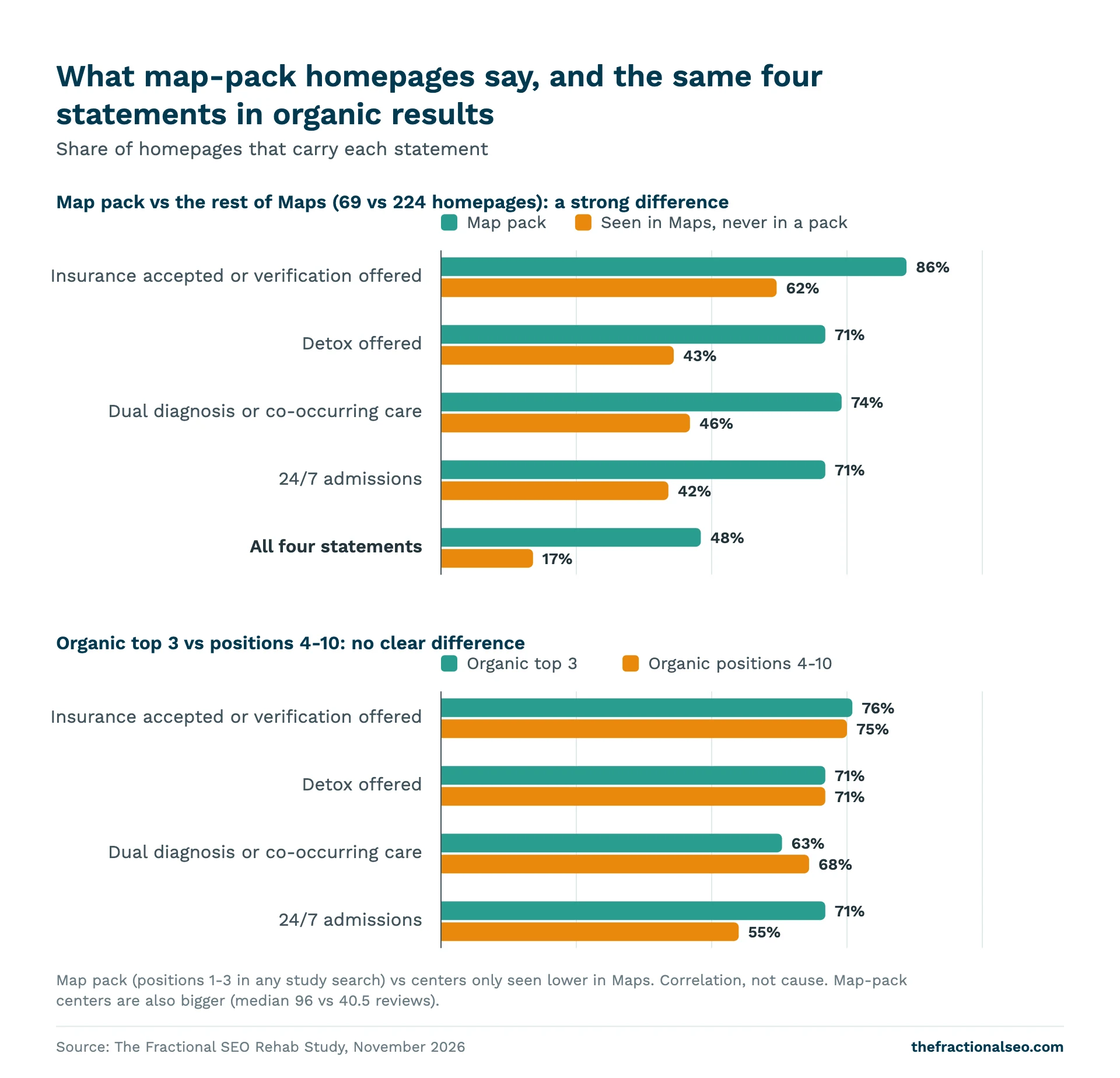
So the lesson is not “add these words to rank”. It is closer to this, in our view: say plainly on the homepage what you offer, who you take and how to get in. Name the levels of care you actually provide. Say which insurance you accept or that you will verify coverage, and link the form. Say when admissions answers the phone. If you don’t offer detox or treat co-occurring conditions, don’t imply it: a family that calls on the strength of a claim you can’t meet is a bad outcome for everyone. Our local SEO guide for addiction treatment centers covers program pages, and the local SEO checklist for addiction treatment centers puts these statements in order.
Credentials lean the same way
Credentials are common and lean toward the map pack: 57.9% of homepages show Joint Commission or CARF accreditation (text or seal) and 34.5% show LegitScript certification (text or seal). Map-pack homepages show accreditation 72% vs 50% and LegitScript 48% vs 29%; the text-only versions fail the correction, so treat this as a lean. NAATP membership is shown on 8 homepages.
In organic results the lean disappears: accreditation 71% vs 70%, LegitScript 47% vs 38%. We also did not check any seal against LegitScript’s or the accreditors’ own registries. A seal on a homepage shows the site claims it.
LegitScript matters for a different reason. Google’s healthcare ads policy says, in its United States section: “In order to advertise for recovery-oriented drug and alcohol addiction services, you must be certified as an addiction services provider by the LegitScript Certification program.” That is an advertising rule, not a ranking factor. Showing accreditation and certification where a family can see them is worth doing because it answers a question they have. Our guide to marketing rules for addiction treatment centers covers the certification and its fees.
Other program details: two leans, the rest no clear difference
What else rehab homepages say: outpatient care 71.6%, residential or inpatient 55.8%, medication-assisted treatment 39.2%, a free assessment 10.5%, Spanish 3.2%, online booking or an online admissions form 5%, prices 2.9%. None of these separates the map pack after the correction.
Two lean toward it without passing: residential or inpatient care (68% vs 47%) and outpatient care (81% vs 67%). Medication-assisted treatment (43% vs 38%), a free assessment (7% vs 10%), online booking or an admissions form (4% vs 5%) and prices (1% vs 4%) show no clear difference. Read the leans the same way as the four above: they describe what a program offers.
What else lines up with the map pack, off the website
The other strong differences sit in links and on the Google Business Profile. Map-pack treatment centers’ sites have a median 418 referring domains vs 231 for those lower in Maps, and a higher domain rank (241 vs 206); in organic results links show no clear difference (469 vs 439). Treatment centers that reached a map pack in any study search have a median of 86 reviews vs 40 for those only seen at positions 4-20. Their profiles have about twice as many photos: median 23 vs 12. And 51% of map-pack centers posted on their profile in the 30 days before collection vs 30% of the rest.
All four are strong in this data, and all four are correlations: bigger, older programs collect more links and more of everything else. They do line up with Google’s own local ranking guidance, which says prominence is “based on info like how many websites link to your business and how many reviews you have”. The profile side is in what 403 Business Profiles show about reviews and our Google Business Profile checklist for addiction treatment centers.
Website features with no clear edge
When you run 69 tests, a few look meaningful by luck, so we applied a standard correction (Holm) that raises the bar for each one. The four program statements passed it. Ordinary website features did not.
Other website features show no edge that survives the correction: click-to-call, a homepage form, a review widget, schema, a blog, location pages and service pages. A city name in the homepage title leans toward the pack (59% vs 41%) but fails it. Service-page counts lean the same way (median 25 vs 11, weak). That does not make them useless. It means the case for each one is about the visitor, which is how the gaps below are written.
Seven common gaps on treatment-center websites
Rehab sites get more estimated search traffic than HVAC sites: median estimated organic traffic 590 visits a month (HVAC: 214), with 23% under 100. Those are estimates, not analytics. Each visit is someone, perhaps a parent or partner, deciding whether to call. The gaps below matter for that call even where they show no ranking edge.
Gap 1: A blog nobody has posted to in a year
68% have a blog, but only 22% posted in the last 12 months and 16% about monthly. Having a blog shows no clear difference in the map-pack comparison (77% vs 64%). We measured having one, not posting to it.
In our view a blog that stopped two years ago makes a program look closed. If nobody will post, take it out of the menu. If someone will, answer what families ask before they call: what the first day of detox is like, whether insurance covers an intensive outpatient program, what to pack, how visiting works. Have your own clinicians review anything clinical and say so on the page.
Gap 2: Slow pages on a phone
Rehab sites are heavy and slow on phones: median mobile PageSpeed score 65, median mobile LCP 7.2 s, 15.1% load the main content within 2.5 s, and 25.5% of homepages weigh over 5 MB. Of the 164 sites with enough real-user data, 58.5% pass Core Web Vitals. The score and LCP are lab tests, one run per site, and lab scores vary run to run.
Speed does not separate the map pack or the organic top 3: median score 66 vs 65 in Maps, LCP 7.3 s vs 7.3 s. That is not proof speed never matters. A family may well be searching on a phone, late at night. Our view: the usual weight is a video header, a photo slider and several chat and tracking scripts. Elementor’s Hello theme alone runs 61 of these sites, and page builders make it easy to stack all three. Compress photos, save them as WebP, and drop anything above the fold that isn’t the phone number and the next step.
Gap 3: No way to start admissions online
42% of sites have a form on the homepage. 31.6% of homepages link an insurance-verification page or form, and 5% offer online booking or an online admissions form. A homepage form shows no clear ranking difference (46% vs 39% in the map-pack comparison). This is a lead question, not a ranking one.
In our view, plenty of people who search at midnight will not call at midnight. Give them a short way in: a verification form that asks only what admissions needs to call back, near the top of the homepage and on every program page. Then read Gap 5 before you add tracking to it, because that form is one of the most sensitive pages on the site.
Gap 4: Basics left blank
24% of sites have LocalBusiness (or medical) schema and 46% name their city in the homepage title. 25.4% are missing meta descriptions on a quarter or more of their pages and 12.4% missing H1s. Schema shows no clear difference (25% vs 24%), and the city in the title is a weak lean that fails the correction. These are cheap to fix: a free crawler will list every page that is missing one, and the city belongs in the title because it tells a family you are near them.
Gap 5: Advertising tags on pages people use to seek care
This gap and the next touch privacy and fraud rules. We explain the rules as written; this is not legal advice, and a center should check its own setup with its counsel or compliance lead.
Tracking on rehab homepages: 75.4% load Google Tag Manager or Google Analytics 4, 21.9% load an advertising pixel in the page itself (Google Ads 15.2%, Meta 6.7%), 7% a session-recording tool (Hotjar or Microsoft Clarity) and 40.6% call tracking. 35 homepages load an ad pixel and show a form on the same page. All of these are floors: tags loaded through Tag Manager after the page loads are not in the HTML we read.
A tag on a homepage is not, by itself, a privacy problem. What matters is what data it sends, and from which pages. 42 CFR Part 2 applies, under § 2.12(a)(1), to records from federally assisted substance use disorder programs that “Would identify a patient as having or having had a substance use disorder either directly, by reference to publicly available information, or through verification of such identification by another person”. HHS has also published guidance on tracking technologies, and a court limited part of it in 2024.
In our view the practical step is a review, with your compliance lead, of which tags and session recordings fire on the admissions, insurance-verification and contact pages, and what they send. Our guide to LegitScript, EKRA and patient privacy goes through the rules in full.
Gap 6: Claims a compliance review reads first
Signals a compliance review would look at first: 14 homepages (4.1%) mention travel or transport to treatment and 28 (8.2%) make a success-rate or outcome claim. Neither separates the map pack or the organic top 3.
A mention is not proof of a problem. Paid travel can be lawful in some forms, and our count cannot tell an offer of free flights from directions to the facility. The reason to look is 18 U.S.C. § 220 (EKRA), which covers knowingly and willfully receiving remuneration “in return for referring a patient or patronage to a recovery home, clinical treatment facility, or laboratory”, or paying it “to induce a referral of an individual” to one, for services covered by a health care benefit program. Our view: no marketer, call center or referral source should be paid per patient or per admission, and any travel offer and any outcome figure on the site should go past counsel. We make no outcome claims of our own, for any client.
Gap 7: Reviews and proof kept off the page
14% of sites show reviews through a review widget. It shows no clear ranking difference (20% vs 13%). In our view, reviews people have already posted publicly can sit near the admissions form, where the decision gets made. Don’t add patients’ names, photos or recovery stories to the site without their written consent, and when you reply to reviews, never confirm that the reviewer was a patient.
What rehab websites already get right
Every crawled site uses HTTPS. 89% of treatment-center sites have a click-to-call link. 85% have service or program pages (median 17 among those) and 65% have location or service-in-city pages. WordPress runs 89.6% of the rehab sites whose platform could be identified, so most of the fixes above need an editor, not a developer.
Every feature we compared
Here is every comparison in this study’s website data. The map-pack column sets centers at positions 1-3 of the Google Maps list in any study search against centers seen in Maps but never in a pack. The organic column sets sites at positions 1-3 of the regular results against those at 4-10. “Strong” passed the correction, “lean” or “weak” looked like a difference before it but not after, and “no clear difference” never did.
| Feature | Map pack vs rest of Maps | Organic 1-3 vs 4-10 |
|---|---|---|
| Insurance accepted or verification offered | 86% vs 62% (p=2.0e-04, strong) | 76% vs 75% (p=1, no clear difference) |
| Detox | 71% vs 43% (p=5.5e-05, strong) | 71% vs 71% (p=1, no clear difference) |
| Dual diagnosis | 74% vs 46% (p=3.3e-05, strong) | 63% vs 68% (p=0.68, no clear difference) |
| 24/7 admissions | 71% vs 42% (p=3.3e-05, strong) | 71% vs 55% (p=0.11, no clear difference) |
| Referring domains | median 418 vs 231 (p=2.2e-04, strong) | median 469 vs 439 (p=0.45, no clear difference) |
| Accreditation shown (text or seal) | 72% vs 50% (p=0.0014, lean) | 71% vs 70% (p=1, no clear difference) |
| LegitScript shown (text or seal) | 48% vs 29% (p=0.0058, lean) | 47% vs 38% (p=0.43, no clear difference) |
| Residential or inpatient | 68% vs 47% (p=0.0036, weak) | not reported |
| City in homepage title | 59% vs 41% (p=0.0088, weak) | not reported |
| Service pages, count | median 25 vs 11 (p=0.0022, weak) | not reported |
| Outpatient care | 81% vs 67% (p=0.034, weak) | not reported |
| Blog | 77% vs 64% (p=0.057, no clear difference) | not reported |
| Click-to-call | 94% vs 86% (p=0.062, no clear difference) | not reported |
| Any service page | 90% vs 82% (p=0.14, no clear difference) | not reported |
| Location pages | 74% vs 64% (p=0.15, no clear difference) | not reported |
| Review widget | 20% vs 13% (p=0.17, no clear difference) | not reported |
| Homepage form | 46% vs 39% (p=0.27, no clear difference) | not reported |
| Prices shown | 1% vs 4% (p=0.46, no clear difference) | not reported |
| Medication-assisted treatment | 43% vs 38% (p=0.48, no clear difference) | not reported |
| Free assessment | 7% vs 10% (p=0.64, no clear difference) | not reported |
| Travel or transport mentioned | 1% vs 4% (p=0.69, no clear difference) | no clear difference |
| Mobile speed score | median 66 vs 65 (p=0.75, no clear difference) | median 60 vs 64 (p=0.056, no clear difference) |
| Outcome claim | 10% vs 9% (p=0.81, no clear difference) | no clear difference |
| LocalBusiness schema | 25% vs 24% (p=0.87, no clear difference) | not reported |
| Online booking or admissions form | 4% vs 5% (p=1, no clear difference) | not reported |
Fisher exact tests (Mann-Whitney for counts, speed and links), Holm correction over 69 comparison tests. The credential rows are extra checks outside that set. Map pack: 69 vs 224 homepages (69 vs 223 sites for crawl features). Organic: 38 vs 84 homepages. Speed: 73 vs 246. Links: 74 vs 252 domains.
Two things to keep in mind. A missing edge is not proof of no effect, and the organic groups are small. And every row is a correlation: none shows what put a center where it ranks.
How to check your own site in 30 minutes
Open your website on your phone. The figures in brackets are from the study. The steps are best practice, not study data.
- Minutes 1-5, the first screen. Without scrolling, can a family tell which levels of care you offer, whether you take their insurance and how to reach admissions tonight? (48% of map-pack homepages say all four of insurance, detox, dual diagnosis and 24/7 admissions.)
- Minutes 5-10, credentials. Are your accreditation and LegitScript certification shown, and do they match what the registries say?
- Minutes 10-15, the way in. Tap the phone number. Find the insurance-verification form. (31.6% of homepages link one.)
- Minutes 15-20, tags. List every tag and recording tool on your admissions, verification and contact pages, and take the list to your compliance lead. (21.9% of homepages load an ad pixel in the page itself.)
- Minutes 20-25, blog and speed. Check the date of the newest post, then run the homepage through PageSpeed Insights on mobile. (22% posted in the last 12 months; median LCP 7.2 s.)
- Minutes 25-30, claims and basics. Read every outcome figure and travel offer on the site as a regulator would. Then check the homepage title names your city.
FAQs
What are the most common SEO mistakes on rehab websites?
Dead blogs, slow phone pages and no way in besides the phone. 68% of sites have a blog, but only 22% posted in the last 12 months. The median mobile LCP is 7.2 s. Only 42% have a form on the homepage. And 21.9% of homepages load an advertising pixel in the page itself, which deserves a privacy review.
Does listing insurance, detox or 24/7 admissions help a treatment center rank?
Those statements line up with the map pack: 86% vs 62% for insurance, 71% vs 43% for detox. But map-pack centers are bigger programs, detox searches favour detox programs, and none of the four separates the organic top 3. Say what you really offer because families need to know, not as a ranking trick.
Do LegitScript or Joint Commission seals help rankings?
They lean toward the map pack (LegitScript 48% vs 29%), but the lean does not pass the correction and does not show in organic results. LegitScript certification is what Google requires to advertise addiction services in the US. It is not a ranking factor.
Do treatment centers need a blog?
This data can’t show that a blog helps you rank: 77% vs 64% in the map-pack comparison, no clear difference. Only 22% of sites posted in the last 12 months, so a blog that answers families’ questions is rare.
Does website speed affect rehab rankings?
Not in this sample: median score 66 vs 65 for map-pack sites and the rest. That is not proof speed never matters, and most rehab homepages are slow for visitors, with a median mobile LCP of 7.2 s.
Want to know what your site says, what it is missing, and which fixes are worth doing first? See how we work with addiction treatment centers.