
Research & Benchmark Rehab / Addiction Treatment
Google Reviews and Rehab Rankings: What 403 Business Profiles Show
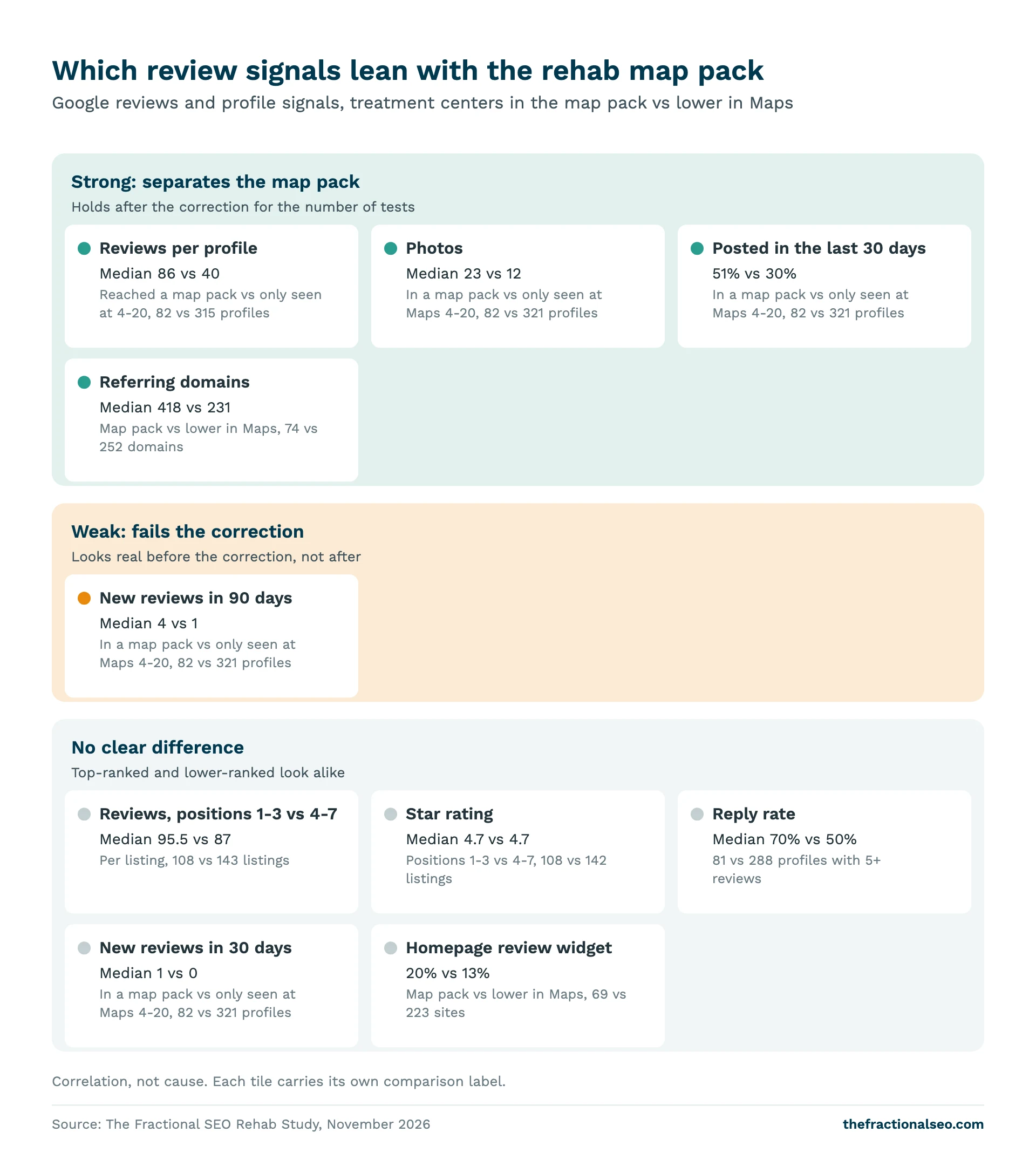
Some rehab marketing guides call Google reviews one of the strongest local ranking signals. None of the guides we read measures it. We checked 403 treatment center profiles. Review totals are higher in the top 7 of the Maps list than further down, but they show no clear difference between the map pack and the listings just below it. The profile signals that do separate the pack are photos and posting.
We analyzed 36 local searches across 12 US metros and three addiction treatment search types, 379 treatment provider websites (341 crawled) and 403 Google Business Profiles, November 2026. The searches were “drug rehab”, “detox center” and “intensive outpatient program”, each followed by the metro. For this article we looked at the review side of the Google Business Profiles: how many reviews each center has, how many came in recently, the star rating, owner replies, photos and Google posts.
Then we set out the review counts that map-pack treatment centers actually have, by kind of program and by market size. The data was collected in November 2026, in one snapshot.
Key findings
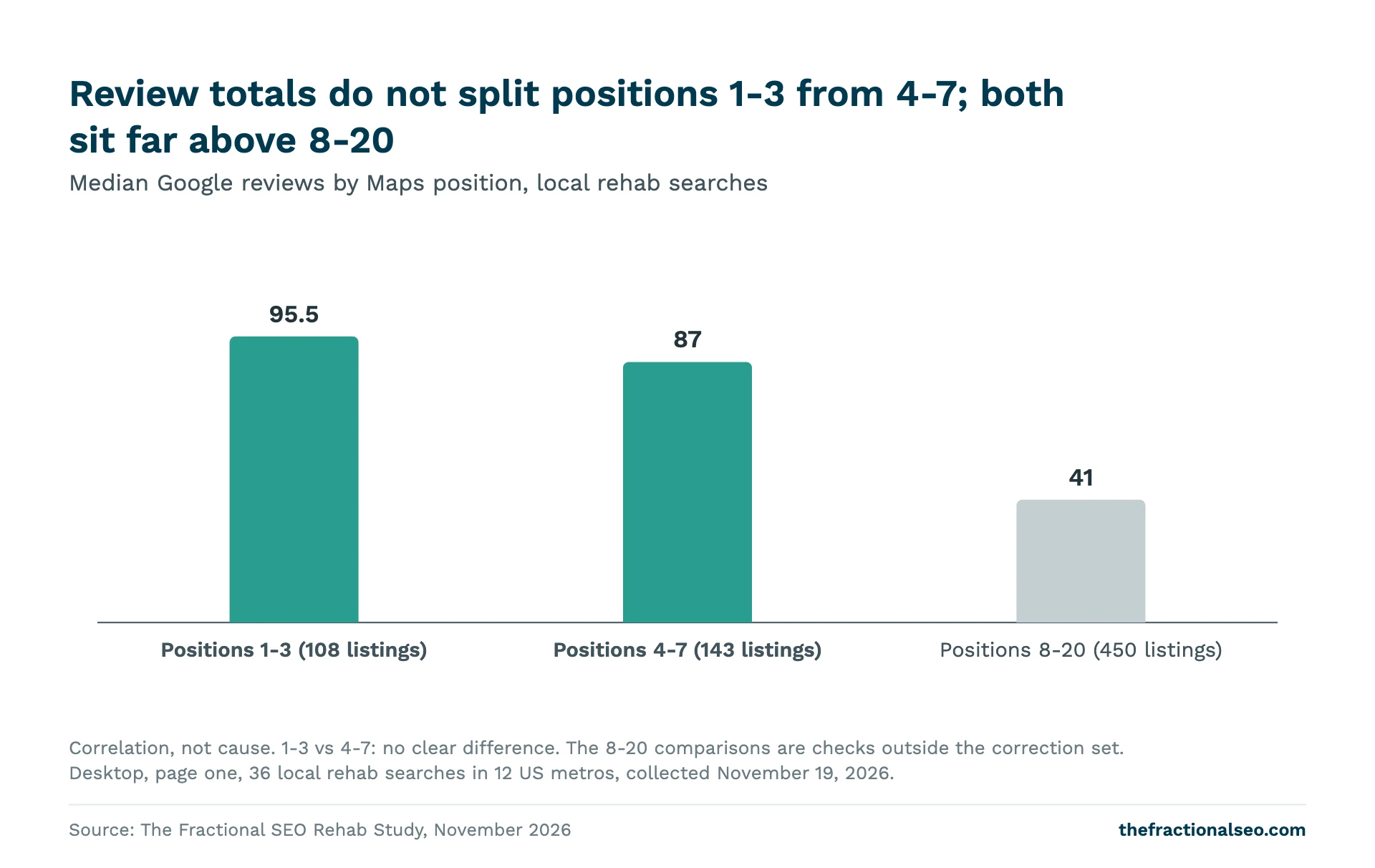
- Review totals, top 3 vs just below: no clear difference. A median of 95.5 reviews at positions 1-3 vs 87 at positions 4-7. Both are far above positions 8-20 (median 41).
- Review totals per center (strong): centers that reached a map pack in any study search have a median of 86 reviews vs 40 for those only seen at positions 4-20.
- Photos (strong): map-pack profiles have about twice as many photos, a median of 23 vs 12.
- Posting (strong): 51% of map-pack centers posted on Google in the 30 days before collection vs 30% of the rest.
- Star rating and reply rate: no clear difference for either.
The website side of the same study is in our study of 341 treatment center websites.
Do Google reviews help SEO? Map-pack centers have more than the field
Start with the widest comparison. At the profile level the gap is wide: treatment centers that reached a map pack in any study search have a median of 86 reviews vs 40 for those only seen at positions 4-20. That counts each center once: 82 profiles that made a map pack against 315 that only showed lower in the Maps list. It was a strong result statistically.
In this study the map pack means the top three listings in the Google Maps list for each search. Positions 4-20 are the rest of the first 20. The “rest” group includes positions 8-20, where review counts are lowest, and that matters for the next section.
Google says something similar in general terms. Its help page on local ranking says prominence is based partly on how many reviews a business has, and that more reviews and positive ratings can help a business’s local ranking. It gives no numbers, and it says there is no way to request or pay for a better local ranking.
So the plain answer is that review count goes with reaching the map pack in our data. It does not prove that reviews are what got those centers there.
Top 3 vs positions 4-7: no clear difference
Now look only at the listings near the top. Unlike HVAC, review totals do not separate the map pack from the listings just below it: a median of 95.5 reviews at positions 1-3 vs 87 at positions 4-7, no clear difference. Both are far above positions 8-20 (median 41). That compares 108 map-pack listings with 143 at positions 4-7 and 450 at positions 8-20, counting a center once for each search it shows up in.
In this sample, review totals are higher in the top 7 than at positions 8-20 but do not split positions 1-3 from 4-7. “No clear difference” means the gap between 95.5 and 87 is small enough that, with this many listings, we can’t tell it from chance. It does not mean reviews don’t matter. In our HVAC study the same comparison was 1,576 vs 615, a strong result.
We checked the result two other ways. Some Maps listings are named only with keywords and have few reviews; our rules flag them, which is not proof a listing is fake. They are rare: 7 listings, 12 Maps rows and 2 of 108 map-pack spots. Without them the medians are 96.5 vs 87. Among independent centers only, they are 99 vs 89. Neither version shows a clear split.
Why 87 here and 40 above? Different groupings. This comparison stops at position 7; the one above counts each center once and includes positions 8-20. Both point the same way.
Photos: about twice as many in the pack
Map-pack treatment-center profiles have about twice as many photos: median 23 vs 12, a gap that survives the correction. That compares 82 centers that reached a map pack with 321 that didn’t. The counts include photos added by visitors, and busier centers may collect more of both.
Photos are also where a treatment center has to be most careful. Never post a photo that shows a patient or anything that could identify one, and remember visitors can add photos too. In our view families want to see the entrance, the rooms, the grounds and the people who will answer the phone. Show staff only with their consent.
Our Google Business Profile checklist for addiction treatment centers covers what to photograph and how to check visitor uploads.
Posting on Google separates the pack here
Posting on the profile separates the map pack, unlike in Landscaping or HVAC: 51% of map-pack centers posted in the 30 days before collection vs 30% of the rest (59% vs 35% over 90 days), both surviving the correction. Overall 34% posted in 30 days and 32% have never posted.
That is the same 82 vs 321 profiles. It is also a cheap gap to close. A post can be a new group schedule, a family program evening, an admissions hours change or a link to a helpful article.
Read it with care. Active posting may mark a center with a marketing team rather than cause the ranking. A center that posts every week may also be the one adding photos and keeping a website up to date. The data can’t pull those apart.
New reviews: a lean that fails the correction
Map-pack centers got a few more new reviews in the 90 days before collection (median 4 vs 1), but the gap fails the correction; over 30 days there is no clear difference (1 vs 0).
We collected each profile’s newest 40 reviews, and 6 profiles hit that cap in 90 days, so the cap does not explain the medians. A steady trickle of reviews is worth having for families. We can’t say from this data that it moves a center up the Maps list.
Star rating made no clear difference
Star rating does not separate them: median 4.7 in the map pack and 4.7 at positions 4-7. That compares 108 map-pack listings with 142 just below. Ratings cluster near 5.0, so there is little room to differ.
In our view the rating still matters to the parent or partner reading it at midnight. Don’t chase a perfect 5.0, and never try to keep unhappy patients or families from posting.
Replying to reviews: about privacy, not ranking
Reply rate does not separate them: map-pack centers reply to a median 70% of their newest 20 reviews vs 50% for the rest, no clear difference. Across all profiles, 32% reply to 90% or more and 24% reply to none. That compares 81 map-pack centers with 288 others, counting only profiles with 5 or more reviews.
Google’s help page on managing reviews says replying shows customers you value their feedback. For a treatment center the harder question is what a reply can say. A reply can confirm that the reviewer was a patient.
The federal rule for substance use disorder records, 42 CFR Part 2, applies to records from federally assisted substance use disorder programs that “Would identify a patient as having or having had a substance use disorder either directly, by reference to publicly available information, or through verification of such identification by another person”. It defines patient identifying information as “the name, address, Social Security number, fingerprints, photograph, or similar information by which the identity of a patient, as defined in this section, can be determined with reasonable accuracy either directly or by reference to other information.”
The practical habit: write every reply so it would read the same whether or not the reviewer was ever a patient. Thank them for sharing, say nothing about their stay or care, and give a general number for anyone who wants to talk. Never argue details in public. This page explains the rules as written and is not legal advice; check your own reply policy with your counsel or compliance lead. Our guide to marketing rules for addiction treatment centers covers Part 2 and the other rules in full.
How many Google reviews does a treatment center need?
Google doesn’t publish a minimum, and no review count guarantees a spot. Here is what the 108 map-pack listings in the study actually have. Few treatment centers reach the map pack on a handful of reviews: 3 of 108 map-pack listings have fewer than 10, three-quarters have 32 or more, the median is 95.5 and 7 have 500 or more.
- Fewer than 10 reviews: 3 of 108.
- Fewer than 50 reviews: 34 of 108.
- 25th percentile: 32. Three-quarters of map-pack listings have 32 or more.
- Median: 95.5.
- 75th percentile: 195.75.
- 500 or more: 7.
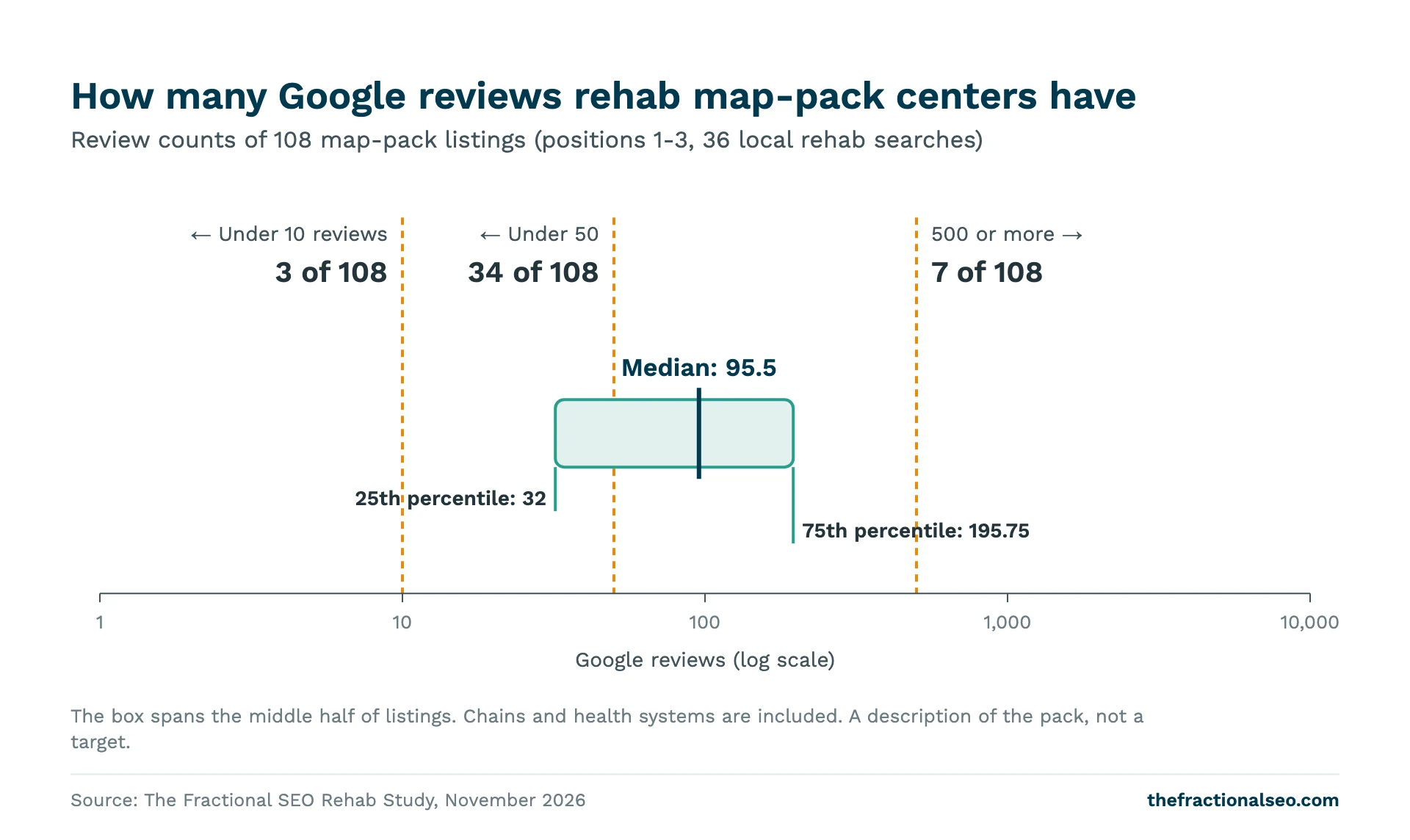
Chains and health systems are included in these counts. How they share page one with independent centers, directories and call centers is in who wins local rehab searches.
By kind of program
Median reviews for a map-pack spot by search: “detox center” 106; “drug rehab” 148; “intensive outpatient program” 50. Intensive outpatient packs are reached with the fewest.
| Search (plus the metro) | Map pack (positions 1-3) | Positions 4-7 | Map-pack listings |
|---|---|---|---|
| detox center | 106 | 97.5 | 36 |
| drug rehab | 148 | 92 | 36 |
| intensive outpatient program | 50 | 54 | 36 |
Only on “drug rehab” searches do pack listings lean toward more reviews than positions 4-7 (148 vs 92). That is an uncorrected result and one of three subgroup tests, so treat it as a lean, not a rule. On outpatient searches the pack median is a little below the one just under it.
By market size
By metro size: large metros 99; mid metros 146; small metros 46.
| Market size | Metros in the study | Median reviews in the map pack | Map-pack listings |
|---|---|---|---|
| Large | New York, Los Angeles, Chicago, Dallas, Houston | 99 | 45 |
| Mid | Charlotte, Nashville, Austin, Columbus | 146 | 36 |
| Small | Boise, Knoxville, Des Moines | 46 | 27 |
We didn’t test why mid-size metros run highest, and the groups are small (27 listings in small metros, 36 per search wording), so read these as a description of these 12 metros. These medians describe what map-pack centers have. They are not targets, and reaching one won’t earn a spot on its own.
How to set your own target
Your real benchmark is your own market and your own program. Here is the method we’d use. It is our advice, not study data.
- Search the wording that matches your program in Google Maps with your city: drug rehab, detox center or intensive outpatient program. Search from inside the area you serve, because results change with where the searcher is.
- Note the review counts of positions 1-7. The middle of the top three is your market’s map-pack median; positions 4-7 show how close the next tier is.
- Compare your count with both. If you sit far below positions 4-7, reviews are a fair priority. If you are already in that range, photos and posting are where the pack pulled ahead in our data.
- Ask in one consistent way. Google’s help page says you can share a review request link or QR code. Agree with your compliance lead when and how you contact people after discharge, and ask everyone the same way.
Never pay for reviews or offer anything for them. Google’s content policy bans incentives “such as payment, discounts, free goods and/or services” and says contributions should reflect a genuine experience. That includes gift cards for alumni or a discount on a family program.
Bigger programs, more of everything
Reviews don’t travel alone. Map-pack treatment centers’ sites have a median 418 referring domains vs 231 for those lower in Maps, a strong gap, across 74 vs 252 websites. Their sites are bigger too: 224 vs 109 indexable pages. Bigger, older programs collect more links, more reviews and more of everything else, and a study like this can’t pull those apart. Google’s ranking page also names distance, which no review can change.
So work on reviews alongside photos, posting and links, not instead of them. The local SEO checklist for addiction treatment centers puts them in order, and the local SEO guide for addiction treatment centers explains each one.
Reviews on your website
14% of treatment-center sites show a review widget, out of 341 crawled sites. Having one shows no edge that survives the correction (20% vs 13% for centers that reached a map pack vs the rest). In our view a widget is for families, not rankings. Check that any review you show never identifies a patient.
Want to see how your profile compares with your own market’s map pack? Talk to us about SEO for addiction treatment centers.
How we did this
We analyzed 36 local searches across 12 US metros and three addiction treatment search types, 379 treatment provider websites (341 crawled) and 403 Google Business Profiles, November 2026.
Searches were “drug rehab”, “detox center” and “intensive outpatient program”, each followed by the metro. Map pack means positions 1-3 of the Google Maps list for each search. Review count, rating and the benchmarks use 108 map-pack listings, counted once per search. The other profile comparisons count each center once: those that reached a map pack in any study search vs those only at positions 4-20. New reviews come from each profile’s newest 40, replies from the newest 20.
What it can’t claim: cause. Bigger programs tend to have more reviews, photos, pages and links. The groups are small, from one desktop snapshot in November 2026, with no “near me” searches.
Questions, answered
Do Google reviews help a treatment center rank?
Review count goes with reaching the map pack: centers that made one have a median of 86 reviews vs 40 for the rest, a strong gap. Inside the top 7 there is no clear difference (95.5 at positions 1-3 vs 87 at 4-7). That’s a correlation, not proof.
How many Google reviews does a rehab center need?
There’s no fixed number. Map-pack listings had a median of 95.5, and three-quarters had 32 or more. Intensive outpatient searches had the lowest median (50) and drug rehab the highest (148). Check your own market.
Can we reply to reviews without risking patient privacy?
Yes, if the reply never confirms the reviewer was a patient. Thank them, say nothing about care, and give a general number. Reply rate itself made no clear difference (70% vs 50%). This is not legal advice: check your policy with counsel.
Does star rating affect map-pack rankings?
We found no clear difference. The median is 4.7 in the map pack and 4.7 at positions 4-7, because ratings cluster near 5.0.
If not review count, what separates the map pack?
On the profile, photos (median 23 vs 12) and posting (51% vs 30% posted in 30 days), both strong. Both may mark centers with more staff and budget rather than cause the ranking.
More research & benchmarks
The whole Rehab / Addiction Treatment library- We Analyzed 341 Rehab Websites: What Map-Pack Treatment Centers Do Differently Map-pack treatment centers' homepages more often say insurance, detox, dual diagnosis and 24/7 admissions across 341…
- Who Wins Local Rehab Searches: A Benchmark of 36 Searches Who holds page one and the map pack when people search for a drug rehab, a…