
Research & Benchmark Rehab / Addiction Treatment
Who Wins Local Rehab Searches: A Benchmark of 36 Searches
Someone looking for help types "detox center" and the name of their city into Google. Who do they see? Mostly treatment providers, but not only them: treatment directories, government health pages, hospital program pages and a few call-center sites share page one. We analyzed 36 local searches across 12 US metros and three addiction treatment search types, 379 treatment provider websites (341 crawled) and 403 Google Business Profiles, November 2026. This page is about search: who holds page one and the map pack, and how drug rehab, detox and intensive outpatient searches differ. If you came for market size, facility counts or admissions figures, this isn't that report.
The addiction treatment statistics pages that rank today cover market size, forecasts and company figures, mostly from other people’s numbers. None we read looked at what a person seeking treatment, or a family member, actually sees when they search for a program nearby. We collected this data in November 2026, as one snapshot of each search.
Key findings
- Providers hold most of page one, not all of it. Treatment providers’ own websites hold 60% of page-one organic results for local rehab searches, more than in HVAC (53%).
- The top spot often goes to someone else. A site that is not a treatment provider holds the #1 organic spot in 14 of 36 searches (39%).
- Treatment directories, not Yelp. Recovery.com showed up on 18 of 36 searches. Yelp appears 3 times.
- Intensive outpatient searches are the hardest. Providers hold 42% of page one there, against 68% on “drug rehab” and 69% on “detox center”.
- Chains hold more than their share. 24 company chains, 6% of 379 provider domains, hold 19 of 108 map-pack spots (18%).
The website side of the same study is in what map-pack treatment centers do differently on their websites.
Who holds page one
Across the 36 searches we recorded 344 organic results on page one. Treatment providers’ own websites hold 60% of page-one organic results for local rehab searches, more than in HVAC (53%). The other 40% are treatment directories (88 results), government and hospital pages (31), social sites (10), call-center lead generators (5) and one insurer.
In counts, 208 of the 344 results were provider sites. “Provider” here includes independent centers, company chains and hospital-run programs with their own Maps listing; we split those out further down.
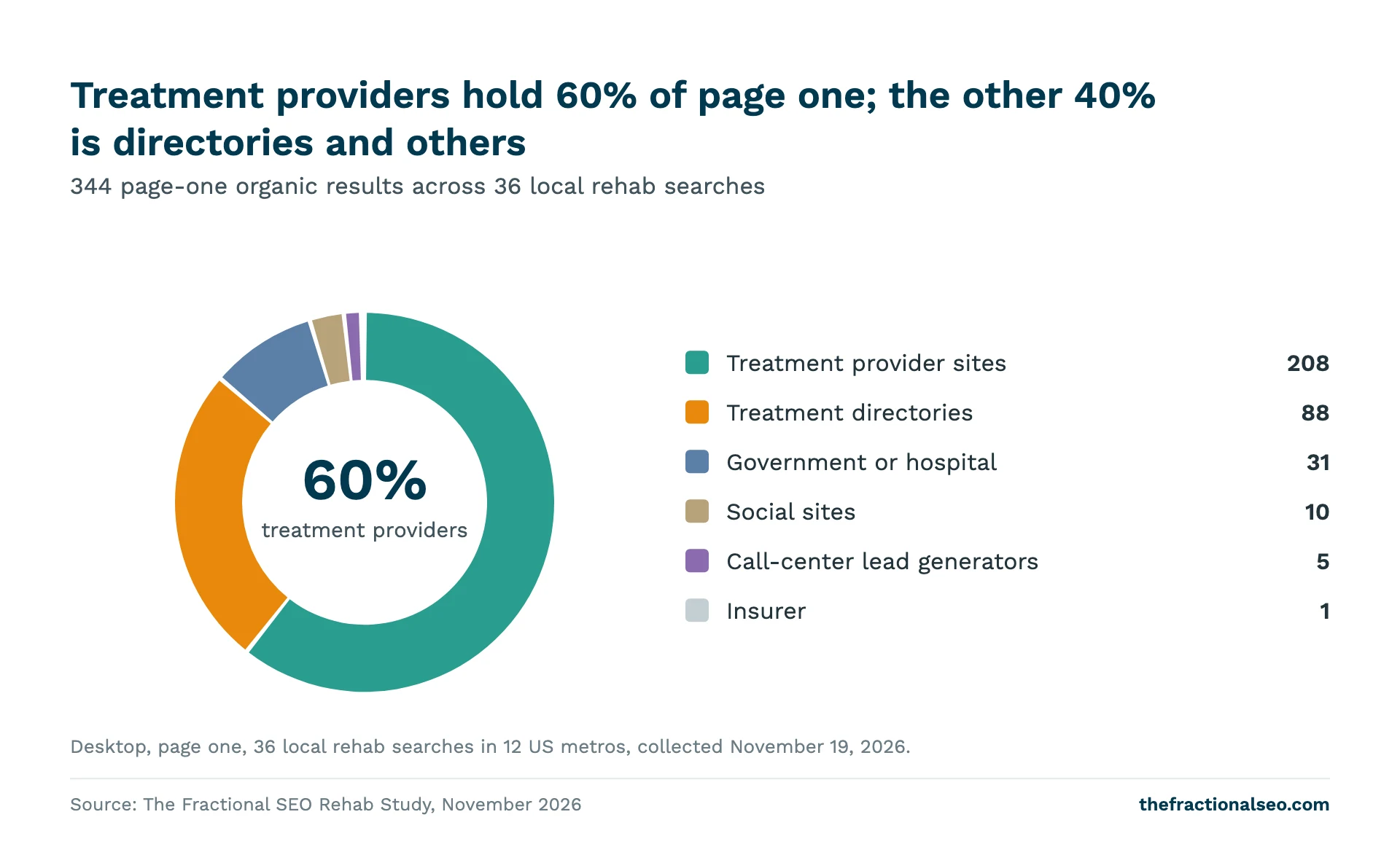
The very top is harder. A site that is not a treatment provider holds the #1 organic spot in 14 of 36 searches (39%): a directory in 9, a government or hospital page in 4 and a call-center lead generator in 1. Non-providers hold 57 of 108 top-3 organic spots (53%). In our HVAC study, non-contractors held 35% of #1 spots.
The study shows who appears, not why. Our reading: a person comparing programs may want a list first, and Google often gives them one.
Treatment directories, not Yelp
The directories rehab centers compete with on page one are treatment directories, not Yelp: Recovery.com (18 results, on 18 of 36 searches), AddictionCenter.com (9), StartYourRecovery.org (9) and Psychology Today (7, all on intensive outpatient searches). Yelp appears 3 times and Facebook 7. The counts are appearances across the 36 searches.
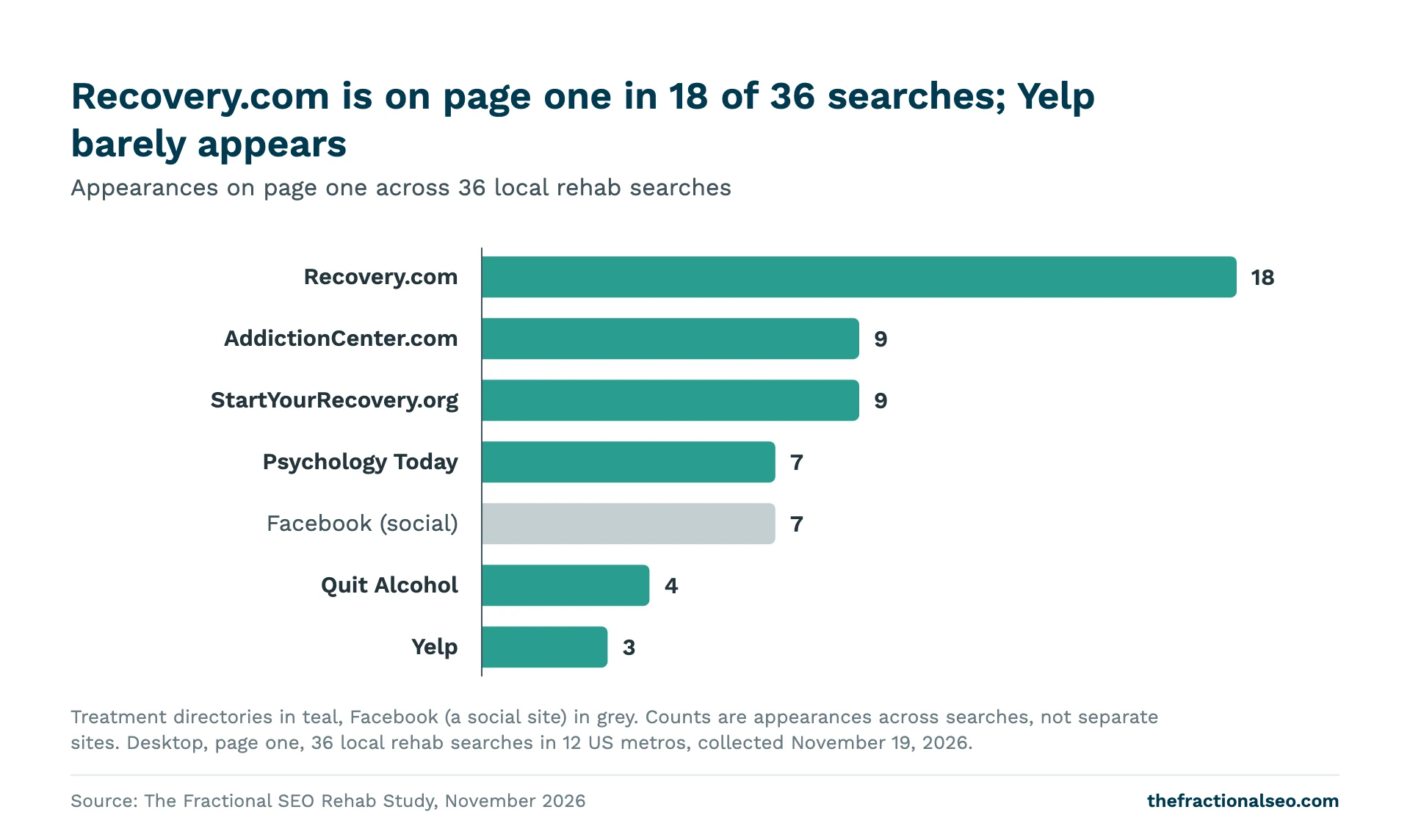
Each search has its own mix. On detox searches Recovery.com took 11 results and StartYourRecovery.org 4. On drug rehab searches Recovery.com and AddictionCenter.com took 7 each and StartYourRecovery.org 5. Intensive outpatient searches look different again, with Psychology Today (7), Quit Alcohol (4) and Yelp (3).
This is the reverse of the trades, where Yelp and the home-service marketplaces lead. How each directory lists centers, what it charges and what its own pages say about who answers its phone numbers is in our page on Recovery.com, Psychology Today and FindTreatment.gov.
Government and hospital pages
Government treatment pages and hospital program pages hold 31 page-one results on 17 of 36 searches, including 4 #1 spots: state and city health departments, county treatment pages and large hospital systems’ addiction service pages.
Our reading: these pages carry weight a private center’s site can’t copy. We count hospital pages here only when they showed up in the organic results. Hospital programs with their own Maps listing are counted as providers and reported as health systems below.
Call-center sites on page one
Call-center lead generators (sites that take calls about treatment and pass them to centers) hold 5 page-one organic results on 4 of 36 searches, at positions 1, 2, 2, 3, 8; 4 of the 5 are on intensive outpatient searches. None appears in Google Maps.
We don’t name these sites, and the count is a floor: we classified each site from its own pages and did not check who owns every directory. Five results out of 344 is a small share, but one of them held a #1 spot.
This is where search meets federal law. The law known as EKRA (18 U.S.C. § 220) covers anyone who, with respect to services covered by a health care benefit program, knowingly and willfully “solicits or receives any remuneration (including any kickback, bribe, or rebate) directly or indirectly, overtly or covertly, in cash or in kind, in return for referring a patient or patronage to a recovery home, clinical treatment facility, or laboratory”, and anyone who pays or offers it “to induce a referral of an individual to a recovery home, clinical treatment facility, or laboratory”. If you buy calls or leads, how you pay matters. This page explains the rule as written and is not legal advice; check your own setup with your counsel or compliance lead. Our page on marketing rules for addiction treatment centers covers it in full.
Three searches, three page ones
Share of page one that is treatment-provider sites, by search: “drug rehab” 68%; “detox center” 69%; “intensive outpatient program” 42%.
| Search (plus the metro) | Provider share of page one | Provider results | Median local searches a month |
|---|---|---|---|
| drug rehab | 68% | 81/120 | 655 |
| detox center | 69% | 82/118 | 245 |
| intensive outpatient program | 42% | 45/106 | 170 |
Drug rehab is the biggest of the three locally, at a median of 655 searches a month per metro. Detox and intensive outpatient searches are smaller, and several small-metro detox and outpatient searches had no reported volume at all. With 12 searches per wording, we describe these gaps rather than test them.
Intensive outpatient searches are the hardest
Intensive outpatient searches are the hardest page one for providers: Psychology Today, directories and call-center sites take most of it. Providers held 45 of 106 results there.
Psychology Today’s 7 results were all on these searches, alongside Quit Alcohol (4) and Yelp (3). 4 of the 5 call-center results were here too. And Google summarizes them: AI Overviews appeared on 10 of the 12 intensive outpatient searches and on none of the drug rehab or detox searches.
If outpatient care is your main program, expect a page one with less room for centers and more answers given before anyone clicks.
Big metros vs small metros
By metro size, providers held 58% of page one in large metros (83/144), 69% in mid-size metros (79/114) and 53% in small metros (46/86). With only 3 small metros, read this as a pattern to watch, not a tested result.
Map pack and organic overlap more than in HVAC
The map pack and the organic results overlap more than in HVAC: 31% of map-pack treatment centers with a website also rank on page one organically for the same search. That’s 33 of 106 listings. In our HVAC study it was 16%.
Google’s help page on local ranking says local results are mainly based on relevance, distance and popularity, and that prominence draws on how many websites link to a business and how many reviews it has. Our reading: the overlap is still under a third, so the map pack and the organic list are two jobs, even if the same strengths help with both.
Every map-pack treatment center but 2 links a website (2 of 108 have none; 21 of 701 provider Maps rows across positions 1-20).
Our guide to local SEO for addiction treatment centers covers both, and what 403 Google Business Profiles show about reviews covers the profile side.
Company chains and health systems
Chains matter more in rehab than in HVAC: 24 company chains (6% of 379 provider domains) hold 19 of 108 map-pack spots (18%) and 37 of 208 provider organic results (18%). There are no franchises. In HVAC, franchises held 8% of pack spots.
Company chain map-pack spots by brand: Pasadena Villa Outpatient 4, Arise Recovery Centers 3, Infinite Recovery 2, The Recovery Village 2, JourneyPure 2 and Positive Recovery Centers 2, then Turning Point Recovery Network, Recovery Unplugged, Briarwood Detox Center and The Meadows Outpatient Center with 1 each. Chains held 9 #1 Maps spots and reached the pack in 8 metros. One site in our chain check couldn’t be read, so these counts are a floor.
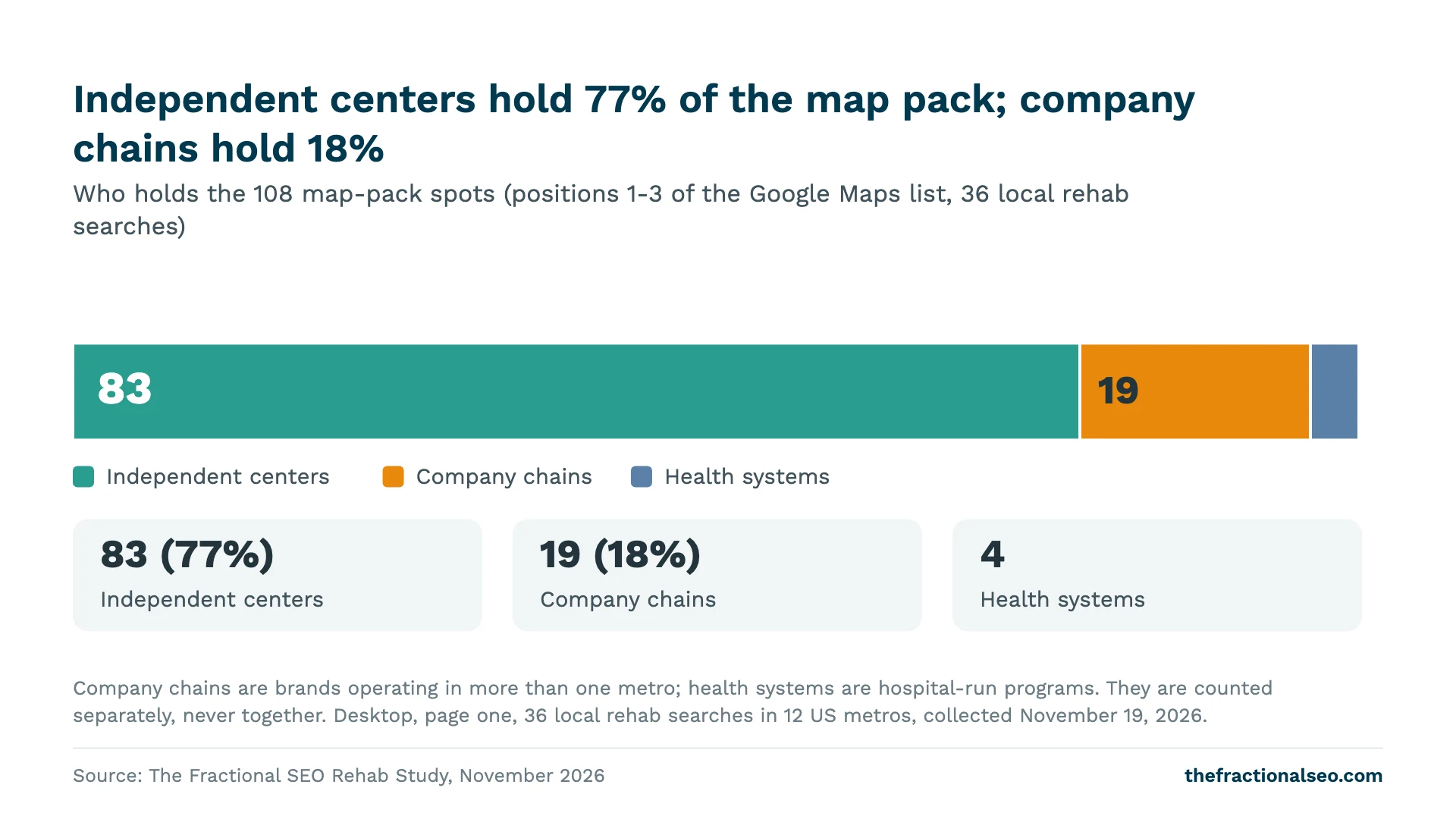
Health systems are counted separately. Hospital-run programs (8 domains) hold 4 map-pack spots, all in one metro, and 9 organic results: MercyOne and UnityPoint Health with 2 pack spots each.
Independent centers hold the other 83 pack spots (77%), and 162 provider organic results. Most of the map pack is still independent.
What sits above the organic results
A map pack appeared on 34 of the 36 searches, with four or more listings on 8 of them. AI Overviews appeared on 10 searches, all of them intensive outpatient searches.
Almost no ads appeared in our snapshot: text ads on 2 of 36 searches and Local Services Ads on none. Read that with care. We ran the searches logged out, on desktop, at night US time, and ads rotate by time, device and user, so a snapshot like this undercounts them. One possible reason for thin ads is Google’s own rule: in the United States, “In order to advertise for recovery-oriented drug and alcohol addiction services, you must be certified as an addiction services provider by the LegitScript Certification program” (Google Ads healthcare policy). We didn’t measure why ads were missing, so don’t read this as rehab searches carrying few ads. The certification rule is covered in marketing rules for addiction treatment centers.
What people search and what a click costs
Local searches are small and expensive to bid on. Median monthly searches and Google Ads cost per click for each search plus the city: “drug rehab” 655 searches, $53.12; “detox center” 245 searches, $67.75; “intensive outpatient program” 170 searches, $37.92. The highest is “detox center houston” at $173.56 a click, followed by “detox center chicago” at $111.54 and “drug rehab nashville” at $105.52.
These are Google Ads planner estimates collected in November 2026, not what any center paid. Only certified advertisers can run these ads in the US.
Search traffic
Rehab sites get more estimated search traffic than HVAC sites: median estimated organic traffic 590 visits a month (HVAC: 214), with 23% under 100 and the top tenth above 8,586. Sites found in both Maps and organic results have the most (median 1,936 estimated visits).
These are modeled estimates, not analytics. They include informational and out-of-area searches, and national chains pull the top end up. The study didn’t measure calls or admissions.
What this means for treatment centers
The study describes who appears, not what makes anyone rank. Here’s how we read it.
- Know which search you’re in. Drug rehab, detox and intensive outpatient searches show different competitors and a different share for providers.
- Your page-one rivals are directories and public pages. Recovery.com, AddictionCenter.com, StartYourRecovery.org and Psychology Today, plus government and hospital pages.
- Work the map pack and the organic list as two jobs. 31% of map-pack centers with a website were also on organic page one for the same search.
- Pay for marketing in ways that never pay per patient. Call-center sites are on page one; the rules on paid referrals are in our compliance guide.
- Look at your own website too. Our flagship study covers what map-pack treatment centers do differently on their websites.
How we did this
We analyzed 36 local searches across 12 US metros and three addiction treatment search types, 379 treatment provider websites (341 crawled) and 403 Google Business Profiles, November 2026.
Searches were “drug rehab”, “detox center” and “intensive outpatient program”, each followed by a metro: New York, Los Angeles, Chicago, Dallas and Houston (large); Charlotte, Nashville, Austin and Columbus (mid); Boise, Knoxville and Des Moines (small). We recorded page one on desktop, logged out, through SerpAPI on 19 November 2026 (the evening of 18 November, US time), plus the Google Maps list for each search: 709 Maps rows, positions 1-20. The map pack is positions 1-3 of that list, 108 spots.
Samples: 344 organic results; 108 map-pack spots (106 listings with a website for the overlap); 379 provider domains. Company chains (24 brands) and health systems (8 hospital-run programs) are reported separately. Traffic is DataForSEO Labs’ modeled estimate; volumes and bids are Google Ads planner figures.
What it can’t claim: why anyone ranks, or anything about calls or admissions. It is one snapshot per search, organic page one moves day to day, and results vary by searcher location. That’s why we report shares and medians, never one center’s position.
Questions, answered
Why do directories outrank treatment center websites?
We measured who ranks, not why. Treatment directories took 88 of 344 page-one results, led by Recovery.com. Google says prominence draws on links and reviews.
Do call centers show up in local rehab searches?
Yes, a little. Call-center sites held 5 page-one organic results on 4 of 36 searches, mostly on intensive outpatient searches, and none appeared in Google Maps.
Is the map pack the same as the organic results?
No. 31% of map-pack treatment centers with a website also rank on page one organically for the same search.
How much organic traffic does a typical rehab website get?
An estimated 590 visits a month at the median, and 23% get fewer than 100. These are modeled estimates.
Do chains dominate local rehab search?
Not overall, but they punch above their weight. Company chains are 6% of provider domains and hold 18% of map-pack spots. Independent centers hold 77%.
Want to know where your center sits against these benchmarks in your own market? See how we approach SEO for addiction treatment centers.
More research & benchmarks
The whole Rehab / Addiction Treatment library- We Analyzed 341 Rehab Websites: What Map-Pack Treatment Centers Do Differently Map-pack treatment centers' homepages more often say insurance, detox, dual diagnosis and 24/7 admissions across 341…
- Google Reviews and Rehab Rankings: What 403 Business Profiles Show Which parts of a treatment center's Google profile separate the map pack, and how many reviews…