
Guide Rehab / Addiction Treatment
LegitScript, EKRA and Patient Privacy: Marketing Rules for Addiction Treatment Centers
Addiction treatment is one of the most closely watched kinds of marketing in the US. Google won't run your ads without a third-party certification, federal law can make paying for patient referrals a crime, and the records that identify someone as a patient have their own federal rule. The rules are written down. This guide quotes them from the source and shows what 342 treatment center homepages actually do.
We analyzed 36 local searches across 12 US metros and three addiction treatment search types, 379 treatment provider websites (341 crawled) and 403 Google Business Profiles, November 2026. The homepage figures below come from the 342 homepages we could read. We read every rule quoted here on 26 November 2026, on the publisher’s own page or, for the statute, the Cornell Legal Information Institute copy of the U.S. Code. This page explains the rules as written. It is not legal advice. Check your own setup, contracts and vendors with your counsel or compliance lead before you change anything.
The short answer
- Ads: to advertise drug and alcohol addiction treatment on Google in the US, you need LegitScript certification, and Google certification on top.
- Referrals: pay marketers for work, never per patient, per admission or per call that turns into a patient. EKRA is about paying for referrals.
- Privacy: treat anything that could show someone is or was your patient as protected. That covers review replies, photos, stories and the tracking tags on your admissions pages.
- Claims: say what you offer, where and for whom. Keep success rates and outcome promises off the site unless counsel has signed off.
- Credentials: show the accreditation and certification you actually hold, and keep them current.
What rehab homepages show
We checked each homepage for credentials, travel and outcome wording, and the tracking tools loaded in the page. None of this says whether a site follows the law: a travel mention can be directions to the building, and a tag tells you nothing about what data it sends. It shows what a compliance review would look at first.
| On the homepage | Share of 342 homepages |
|---|---|
| Joint Commission or CARF accreditation shown (text or seal) | 57.9% |
| LegitScript certification shown (text or seal) | 34.5% |
| Google Tag Manager or Google Analytics 4 loaded | 75.4% |
| Advertising pixel loaded in the page itself | 21.9% (Google Ads 15.2%, Meta 6.7%) |
| Session-recording tool (Hotjar or Microsoft Clarity) | 7% |
| Call tracking | 40.6% |
| Analytics vendor that markets itself for HIPAA | 1.2% |
| Travel or transport to treatment mentioned | 4.1% |
| Success-rate or outcome claim | 8.2% |
Two cautions. Tracking counts are a floor: tags loaded through Tag Manager after the page loads are not in the homepage code we read, so real pixel use is higher. And a seal on a homepage shows the site claims the credential. We didn’t check any seal against LegitScript’s or the accreditors’ records.
Google Ads and LegitScript certification
Google’s Healthcare and medicines policy is set country by country. The US section says: “In order to advertise for recovery-oriented drug and alcohol addiction services, you must be certified as an addiction services provider by the LegitScript Certification program.” It adds that “Advertisers must also be certified with Google.” So there are two certifications to hold: LegitScript’s and Google’s own healthcare certification.
Google’s policy also says: “Not all drug and alcohol addiction services are eligible for LegitScript Certification. Those that are not eligible for certification are not allowed to advertise for drug and alcohol addiction services on Google.” The policy is about drug and alcohol treatment only. It says services “like services for impulse control disorders, behavioral addiction, or nicotine addiction, are out of scope of this policy.”
LegitScript describes its program as “the only certification and monitoring solution recognized by Google, Meta, Microsoft and Nextdoor to vet addiction treatment advertisers.” Its page lists who might not qualify, including a “lead generator, call center, or marketer referring patients to other providers in exchange for compensation” and a “sober living home or recovery residence without licensed clinical services”.
The fees, as LegitScript showed them in November 2026, are charged per facility, with lower rates at higher facility counts:
| Tier | Application fee (nonrefundable) | Annual certification fee |
|---|---|---|
| Standard range, per facility | $1,395–$1,595 | $2,550–$3,095 |
| 1 to 9 facilities, per facility | $1,595 | $3,095 |
| Individual practitioner | $535 | $1,070 |
Organizations with 10 or more facilities may qualify for an Enterprise program instead, per the LegitScript FAQ, and hardship waivers may be available for qualifying nonprofits. Google’s policy also notes that “fee waivers may be available in certain circumstances.”
LegitScript checks more than your license. Of its 16 Certification Standards, four read like a marketing brief. Standard 9 says “All photographs on the applicant’s website must truthfully and accurately depict applicant’s facilities.” Standard 12 covers lead generators (more below). Standard 13 says “Applicants must ensure that all advertisements are accurate, transparent, and not misleading to the public in any way,” and that a center “may not claim to operate in locations where they do not provide services.” Standard 14 covers incentives such as travel.
In our study, 34.5% of homepages show LegitScript certification as text or a seal. Certification is what Google requires to advertise. It is not a ranking factor in Google’s map or organic results, and nothing in our data says it is.
The ads themselves were rare in our searches: text ads on 2 of 36 searches and Local Services Ads on none, and only 29 of 379 treatment-center domains (7.7%) show any estimated paid-search activity. That was a logged-out, desktop, night-time snapshot, which undercounts ads, and the paid-search estimate comes from one data source that often misses small advertisers. The certification rule is one possible reason for so few ads; we can’t say it is the cause. Clicks aren’t cheap when ads do run: planner estimates put the median cost per click at $53.12 for “drug rehab” plus a city, $67.75 for “detox center” and $37.92 for “intensive outpatient program”, with “detox center houston” at $173.56, and $22.37 across 1,067 addiction-treatment keyword groups.
EKRA: never pay for a patient
The Eliminating Kickbacks in Recovery Act is 18 U.S.C. § 220. It applies “with respect to services covered by a health care benefit program”. It makes it a crime when someone knowingly and willfully “solicits or receives any remuneration (including any kickback, bribe, or rebate) directly or indirectly, overtly or covertly, in cash or in kind, in return for referring a patient or patronage to a recovery home, clinical treatment facility, or laboratory”.
It works in the other direction too. Paying or offering remuneration is covered when it is “to induce a referral of an individual to a recovery home, clinical treatment facility, or laboratory” or “in exchange for an individual using the services of that recovery home, clinical treatment facility, or laboratory”. The penalty: the person “shall be fined not more than $200,000, imprisoned not more than 10 years, or both, for each occurrence.”
The law defines a clinical treatment facility as “a medical setting, other than a hospital, that provides detoxification, risk reduction, outpatient treatment and care, residential treatment, or rehabilitation for substance use, pursuant to licensure or certification under State law”. A recovery home is “a shared living environment that is, or purports to be, free from alcohol and illicit drug use and centered on peer support and connection to services that promote sustained recovery from substance use disorders.”
Subsection (b) lists eight exceptions. One, (b)(2), covers certain payments by an employer to an employee or independent contractor where the payment “is not determined by or does not vary by” “the number of individuals referred to a particular recovery home, clinical treatment facility, or laboratory” or two other measures listed there. We don’t interpret the exceptions. Whether one fits a contract you have is a question for your counsel.
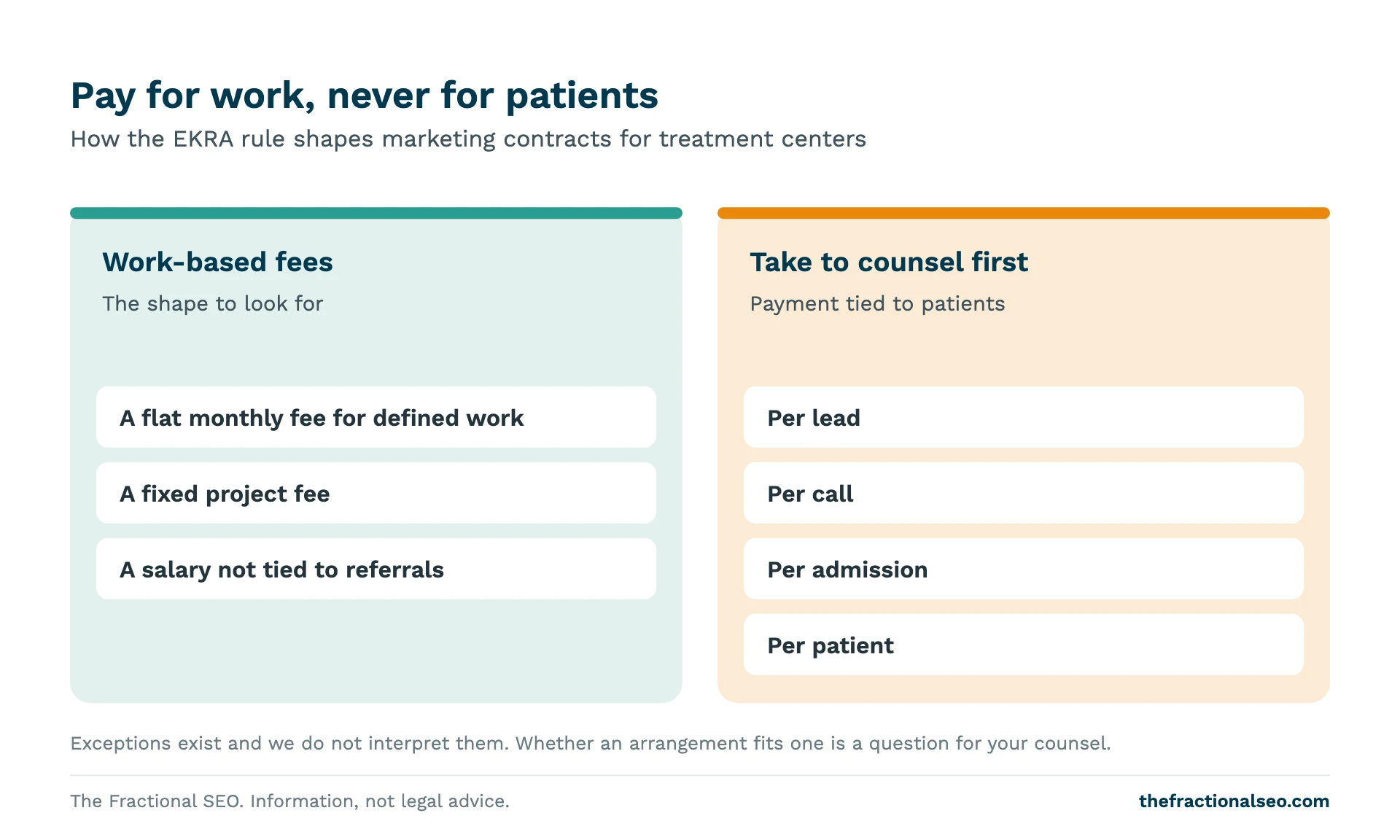
What this means for marketing, in plain terms: pay your SEO firm, web developer, ad manager and admissions staff for their work, never for the patients they bring. A flat monthly fee for defined work is the shape to look for. Per lead, per call, per admission or per patient is the shape to take to counsel before you sign. Our post on what an SEO contract should say covers the rest of the contract.
Call centers on page one
Call-center lead generators, sites that take calls about treatment and pass them to centers, held 5 page-one organic results on 4 of our 36 searches, at positions 1, 2, 2, 3 and 8. Four of the five were on intensive outpatient searches, and none appeared in Google Maps. We don’t name them. The count is a floor, because we didn’t check who owns each directory. Our directories guide sets out what each named directory says on its own pages about who answers its phone numbers.
LegitScript’s Standard 12 is blunt about these sites: “Co-ownership of, or any formal or informal business affiliation with, lead generators (as defined in the certification application) is prohibited and may be grounds for immediate denial.” It adds that “Informal business affiliation with a lead generator includes but is not limited to sponsoring or answering the hotline for a lead generator.” If you run your own admissions line, put your center’s name on it.
Travel offers
14 homepages (4.1%) mention travel or transport to treatment. That wording is a signal to review, nothing more: our check can’t tell an offer of free flights from directions to the facility, and some forms of paid travel can be lawful. LegitScript’s Standard 14 says “In general, applicants that offer incentives such as offering to pay for travel will not be eligible for approval.” If your site offers to pay for anything a patient would otherwise pay for, ask counsel how it fits EKRA’s “in exchange for an individual using the services” wording before it goes back on the page.
Patient privacy: Part 2 and your marketing
The federal confidentiality rule for substance use disorder records is 42 CFR Part 2. Under § 2.12, its restrictions apply to records that “Would identify a patient as having or having had a substance use disorder either directly, by reference to publicly available information, or through verification of such identification by another person” and that come from a federally assisted program. Keep the words “through verification of such identification by another person” in mind whenever someone says in public that they were your patient.
§ 2.11 defines the identifying details: “Patient identifying information means the name, address, Social Security number, fingerprints, photograph, or similar information by which the identity of a patient, as defined in this section, can be determined with reasonable accuracy either directly or by reference to other information.” The patient definition “includes both current and former patients.”
Part 2 applies to federally assisted programs, and § 2.12(b) gives examples such as taking part in Medicare, a DEA registration to dispense for substance use treatment, federal funds and tax-exempt status. Whether your program is covered, and how Part 2 and HIPAA fit together for you, is for your counsel. The rule was updated in 2024: the final rule says “This final rule is effective on April 16, 2024” and “Persons subject to this regulation must comply with the applicable requirements of this final rule by February 16, 2026.”
Replying to reviews
Most marketing advice says to reply to every review. In rehab, a reply can confirm that the reviewer was a patient, which is close to the verification wording in § 2.12. Our data gives no ranking reason to take that risk: map-pack centers reply to a median 70% of their newest 20 reviews vs 50% for the rest, no clear difference. Across all profiles, 32% reply to 90% or more and 24% reply to none.
If you reply, write so that nothing confirms a relationship. “Thank you for sharing. We’d welcome a call to the main line” works for praise and complaints alike. Never mention dates, programs, staff or anything about the person’s care. Google’s Business Profile guidelines also bar content with “private or confidential information”. Our Google Business Profile checklist has reply wording to adapt.
Photos and stories
Photos matter on a profile: map-pack treatment-center profiles have about twice as many photos, median 23 vs 12, a gap that survives the correction. That is a correlation, and the counts include visitors’ photos. The privacy rule is the same either way: a photograph is in Part 2’s list of patient identifying information. Show rooms, grounds, food and staff who have agreed, never patients or anything that identifies one. LegitScript’s Standard 9 adds that photos must truthfully show your own facilities, so stock photos of somewhere else are out.
Patient stories and testimonials are a consent question first. § 2.31 begins “A written consent to a use or disclosure under the regulations in this part may be paper or electronic and must include:”. Have counsel approve the consent form before any story, video or quote goes on the site.
Pixels, session recording and ad audiences
75.4% of homepages load Google Tag Manager or Google Analytics 4, 21.9% load an advertising pixel in the page itself (Google Ads 15.2%, Meta 6.7%), 7% load a session-recording tool and 40.6% use call tracking. 35 homepages load an ad pixel and have a form on the homepage. Remember the floor: tags fired through Tag Manager aren’t counted, so real use is higher. A tag on a homepage is not by itself a privacy problem. What matters is what data it sends, from which pages, to whom.
HHS has published guidance on online tracking technologies, and a federal court limited part of it in 2024 (American Hospital Association v. Becerra, Northern District of Texas, June 20, 2024). We couldn’t read the HHS page itself for this guide, so we don’t summarize it here. Ask your counsel what it means for your site today.
Google’s own ad rules add a limit. Its personalized advertising policy lists sensitive interest categories that include “Health”, “Alcohol” and “Restricted drug terms”, and says: “Advertisers promoting products and services that fall within sensitive interest categories are unable to use advertiser-curated audiences.” Customer match, your data segments (previously called remarketing), audience expansion and lookalike segments are marked not supported for those categories.
The practical review: list every tag and session-recording tool on your admissions, insurance-verification, contact and chat pages, note what each collects and where it sends it, and take that list to counsel. Only 1.2% of homepages use an analytics vendor that markets itself for HIPAA, and a vendor’s marketing is not a contract.
Outcome claims and what the homepage promises
28 homepages (8.2%) make a success-rate or outcome claim, such as a percentage of patients sober after treatment. Neither outcome claims nor travel mentions separate the map pack or the organic top 3, so there is no search reason to make one. LegitScript’s Standard 16 asks that “all practices and offers are accurate, transparent, and not misleading to patients or the public”, and Standard 13 asks the same of every ad.
Say what you can state as fact: levels of care, who you treat, insurance you accept, where you are and how to get in. We make no outcome claims of our own in this library.
Credentials: show what you hold
Credentials are common: 57.9% of homepages show Joint Commission or CARF accreditation and 34.5% show LegitScript certification, as text or a seal. They lean toward the map pack. Comparing centers that reached a map pack with those seen lower in Maps, accreditation shows on 72% vs 50% of homepages and LegitScript on 48% vs 29%. The text-only versions fail the correction, so treat this as a lean, not a ranking rule. NAATP membership is shown on 8 homepages.
LegitScript’s page invites certified centers to “Display the LegitScript seal on your addiction treatment website”. Show the seals you hold, link them where the issuer offers a lookup, and take them down the day a certification lapses. Our study of 341 rehab websites covers what else map-pack homepages say.
A marketing compliance check
Take this list to your counsel or compliance lead yearly and whenever you hire a vendor:
- Every marketing, SEO, ad and referral contract: what exactly is paid for? Anything per lead, per call, per admission or per patient goes to counsel.
- Every phone number on your site and profiles is your own line, under your own name.
- No sponsorship of, or answering for, another site’s hotline.
- LegitScript and Google certification current before any addiction-treatment ad runs.
- Website photos show your own facility, and no patients.
- Review replies confirm nothing about anyone’s care.
- Testimonials and stories only with a written consent counsel has approved.
- A list of every tag and session-recording tool on admissions, insurance, contact and chat pages, and what each sends where.
- No success-rate or outcome claims without counsel’s sign-off; travel and other offers reviewed against EKRA and LegitScript’s incentives standard.
Our local SEO checklist includes the tracking review alongside the search work.
Where this fits with SEO
Google’s certification rule is about ads, not organic or Maps results, so a clear website, an accurate profile and real reviews are the parts of marketing you fully control. Our local SEO guide for treatment centers covers that work, and our benchmark of 36 searches shows who holds page one.
Want SEO that builds your own pages, profile and reviews, paid by the month and never by the patient? Talk to us about SEO for addiction treatment centers.
FAQs
Do I need LegitScript certification to rank on Google?
No. Google’s rule is about ads: the US policy requires LegitScript certification to advertise drug and alcohol addiction services. Showing the seal leans with map-pack homepages in our data, but it is not a ranking factor and the lean is not strong enough to call a rule.
Can I pay a marketing agency per admission?
Take that to counsel before you sign. EKRA covers paying or offering remuneration to induce a referral to a clinical treatment facility or recovery home, and its exceptions are technical. A flat fee for defined work, not tied to patients or referrals, is the simpler arrangement to put in front of counsel.
Can I reply to Google reviews from patients?
Carefully. Where Part 2 applies, it covers records that identify someone as a patient, including through verification by another person, and a reply can do that. Use a short reply that confirms nothing, or don’t reply. Reply rate made no clear difference to map-pack placement in our data.
Can I use Meta or Google pixels on a rehab website?
That depends on what they send and from which pages, a question for counsel. Google’s policy also blocks advertiser-curated audiences, including data segments (remarketing), for sensitive categories such as Health.
Sources
- TFS Rehab and Addiction Treatment Study, November 2026: our study of 341 rehab websites
- Google Advertising Policies Help, Healthcare and medicines (Addiction services, United States)
- Google Advertising Policies Help, Restricted targeting in Personalized advertising
- LegitScript, Addiction Treatment Certification (standards and pricing)
- LegitScript, Addiction Treatment Certification FAQs
- 18 U.S.C. § 220 (Legal Information Institute, Cornell Law School)
- 42 CFR Part 2, 2024 edition (govinfo)
- Confidentiality of Substance Use Disorder Patient Records, final rule, Federal Register, February 2024
- Google Business Profile Help, Guidelines for representing your business on Google
- American Hospital Association v. Becerra, N.D. Tex. (govinfo record)